Owyhee Opal Meaning, Properties, Identification & Value
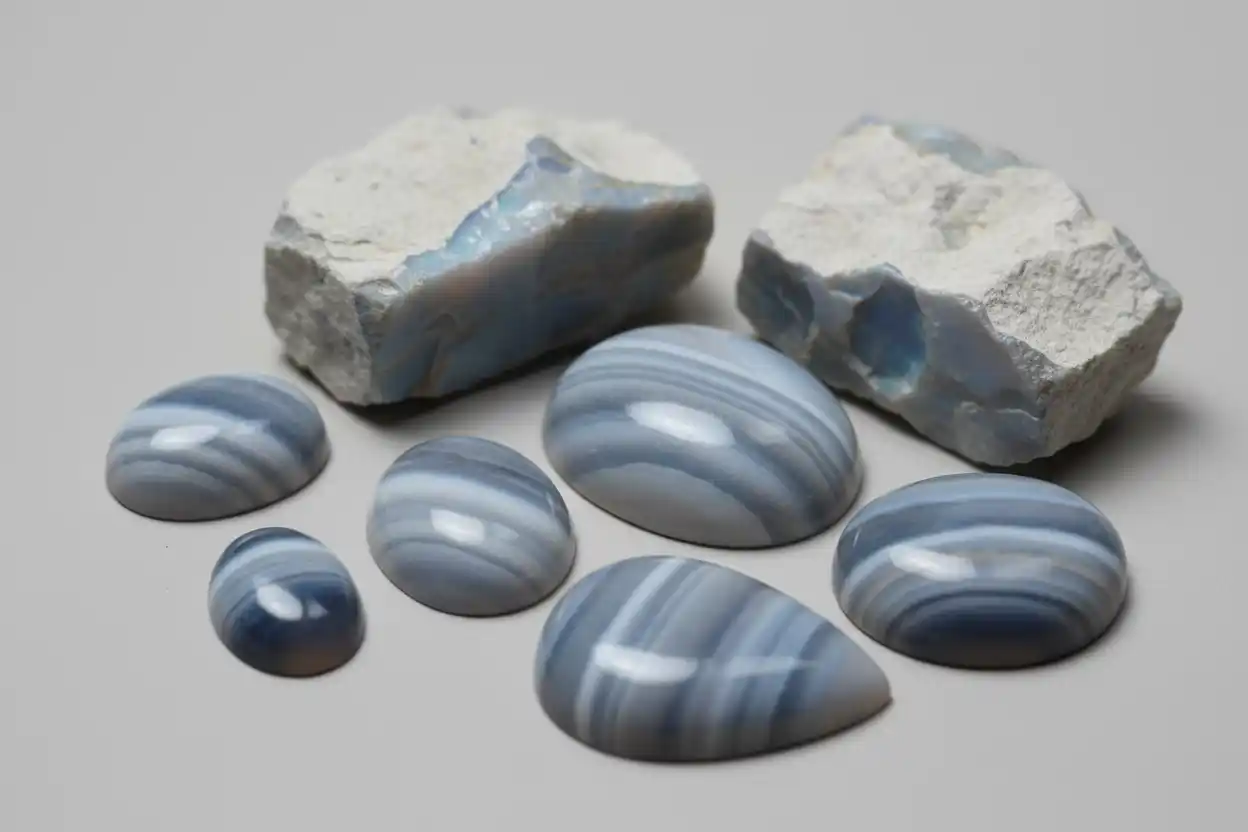
Owyhee Opal is a blue-to-blue-gray common opal associated with the Owyhee region of eastern Oregon, particularly Malheur County. It is valued for its cloudy sky-blue bodycolor, soft translucency, white or dark banding, and occasional dendritic or matrix patterns rather than for the spectral play-of-color seen in precious opal.
The locality is central to the name. Blue opal from India, Peru, Indonesia, or another region may resemble Owyhee material, but it should not be sold under the Oregon locality name without credible provenance.
Owyhee Opal at a Glance
| Property | Owyhee Opal |
|---|---|
| Material type | Blue common opal and locality-based gem variety |
| Composition | Hydrated amorphous silica, commonly written SiO₂·nH₂O |
| Opal category | Common opal, usually without play-of-color |
| Common colors | Sky blue, powder blue, blue-gray, white, cream, charcoal gray, brown-gray, and banded combinations |
| Structure | Amorphous mineraloid rather than a crystalline mineral |
| Typical form | Massive seams, nodules, veins, fragments, cabochons, beads, freeforms, and polished slabs |
| Luster | Waxy to vitreous after polishing |
| Transparency | Translucent to opaque, with some darker areas becoming translucent under strong backlighting |
| Mohs hardness | Commonly approximately 5.5–6.5 |
| Cleavage | None |
| Fracture | Conchoidal to uneven |
| Tenacity | Brittle |
| Common uses | Cabochons, pendants, earrings, rings, beads, carvings, and collector rough |
| Main care concern | Crazing, scratching, heat, drying extremes, fractures, porosity, treatment, and false Oregon provenance |
Owyhee Opal Is Common Opal
The parent opal guide explains opal’s hydrated silica composition and amorphous structure.
Owyhee material usually belongs to common opal, which lacks the regularly ordered silica structures needed to create spectral play-of-color.
Its beauty instead comes from bodycolor, translucency, banding, internal depth, and the contrast between pale blue and darker gray or brown sections.
The term common does not mean synthetic or unattractive. It is a gemological distinction between opal with play-of-color and opal without that effect.
The broader types of opal guide places Owyhee among blue and locality-based common opals without merging it with Australian black opal, Ethiopian precious opal, Mexican fire opal, or Peruvian blue opal.
The Owyhee Locality
The Owyhee region spans remote volcanic terrain across parts of eastern Oregon, southwestern Idaho, and northern Nevada.
Commercial Owyhee Opal is principally associated with eastern Oregon, particularly localities near the Owyhee River, Owyhee Dam, and Malheur County.
The region contains extensive volcanic rocks, ash-rich deposits, tuffs, rhyolites, basalts, fractures, and silica-bearing hydrothermal or groundwater systems.
Silica released from volcanic glass and rock alteration can move in water before precipitating as opal within voids, seams, fractures, and porous sediment.
A precise claim should identify Oregon rather than relying only on the wider word Owyhee. Material from the Idaho or Nevada portions of the region may have a different deposit history.
Mine and claim details are often withheld because small private occurrences are vulnerable to trespass and unauthorized collecting. Nevertheless, a responsible dealer should still distinguish direct Oregon material from imported blue opal.
How Owyhee Opal Forms
Owyhee Opal formed when silica-rich water moved through volcanic and tuffaceous rocks.
As chemical conditions changed and water evaporated or reacted with the host, hydrated silica accumulated as a gel-like deposit.
The silica later hardened into opal while retaining variable water content and microscopic porosity.
Repeated precipitation can produce blue, white, gray, brown, or nearly black bands. Sediment, iron compounds, manganese-rich material, clay, and host-rock fragments may create darker zones.
Some pieces contain dendritic markings formed by branching manganese or iron oxides entering small fractures.
Because the deposit material is noncrystalline, it lacks the external crystal faces seen in quartz or calcite.
What Creates the Blue Color?
Owyhee Opal’s blue bodycolor is generally associated with light scattering from microscopic structures rather than with a strongly colored blue pigment.
Very small particles, pores, or structural inhomogeneities scatter shorter blue wavelengths more effectively than longer red wavelengths.
This Rayleigh-like scattering can create a soft sky-blue appearance similar in principle to other milky blue natural and manufactured materials.
Particle size, porosity, water content, impurities, thickness, and background all affect the visible tone.
Some stones appear more saturated against a dark backing. Thin edges may become pale or nearly colorless under transmitted light.
A blue bodycolor should not be confused with blue play-of-color. Owyhee Opal normally lacks discrete spectral flashes that move across the surface.
The difference between bodycolor and play-of-color is explained in the opal color guide.
Color, Banding, and Matrix
Fine Owyhee Opal can range from pale powder blue to stronger denim, smoky blue, or blue-gray.
White bands may be opaque or translucent. Meanwhile, dark gray, brown, or charcoal areas can form irregular stripes, eyes, clouds, and matrix patterns.
Some dark-looking zones transmit light when the stone is held over a strong source. This hidden translucency can create depth within a cabochon.
Dendritic branches may resemble trees, moss, or lightning. They add visual interest when sharply defined but should not be interpreted as fossil plants.
Uniformly pale stones suit calibrated jewelry, while strongly banded pieces are more likely to receive custom freeform cuts.
Digital photographs often exaggerate blue saturation. Neutral daylight and transmitted-light videos provide a more realistic impression.
Owyhee Opal and White Opal
White Opal has a white, cream, or light-gray body and may display play-of-color.
Owyhee Opal is recognized principally by its blue-to-blue-gray bodycolor and Oregon provenance.
White bands can occur inside Owyhee material, but they do not convert the stone into a separate white-opal variety.
A pale blue stone photographed over a blue background can appear whiter or more saturated than it is. Buyers should evaluate the loose gem against both white and dark neutral surfaces.
Owyhee Opal and Pink or Yellow Common Opal
Pink Opal is generally valued for a blush-to-rose bodycolor, while Yellow Opal ranges from pale lemon to honey and ochre.
All three are commonly sold without play-of-color.
Their mineral classification overlaps, but locality, impurities, scattering structures, color, and associated matrix differ.
The existence of several common-opal colors demonstrates why a non-spectral bodycolor can still define a recognizable commercial variety.
Owyhee Opal and Hyalite
Hyalite Opal is colorless to pale transparent common opal, often occurring as glassy botryoidal crusts.
Some hyalite fluoresces vivid green because of trace uranium compounds, although fluorescence varies by locality.
Owyhee Opal generally appears massive, blue, and suitable for cabochons rather than as clear grape-like coatings.
A transparent bluish glow alone cannot separate them. Structure, locality, fluorescence, spectroscopy, and water content may all contribute to identification.
Owyhee Opal and Opalite
Opalite is usually manufactured opalescent glass.
It commonly appears milky blue in reflected light and orange or amber when strongly backlit. This optical behavior can resemble pale blue common opal in photographs.
Opalite tends to be more uniform and may contain round gas bubbles, flow lines, or mold-related features.
Owyhee Opal usually shows natural banding, matrix, dendrites, uneven translucency, or subtle internal variation.
However, clean natural common opal can also appear uniform. Laboratory testing remains more reliable than visual assumptions.
Owyhee Opal and Peruvian Blue Opal
Peruvian blue opal is a separate locality material from Peru. It commonly appears blue-green, turquoise, mint, or aqua and may contain brown or black matrix.
Owyhee material is more often dusty sky blue, smoky blue, or blue-gray, although their colors can overlap.
Neither variety usually displays strong play-of-color.
A retailer should state Peru or Oregon accurately rather than treating Owyhee as a generic synonym for all blue common opal.
The same rule applies to blue opal from India, Indonesia, Tanzania, Mexico, or other sources.
The Online Mislabeling Problem
Large quantities of inexpensive pale-blue cabochons and towers are sold online as Owyhee Opal while being shipped from cutting centers in India.
International cutting is not itself evidence of false origin. Genuine Oregon rough can be exported and processed elsewhere.
However, extremely large, continuous supplies combined with vague or contradictory locality statements deserve scrutiny because verified Oregon material is limited.
Some retailers openly describe their product as Indian blue opal or Owyhee-style opal. That wording preserves the visual comparison without making a false Oregon claim.
Others state Owyhee as though it were now a generic trade name. This usage weakens geographic meaning and creates keyword cannibalization with genuine locality material.
A buyer should insist that the invoice distinguish geological source from cutting location.
How to Identify Owyhee Opal
First confirm that the material is opal. Its refractive index, specific gravity, spectrum, amorphous optical response, and microscopic structure differ from glass, chalcedony, calcite, and feldspar.
Common opal usually gives a refractive index near 1.44–1.46, although porosity and composition can cause variation.
Specific gravity commonly falls around 1.9–2.2 but may shift with water content, matrix, and inclusions.
The surface has a waxy-to-vitreous polish. Broken rough can show conchoidal fracture but no cleavage.
Magnification may reveal natural color zoning, dendrites, pores, fractures, matrix boundaries, polishing marks, resin, or dye.
The strongest locality evidence comes from traceable rough, mine documentation, an established Oregon lapidary, or a seller with a direct regional supply chain.
A standard gemological report can identify natural common opal but may not always provide a geographic-origin opinion for Owyhee material.
The analytical sequence in how to identify crystals helps distinguish material identity from origin.
Common Imitations and Substitutes
Opalescent glass can imitate the blue glow. Round bubbles, flow lines, a uniform orange transmission effect, and mold seams may provide clues.
Blue resin or plastic can appear unusually light, warm, or easily scratched.
Dyed chalcedony is harder than opal and commonly concentrates pigment in fractures or pores.
Calcite, aragonite, larimar-like material, feldspar, and ceramic may also be sold under blue-opal names.
Composite stones can contain a thin blue opal slice over backing or resin. Such construction is acceptable when disclosed.
The broader signs of doublets, triplets, glass, synthetic opal, and assembled products appear in real versus fake opal.
Treatments
Much authentic Owyhee Opal is sold after ordinary cutting and polishing. However, common opal can be porous, fractured, or structurally variable.
Resin impregnation may improve strength and polish. Fracture filling can conceal cracks and reduce the visibility of cavities.
Dye can deepen blue, black, green, or gray. Pigment often accumulates along fractures, pores, and drill holes.
Oil or wax can temporarily increase translucency and saturation. Clear coatings may create gloss but can scratch or peel.
Backing can strengthen thin translucent pieces and intensify color. An assembled cabochon should be described clearly.
Treatment-specific warning signs and laboratory methods are covered in treated opal identification.
Crazing and Structural Stability
Crazing is a network of fine cracks caused by internal stress, water loss, environmental change, or unstable structure.
Not every Owyhee Opal crazes, but no seller should promise that all blue common opal is immune.
Rough that remained stable for years before cutting provides greater confidence than recently mined material, although it offers no absolute guarantee.
Rapid heating, prolonged dryness, temperature shocks, and direct exposure to strong sunlight through a window can increase stress.
A thin cabochon may respond differently from thick rough because cutting changes the internal stress balance.
Buyers should inspect magnified photographs for existing crazing, especially in pale translucent areas.
Jewelry Suitability
Owyhee Opal works well in pendants, earrings, brooches, beads, and protected rings.
Its hardness generally falls below quartz, so dust and harder gemstones can scratch the surface.
The gemstone hardness chart provides the relevant comparison.
Opal is also brittle. A sharp blow can chip an edge or extend an existing fracture, as explained in gemstone toughness versus hardness.
A bezel protects a cabochon more effectively than widely spaced prongs. It can also support thin or naturally banded material.
Rings should remain low and should be removed for housework, gardening, exercise, bathing, and temperature-intensive tasks.
Pendants offer greater freedom for large patterned cabochons and reduce the risk of impact.
Current Owyhee Opal Asking Prices
The current market contains both credible Oregon material and many low-cost stones with doubtful locality claims. Price alone cannot establish authenticity.
| Owyhee Opal product | Broad retail asking range |
|---|---|
| Small documented rough piece or slice | About $8–$30 |
| Common small Oregon cabochon | About $15–$50 |
| Strongly colored or patterned designer cabochon | About $35–$120 |
| Large, unusually translucent, or fine banded cabochon | About $75–$250 or more |
| Matched cabochon pair | About $30–$150 |
| Simple sterling-silver pendant or earrings | About $60–$250 |
| Designer silver jewelry | About $150–$600 |
| Gold or custom jewelry | About $400–$2,000 or more |
| Large documented collector rough or lapidary display | Individually priced |
These figures represent broad July 2026 asking prices rather than appraisals or resale guarantees.
Listings offering large “Owyhee” stones for only a few dollars may represent low-grade material, imported blue opal, heavily discounted stock, or incorrect provenance. Conversely, an expensive label does not prove Oregon origin.
Detailed opal market principles belong on the opal price guide.
What Gives Owyhee Opal Value?
Verified Oregon origin creates the starting point for locality value.
Color matters next. Even sky blue, stronger dusty blue, and attractive blue-gray generally command more interest than chalky or weakly colored material.
Translucency adds depth, particularly when darker zones transmit light unexpectedly.
Banding, dendrites, contrasting matrix, and eye-like patterns can raise value when the cutter positions them intentionally.
Structural stability remains essential. A vivid stone with crazing or major edge-reaching fractures may be unsuitable for jewelry.
Polish should be smooth and even. Pits, flat spots, sanding lines, resin pools, and chipped girdles reduce quality.
Treatment disclosure supports confidence. Stabilized material can be practical, but it should not be priced as completely untreated natural Oregon opal without explanation.
Buying Owyhee Opal
Ask directly whether the rough was mined in Oregon and whether the seller can identify the claim, district, supplier, or original cutter.
Clarify whether India, Jaipur, or another country refers to cutting location rather than geological source.
Request photographs against white, gray, and black backgrounds. Blue common opal can change dramatically with backing.
A transmitted-light video reveals translucency, banding, matrix, and possible assembly.
Inspect for crazing, open fractures, resin, coating, dye, glue, and a separate backing layer.
Avoid relying on phrases such as rare American gemstone, AAA natural, or museum blue. Those terms do not establish source or treatment.
The general transaction checks on the opal buying guide remain useful, although Owyhee requires stronger locality verification than a generic opal category.
Owyhee Opal appears in the crystals beginning with O directory and the gemstones beginning with O directory.
Cleaning and Storage
Clean Owyhee Opal with a soft damp cloth or brief exposure to lukewarm water and mild soap.
Do not soak the stone. Porosity, fractures, filling, backing, glue, and matrix can respond differently to prolonged water contact.
Avoid steam and ultrasonic cleaning. Heat and vibration can aggravate fractures, crazing, and assembled construction.
Do not use alcohol, bleach, strong acid, ammonia, abrasive paste, or solvent-based cleaners.
Keep the stone away from rapid temperature changes, radiators, hot display lamps, and extremely dry storage.
Store it in a padded compartment separate from quartz and harder gemstones. Ordinary household humidity is preferable to either water immersion or deliberate desiccation.
Complete jewelry instructions appear in how to clean opal jewelry.
The broader water-safety guide provides useful context, although locality opal deserves more conservative handling than dense quartz.
Owyhee Opal Meaning and Symbolism
Modern crystal traditions associate Owyhee Opal’s blue color with communication, careful listening, perspective, and expressing a thought without unnecessary intensity.
Its cloudy appearance inspires symbolism involving ideas taking shape gradually rather than arriving fully formed.
Dark and pale bands can represent the coexistence of clarity and uncertainty within one decision.
The remote Oregon landscape also supports modern associations with independence, open space, and maintaining calm in an unfamiliar environment.
Because Owyhee Opal is a relatively recent commercial locality name, elaborate claims of one ancient healing tradition specific to it are not historically well supported.
These meanings remain personal, artistic, cultural, or spiritual interpretations. Scientific evidence does not show that Owyhee Opal treats illness, improves speech, or produces guaranteed emotional outcomes.
Frequently Asked Questions
Is Owyhee Opal a real opal?
Yes. Genuine material is natural common opal composed of hydrated amorphous silica.
Does Owyhee Opal display play-of-color?
Usually not. It is principally valued for blue bodycolor, translucency, banding, and matrix rather than spectral flashes.
Where does genuine Owyhee Opal come from?
It is associated with the Owyhee region of eastern Oregon, particularly Malheur County and localities near the Owyhee River and dam.
What causes the blue color?
Microscopic structures, particles, pores, and compositional variations scatter short blue wavelengths more strongly than longer wavelengths.
Is all blue opal from India called Owyhee?
No. Owyhee is an Oregon locality name. Indian blue opal should be sold with its actual origin rather than relabeled through visual similarity.
Is Owyhee Opal the same as Peruvian blue opal?
No. They are separate locality materials. Peruvian opal is commonly more turquoise or blue-green, although visual overlap occurs.
How can I distinguish Owyhee Opal from opalite glass?
Natural Owyhee material commonly shows uneven banding, matrix, dendrites, or variable translucency. Opalite glass is often more uniform and may contain bubbles or flow lines.
Is Owyhee Opal hydrophane?
Porosity varies, and the Owyhee name does not guarantee one hydrophane response. Do not test a finished stone by prolonged immersion.
Can Owyhee Opal craze?
Yes. Like other opals, some material can develop fine cracks because of internal stress, water loss, heat, or environmental change.
Is Owyhee Opal suitable for a ring?
It can be worn in a low protective bezel with careful use. Pendants and earrings expose it to less impact and abrasion.
Is Owyhee Opal normally treated?
Some material is untreated, but resin stabilization, fracture filling, dye, coating, oil, wax, and backing can occur.
What makes Owyhee Opal valuable?
Verified Oregon origin, blue color, translucency, attractive banding or dendrites, structural stability, polish, cutting, treatment disclosure, and craftsmanship determine value.
Owyhee Opal is most credible when its Oregon provenance remains as visible in the description as its blue color is in the stone. Without that geographic evidence, the safer identification is simply blue common opal.