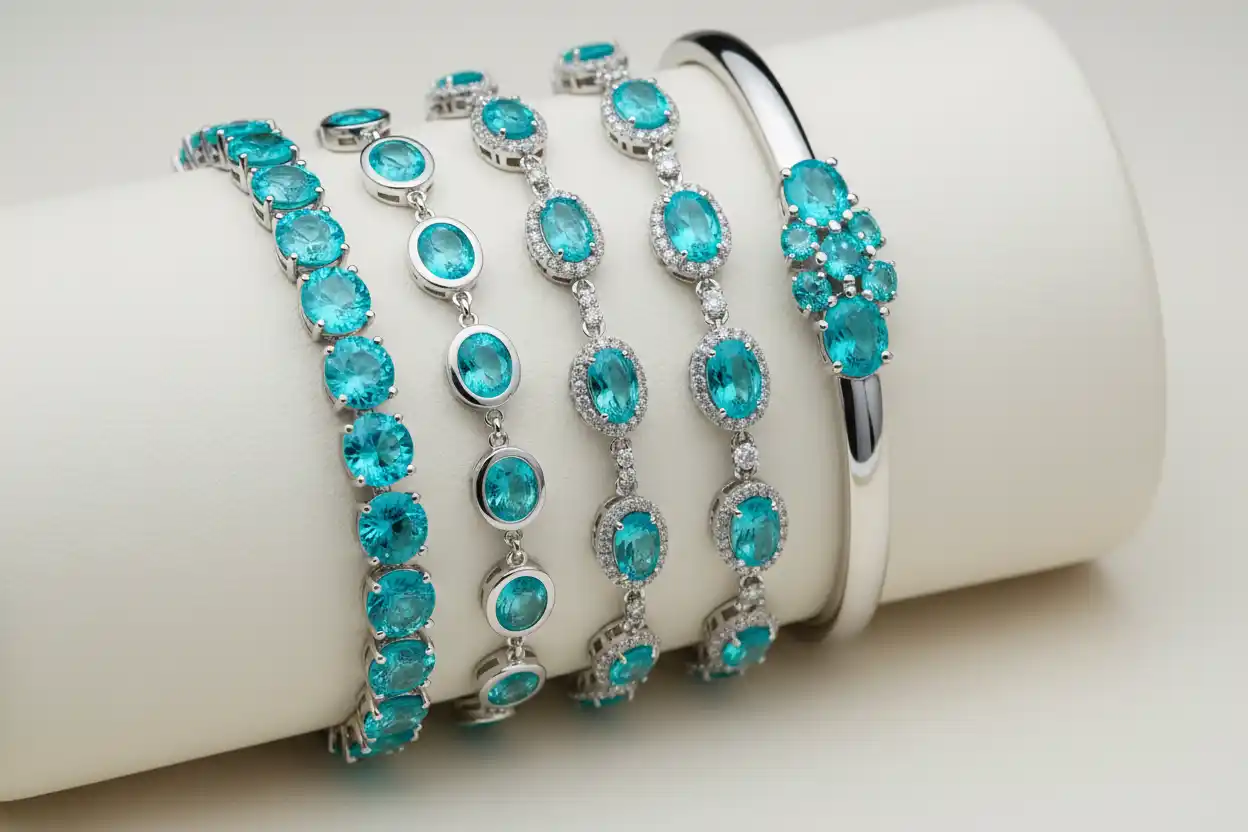
Paraiba Tourmaline Bracelets: Complete Buying Guide
Paraiba Tourmaline bracelets place one of the colored-gem market’s most vivid materials into a format that requires exceptional matching. Fine stones can appear electric blue, turquoise, greenish blue, vivid green or violet-blue, with a bright visual intensity associated with copper-bearing Tourmaline.
One extraordinary loose stone is difficult to find. A bracelet may require several or dozens of gems that coordinate in hue, tone, saturation, cut, dimensions and treatment. Consequently, a well-matched line can carry a premium beyond the combined weight of its individual stones.
The name also requires documentation. Copper-bearing Tourmaline occurs in Brazil, Nigeria and Mozambique, while origin can influence price substantially. Appearance alone cannot determine geographic source reliably.
The broader Paraiba Tourmaline guide owns geology, chemistry, source history and symbolism. This article focuses specifically on bracelet construction, matching, treatments, reports, fit and long-term wear.
Paraiba Tourmaline Bracelets at a Glance
| Feature | What to evaluate |
|---|---|
| Gem identity | Copper-bearing blue-to-green Tourmaline |
| Main coloring elements | Copper with manganese and other influences |
| Mohs hardness | Approximately 7–7.5 |
| Toughness | Generally fair |
| Important sources | Brazil, Nigeria and Mozambique |
| Main value factor | Vivid attractive color |
| Main bracelet challenge | Matching multiple rare stones |
| Common formats | Tennis lines, bezels, stations, bangles and clusters |
| Main treatment concern | Heat, filling and possible irradiation-related color |
| Main report concern | Copper-bearing identity, treatment and geographic origin |
| Main structural concern | Inclusions, fractures, links, prongs and clasp |
| Safest cleaning | Warm soapy water; avoid steam and ultrasonic cleaning |
What Is Paraiba Tourmaline?
Paraíba Tourmaline is a copper-bearing member of the Tourmaline group known for vivid blue, greenish blue, turquoise, violet and green colors.
The name originated with discoveries in Brazil’s Paraíba State during the late twentieth century. Similar copper-bearing material was later identified in Nigeria and Mozambique.
The broad Tourmaline gemstone guide owns the full mineral-group context, while Types of Tourmaline places Paraíba beside Rubellite, Indicolite, Chrome Tourmaline and Watermelon Tourmaline.
Copper-bearing identity and geographic origin require laboratory evidence. A neon blue-green appearance alone does not prove that a gemstone belongs to this category.
Why Paraiba Color Looks Different
Copper contributes strongly to the bright blue-to-green appearance, while manganese and other elements modify the resulting hue.
Fine stones may appear to glow because intense saturation remains visible without becoming excessively dark. However, neon and electric are trade descriptions rather than measurable grades.
Some stones lean toward turquoise or greenish blue. Others are violet-blue, bluish green or vivid green.
The general Tourmaline Color Meaning guide owns symbolism across the group. Bracelet quality should be evaluated through actual color, not the emotional effect of a marketing adjective.
Why Bracelets Are Difficult to Match
A bracelet presents several gemstones simultaneously.
Each stone needs compatible hue, tone and saturation. One gray, overly dark or yellowish gem can interrupt an otherwise vivid blue-green line.
Cutting must also coordinate. Differences in depth can make one setting taller, while mismatched outlines disrupt articulation.
Inclusions and treatments should remain broadly consistent. One heavily filled stone should not be hidden among untreated or conventionally heated gems without disclosure.
The difficulty of assembling a coordinated line can add substantial value beyond simple carat-weight multiplication.
Main Bracelet Styles
| Bracelet style | Main advantage | Main concern |
|---|---|---|
| Tennis bracelet | Continuous vivid color | Matching and numerous settings |
| Bezel-link bracelet | Strong edge protection | More visible metal |
| Prong-link bracelet | Maximum gemstone exposure | Exposed girdles |
| Station bracelet | Uses fewer rare stones | Chain strength and flipping |
| Graduated bracelet | Concentrates larger gems at the center | Smooth color and size progression |
| Diamond-accented line | Adds brilliance and contrast | Harder accents and extra prongs |
| Cluster bracelet | Broad color using smaller stones | Shared settings |
| Bangle | Structured and refined appearance | Hinge and fit |
| Cuff | Strong design surface | Metal flexing |
| Charm bracelet | Personal and expandable | Stone collision |
| Cabochon bracelet | Accommodates included material | Surface exposure |
| Mixed-Tourmaline bracelet | Creates a broader blue-green spectrum | Accurate stone identification |
Paraiba Tennis Bracelets
A tennis bracelet creates a continuous line of similarly sized faceted stones.
Color matching is the main challenge. The gems should form a deliberate sequence rather than alternate between neon turquoise, gray-blue and dark green unintentionally.
Millimeter dimensions matter more than equal carat weights because deep Tourmalines can retain hidden weight.
Every link should articulate smoothly. A stiff section can twist the bracelet and place pressure on nearby settings.
The clasp should engage positively and include one or more safety features when the line carries significant value.
Bezel-Link Bracelets
Bezels surround each gemstone with metal.
This construction protects girdles, reduces snagging and prevents neighboring stones from making direct contact.
Platinum and white gold create a cool frame that preserves blue and turquoise impressions. Yellow gold provides stronger contrast and can emphasize green components.
The bezel should follow the stone evenly without gaps or excessive pressure over fractures.
Open or partially open backs allow cleaning beneath the gems and preserve light entry.
A bezel line often provides the best balance between protection and continuous visible color.
Prong-Link Bracelets
Prong settings expose more of each gemstone.
Four-prong baskets are common for oval, cushion and round stones. Shared prongs reduce visible metal but make neighboring gems dependent on the same components.
Tourmaline can contain liquid inclusions, tubes, healed fractures and surface-reaching features. Prongs must not press directly over weak areas.
The stones should rest inside supportive baskets rather than remain suspended only between tips.
A valuable prong bracelet requires periodic professional inspection because gradual metal wear can lead to loss.
Station Bracelets
A station bracelet places several Paraiba Tourmalines at intervals along a chain.
The format uses fewer rare stones and can offer a more accessible, lightweight design.
Two-point connections help flat settings remain face-up. One-point stations rotate more freely and may display their backs frequently.
The chain must be proportionate to the total station weight.
Enough space should remain between gems to prevent collision when the bracelet curves around the wrist.
A station design can also combine one documented Paraiba center with ordinary blue or green Tourmaline sides, provided every material is identified accurately.
Graduated Bracelets
A graduated line increases stone size toward the center.
The progression may also strengthen slightly in saturation, although abrupt changes weaken the visual flow.
Larger center stones should not be much deeper than the surrounding gems, or their baskets may interrupt articulation.
The invoice should state which stones have individual laboratory reports and how the smaller gems were represented.
A central Brazilian-origin Tourmaline does not establish that every smaller stone shares the same source.
Bangles and Cuffs
A bangle provides a rigid or hinged structure for one or several Paraiba Tourmalines.
The hinge should carry movement rather than forcing the stone-set section to flex.
Open cuffs should not be bent repeatedly around the wrist. Repeated adjustment fatigues the metal and can loosen settings.
Flush or bezel-set stones work particularly well in broad bangles.
The fit should permit comfortable movement without allowing the bracelet to rotate continuously beneath the wrist.
Cabochon Paraiba Bracelets
Included copper-bearing Tourmaline may be cut into cabochons rather than faceted.
A cabochon can preserve color and weight when fractures or tubes would make brilliant cutting impractical. Some material may also display chatoyancy or attractive internal texture.
The surface should have a smooth, even polish without open cavities likely to collect dirt.
A bezel protects the rounded perimeter more effectively than isolated prongs.
Cabochon color can remain vivid, but transparency and brilliance expectations differ from faceted stones.
Color Matching
Color should be examined under daylight-equivalent illumination, ordinary indoor light and warm evening lighting.
The gems should remain coordinated even when the overall bracelet shifts slightly greener or bluer.
Strong grayness, excessive darkness and pale washed-out sections reduce consistency.
The Blue Gemstones guide and Green Gemstones guide provide neighboring color alternatives without defining Paraiba identity.
A video of the complete line in motion is more informative than separate photographs of selected stones.
Color Is More Important Than Size
Paraiba value depends heavily on vivid attractive color.
A smaller clean stone with bright electric blue-green appearance may be more desirable than a larger dark, gray or weakly saturated gem.
This means that total carat weight alone cannot describe bracelet quality.
A line of small intensely colored stones can carry a substantial premium because matching several of them is difficult.
The Paraiba Tourmaline Price Guide owns current valuation rather than this construction-focused page.
Clarity and Inclusions
Tourmaline commonly contains liquid inclusions, needles, tubes, crystals, fingerprints and fractures.
Paraiba material may remain valuable despite visible inclusions when the color is exceptional.
For bracelets, consistency matters. One heavily clouded stone should not interrupt an otherwise transparent line unless it serves as an intentional center.
Surface-reaching fractures create practical setting concerns.
A clarity-enhanced stone can appear cleaner, but filling affects value, cleaning and repair and must be disclosed.
Cut Quality
Oval, cushion, round and emerald cuts are common.
The cutter must manage Tourmaline’s pleochroism and tendency to appear darker along certain directions.
A broad window makes the center look pale and allows the setting or skin to show too clearly. Extinction creates dark inactive regions.
Deep stones can retain weight without producing corresponding face-up size.
A matched bracelet should use coordinated visible dimensions and pavilion depths so the line remains even.
Copper-Bearing Identity
Not every vivid blue or green Tourmaline contains enough copper to qualify for Paraiba-related nomenclature.
Standard visual inspection cannot establish trace-element chemistry conclusively.
A laboratory may use spectroscopy and chemical analysis to determine whether copper contributes to the color.
The Gemstone Certification guide explains the difference between identification, treatment and geographic-origin reporting.
The seller should not rely only on a verbal statement from the supplier when the identity creates a major premium.
Brazil, Nigeria and Mozambique
Copper-bearing Tourmaline is known from Brazil, Nigeria and Mozambique.
Brazilian material has the strongest connection with the original Paraíba discoveries and can command a significant origin premium.
Mozambique has produced larger quantities and a broad color range, including stones capable of strong blue-to-green appearance after heat treatment. Nigerian material also occupies the copper-bearing market.
Origin cannot be determined reliably from color alone.
The complete purchase workflow belongs to the Paraiba Tourmaline Buying Guide.
Heat Treatment
Heating is common in copper-bearing Tourmaline.
It can reduce purple or reddish manganese-related components and produce brighter blue-to-green colors.
Heated Tourmaline remains natural material, but the treatment should be disclosed when known.
Heat may also damage a finished stone during jewelry repair, especially when fractures and liquid inclusions are present.
A jeweler should remove valuable Tourmaline before soldering whenever practical.
Filling and Other Enhancement
Fracture filling can improve apparent clarity.
Oils, resins or other substances may enter surface-reaching fractures, making them less visible. The degree and stability of enhancement vary.
Filled stones require more conservative cleaning because heat, chemicals and ultrasonic vibration can damage the filler.
Irradiation can alter selected Tourmaline colors, and some induced color may fade with heat or bright light.
Treatment should be evaluated through laboratory evidence rather than seller assumptions.
Natural and Imitation Material
Glass, synthetic Spinel, synthetic Sapphire, Apatite and other blue-green gems can imitate Paraiba color.
True commercially available laboratory-grown Tourmaline is uncommon compared with synthetic corundum or glass imitation.
A thermal Diamond tester cannot establish Paraiba identity.
The broader Tourmaline Buying Guide owns general identification and quality questions across the mineral group.
A very low price for a large supposedly Brazilian neon stone should prompt verification rather than immediate confidence.
Diamond Accents
Diamond accents create strong contrast with vivid blue-green Tourmaline.
Their girdles must remain separated from the Tourmalines by metal. Diamond can scratch the softer stones during rubbing or repair.
The invoice should distinguish natural Diamond, laboratory-grown Diamond, Moissanite and other colorless accents.
Shared settings reduce visible metal but create additional maintenance points.
Accent size should support the Tourmaline color rather than overpower it.
Metal Choices
White gold and platinum preserve a cool blue-green presentation.
Yellow gold creates a warmer contrast and may make green components more noticeable. Rose gold can create an unusual complementary effect with turquoise centers.
Metal color does not alter the gemstone permanently, but reflection can influence face-up appearance.
The alloy must also suit the wearer’s skin and lifestyle.
A strong clasp and adequately thick links matter more than using the most prestigious metal name.
Bracelet Fit
Measure the wrist at the intended wearing position.
The bracelet should move slightly without rotating continuously beneath the wrist. Excessive looseness increases impact against desks and doors.
A tight line places constant stress on hinges, prongs and the clasp.
Large settings occupy internal space, so the laid-flat measurement may overstate wearable circumference.
A valuable bracelet should remain comfortable enough that the wearer does not repeatedly pull or adjust it.
Clasps and Safety Features
A box clasp with side safety latches is common for high-value tennis bracelets.
The closure should engage positively without excessive force. Weak resistance, visible gaps or changing behavior can indicate wear.
Inspect the links adjacent to the clasp because they carry repeated stress during opening and closing.
A secondary safety chain may help, but it should be short enough not to catch on objects or strike the gemstones.
Magnetic clasps are generally unsuitable for valuable heavy lines unless supported by a separate mechanical closure.
Stacking Paraiba Bracelets
Paraiba Tourmaline should not rub continuously against Diamond, Sapphire or rough-edged metal bracelets.
The harder materials can scratch and abrade Tourmaline.
A smooth metal spacer can reduce contact, but wearing the Paraiba bracelet alone provides the safest approach.
A general Tourmaline Bracelet guide covers multi-color and ordinary Tourmaline stacking choices.
Remove the bracelet before exercise, gardening, cleaning and mechanical work.
Price and Value
The bracelet’s value depends on color, matching, copper-bearing identity, geographic origin, treatment, clarity, cut, total weight, documentation, metal and craftsmanship.
Matching several exceptional small stones may cost more than selecting one larger pendant center.
Brazilian origin can create a premium, but a weak Brazilian stone is not automatically more beautiful than fine African material.
The general Tourmaline Price Guide provides family-level context, while the dedicated Paraiba price page owns this variety’s market.
A bracelet should not be purchased through guaranteed appreciation or investment claims.
Buying Online
Follow How to Buy Gemstones Online Without Getting Scammed.
Request continuous video of the exact bracelet in neutral, warm and ordinary indoor light. The line should be shown flat, curved and worn.
Confirm the number of stones, individual and total weights, dimensions, treatment, report coverage, origin claims, metal alloy, clasp, safety features and return terms.
The bracelet should arrive with an invoice identifying whether every stone is copper-bearing Paraiba Tourmaline or whether other Tourmalines are included.
Stock photographs cannot establish the matching or condition of the actual line.
Coordinating Paraiba Jewelry
A pair of Paraiba Tourmaline earrings can repeat the bracelet’s color direction.
A Paraiba Tourmaline necklace can present a larger central stone, while a Paraiba Tourmaline ring creates a hand-level focal point.
The pieces do not need identical origin or tone unless the seller claims a matched suite.
Tourmaline is also one of the recognized stones in the October Birthstone guide.
Cleaning and Maintenance
Follow How to Clean Paraiba Tourmaline Jewelry Safely.
Warm water, mild soap and a soft brush provide the safest routine method.
Do not use steam or ultrasonic equipment. Heat, liquid inclusions, fractures and fillers create avoidable risks.
Dry beneath settings and around the clasp carefully.
Store the bracelet flat in a padded compartment, separated from harder gemstones.
Stop wearing it if a stone moves, a prong catches, a link becomes stiff or the clasp no longer engages consistently.
Frequently Asked Questions
1. What makes Paraiba Tourmaline different?
It is copper-bearing Tourmaline known for vivid blue, greenish blue, turquoise, violet and green colors.
2. Is Paraiba Tourmaline durable enough for bracelets?
It can be used successfully, but Tourmaline is less durable than Sapphire and needs secure settings and careful wear.
3. Which bracelet style is safest?
A low bezel-link bracelet provides strong girdle protection and prevents neighboring stones from touching.
4. Why are matched bracelets expensive?
Several stones must coordinate in rare color, dimensions, cut, treatment and clarity.
5. Does every stone need a laboratory report?
High-value stones should be tested proportionately, and the seller must disclose the scope of documentation for the complete line.
6. Is Brazilian Paraiba always more valuable?
Brazilian origin can command a premium, but individual color and quality still matter.
7. Is heat treatment common?
Yes. Heat can reduce purple or red components and produce brighter blue-to-green color.
8. Can Paraiba Tourmaline be clarity enhanced?
Yes. Surface-reaching fractures may be filled with oil or resin and require disclosure.
9. Can laboratory-grown Paraiba Tourmaline exist?
Commercial synthetic Tourmaline is uncommon, but glass and other synthetic gems can imitate its color.
10. Can it be stacked with Diamond bracelets?
Direct contact is not advisable because Diamond and its settings can scratch Tourmaline.
11. Can the bracelet go in an ultrasonic cleaner?
No. Warm soapy water is safer because fractures, inclusions and fillers can react badly to vibration or heat.
12. What should I do if one link becomes stiff?
Stop wearing the bracelet and have the articulation inspected before pressure damages a setting or the link fails.
A Paraiba Tourmaline bracelet succeeds when its stones appear to belong to one color environment without looking artificially identical. Vivid copper-bearing color creates the attraction, but precise matching, secure articulation and credible documentation turn rare material into jewelry that can be worn responsibly.