Paraiba Tourmaline Necklaces and Pendants Guide
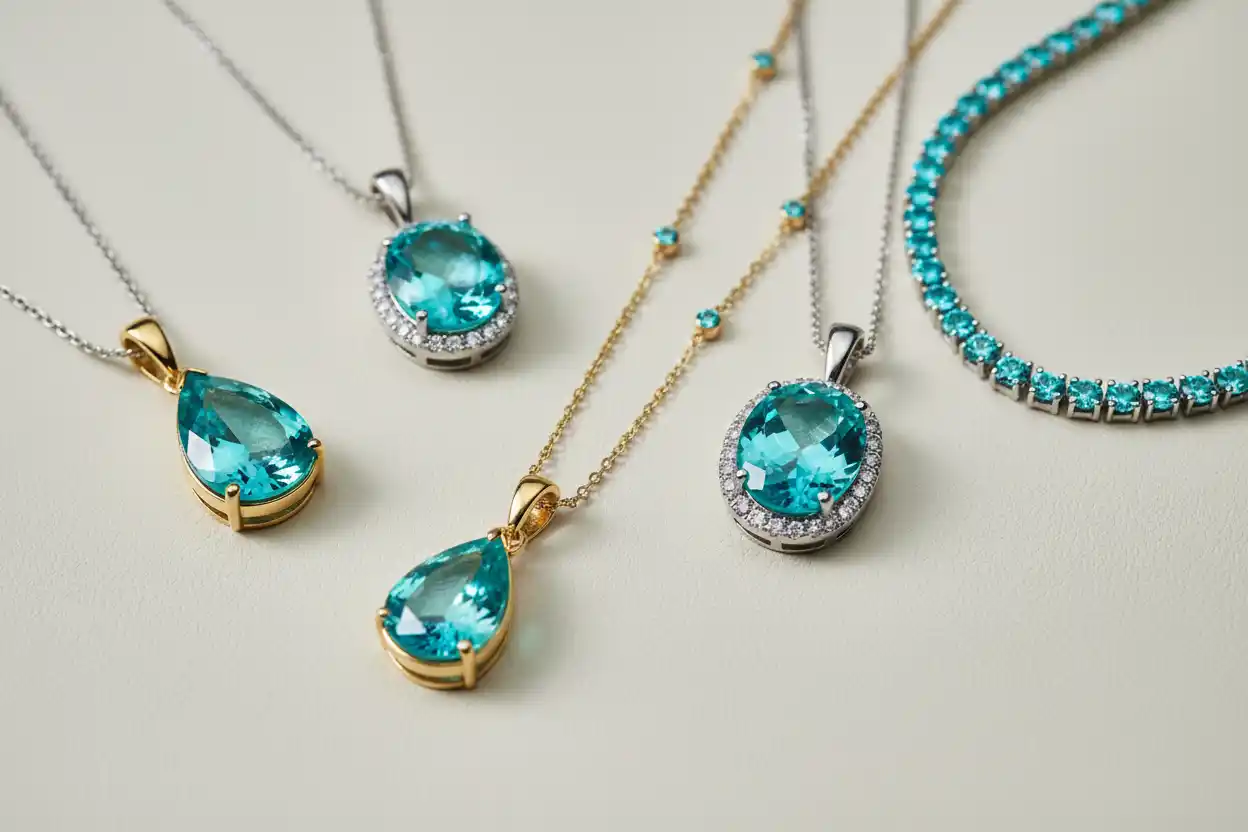
A Paraiba tourmaline necklace places one of the gem world’s most vivid blue-green colors at the center of the neckline. Because the stone faces outward and receives light from several directions, a well-cut pendant can display strong brightness without requiring the size or matching needed for a bracelet or pair of earrings.
The category includes delicate solitaire pendants, diamond halos, clusters, station necklaces and substantial one-of-a-kind pieces. Each design creates a different balance between gemstone value, visibility, chain strength and wearability.
This page concentrates on necklace and pendant design rather than repeating the gem’s full background. Readers seeking its mineralogical identity, source history and symbolic associations should begin with the Paraiba tourmaline meaning guide.
Why Paraiba Tourmaline Makes an Exceptional Pendant Stone
Copper-bearing tourmaline can display vivid blue, turquoise, greenish-blue and bluish-green colors. In a pendant, these hues remain visible because the stone generally lies flat against the chest rather than rotating constantly.
A pendant also allows a buyer to concentrate the budget on one center stone. Earrings require two visually compatible gems, while bracelets may need several calibrated stones or a construction that exposes the centerpiece to repeated contact. A single necklace can therefore present a stronger individual gemstone at the same total budget.
Placement near the collarbone gives the color a clear visual field. Open necklines, neutral fabrics and contrasting metal can strengthen that effect. The necklace should still be assessed under normal indoor light, since intense jewelry-store illumination can make almost any transparent colored stone appear brighter.
For a fuller review of color, clarity, cutting, documentation and seller disclosure, use the dedicated Paraiba tourmaline buying guide.
Main Paraiba Tourmaline Necklace Styles
| Necklace or pendant style | Character | Best use | Principal concern |
|---|---|---|---|
| Solitaire pendant | Clean and gem-focused | Daily or formal wear | Bail and setting security |
| Diamond halo pendant | Bright and visually larger | Evening and occasion jewelry | Halo should not overpower the center |
| Bezel pendant | Modern and protective | Frequent wear | Thick metal can reduce apparent size |
| Cluster pendant | Broad field of color | Statement jewelry | Consistency among multiple stones |
| Station necklace | Repeated color around chain | Layering and contemporary wear | Chain balance and stone orientation |
| Lariat or drop necklace | Vertical movement | Open necklines | Tangling and connector durability |
| Convertible pendant | Flexible styling | Travel and event use | Complexity of detachable components |
Solitaire Paraiba Tourmaline Pendants
The solitaire pendant is the most direct presentation of the gem. It can use an oval, cushion, pear, round or emerald-cut stone with minimal surrounding decoration.
A four-prong design reveals more of the outline but leaves the girdle exposed. Six prongs provide additional security, particularly for valuable ovals and rounds. Pear shapes need protection at the tip, usually through a V-prong, capped prong or partial bezel.
The bail should be proportional to the chain and setting. A tiny decorative bail on a heavy pendant may wear, bend or restrict movement. Conversely, an oversized bail can dominate a delicate stone.
A hidden bail behind the setting creates a floating appearance. However, the opening must still be large enough for the intended chain clasp to pass through if the pendant is removable.
Halo Pendants
Diamond halos create contrast and increase face-up presence. They are particularly useful when the Paraiba tourmaline is vivid but modest in size. A fine halo can make the colored center appear larger without sacrificing the rarity of a high-quality stone.
The diamonds should be consistent in brightness and securely set. A halo that is too broad may turn the piece into a diamond pendant with a small blue center rather than a Paraiba-focused design.
Double halos and elaborate frames add impact but also increase weight. The chain, bail and attachment points must be engineered for the finished piece rather than selected as decorative afterthoughts.
Buyers interested in coordinating the pendant with a brighter face-framing piece can compare Paraiba tourmaline earrings.
Bezel and Semi-Bezel Pendants
A bezel surrounds the girdle with metal and gives the pendant a clean contemporary outline. It offers useful edge protection, especially for a necklace intended for frequent wear.
Full bezels can slightly reduce face-up spread and may influence color if yellow or rose metal is visible beneath a pale stone. A white-metal inner bezel combined with a colored-gold outer frame can preserve a cooler appearance.
Semi-bezels protect the sides while leaving more of the gemstone visible. Their open ends must be constructed so that the stone cannot shift under pressure.
Cluster and Multi-Stone Necklaces
Cluster pendants combine multiple small Paraiba tourmalines into a larger composition. Designs may use a floral arrangement, geometric mosaic or irregular constellation.
Small stones can carry excellent color, and a cluster may look intensely saturated because several flashes overlap. Matching still matters. One gray, dark or windowed stone can interrupt the visual field.
A necklace composed entirely of Paraiba tourmaline stations or graduated gems requires greater attention to color consistency. Deliberate gradation can be attractive, but random alternation between bright blue, yellowish green and dull gray-green usually appears less refined.
Those comparing different tourmaline palettes can review types of tourmaline, indicolite, rubellite, verdelite and watermelon tourmaline.
Selecting the Right Paraiba Color
Paraiba tourmaline is not defined by one uniform shade. Commercially desirable stones may be violetish blue, blue, greenish blue, bluish green or vivid green. The common thread is a copper-related color with enough saturation and brightness to create a lively appearance.
In a pendant, medium-light to medium tones often remain visible against both skin and fabric. Very pale gems may disappear against a light blouse, whereas overly dark stones can lose their electric quality in evening conditions.
Evaluate the gemstone against the colors it will actually be worn with. A greenish-blue stone may look more blue beside yellow gold, while a blue-dominant gem may look greener near warm fabric. These shifts do not necessarily indicate instability; human color perception changes with surrounding hues and lighting.
Evaluating Cut in a Pendant
A pendant is commonly viewed straight on, so windowing is important. A window appears as a pale or transparent central area through which the background can be seen too clearly. It reduces color concentration and can reveal skin or clothing through the center.
Extinction produces the opposite effect: areas of the gem appear persistently dark. Some contrast is necessary for scintillation, but broad black zones reduce liveliness.
Tourmaline crystals often form in elongated shapes, which can encourage oval, pear, emerald and rectangular cuts. The cutter must balance weight retention against face-up performance. Rare rough should not be expected to conform to the proportions used for standardized colorless stones.
A slightly asymmetrical outline may be acceptable in a custom pendant if the cutting distributes color effectively. Poor facet alignment, a crooked table or severe bulging should not be excused merely because the material is rare.
The carat-versus-millimeter guide is useful when comparing two pendants with similar stated weights but different visual dimensions.
Clarity, Fractures and Surface Condition
Internal features are common in many tourmalines. Paraiba tourmaline may show growth tubes, healed fissures, liquid inclusions or other natural structures. Their effect depends on location, size and contrast.
A bright stone with a few visible inclusions can be more attractive than a cleaner gem with weak color. Nevertheless, surface-reaching fractures may collect residue and complicate repair or cleaning.
Inspect the pendant from the front, back and sides. The mounting should not hide a chipped girdle, cavity or damaged point. When the back is enclosed, ask whether the gemstone can be examined before purchase or whether the seller has clear photographs from before setting.
Pendant Size and Visual Presence
Carat weight alone does not determine how large the pendant looks. Tourmaline’s density, cut depth, outline and setting all affect face-up presence.
A broad oval in a fine bezel may look larger than a deeper cushion of equal weight. A halo increases overall diameter but does not change the size of the Paraiba center. Product descriptions should distinguish center-stone weight, total Paraiba weight and total weight including diamonds.
Scale should suit the necklace length. A tiny pendant on a long chain may look visually lost, while a heavy piece at choker length can pull or turn.
Choosing the Chain Length
A Paraiba pendant should sit where its color remains visible and the setting lies flat.
| Approximate chain length | Typical position | Best suited to |
|---|---|---|
| 14–16 inches | Base of the neck | Small solitaires and layering |
| 17–18 inches | Collarbone area | Most everyday pendants |
| 20 inches | Upper chest | Medium pendants and open necklines |
| 22–24 inches | Mid-chest | Larger pendants and relaxed styling |
| 28 inches or longer | Lower chest | Statement or convertible designs |
Actual placement depends on neck circumference, body proportions and the weight of the pendant. An adjustable chain provides useful flexibility, particularly when the necklace will be worn over different necklines.
The pendant should not constantly strike buttons, zippers or desk surfaces. An expensive Paraiba tourmaline may be better positioned slightly higher if the wearer is active.
Chain Construction and Security
A high-value pendant should not hang from a chain chosen only for delicacy. The links, clasp and connecting rings need enough strength for the pendant’s weight.
Cable, box, wheat and sturdy curb chains can all work when properly proportioned. Very thin snake chains may kink, while weak jump rings can open under tension.
A lobster clasp generally provides secure everyday operation. Spring-ring clasps suit lighter pieces but should close fully and move freely. Larger necklaces may use box clasps with safety catches.
The ring connecting the clasp to the chain should be soldered or otherwise secured. An open jump ring can gradually spread without obvious warning.
White, Yellow or Rose Gold
White gold and platinum reinforce cool blue and turquoise tones. They also blend visually with diamond halos, allowing the center color to remain dominant.
Yellow gold creates warmer contrast and can make blue-green Paraiba tourmaline appear more tropical. A white-metal basket beneath the gem can prevent yellow reflections from changing the face-up color too strongly.
Rose gold offers a softer complementary effect. It can be especially attractive with intense turquoise stones but may visually compete with pale or grayish material.
Mixed-metal necklaces provide styling flexibility. A white setting on a yellow chain can preserve the stone’s cool optical environment while coordinating with warm jewelry.
Treatment and Disclosure
Heat treatment is associated with many copper-bearing tourmalines and can reduce purple or red components, producing more commercially desirable blue or green colors. Treatment should not automatically disqualify an attractive pendant, but it should be represented honestly.
The separate gemstone treatments guide explains broader treatment categories. For an important Paraiba purchase, ask the seller what is known, assumed or laboratory-determined about the stone.
Heating can be difficult or impossible to establish conclusively in some tourmalines. Therefore, a report may use cautious wording rather than promising an absolute untreated determination.
Documentation and Origin Claims
The original source in Paraiba State, Brazil, established the gem’s name. Copper-bearing tourmaline has also been found in Mozambique and Nigeria. Similar appearance does not allow a reliable geographic conclusion by eye.
Laboratories may use trace-element chemistry and reference collections to investigate origin. A sales description stating “Brazilian” is not equivalent to an independent origin report.
The gemstone certification guide helps compare laboratory services. Once a report is provided, use how to read a gem lab report to distinguish identity, origin opinion, treatment comments and trade terminology.
Documentation should correspond to the stone in the pendant. Verify measurements, weight where available and identifying images or report numbers. A generic appraisal for the finished necklace does not replace gemological identification.
Price Considerations
Paraiba necklace prices span a wide range because the category includes small melee pendants, fine solitaires, major Brazilian stones and elaborate diamond designs.
Color usually drives desire more strongly than size. However, large stones with fine saturation, transparency and documentation can carry substantial premiums. Metal weight, diamond quality, brand, craftsmanship and provenance also affect the finished price.
Use the dedicated Paraiba tourmaline price guide for current market context. For comparison with the broader family, consult the tourmaline price guide and tourmaline buying guide.
The cost of a necklace should be separated into gemstone value, construction quality and design premium. A famous signature does not correct weak color, insecure prongs or inadequate documentation.
Buying Online
Remote purchases can work well when the seller supplies realistic information. Request video in diffused daylight and ordinary indoor light, not only spotlighted studio footage.
The listing should state the center stone’s dimensions, carat weight, known treatment, claimed origin, metal fineness, accent-stone details, chain length and return period. Ask whether the necklace shown is the exact piece being sold.
Follow the risk-control steps in how to buy gemstones online without getting scammed. High-value purchases should allow independent inspection during a meaningful return window.
Wearing and Layering a Paraiba Necklace
A solitaire can be worn alone as the focal point or layered with simple chains. Keep sufficient distance between necklaces so the Paraiba pendant does not rub against other gemstones or metal edges.
When layering, vary chain lengths and visual weights. A fine Paraiba pendant at 17 inches can sit above a plain gold chain at 20 inches. Avoid placing a rough-textured necklace directly beside the gemstone.
A statement pendant generally needs fewer competing elements. Simple earrings or a plain ring allow the necklace to remain central. Those building a complete suite can compare Paraiba tourmaline rings and the previously completed Paraiba tourmaline bracelet guide.
October Birthstone Necklaces
Tourmaline is a recognized October birthstone. Paraiba tourmaline offers an unusually rare interpretation of that tradition, particularly for milestone gifts and collector-oriented jewelry.
The broader October birthstone guide explains the month’s association with tourmaline and opal. The October birthstone jewelry guide covers practical gift formats and personalization.
For directory navigation, Paraiba appears among Gemstones That Start With P, while the family can be traced through Gemstones That Start With T and Crystals That Start With T.
Durability and Daily Wear
Tourmaline’s Mohs hardness of approximately 7 to 7.5 gives it reasonable resistance to scratching. A pendant is also less exposed to direct impact than a ring.
However, the gem can still fracture from a sharp blow or sudden temperature change. Long necklaces may swing into desks, countertops or seat belts, so placement matters.
Check prongs, bails, hinges and clasps periodically. Any looseness, clicking sound or visible movement of the stone requires professional inspection.
Cleaning and Maintenance
Warm water, mild soap and a soft brush are appropriate for routine cleaning. Support the pendant while brushing so the chain does not pull against the bail.
Rinse carefully, dry with a lint-free cloth and allow the necklace to dry completely before storage. Avoid ultrasonic and steam equipment because inclusions and fractures can increase risk.
The exact cleaning procedure and treatment precautions are covered in how to clean Paraiba tourmaline jewelry safely.
Store the necklace flat or suspended so the chain does not knot. Keep the gemstone in a padded compartment away from harder jewelry.
Frequently Asked Questions
1. What is the best chain length for a Paraiba tourmaline pendant?
An adjustable 17- to 18-inch chain suits many everyday pendants because it places the stone near the collarbone. Larger statement pieces may look better at 20 to 24 inches.
2. Is a Paraiba tourmaline necklace suitable for daily wear?
Yes, provided the setting and chain are secure. Avoid hard impacts, high heat, sudden temperature changes and activities that could pull or strike the pendant.
3. Which pendant shape shows Paraiba color best?
Ovals, cushions and pears often balance color, spread and rough retention effectively. The best individual stone is the one with bright face-up color and minimal windowing.
4. Should a Paraiba pendant have an open back?
An open back can simplify inspection and cleaning, but it does not automatically improve brilliance. Security, workmanship and the gemstone’s cut matter more than whether the basket is completely open.
5. Is a diamond halo worth adding?
A halo can increase visual presence and emphasize the blue-green center. It is most successful when the diamonds are fine enough to support rather than overwhelm the Paraiba tourmaline.
6. Can Paraiba tourmaline be worn on a yellow gold chain?
Yes. Yellow gold creates warm contrast and can make the blue-green color look especially vivid. A white-metal basket may be used if yellow reflection through the gem is undesirable.
7. Are Paraiba tourmaline necklaces always heat-treated?
Not every stone is treated, but heating is common in copper-bearing tourmaline. Buyers should request accurate disclosure rather than assuming either treated or untreated status.
8. Does Brazilian Paraiba tourmaline always cost more?
Brazilian origin can command a premium when supported by a respected laboratory and accompanied by fine color. Origin alone does not compensate for poor cutting, weak saturation or damage.
9. Can I wear a Paraiba pendant while exercising?
It is better to remove it. Sweat, impact, equipment, sudden pulling and repeated movement can damage the chain, clasp or setting.
10. How can I tell whether the necklace is authentic?
Visual appearance alone is not enough for a high-value conclusion. Review the seller’s disclosure, independent laboratory report, measurements, return policy and documentation linking the report to the actual stone.
11. Why does my Paraiba pendant look different over black clothing?
Dark backgrounds can increase apparent saturation and contrast, while pale fabric may reveal windowing or make a light stone look less intense. This is a normal interaction between gemstone optics and the surrounding color.
12. How should a Paraiba tourmaline necklace be stored?
Lay it flat in a fabric-lined compartment or hang it where the chain cannot tangle. Keep the pendant separated from harder gemstones and fasten the clasp before storage.
A successful Paraiba tourmaline necklace is built around more than the rarity of its center stone. The gemstone should remain vivid in realistic light, the cut should carry color across the face, and every structural element—from the bail to the clasp—should match its value. When those details are resolved, even a restrained solitaire can hold the neckline with unmistakable blue-green intensity.