Peridot Bracelets: How to Choose, Size and Wear Them
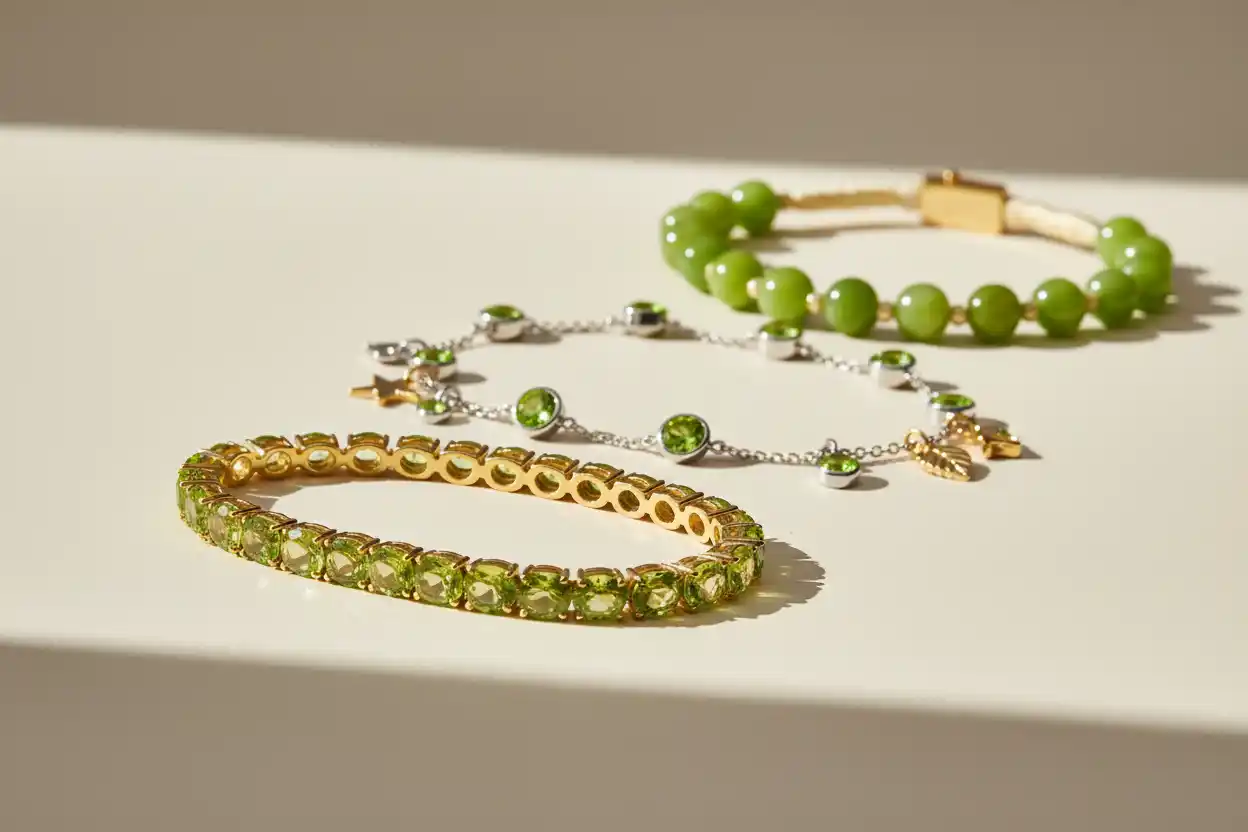
Peridot bracelets bring the gem’s unmistakable yellow-green color into a jewelry format that remains visible to the wearer throughout the day. A bright line bracelet can create continuous flashes around the wrist, while a single-stone station bracelet offers a quieter accent that works with watches and other jewelry.
The wrist is also a demanding position. Bracelets regularly touch desks, doorframes, bags and clothing, so peridot quality cannot be considered separately from setting protection, articulation, clasp security and fit. A beautiful stone in an underbuilt bracelet may spend more time being repaired than worn.
This guide focuses on bracelet construction, sizing, comfort and styling. The broader peridot meaning guide owns the gem’s symbolism, formation and general properties.
Why Peridot Works in Bracelets
Peridot is the transparent gem variety of olivine, a mineral group that occurs in Earth’s mantle, volcanic rocks and, rarely, meteorites. Unlike gemstones whose color comes from trace impurities, iron is part of peridot’s chemical composition and creates its characteristic green.
Its narrow color range gives a bracelet visual continuity. Stones may vary from greenish yellow through yellowish green to a comparatively pure grass green, but they generally remain recognizable as members of the same palette. That makes peridot suitable for calibrated line bracelets and graduated designs.
Peridot measures approximately 6.5–7 on the gemstone hardness chart. This rating provides reasonable scratch resistance, although it does not make the gem resistant to every type of damage. The distinction is explained more fully in gemstone toughness versus hardness.
A bracelet exposes its stones to more contact than earrings or pendants. Consequently, protective construction matters more than an exceptionally delicate appearance.
Peridot Bracelet Styles
| Bracelet style | Visual effect | Practical advantage | Main buying concern |
|---|---|---|---|
| Tennis bracelet | Continuous line of green | Formal yet adaptable | Articulation, clasp and stone security |
| Bezel station bracelet | Spaced points of color | Better edge protection | Chain strength and station orientation |
| Single-stone bracelet | Minimal focal accent | Easy to layer | Centering and chain balance |
| Charm bracelet | Personal and informal | Can mix symbols and materials | Charms striking the gemstone |
| Beaded bracelet | Saturated casual color | Comfortable and accessible | Cord quality and bead abrasion |
| Bolo or slider bracelet | Adjustable fit | Useful for gifts | Slider grip and dangling ends |
| Cuff or bangle | Sculptural presentation | Strong visual structure | Rigid fit and impact exposure |
| Cluster bracelet | Larger patches of color | Uses smaller calibrated gems | Matching and replacement difficulty |
Peridot Tennis Bracelets
A tennis bracelet uses a flexible row of individual settings joined by articulated links. Round and oval peridots are common because they can be calibrated efficiently, although square cushions and emerald cuts create a more geometric line.
The bracelet should bend smoothly in one intended direction without twisting sharply sideways. Stiff joints can cause sections to stand away from the wrist, while overly loose joints allow the bracelet to roll and expose the stones to impact.
Inspect the underside as carefully as the front. The galleries should feel smooth, without rough casting, sharp prong ends or narrow edges that press into the skin. Every link needs enough metal to support repeated flexing.
A box clasp with one or two safety catches is preferable for a valuable line bracelet. The tongue should engage positively, and the safety mechanisms should close without requiring excessive force.
Bezel and Station Bracelets
A bezel surrounds all or most of a gemstone’s girdle with metal. This makes bezel-set stations a practical option for peridot because the vulnerable edges receive greater protection.
Station bracelets usually place several gems at intervals along a chain. Each station should face outward instead of continually flipping. Double chain connections or carefully positioned loops can improve orientation.
The chain must be proportioned to the weight of the settings. An extremely fine chain may look elegant in a photograph but can stretch or break when supporting several metal-framed stones.
Spacing changes the overall character. Wide intervals create a light, minimalist bracelet, while closer stations produce a stronger field of green without requiring a full tennis construction.
Single-Stone Peridot Bracelets
A single oval, round or cushion peridot set at the center of a chain offers an understated alternative to a full row. The center should remain reasonably aligned on top of the wrist.
Bracelets with only one connection on each side may rotate, especially when the setting is top-heavy. A low bezel, broad side loops or double-chain design can reduce flipping.
This format allows the buyer to concentrate on one stronger gem rather than matching many stones. The detailed color, clarity and cut evaluation belongs in the peridot buying guide, while market-specific figures remain within the peridot price guide.
Peridot Charm Bracelets
A peridot charm can represent an August birthday, anniversary, personal milestone or simply a preference for bright green jewelry. Charms may use faceted stones, cabochons, beads or small crystal forms.
The gemstone should not strike heavier metal charms continually. Space the components so the peridot remains separated from hard edges, dangling keys or dense decorative pieces.
Check the jump ring attaching the charm to the bracelet. A soldered or otherwise secured ring is less likely to open than a thin unsoldered connector.
Charm bracelets are frequently adjusted over time. A jeweler should inspect the gemstone setting whenever components are added, removed or rearranged.
Peridot Bead Bracelets
Peridot beads may be round, faceted, chip-shaped or irregular. Fine transparent beads can be costly, while more included or translucent material supports affordable casual designs.
The drill holes should be reasonably centered and free from severe chipping. Sharp hole edges can abrade elastic or thread, eventually causing failure.
Elastic bracelets should return to their original size without remaining stretched. Knotted cord, covered wire or multiple-strand construction may provide greater security for valuable beads.
Do not choose a bracelet solely because sellers describe the beads as “natural crystal.” Confirm that the listing identifies the material as peridot rather than generically colored glass, serpentine or another green stone.
Cuffs and Bangles
Rigid cuffs and bangles can present peridot as a central sculptural feature. Their structure may protect the underside of the wrist better than a loose bracelet, yet poor fit can cause the piece to rotate or strike hard surfaces.
A hinged bangle should close precisely and include an effective safety mechanism when valuable stones are present. The hinge must move smoothly without visible looseness.
Open cuffs should flex only when the design is intended to be adjustable. Repeated bending weakens metal and can change pressure around the gemstone setting.
The opening should pass over the narrow side of the wrist without requiring force that places stress on the center stone.
Choosing Peridot Color
The most desirable peridot generally shows strong green color with minimal brown. Most commercial stones have some yellow component, and a vivid yellowish green can be more attractive than a darker stone marketed as “pure green.”
Color should be evaluated in daylight and ordinary indoor illumination. Warm lighting can intensify yellow, while cool lighting may make the same bracelet look greener.
In a multi-stone bracelet, consistent tone matters. One pale or brownish stone can interrupt an otherwise coherent row. Exact identity is unnecessary, but the gems should appear intentionally matched.
Larger peridots can show deeper color because the longer light path increases saturation. Small calibrated stones may appear lighter even when the rough came from similar material.
Clarity and Inclusions
Fine peridot is often eye-clean. Common internal features include small dark mineral crystals and reflective disc-like fractures sometimes called lily pads.
A few inclusions do not automatically make a bracelet unattractive. Their effect depends on visibility, location and durability. Dark spots near the center of a pale stone are more distracting than small transparent features near an edge.
Surface-reaching fractures deserve closer inspection because bracelet stones experience repeated contact. A fracture under a prong may also be subjected to localized pressure during setting or repair.
Line bracelets should be examined stone by stone. One damaged gem can be overlooked when the overall row appears bright under display lighting.
Cut and Face-Up Size
Round, oval and cushion peridots dominate bracelets because cutters and manufacturers can produce them in repeatable dimensions. Emerald and square cuts offer a more architectural style but reveal windowing and inclusions readily.
A well-cut stone distributes green across its face. Very shallow stones may display a transparent center, while overly deep stones retain weight without creating proportional face-up size.
Equal carat weights do not ensure equal dimensions. The carat-versus-millimeter size chart explains how density and cutting proportions affect visual spread.
In a tennis bracelet, matching measurements often matters more than the exact combined carat weight. Uneven outlines create irregular gaps and make prong alignment more difficult.
Measuring the Wrist
Wrap a flexible measuring tape around the wrist at the position where the bracelet will sit. The tape should touch the skin without compressing it.
Then add ease according to the desired fit:
| Desired fit | Suggested added length |
|---|---|
| Close fit | Approximately 0.25–0.5 inch |
| Comfortable standard fit | Approximately 0.5–0.75 inch |
| Loose fit | Approximately 0.75–1 inch |
These additions are starting points rather than universal rules. Large beads and deep settings reduce the bracelet’s internal circumference, so a chunky design may need more length than a fine chain with the same stated measurement.
A bracelet should pass over the widest part of the hand only when it lacks a clasp. Hinged, chain and tennis bracelets should be fitted around the wrist rather than sized from hand circumference.
Preventing a Bracelet from Turning
Bracelets rotate when weight is concentrated in one top-heavy center, the chain is too loose or the underside lacks a counterbalancing element.
A slightly closer fit can help, provided it does not restrict movement. Wider side connections, lower settings and a small counterweight near the clasp may also improve orientation.
Continuous tennis bracelets naturally distribute weight more evenly. Station designs require careful balancing so one metal section does not pull the entire piece underneath the wrist.
Before buying, move the hand naturally for several minutes. A design that faces forward only when the wrist remains still may become frustrating during ordinary wear.
Setting Protection
Peridot can chip or fracture under a hard blow. The principles in gemstone cleavage explained are useful even though damage can occur through several mechanisms, not cleavage alone.
Bezel settings offer the greatest edge coverage. Six-prong rounds provide additional redundancy, while four-prong settings expose more of each stone.
Shared-prong tennis bracelets use less metal between adjacent gems but depend heavily on precise workmanship. If one shared prong bends, more than one stone may become vulnerable.
V-prongs or capped ends should protect pointed shapes. Thin exposed tips on pear or marquise peridots are poorly suited to a bracelet expected to receive frequent wear.
Clasp and Safety Features
The clasp is one of the most important parts of a peridot bracelet. A beautiful row of gems has little practical value if the closure opens unexpectedly.
Box clasps should engage with a distinct click. Lobster clasps work well on lighter chain and station bracelets, provided the spring remains strong and the connecting ring is secure.
Safety chains can prevent immediate loss when a primary clasp opens, although they may snag if too long. Side safety catches on tennis bracelets offer a cleaner alternative.
Inspect the clasp periodically for widening, distortion or reduced tension. Repairs should be made before the bracelet is worn again.
Choosing a Metal
Yellow gold emphasizes the gem’s warm yellow-green component and creates a traditional combination. It works particularly well with olive, lime and golden-green stones.
White gold and platinum produce stronger cool contrast, which can make the green appear crisper. Rhodium-plated white gold may require periodic replating as the bracelet surface wears.
Rose gold creates a warmer complementary effect. It can be attractive with bright peridot, although pale stones may lose visual strength when surrounded by substantial pink metal.
Sterling silver provides an accessible option but requires tarnish maintenance. Cleaning products used on silver should not automatically be applied to the peridot.
Authenticity, Treatments and Reports
Peridot is not known for routine heat treatment, and claims that a stone is “unheated” do not establish exceptional quality. Buyers should focus on color, clarity, cutting and accurate identity instead.
The gemstone treatments guide explains why disclosure remains important even for materials that are rarely enhanced. Coatings, assembled products or imitations can still occur in jewelry.
A standard commercial bracelet may not need an individual report for every small stone. A major center stone, unusual claimed origin or exceptionally high price may justify documentation through one of the services discussed in the gemstone certification guide.
When paperwork is provided, use how to read a gem lab report to separate identification, treatment comments, measurements and origin opinions.
Remote purchases should follow the safeguards in how to buy gemstones online. Request videos of the exact bracelet, complete measurements, metal fineness, gemstone count, total weight, clasp details and a workable return period.
Peridot Lookalikes in Bracelets
Peridot may be confused with emerald, green tourmaline, green glass, prasiolite, chrysoberyl or other green materials.
The upcoming peridot versus emerald guide owns that direct comparison, while prasiolite versus peridot addresses two lighter green stones with different optical and mineralogical properties.
The broader green gemstones guide helps place peridot among alternatives. Color alone should not be treated as proof of identity, particularly when an inexpensive bracelet is marketed with unusually large, perfectly uniform “peridot” stones.
August Birthstone Bracelets
Peridot is one of August’s recognized birthstones. The August birthstone guide explains its historical position alongside spinel and sardonyx.
A bracelet works well as a birthday gift because sizing can be flexible, especially with an adjustable bolo closure or extender. However, the recipient’s routine should influence the design. Someone who works frequently with their hands may prefer a low station bracelet over a high-set tennis style.
The August birthstone jewelry guide covers month-specific gift combinations and personalization without replacing bracelet construction checks.
Wearing Peridot with Other Jewelry
A peridot bracelet can be worn alone as a vivid color accent or coordinated with peridot earrings, a peridot necklace or a peridot ring.
A full matching suite can look formal, while one peridot piece paired with simple gold or diamond jewelry feels more relaxed. Exact green matching is unnecessary when the pieces are separated across the body, though similar saturation creates greater harmony.
Wear the bracelet on the opposite wrist from a heavy metal watch when possible. Repeated contact between a watch case and peridot settings can scratch metal, loosen links and abrade exposed gemstones.
When stacking, place soft cord or smooth metal bracelets nearby rather than hard gemstone beads with sharp edges.
Wearing Peridot for Personal Meaning
Some wearers associate peridot with optimism, renewal, confidence or releasing resentment. These are cultural and contemporary spiritual interpretations rather than scientifically proven effects.
The dedicated peridot healing properties guide covers those beliefs without turning this jewelry page into a healing article.
A bracelet can still work as a visible intention reminder. Its usefulness comes from the wearer’s habits and personal associations, not a medically demonstrated energy.
Cleaning and Storage
Warm water, mild soap and a soft brush provide the safest routine for most peridot bracelets. Clean gently beneath settings and around hinges where lotion and residue accumulate.
Ultrasonic and steam cleaning are not recommended. Sudden or uneven heat may fracture peridot, while vibration can worsen existing damage or loosen a heavily articulated bracelet.
The full procedure is provided in how to clean peridot jewelry safely.
After cleaning, dry the bracelet thoroughly before closing the clasp and storing it. Keep it flat in a padded compartment so links do not twist.
Store peridot away from harder gemstones. A loose diamond ring placed against a bracelet can scratch exposed peridot surfaces.
Frequently Asked Questions
1. Can a peridot bracelet be worn every day?
It can be worn regularly with care, although bracelets receive frequent impact. A low, protective setting and secure clasp are preferable for daily use.
2. What is the safest peridot bracelet style?
Bezel-set station bracelets provide strong edge protection. A well-built tennis bracelet can also be secure when its links, prongs and clasp are substantial.
3. How tight should a peridot bracelet fit?
It should move slightly without sliding repeatedly over the hand or rotating excessively. Many wearers add approximately half to three-quarters of an inch to the measured wrist.
4. Are peridot bead bracelets genuine?
Some are genuine, while others use glass or different green minerals. Review the material description, drill holes, price, seller disclosure and return policy.
5. Why does my peridot bracelet keep turning over?
The bracelet may be too loose, top-heavy or poorly balanced. A closer fit, lower setting or adjusted counterweight can improve orientation.
6. Is a peridot tennis bracelet durable?
It can be durable when made with secure links and settings, but it remains more vulnerable to impact than a comparable sapphire or diamond bracelet.
7. Which metal looks best with peridot?
Yellow gold emphasizes warmth, while platinum and white gold create cool contrast. Rose gold offers a contemporary complementary combination.
8. Does dark green peridot have better quality?
Not automatically. Fine color should be vivid and attractive rather than merely dark. Excessive depth or brown components can reduce brightness.
9. Can peridot bracelets go in an ultrasonic cleaner?
No. Warm soapy water is safer because vibration may affect included stones, settings and articulated links.
10. Is “unheated peridot” more valuable?
No standard heat treatment is known to improve peridot routinely, so “unheated” is generally a misleading marketing distinction rather than a special premium.
11. Can a peridot bracelet be resized?
Chain, station and some tennis bracelets can often be shortened or extended. Rigid bangles and fully patterned designs may have limited alteration options.
12. How often should the clasp and settings be inspected?
Inspect the bracelet before wear and after any hard impact. A frequently worn valuable bracelet also benefits from periodic professional checks for loose links, worn prongs and reduced clasp tension.
A well-chosen peridot bracelet should feel secure before it looks delicate. Consistent color, smooth articulation, a clasp proportioned to the bracelet and enough protection around each gem matter more than maximizing total carat weight. When those structural details are correct, peridot’s vivid green can remain visible on the wrist without making the wearer anxious about every movement.
Peridot is also listed in Gemstones That Start With P.