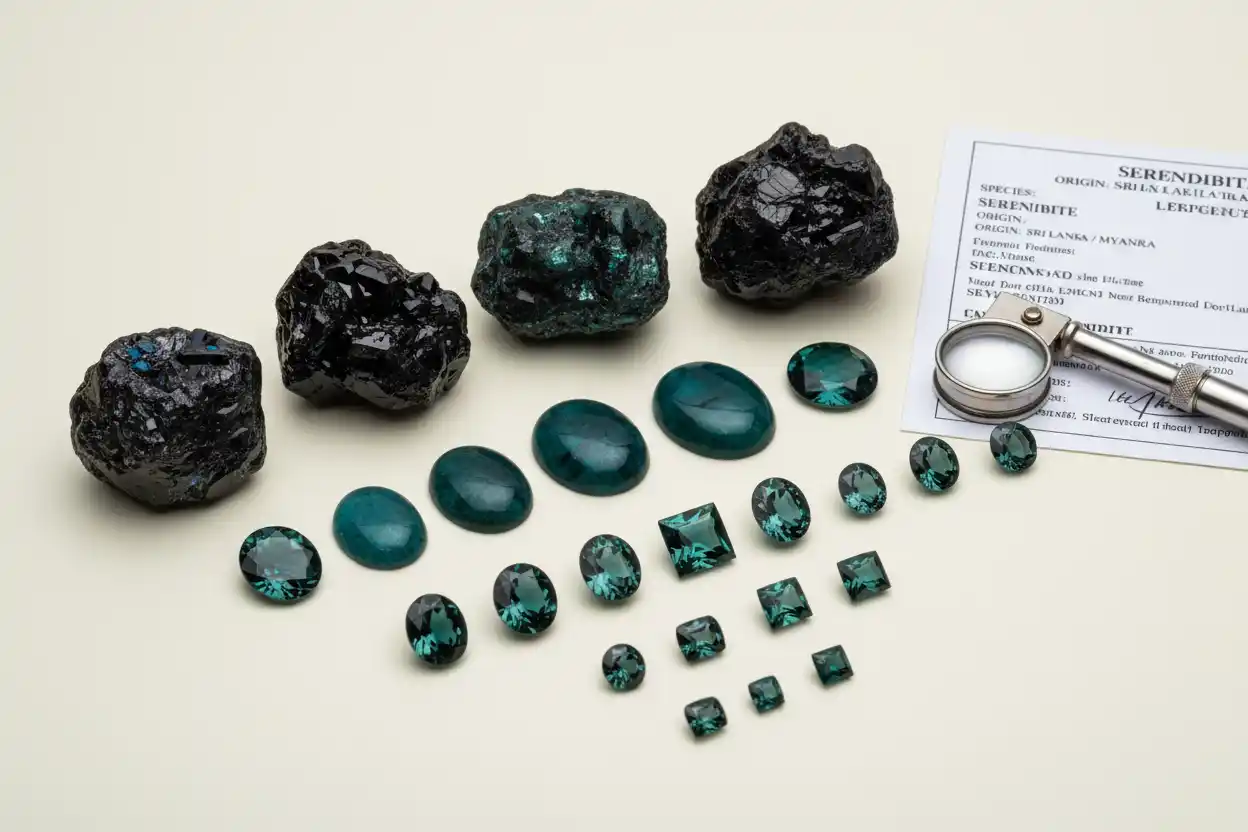
Serendibite Price Guide: Value and Cost in 2026
Serendibite prices in 2026 range from less than $20 per carat for ordinary opaque material to approximately $500 per carat for attractive transparent-to-translucent Myanmar stones. Exceptionally rare blue-green Sri Lankan gems with strong provenance can reach several thousand dollars per carat.
Older references sometimes repeat prices of $14,000, $18,000 or even millions of dollars per carat. Those figures relate to historically important specimens, exceptionally scarce early discoveries or unsupported rarity claims—not the majority of Serendibite currently offered for sale.
Serendibite Price per Carat in 2026
The following ranges reflect the fragmented specialist market for natural Serendibite. Prices vary substantially because opaque black stones, translucent Myanmar gems and rare blue-green Sri Lankan material are fundamentally different products.
| Serendibite quality | Typical characteristics | Approximate 2026 retail price |
|---|---|---|
| Entry specimen or opaque facet | Black, opaque, commercial cutting, weak polish or abundant fractures | $5–$50 per carat |
| Good opaque to translucent material | Dark blue-black or green-black, recognizable translucency and competent cutting | $50–$200 per carat |
| Transparent Myanmar Serendibite | Blue-black, greenish blue or dark green, useful transparency and limited inclusions | $200–$750 per carat |
| Fine transparent collector gem | Attractive blue-green color, high transparency, rare size and respected identification | $750–$3,000 per carat |
| Exceptional Sri Lankan or historically important material | Vivid greenish blue, major provenance, rare transparency and laboratory documentation | $3,000–$15,000+ per carat |
These ranges should be treated as market bands rather than formal appraisal grades. Serendibite has too few comparable transactions for one standardized price chart.
The broader relationship among rarity, appearance, demand and liquidity appears in How Gemstone Prices Are Determined.
Why Serendibite Price Claims Differ So Much
Serendibite developed its reputation when only a few gem-quality examples were known. Early Sri Lankan stones reportedly sold for approximately $14,000 per carat, creating a memorable headline that continues to appear in modern articles.
Later Myanmar discoveries introduced darker, more included and more affordable material. Some of these stones are opaque black, while others become blue-green or translucent under strong illumination.
As a result, a seller can accurately call a $100-per-carat stone Serendibite without contradicting the existence of a historically important gem worth thousands per carat.
The difference lies in quality, provenance and market category. Rare mineral identity alone does not make every example equally valuable.
What Is Serendibite?
Serendibite is a complex calcium-magnesium-aluminum borosilicate mineral.
It normally forms in high-grade metamorphic or contact-metamorphic environments where boron-rich fluids interact with carbonate rocks.
The mineral can occur in blue, greenish blue, gray-blue, dark green, black and occasionally lighter yellowish colors. However, most material is too opaque or included for conventional faceting.
The completed Serendibite guide owns its composition, geological formation, discovery history and symbolic traditions.
This article remains focused on commercial pricing rather than repeating the full mineral profile.
Transparency Creates the Largest Value Difference
Opaque black Serendibite is far more available than transparent blue-green material.
An opaque stone may be cut into a simple faceted shape because polished facets create visual interest, but it does not behave like a transparent gemstone. Its price commonly remains below $200 per carat.
Translucent stones allow light to enter around thin edges or through selected sections. They may show blue, green or violet undertones under strong illumination.
Transparent Serendibite is much scarcer. Fine examples transmit light through most of the body and can display brilliance, pleochroism and identifiable blue-green color.
A transparent half-carat gem may therefore cost more than a five-carat opaque stone.
Sellers should provide reflected-light and transmitted-light videos. Backlighting alone can make an opaque specimen appear much more transparent than it is during normal viewing.
Color and Serendibite Value
Fine gem Serendibite is traditionally associated with greenish blue, violetish blue and blue-green color.
The strongest premiums belong to stones whose color remains visible in ordinary reflected light. A nearly black gem that reveals blue only under a flashlight occupies a lower market.
Green and blue components can shift with viewing direction because Serendibite may show pleochroism.
Gray or brown modifiers reduce visual appeal, although they remain common in natural material.
The color hierarchy differs from Sapphire or Tourmaline because so few transparent Serendibites exist. A clean gray-blue gem may still be important even when its saturation is modest.
The broader visual categories appear in Blue Gemstones, Green Gemstones and Black Gemstones.
Sri Lankan Serendibite Prices
Serendibite was first identified from Sri Lanka, whose older name Serendib inspired the mineral’s name.
The early gem-quality Sri Lankan stones became famous for attractive greenish-blue or violetish-blue color. Only a very small number entered documented collections.
A verified transparent Sri Lankan Serendibite may command several thousand dollars per carat. Historically important examples with old provenance can reach much higher prices.
However, the Sri Lankan label should not be accepted without strong evidence. A blue-green stone offered online with only a seller-issued certificate may be Sapphirine, Zoisite, Tourmaline, Spinel or another lookalike.
Origin becomes meaningful only after the mineral identity has been established independently.
Myanmar Serendibite Prices
The Mogok region of Myanmar introduced a broader supply of gem and near-gem material.
Many Myanmar stones appear black or dark blue-black in ordinary light. Better examples show green, blue or violet around the edges and may be translucent or transparent.
Commercial opaque stones may cost less than $100 per carat. Cleaner translucent and transparent examples commonly enter the $200-to-$750-per-carat market.
Rare highly transparent Myanmar stones can cost more, particularly when they exceed one carat and carry dependable documentation.
The country name alone does not create the premium. Buyers should compare actual transparency, color, cutting and report quality.
North American and Other Serendibite Specimens
Serendibite occurs in New York, New Jersey, Canada, Madagascar, Tanzania and other metamorphic localities.
Most material from these regions belongs to the mineral-specimen market rather than the faceted-gem market.
A specimen may consist of blue or dark Serendibite associated with Phlogopite, Calcite, Spinel or other minerals. Its value depends on crystal exposure, matrix aesthetics, size, locality and provenance.
Large opaque specimens can cost only a few dollars per carat equivalent because mineral collectors price the complete object rather than the weight of the Serendibite alone.
An old collection label from a classic locality may add more value than cutting the material into an opaque faceted stone.
Serendibite Size Premiums
Size premiums depend on transparency.
| Example stone | Approximate price per carat | Approximate total price |
|---|---|---|
| 0.50 ct opaque black Serendibite | $10–$75 | $5–$38 |
| 1.00 ct translucent Myanmar stone | $75–$300 | $75–$300 |
| 0.50 ct transparent Myanmar gem | $250–$750 | $125–$375 |
| 1.00 ct fine transparent Serendibite | $750–$3,000 | $750–$3,000 |
| Exceptional blue-green Sri Lankan gem | $3,000–$15,000+ | Individually evaluated |
A three-carat semi-translucent stone can cost less than a clean half-carat gem.
Large transparent Serendibite deserves extensive verification because suitable rough is exceptionally uncommon. An implausibly large flawless stone offered cheaply is more likely to be misidentified than an extraordinary bargain.
Clarity and Inclusions
Most Serendibite contains fractures, mineral inclusions or opaque zones.
The market tolerates inclusions because facetable material is scarce. Nevertheless, a stone should transmit enough light to justify a transparent-gem premium.
Large fractures reduce value and create setting risk. Open fissures can collect dirt and become more visible after cleaning.
Dense black areas should be evaluated separately from dark body color. A stone may have an attractive blue-green body but appear black because of internal opacity.
Small natural inclusions can support identification, although Serendibite does not have one simple inclusion scene that consumers can use as a home test.
Cut Quality
Serendibite rough often has irregular transparent sections surrounded by opaque or fractured material.
Cutters may use cushions, rounds, ovals and freeform mixed cuts to preserve the usable area.
Weight retention can lead to deep pavilions or uneven outlines. Some compromise is understandable, but a large central window or completely inactive face should still lower value.
A transparent stone should show useful brilliance and color distribution. An opaque stone is valued more for polish, shape and collector identity than optical performance.
Dimensions should always be compared with carat weight. A deep stone may contain substantial hidden weight while presenting a small face-up area.
Detailed inspection belongs to the Serendibite Buying Guide.
Serendibite vs Sapphirine
Serendibite can resemble Sapphirine in blue, blue-green and dark gray colors.
Both minerals occur in high-grade metamorphic environments and may appear together in collector discussions.
Their refractive properties, optical character and chemistry differ, but ordinary photographs cannot establish the distinction.
A seller should not price a dark blue stone as Serendibite merely because it came from a metamorphic locality.
Advanced gemological testing is necessary when the identity affects value.
Serendibite vs Blue Spinel
Dark blue or blue-black Spinel can resemble Serendibite.
Spinel is singly refractive and belongs to a much broader commercial market. Serendibite is biaxial and has different chemistry and optical behavior.
Blue Spinel may be more valuable than opaque Serendibite when its color, transparency and provenance are superior.
The rarity of one mineral species does not automatically make it more commercially valuable than a beautiful gem from another species.
The planned Spinel Price Guide owns Spinel’s separate market.
Serendibite vs Grandidierite
Grandidierite is another rare borosilicate associated with blue-green and teal colors.
Its market contains inexpensive opaque cabochons as well as rare transparent faceted gems.
The Grandidierite Price Guide owns those separate tiers.
Transparent Grandidierite generally has a more established modern faceted market. Serendibite remains less familiar and can trade for lower prices despite its rarity.
Serendibite vs Musgravite and Painite
Musgravite and Painite are frequently grouped with Serendibite on rare-gem lists.
Fine Musgravite commonly commands much higher prices because verified transparent stones have an established specialist market. Current ranges appear in the Musgravite Price Guide.
Painite has both low-priced included material and extremely expensive transparent collector gems. Its market appears in the Painite Price Guide.
All three illustrate the limits of rarity rankings. Quality tier and liquidity matter more than the number assigned by an online list.
The site’s broader rarity overview appears in Rarest Gemstones in the World and Their Cost.
Is Serendibite Worth Millions per Carat?
Claims of $1.8 million or $2 million per carat are not supported by a broad, transparent transaction market.
Such figures are often repeated without a named stone, sale venue, date or laboratory report.
Historically important Sri Lankan gems have been associated with prices around $14,000 per carat. Even that figure should not be applied to ordinary Myanmar or opaque material.
A credible valuation should compare the stone with actual transparent, translucent or opaque examples in the same quality category.
The site’s Most Expensive Gemstones in the World article provides high-level context but should never replace a stone-specific appraisal.
Treatment and Synthetic Concerns
Routine heat, irradiation and filling are not central to the documented Serendibite market.
Misidentification presents the larger risk. Dark Spinel, Tourmaline, Sapphirine, glass and other materials may be sold under the rare name.
A seller’s statement that a stone is untreated does not confirm that it is Serendibite.
Laboratory-grown lookalikes can also imitate dark blue or green colors without having Serendibite’s chemistry.
The broader treatment framework appears in Gemstone Treatments Explained, although identity confirmation should take priority for this material.
Laboratory Certification Is Essential
Any meaningful transparent Serendibite purchase should have an independent laboratory report.
Useful testing may include:
- Refractive-index measurement
- Specific-gravity testing
- Polariscope examination
- Pleochroism observation
- Raman spectroscopy
- Chemical analysis
- Microscopic examination
The report should state natural Serendibite specifically. A document saying only rare gemstone, natural blue stone or borosilicate is inadequate.
The report number, dimensions and weight should match the actual gem.
The Gemstone Certification Labs comparison explains laboratory scope and report limitations.
Serendibite Jewelry Prices
Serendibite jewelry is uncommon. Most stones remain loose in specialist collections.
| Jewelry type | Broad specialist-market range |
|---|---|
| Silver pendant with opaque Serendibite | $75–$400 |
| Gold pendant with translucent material | $300–$1,500 |
| Ring with a small transparent Myanmar gem | $800–$5,000 |
| Fine documented blue-green collector jewel | $3,000–$25,000+ |
The setting may cost more than an ordinary opaque stone.
Transparent gems should be mounted so the report can still be associated with the stone. A protective design is advisable because replacement can be difficult.
Durability and Care
Serendibite has moderate hardness, but individual stones can contain fractures and vulnerable inclusions.
A collector gem should be protected from impact, sudden temperature changes and aggressive cleaning.
Warm water, mild soap and a soft cloth provide a cautious cleaning method. Steam and ultrasonic systems should be avoided for fractured stones.
Opaque mineral specimens may include softer associated minerals that require different care.
Professional inspection is advisable before setting or repairing a rare transparent gem.
Does Serendibite Hold Its Value?
Transparent, well-documented Serendibite has genuine specialist rarity.
However, its resale market is extremely small. Few buyers understand the mineral, and comparable transaction data is limited.
Opaque black stones have weaker resale potential because current supply is sufficient for a niche collector market.
The strongest position belongs to transparent blue-green gems with respected laboratory reports, old provenance and defensible purchase prices.
A rare stone can still take months or years to sell. The broader secondary-market framework appears in Do Gemstones Hold Their Value?.
Price Guide vs Buying Guide
This page owns Serendibite’s 2026 price tiers and separates ordinary opaque material from rare transparent gems.
The dedicated buying guide owns the inspection checklist, seller questions and report-verification process.
Online buyers should avoid listings based primarily on rarity rankings or unsupported million-dollar claims. The wider fraud-prevention process appears in How to Buy Gemstones Online Without Getting Scammed.
The Buying & Value hub connects Serendibite pricing with certification, rare-gem comparisons and resale guidance.
Frequently Asked Questions
1. How much is Serendibite worth per carat in 2026?
Opaque material may cost $5 to $200 per carat. Transparent Myanmar stones commonly range from approximately $200 to $750 per carat, while exceptional Sri Lankan gems can cost several thousand per carat.
2. Is Serendibite really worth $2 million per carat?
There is no broad transparent market supporting that figure. It is usually an unsupported online claim rather than a documented transaction price.
3. Why do some Serendibites cost only a few dollars?
Many current stones are opaque, black, included or commercially cut. Their quality differs fundamentally from rare transparent blue-green gems.
4. What Serendibite color is most valuable?
Transparent greenish blue, blue-green and violetish blue generally receive the strongest collector demand.
5. Is black Serendibite valuable?
It has mineral-collector value, but ordinary opaque black material usually costs far less than transparent Serendibite.
6. Is Myanmar Serendibite valuable?
Yes, particularly when it is transparent and visibly blue-green. Much Myanmar material is dark or opaque and occupies a lower tier.
7. Is Sri Lankan Serendibite more expensive?
Verified transparent Sri Lankan material can command a major provenance premium because documented gem-quality stones are exceptionally scarce.
8. How much is a one-carat Serendibite?
An opaque one-carat stone may cost below $200. A fine transparent gem can range from several hundred to several thousand dollars.
9. What gemstones resemble Serendibite?
Sapphirine, Spinel, Tourmaline, Zoisite, Grandidierite and dark glass can overlap visually.
10. Does Serendibite need a laboratory report?
Yes, when the stone is transparent, expensive or sold with a premium origin claim.
11. Does Serendibite hold its value?
Fine documented gems may retain specialist interest, but resale is slow because the buyer market is extremely small.
12. Is Serendibite a good investment?
It is a speculative collector purchase rather than a liquid investment. Identification, transparency and purchase price are critical.
Serendibite Value Depends on Which Market the Stone Belongs To
Serendibite’s reputation was built by a handful of rare blue-green gems, but the modern market also contains affordable opaque and dark Myanmar material. Applying the price of one category to another creates misleading valuations.
In 2026, ordinary stones commonly cost below $200 per carat, while transparent gems occupy a market ranging from several hundred to several thousand dollars per carat. The strongest premium belongs to independently identified material whose color and transparency remain visible without artificial backlighting.