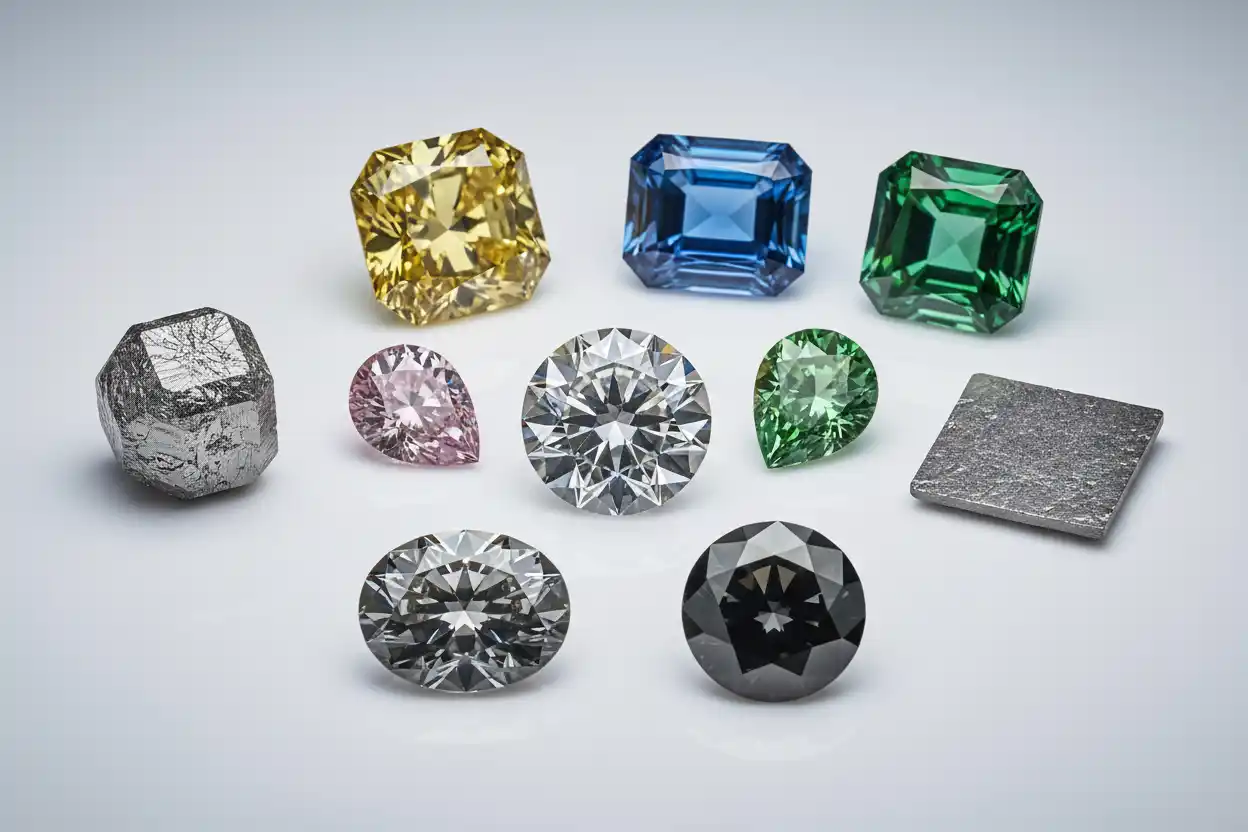
Types of Lab Diamond: Colors and Varieties Explained
Laboratory-grown diamonds are crystalline carbon produced in controlled manufacturing systems rather than mined from geological deposits. They have diamond’s fundamental chemical composition, crystal structure, hardness, refractive index, dispersion, and thermal conductivity, but their growth history differs from that of natural diamond.
The principal types of lab diamond are defined by growth method, atomic impurity class, as-grown or post-growth-treated condition, body color, inclusion pattern, and whether the material is a single-crystal gem or an industrial polycrystalline product. The main lab diamond meaning and properties guide covers the broader material, while this article separates those technical and commercial categories.
Lab Diamond at a Glance
| Property | Laboratory-Grown Diamond |
|---|---|
| Composition | Carbon, C |
| Material group | Laboratory-grown crystalline diamond |
| Main colors | Colorless, near-colorless, yellow, orange, brown, pink, red, purple, blue, green, gray, and black |
| Crystal system | Cubic |
| Typical habit | Cuboctahedral or modified HPHT crystals; tabular CVD layers; cut single crystals; polycrystalline plates and films |
| Luster | Adamantine |
| Transparency | Transparent to opaque |
| Mohs hardness | 10 |
| Cleavage | Perfect octahedral cleavage |
| Tenacity | Brittle despite extreme hardness |
| Common uses | Engagement rings, fine jewelry, watch components, cutting tools, heat spreaders, optics, electronics, detectors, and quantum technology |
| Main care concern | Cleavage and chipping, undisclosed growth origin, post-growth color treatment, misleading reports, and rapidly changing market value |
Lab Diamond Is Diamond, but Its Origin Is Different
A laboratory-grown diamond is not cubic zirconia, glass, moissanite, synthetic spinel, or another diamond simulant.
Its atoms are arranged in the same diamond lattice as natural crystalline carbon. Therefore, it receives the same hardness and basic optical properties.
The difference lies in origin. Natural diamonds formed in Earth’s mantle or, more rarely, through other geological processes. Laboratory-grown diamonds develop on a diamond seed inside manufacturing equipment over days or weeks.
That distinction is explained in the broader lab-grown versus natural gemstones guide. The parent diamond guide covers the mineral species, while the types of diamond guide focuses primarily on natural structural and color varieties.
HPHT-Grown Diamonds
HPHT stands for high pressure, high temperature.
The process recreates the pressure-and-temperature conditions under which diamond is stable. A small diamond seed sits with a carbon source and metallic catalyst or solvent inside a press.
As the system reaches extreme conditions, carbon dissolves in the molten metal and crystallizes onto the seed. The resulting rough commonly develops cuboctahedral or mixed cube-octahedron forms rather than the simple octahedra associated with much natural rough.
HPHT manufacturers can produce colorless, near-colorless, yellow, orange, blue, and other colors. Growth chemistry strongly affects nitrogen, boron, metallic inclusions, fluorescence, and electrical conductivity.
Early gem-quality HPHT products were often yellow-orange because isolated nitrogen entered the lattice. Modern process control now produces substantial quantities of colorless and near-colorless material.
CVD-Grown Diamonds
CVD stands for chemical vapor deposition.
A thin diamond seed plate enters a low-pressure chamber containing carbon-bearing gas, commonly methane mixed with hydrogen. Microwave or another energy source creates a plasma that breaks the gas into reactive components.
Carbon atoms settle onto the seed and build diamond layer by layer. CVD rough therefore tends to grow as tabular plates rather than thick cuboctahedral crystals.
As-grown CVD material may contain brown, gray, or uneven color related to vacancies, strain, non-diamond carbon, and growth defects. Manufacturers often apply HPHT treatment after growth to reduce brown coloration and improve appearance.
CVD production allows close control of purity, isotopic composition, thickness, and electronic properties. Consequently, the method supports jewelry as well as advanced technological applications.
Hybrid or Post-Treated CVD Diamonds
A CVD-grown diamond may undergo HPHT processing after growth.
This does not convert it into an HPHT-grown diamond. Its original growth method remains CVD, while the later process is a post-growth treatment.
HPHT treatment can reduce brown or gray appearance, modify defects, improve color, or help create fancy hues. Irradiation and annealing may provide additional color changes.
Reports should distinguish growth method from post-growth treatment. A properly disclosed description may therefore read “CVD-grown, with indications of post-growth treatment.”
As-Grown Lab Diamonds
An as-grown diamond has not received a deliberate post-growth color modification after crystal growth.
The term does not mean the stone is automatically colorless, untreated in every manufacturing sense, or superior. Growth conditions themselves are engineered, and cutting and polishing still follow.
As-grown HPHT material may be yellow, orange, blue, brown, or near-colorless depending on impurities. CVD material can emerge colorless, near-colorless, brown, gray, or with visible growth-related zoning.
Some buyers prefer as-grown material because its final color reflects the growth run rather than a later treatment. Others prioritize beauty and price regardless of post-growth processing.
Post-Growth-Treated Lab Diamonds
Post-growth treatment is common enough that it deserves separate disclosure.
HPHT processing can improve colorless appearance or alter fancy color. Irradiation creates vacancy-related colors, and controlled annealing changes how those defects combine with nitrogen or other lattice features.
Pink, red, purple, green, blue, yellow, and orange laboratory-grown diamonds may involve one or several treatment stages.
Treatment does not make the stone cease to be diamond. However, growth method and treatment history should appear on an appropriate laboratory report.
The dedicated treated or synthetic diamond guide retains the deeper detection intent, while the gemstone treatments guide explains general enhancement terminology.
Type IIa Lab Diamonds
Diamond type describes measurable atomic impurities rather than growth origin.
Type IIa diamonds contain no detectable nitrogen or boron in conventional infrared classification. Many high-quality colorless CVD diamonds fall into this category.
Modern HPHT growth can also produce Type IIa material. Therefore, Type IIa does not prove a diamond is natural or CVD-grown.
Although chemically pure Type IIa material can be highly colorless, lattice strain, vacancies, or non-diamond carbon may still create brown or gray tones.
Type Ib Lab Diamonds
Type Ib diamonds contain isolated nitrogen atoms.
This structure commonly produces yellow, orange-yellow, or brownish yellow color. Early HPHT-grown gem diamonds frequently belonged to Type Ib.
Manufacturers can control nitrogen concentration to produce intentional fancy yellow colors. Strongly saturated stones may resemble natural canary diamonds, but laboratory testing reveals their growth origin.
Type IIb Lab Diamonds
Type IIb diamonds contain boron.
Boron can produce blue, gray-blue, or blue-green color and may make the diamond electrically conductive. Fancy blue HPHT-grown diamonds were among the earliest commercially important colored laboratory-grown products.
Colorless or near-colorless HPHT diamonds can also contain very small amounts of boron without appearing strongly blue.
Type IIb classification does not prove natural origin because both natural and laboratory-grown blue diamonds may contain boron.
Type Ia Lab Diamonds
Type Ia structure involves aggregated nitrogen.
It dominates natural diamonds but is less common in newly grown laboratory material because nitrogen does not have geological time to aggregate naturally.
However, treatment, unusual growth conditions, or complex manufacturing histories may produce features that do not fit a simple consumer-level Type Ib or Type IIa label.
Diamond type belongs to advanced spectroscopy and should not be inferred from color alone.
Colorless Lab Diamonds
Colorless and near-colorless stones represent the largest part of today’s lab-diamond jewelry market.
Cut quality has a greater visible effect than small differences among high color and clarity categories. A poorly cut colorless diamond can appear dull despite excellent material purity, while a well-cut near-colorless stone can look bright and white.
Colorless lab diamonds are available in rounds, ovals, cushions, radiants, emerald cuts, pears, marquises, hearts, Asschers, and specialty shapes.
GIA currently uses a separate Quality Assessment for colorless-to-near-colorless laboratory-grown diamonds, classifying qualifying stones as Premium or Standard rather than applying the full natural-diamond nomenclature. Other laboratories may continue to use conventional letter and clarity grades.
Near-Colorless and Warm Lab Diamonds
Near-colorless lab diamonds may show slight yellow, brown, gray, or blue undertones.
Subtle warmth can result from nitrogen, vacancies, strain, boron, or combinations of defects. Some near-colorless stones look whiter in yellow or rose gold than in platinum.
Grayness can reduce brightness when it appears as a uniform body color, whereas a faint warm tone may be difficult to detect once mounted.
Buyer preference should take precedence over pursuing a nominal grade that is invisible in the final jewelry.
Yellow Lab Diamonds
Yellow lab diamonds are commonly associated with nitrogen.
HPHT growth can deliberately incorporate isolated nitrogen to create pale yellow, canary, golden, orange-yellow, and deep fancy colors. CVD-grown yellow stones also exist, including material modified through post-growth treatment.
Strong saturation can make yellow laboratory-grown diamonds visually comparable to rare natural fancy-color stones at a small fraction of the price.
Radiant and cushion cuts commonly intensify color. Round brilliants may appear lighter because their facet design disperses body color.
Yellow symbolism and color comparisons belong in the lab diamond color meaning guide.
Orange and Brown Lab Diamonds
Orange lab diamonds may combine nitrogen-related absorption with vacancies and treatment-induced defects.
Colors range from peach and yellow-orange to saturated tangerine and reddish orange. Pure orange is less common than yellow-orange or brownish orange.
Brown CVD material can result from lattice strain, vacancies, and growth-related defects. HPHT treatment frequently reduces unwanted brown coloration, although some manufacturers preserve or intentionally produce champagne and cognac tones.
Brown and orange stones provide lower-cost alternatives to natural fancy colors, but treatment and growth method should still be disclosed.
Blue Lab Diamonds
Boron-bearing HPHT diamonds commonly produce blue.
Colors range from pale ice blue and gray-blue to saturated teal and vivid blue. Some stones display a slight gray or green modifier.
Irradiation may also create blue or blue-green color in HPHT- or CVD-grown diamonds. Consequently, two visually similar blue stones can have different growth and treatment histories.
A laboratory report should establish that the stone is lab-grown and identify detectable post-growth treatment. Visual color alone cannot reveal whether boron or irradiation dominates.
Pink, Red, and Purple Lab Diamonds
Pink lab diamonds often receive their color through irradiation and annealing, sometimes after CVD or HPHT growth.
The treatment creates or modifies vacancy-related defects that interact with nitrogen. Different processes produce blush pink, rose, hot pink, orangy pink, purplish pink, red, or violet.
Strong red remains more difficult to produce than ordinary pink, but lab-grown red diamonds are still far more available than natural red diamonds.
Coatings can also create pink or purple surfaces on diamond or simulants. An independent report helps separate internal diamond color from a surface-applied film.
Green Lab Diamonds
Green laboratory-grown diamonds may derive color from irradiation, growth defects, nickel-related features, hydrogen-related defects, or combinations of treatment and impurities.
Shades include yellow-green, blue-green, emerald green, olive, and gray-green.
Some green stones show uneven color concentration or sector zoning. Cutters may orient the rough to improve face-up distribution.
Because natural and artificially irradiated green diamond color can be difficult to interpret, growth-origin and treatment reporting remain important even when the stone is already disclosed as laboratory-grown.
Gray Lab Diamonds
Gray color may relate to boron, vacancies, metallic inclusions, strain, graphitic features, or post-growth treatment.
Some gray lab diamonds appear silvery and translucent, while others look smoky, blue-gray, or nearly black.
Gray stones have become popular in alternative engagement-ring designs because they can retain diamond brilliance while displaying a less conventional neutral color.
The term salt-and-pepper may be applied when visible black and white inclusions contribute to the appearance, though it remains a commercial description rather than a formal grade.
Black Lab Diamonds
Black lab diamonds are opaque or nearly opaque.
Dense graphitic inclusions, non-diamond carbon, fractures, irradiation, or additional treatment can create the black appearance. Some material begins as heavily included diamond that is darkened intentionally.
Black laboratory-grown diamond should still be distinguished from black cubic zirconia, moissanite, spinel, glass, and ceramic.
The stone’s carbon structure gives it diamond hardness, but heavy inclusions and fractures may reduce toughness.
Single-Crystal Gem Lab Diamonds
Fine jewelry uses single-crystal laboratory-grown diamonds.
A single crystal provides consistent optical behavior and can be faceted with the same general shapes and proportions used for natural diamond.
Gem quality requires adequate transparency, manageable strain, favorable color, and inclusions that do not threaten cutting or durability.
Large single crystals are increasingly available, but producing thick clean rough remains more demanding than producing small melee.
Lab-Grown Diamond Melee
Melee refers to small polished diamonds used as accents, pavé, halos, side stones, and continuous lines.
Laboratory growth is especially efficient for small stones. As a result, lab-grown melee can reduce the cost of heavily set jewelry.
Mixed parcels create identification challenges because natural, HPHT-grown, CVD-grown, and simulant stones may be similar in size. Professional screening equipment is essential for manufacturers and jewelers.
Polycrystalline and Industrial Lab Diamond
Not every laboratory-grown diamond is a facetable single crystal.
Polycrystalline diamond consists of many small diamond grains bonded together. It is widely used in cutting tools, drill bits, abrasives, wear-resistant coatings, and high-pressure equipment.
CVD diamond films and plates support optics, heat management, electronics, radiation detection, electrochemistry, quantum sensors, and high-power devices.
Industrial material may be transparent, translucent, gray, black, or opaque depending on grain size and impurities. It is genuine diamond but not necessarily suitable for jewelry.
HPHT Inclusions and Growth Features
HPHT-grown diamonds may contain metallic flux inclusions from iron, nickel, cobalt, or related catalyst systems.
These inclusions can appear dark, metallic, reflective, or irregular. Some create weak magnetic response, although magnetism is not a reliable consumer test.
Growth zoning can follow cubic and octahedral sectors. Fluorescence imaging may reveal cross-shaped or geometric patterns unlike common natural-diamond growth.
Modern high-quality material can be extremely clean, so the absence of visible metallic inclusions does not prove natural origin.
CVD Inclusions and Growth Features
CVD diamonds may contain pinpoint graphite, non-diamond carbon, growth layers, strain lines, brown graining, or small cavities associated with interrupted growth.
Parallel bands can reflect layer-by-layer deposition. Manufacturers may stop, clean, and restart a growth run, creating distinct interfaces.
Post-growth HPHT treatment can reduce some visible coloration while preserving spectroscopic evidence of CVD origin.
Basic microscopy may raise suspicion, but advanced spectroscopy and fluorescence imaging provide the strongest separation.
Identification and Laboratory Reports
Standard diamond testers can confirm diamond-like thermal conductivity, but they cannot reliably determine natural versus laboratory-grown origin.
Moissanite testers, electrical-conductivity tools, ultraviolet imaging, photoluminescence spectroscopy, infrared spectroscopy, and specialized screening instruments provide additional evidence.
A reputable report should state laboratory-grown origin clearly. Depending on the laboratory and service, it may also identify HPHT or CVD growth, post-growth treatment, color, clarity, measurements, finish, and inscription.
The gemstone certification guide explains what reports establish, while real versus fake diamond owns the consumer-level simulant comparison.
Lab Diamond Versus Moissanite and Cubic Zirconia
Moissanite is silicon carbide, while cubic zirconia is stabilized zirconium dioxide.
Both can imitate diamond, but neither has diamond’s carbon composition or exact physical properties.
Moissanite is doubly refractive, strongly dispersive, and approximately 9.25 in hardness. Cubic zirconia is denser, softer, and usually displays stronger rainbow fire with less sharp white brilliance.
The focused lab diamond versus moissanite guide owns the direct two-stone comparison. A broader three-way analysis appears in moissanite versus diamond versus lab diamond, while types of cubic zirconia covers CZ colors and manufacturing.
Cutting Behavior
Lab diamonds are cut with the same specialized tools and principles used for natural diamond.
Extreme hardness requires diamond-coated or diamond-bearing equipment. Directional hardness allows one diamond surface to polish another when the lap and facet are oriented correctly.
HPHT rough may offer cube, octahedral, or cuboctahedral growth sectors. CVD plates can favor shallower shapes, elongated cuts, or several smaller stones rather than one deep round.
Cut planning balances weight, clarity, color, growth striations, strain, and market demand. Fancy-color stones may be cut to intensify saturation, while colorless stones prioritize brightness, fire, and symmetry.
Durability and Jewelry Suitability
Laboratory-grown diamond has Mohs hardness 10, the same as natural diamond. The gemstone hardness chart therefore places it above other mainstream jewelry stones.
However, diamond has perfect octahedral cleavage and can chip. A hard blow at the girdle, culet, or pointed corner can cause damage.
The gemstone cleavage guide explains why princess, marquise, pear, and heart shapes need protected points.
Structurally sound lab diamonds suit rings, earrings, bracelets, and necklaces. A lab diamond engagement ring can withstand daily wear when the cut and setting protect vulnerable areas.
Lab Diamond Prices in 2026
Laboratory-grown diamond prices remain highly competitive and change faster than prices for many natural gemstones.
As a broad July 2026 retail range, a one-carat colorless or near-colorless loose stone may cost approximately $300–$1,200, depending on cut, shape, quality, report, retailer, and brand. Current market averages for popular round stones commonly fall around the middle of that range.
Two-carat stones often retail around $700–$2,500, while three-carat stones commonly range from approximately $1,100–$4,000. Exceptional cutting, high-end branding, specialty shapes, or matching pairs can exceed those figures.
Fancy-color lab diamonds vary widely. Pale or commercial colors may cost similarly to colorless material, while vivid pink, red, blue, or green stones can carry premiums for manufacturing complexity and demand.
Resale value is usually limited because production efficiency continues to improve and new stones enter the market at lower costs. The dedicated lab diamond price guide should retain detailed and frequently updated price tables.
Natural and manufactured diamond prices should not be compared solely by carat. The separate diamond price guide owns natural-market valuation.
Buying Guidance
Prioritize cut, face-up appearance, report reliability, and total budget.
A lab diamond’s low material price does not correct poor proportions. Excessively deep stones look small for their carat weight, while shallow stones may leak light.
Confirm the growth origin, report number, laser inscription, post-growth treatment, exact dimensions, and return policy. For fancy colors, review hue, saturation, tone, distribution, and color stability.
GIA’s current Premium and Standard assessment applies its own criteria to qualifying colorless-to-near-colorless lab diamonds. Other laboratories may use conventional color and clarity scales, so reports from different organizations should not be treated as identical.
The dedicated lab diamond buying guide retains the full quality checklist. General online-purchase safeguards appear in how to buy gemstones online.
Environmental and Ethical Claims
Laboratory growth avoids conventional diamond mining, but that does not make every lab diamond automatically low-impact.
Energy demand differs according to growth method, equipment efficiency, electricity source, production yield, location, and post-growth treatment. A coal-powered factory and a renewable-energy facility can have very different emissions.
Working conditions, supply-chain transparency, polishing location, and metal sourcing also affect a finished jewel’s wider impact.
Buyers seeking environmental evidence should request specific audited data rather than relying on broad phrases such as eco-friendly, conflict-free, or sustainable.
Cleaning and Storage
Clean lab diamond jewelry with lukewarm water, mild soap, and a soft brush. Oil and lotion adhere to diamond readily, so brushing the pavilion and underside of the setting restores brilliance.
Rinse carefully and dry with a lint-free cloth. Inspect prongs and shared pavé settings before cleaning.
Many untreated and securely mounted lab diamonds tolerate ultrasonic cleaning, but fractures, loose settings, coatings, fillers, and delicate designs create exceptions. The complete process belongs in how to clean lab diamond jewelry.
Store diamond jewelry separately because diamonds can scratch one another as well as almost every other gemstone.
Meaning and Symbolism
Lab diamonds commonly carry the same modern symbolism as natural diamonds: commitment, endurance, clarity, celebration, and partnership.
Some wearers also associate laboratory growth with innovation, technology, accessible luxury, or the freedom to select a larger stone without a natural-rarity premium.
Fancy colors add contemporary interpretations. Pink may represent affection, blue composure, green renewal, yellow optimism, and black independence.
Lab diamond is also connected with diamond’s place as the traditional April birthstone, although its manufactured origin gives it a distinct personal and commercial story.
These associations are cultural or personal rather than scientifically demonstrated effects of crystalline carbon.
Frequently Asked Questions
1. What are the two main types of lab diamond?
The two principal gem-growth types are HPHT-grown and CVD-grown diamond.
2. Is a lab diamond chemically the same as a natural diamond?
Yes. Both are crystalline carbon with the diamond structure, although their growth histories and diagnostic features differ.
3. Is CVD diamond better than HPHT diamond?
Neither method is inherently better. Cut, color, clarity, treatment, strain, inclusions, price, and individual appearance matter more than the growth label alone.
4. Can a CVD diamond receive HPHT treatment?
Yes. HPHT processing is commonly used after CVD growth to reduce brown coloration or modify defects.
5. What type are most colorless lab diamonds?
Many colorless CVD and modern HPHT diamonds are Type IIa, but type classification alone does not establish growth method or quality.
6. What causes yellow lab diamonds?
Isolated nitrogen atoms commonly create yellow or orange-yellow color, particularly in Type Ib HPHT-grown material.
7. What causes blue lab diamonds?
Boron commonly produces blue HPHT-grown diamonds, while irradiation can also create blue or blue-green colors.
8. Are pink lab diamonds usually treated?
Many pink, red, and purple lab diamonds receive irradiation and annealing or another post-growth color process, although manufacturing histories vary.
9. Can a standard diamond tester identify a lab diamond?
A basic tester may confirm that a stone is diamond, but specialized equipment or laboratory analysis is needed to determine natural versus laboratory-grown origin.
10. Does GIA grade lab diamonds with the natural-diamond scales?
GIA now uses Premium or Standard quality assessments for qualifying colorless-to-near-colorless lab diamonds. Its colored lab-diamond services provide different reporting information.
11. Do lab diamonds retain resale value?
Resale is usually limited because new production remains abundant and retail prices have fallen substantially as manufacturing has improved.
12. Are lab diamonds suitable for daily-wear engagement rings?
Yes. Their hardness and fundamental durability equal natural diamond, although cleavage, setting quality, pointed corners, and existing inclusions still affect damage risk.
Lab-diamond types reveal two different layers of classification: HPHT and CVD explain how the crystal grew, while atomic impurities, treatment, and cutting explain how the finished stone looks. A colorless Type IIa CVD round, boron-blue HPHT radiant, irradiated pink cushion, and graphitic black diamond remain crystalline carbon, yet their manufacturing histories and market behavior differ. Related L entries appear in the crystals that start with L directory and the gemstones that start with L guide.