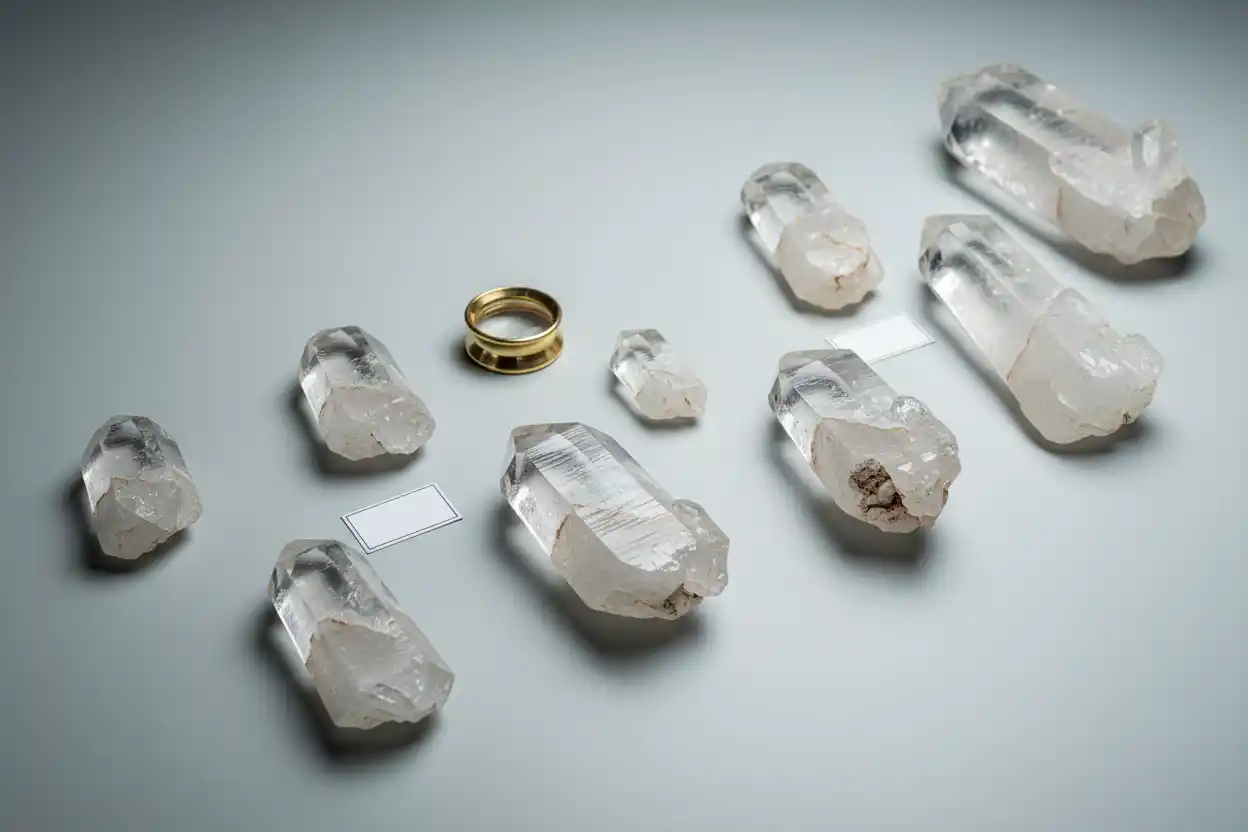
Where to Buy Real Lemurian Quartz and Avoid Engraved Fakes
Lemurian Quartz is a modern trade name applied to selected natural quartz points, commonly those with pronounced horizontal striations, alternating surface textures and an elongated crystal form.
It is not an approved mineral species, a unique chemical variety or a scientifically recognized crystal from a lost civilization. Mineralogically, it is quartz.
Therefore, buying “real” Lemurian Quartz means verifying that the object is natural quartz, that its crystal surfaces and striations formed naturally rather than through carving, and that the seller describes locality, polishing and treatment honestly. It does not mean proving metaphysical claims about Lemuria.
The Lemurian Quartz meaning and properties guide covers the trade name and associated spiritual traditions. This guide focuses on natural-versus-synthetic quartz, genuine growth features, engraving, repairs, locality claims and commercial grading.
Lemurian Quartz Is a Trade-Named Form of Quartz
Lemurian Seed Crystal and Lemurian Quartz are commercial synonyms for quartz rather than separate mineral identities.
The quartz family guide covers quartz mineralogy, while the clear quartz guide addresses ordinary colorless rock crystal.
The types of clear quartz guide separates natural crystal habits, included forms, trade-named varieties and growth features.
A seller may use the Lemurian name descriptively when the crystal has the morphology expected in that market. However, the label should not create the impression that standard quartz testing can prove an ancient cultural origin.
Which Features Are Commonly Marketed as Lemurian?
Retail descriptions commonly emphasize:
- Strong horizontal striations across one or more prism faces
- Alternating smoother and more deeply textured faces
- A tapered or elongated natural crystal point
- Frosted, etched or lightly weathered surface areas
- Relatively clear or milky internal structure
- A natural unpolished base
- Occasional pink, smoky or pale golden color
- Individual points rather than dense clusters
None of these features belongs exclusively to “Lemurian” quartz. Natural quartz from several localities can display horizontal growth striations, etching and varied face texture.
Therefore, morphology can support the trade description without proving a unique mineral type.
Horizontal Striations Are Natural Quartz Growth Features
Natural quartz prism faces commonly develop horizontal growth lines perpendicular to the crystal’s long axis.
These striations can be shallow, deep, continuous or interrupted. One face may show pronounced lines while the neighboring face looks smoother.
Striations can result from changing growth conditions as the crystal develops. They are not writing, barcodes or evidence of human-made records embedded in the mineral.
Artificial engraving can imitate the appearance. Consequently, buyers should examine how the lines interact with crystal edges, chips and natural surface texture.
Choose the Product Form Before Shopping
| Product form | Best source | Main buying concern |
|---|---|---|
| Natural single point | Specialist quartz or mineral dealer | Natural faces, termination, locality and repair |
| Frosted or etched point | Mineral dealer | Natural etching versus acid or mechanical alteration |
| Pink Lemurian Quartz | Included-quartz specialist | Natural color, coating and iron-related surface staining |
| Smoky Lemurian Quartz | Quartz dealer | Irradiation, heat and trade-name stacking |
| Polished Lemurian tower | Requires clear disclosure | Natural quartz versus carved shape and artificial lines |
| Cluster | Mineral dealer | Whether the form fits the trade usage and whether points were glued |
| Pendant | Independent maker | Drilling, glue, repaired tip and source |
| Bulk parcel | Established wholesaler | Mixed ordinary quartz, grading and unsupported origin claims |
| Collector locality specimen | Dealer with original labels | Precise source, natural preparation and provenance |
| Synthetic display crystal | Scientific or educational supplier | Full synthetic disclosure rather than Lemurian marketing |
Natural single points remain the clearest form for evaluating the trade-name features.
Where to Buy Genuine Natural Lemurian-Type Quartz
Specialist mineral dealers
A mineral dealer should identify the object first as natural quartz and second as Lemurian trade material.
Request the country, region or mine and the basis for that claim. Original labels and supplier records are more useful than spiritual certificates.
Ask whether any face was polished, acid-cleaned, mechanically etched or engraved.
A reputable dealer should also disclose repaired terminations and glued bases.
Quartz specialists
Dealers who handle Phantom Quartz, Garden Quartz, Rutilated Quartz and other natural quartz forms often understand crystal surfaces better than general gift retailers.
They should distinguish natural growth striations from cutting marks and explain whether frostiness comes from growth, natural dissolution or later preparation.
Gem and mineral shows
Shows allow you to compare trade-labeled Lemurian points with ordinary natural quartz, polished towers, glass and synthetic quartz.
Use a loupe to inspect prism faces and terminations. Natural surface texture should show subtle irregularity rather than mechanically identical grooves.
Examine the base. An unpolished broken attachment can support natural crystal growth, while a flat sawed base indicates lapidary preparation.
Do not scratch the crystal. The crystal identification guide explains safer methods based on morphology, inclusions and gemological testing.
Established online sellers
The online gemstone buying guide covers protected payment methods, seller identity and returns.
Request exact-item photographs of every prism face, the termination and base. One side photograph cannot establish natural striations.
Ask for neutral-light video. Strong side lighting can exaggerate shallow scratches until they resemble deep growth lines.
The seller should identify any digital sharpening used in the images.
Independent jewelry makers
A maker may drill, wrap or cap natural Lemurian-type points.
Ask whether the point was natural before mounting and whether adhesive fills a damaged termination or base.
For a premium pendant, request photographs of the loose crystal before metalwork.
What Natural Lemurian-Type Quartz Looks Like
The host quartz may be transparent, translucent, milky or internally veiled.
Prism faces commonly show horizontal striations at different depths. Some lines continue across most of a face, while others fade or terminate against growth irregularities.
Natural terminations may be sharp, contacted, etched or slightly chipped. Perfect symmetry is not required.
Frosted faces can occur beside clear glossy faces. However, the alternating-face story frequently used in marketing should not be treated as a strict identification rule.
Internal features can include fluid inclusions, healed fractures, veils, mineral inclusions and cloudy growth zones.
A flawless crystal can still be natural. Conversely, visible inclusions do not prove that the external striations remain untouched.
Natural Growth Lines Versus Artificial Engraving
Artificially engraved lines often appear excessively straight, evenly spaced and equally deep.
A cutting tool may leave parallel scratches that continue across natural chips or stop abruptly before an edge.
Under magnification, engraved grooves can contain polishing residue and sharp fresh edges. Natural growth lines usually integrate more gradually into the crystal surface.
However, surface appearance alone can be ambiguous. Sandblasting, acid etching and weathering can complicate the comparison.
Ask whether the seller or supplier modified the faces. A natural quartz point with decorative engraving is still quartz, but it should not be sold as an untouched natural Lemurian crystal.
Natural Point Versus Polished Tower
A natural point grew with its existing termination faces and prism surfaces.
A polished tower was cut and shaped from natural or synthetic quartz. It commonly has a flat base, symmetrical sides and a newly formed point.
The crystal-points guide explains the terminology for natural, polished and carved points.
Some sellers engrave horizontal grooves into a polished tower and market it as Lemurian Quartz. The underlying material may be real quartz, yet the defining surface feature is artificial.
A listing should state “carved natural-quartz tower with Lemurian-style grooves” rather than implying natural crystal growth.
Natural Quartz Versus Hydrothermal Synthetic Quartz
Synthetic quartz is grown in laboratories through hydrothermal processes.
It has the same essential SiO2 composition and crystal structure as natural quartz. Therefore, a basic test confirming quartz does not prove natural origin.
Synthetic crystals may contain seed-plate remnants, characteristic growth structures or diagnostic inclusions. Nevertheless, both natural and synthetic quartz can be very clean, making some specimens difficult to separate.
The treated or synthetic Clear Quartz guide owns the detailed identification process.
For expensive, unusually flawless or large crystals, an independent laboratory may use microscopy and infrared spectroscopy.
Natural Quartz Versus Glass
Glass can be molded or cut into elongated points and engraved with horizontal lines.
Round bubbles, flow lines, mold seams and a uniform amorphous body can support glass identification.
Natural quartz may contain gas bubbles within fluid inclusions, so bubbles should be evaluated within their complete internal structure.
The real-versus-fake Clear Quartz guide covers the detailed diagnostic workflow. The completed guide to buying genuine Clear Quartz owns the broader seller and product-form market.
Pink Lemurian Quartz
Pink Lemurian Quartz is a commercial name applied to pale pink quartz points, often with surface staining or iron-related inclusions.
The color may be internal, surface-focused or associated with fine coatings and inclusions. It is not automatically the same material as massive Rose Quartz.
Ask whether the pink color is natural, coated, dyed or digitally enhanced. Inspect chipped areas and crystal bases for color continuity.
A vivid neon-pink surface deserves particular caution.
Smoky Lemurian Quartz
Smoky Lemurian Quartz combines the Lemurian trade morphology with smoky quartz color.
Natural smoky color can form through irradiation-related color centers. Artificial irradiation can also deepen quartz.
A seller should disclose known treatment rather than using the Lemurian name to imply that the smoky color must be natural.
The article should not duplicate the wider smoky-quartz buying market; instead, verify natural crystal surfaces and color separately.
Lemurian Quartz Versus Phantom Quartz
Phantom Quartz contains visible outlines of previous growth stages within a later quartz crystal.
A Lemurian-type point can contain a phantom, but horizontal surface striations do not create a phantom.
The planned guide to buying real Phantom Quartz owns internal growth-outline authenticity.
Sellers should avoid stacking trade names simply to increase perceived rarity when the relevant feature is absent.
Lemurian Quartz Versus Lithium Quartz
Lithium Quartz is an ill-defined commercial term generally applied to quartz associated with lithium-bearing minerals or colored by fine inclusions.
It does not become Lemurian merely because it is pink, lavender or striated.
The next dedicated guide to buying Lithium Quartz will own lithium-content claims, mineral inclusions and laboratory verification.
Coatings, Aura Treatment and Dye
Clear quartz can receive metallic aura coatings, colored films, dye and fracture-filling material.
A metallic coating may settle into natural striations and make them more visible. The crystal remains quartz but no longer has an untreated natural surface.
Dye can enter fractures and produce pink, blue, purple or golden color.
Inspect the base, chipped edges and high-wear points for a change in color or luster.
The gemstone treatments guide explains coating, dye, filling and irradiation.
Repaired Tips and Glued Bases
Quartz terminations can break during mining, cleaning and shipping.
A broken tip may be polished into a new termination or reattached with clear adhesive. Both alterations should be disclosed.
Loose points can also be glued into artificial clusters or mounted on fabricated matrix.
Inspect the base for glossy filler, bubbles and geometric sockets. A repaired original point differs from a fully reconstructed cluster, but each affects value.
How to Evaluate a Natural Point
Prism faces
Compare all faces rather than focusing on one strongly striated side. Natural texture should remain consistent with the crystal’s growth.
Striations
Look for horizontal lines with natural variation in depth, spacing and continuity.
Termination
Inspect for complete growth faces, contact areas, chips, polishing and adhesive.
Base
An irregular attachment or break can support natural crystal form. A flat saw cut indicates preparation.
Internal features
Fluid inclusions, veils and mineral grains can support natural origin, though their absence does not prove synthesis.
Surface treatment
Check for coating, acid frosting, mechanical engraving and polishing compound.
Locality
Request source records. Striations cannot prove a specific mine or country.
Buying Bulk Parcels
Bulk Lemurian parcels often combine several grades of ordinary natural quartz.
Ask whether every point meets a stated morphological standard or whether the name applies to the shipment as a whole.
Request random-sample photographs rather than the best crystal in the parcel.
Determine the percentage of broken tips, polished points, coated crystals and low-grade fragments.
A grading system should address size, condition, clarity and surface features rather than metaphysical strength.
Buying Jewelry
Natural points can make attractive pendants and earrings. However, sharp terminations and drilled holes remain vulnerable.
Quartz has Mohs hardness 7, but internal fractures can reduce toughness. The gemstone hardness chart and toughness-versus-hardness guide explain that distinction.
Ask whether the point is drilled, glued or capped. Adhesive should not conceal a broken termination.
Rings with exposed natural points are impractical for frequent wear.
Price and Value
Ordinary natural quartz is abundant. Therefore, a Lemurian label should not create a large premium by itself.
Value should reflect:
- Attractive natural striations
- Intact termination
- Natural surface preservation
- Clarity or interesting inclusions
- Size
- Aesthetic proportions
- Documented locality
- Minimal repair
- Unusual natural color
- Historical or collection provenance
A modest natural point with excellent surfaces may be more defensible than a large polished tower accompanied by unverifiable spiritual certification.
The gemstone pricing guide explains how rarity, evidence, condition and retail storytelling influence price.
Questions to Ask the Seller
Ask whether Lemurian Quartz is being used as a trade name for natural quartz.
Request the locality and the basis for that claim. Confirm whether the point is naturally terminated, partly polished or fully carved.
Ask whether the lines are natural growth striations, acid etching or mechanical engraving.
Request disclosure of coating, dye, irradiation, filling, glue and repair.
Obtain close-ups of every face, termination and base. Finally, ensure the return policy allows magnified and gemological inspection.
Professional Identification
Standard gemological testing can confirm quartz and separate it from most glass and resin.
Microscopy can reveal natural inclusions, seed plates, synthetic growth features, coatings, engraving and adhesive.
Infrared spectroscopy may help distinguish natural from hydrothermal synthetic quartz, although some specimens remain challenging.
No laboratory test can prove that a crystal came from the legendary civilization of Lemuria. Reports should address mineral identity, natural origin, treatment and observable morphology only.
Cleaning and Storage
Clean sound untreated quartz with lukewarm water, mild soap and a soft cloth.
Avoid prolonged soaking when glue, filler, coating or open fractures are present. Do not use steam or ultrasonic equipment on repaired points or clusters.
Store individual points separately so their terminations cannot strike one another.
Avoid polishing natural faces unless restoration is necessary, since original surface texture contributes to the trade-name appeal.
Frequently Asked Questions
1. Is Lemurian Quartz a recognized mineral species?
No. It is a trade name for selected natural quartz crystals.
2. What makes quartz “Lemurian” in the market?
Retailers usually emphasize pronounced horizontal striations, elongated points, frosted surfaces and alternating face texture.
3. Do horizontal lines prove a crystal is Lemurian?
No. Horizontal growth striations occur naturally on ordinary quartz from many localities.
4. Can Lemurian lines be engraved?
Yes. Mechanical cutting, sandblasting and acid treatment can imitate or exaggerate natural surface lines.
5. Is a polished Lemurian tower natural?
The quartz may be natural, but the tower shape and any carved grooves were manufactured.
6. Is Lemurian Quartz different from Clear Quartz?
Mineralogically, no. Lemurian Quartz is clear or lightly colored quartz selected under a trade-name morphology.
7. Can Lemurian Quartz be synthetic?
Hydrothermal synthetic quartz can be shaped or marketed under the name, so natural origin should be verified separately.
8. Does a flawless crystal prove synthetic growth?
No. Natural quartz can be exceptionally clear, while synthetic quartz can contain visible features.
9. Is Pink Lemurian Quartz always naturally colored?
No. Pink color may come from natural inclusions or staining, but dye, coating and image editing are also possible.
10. Can Lemurian points be repaired?
Yes. Broken tips may be polished or reattached, and loose points can be glued into clusters. Repairs should be disclosed.
11. Do ordinary points need laboratory reports?
Usually not. Reports are more useful for expensive, unusually flawless, synthetic-origin or treatment disputes.
12. What is the biggest warning sign in a listing?
Be cautious when an expensive crystal has perfectly uniform machine-like lines, a flat cut base and no disclosure of polishing, engraving or locality.
Buy Natural Quartz Features, Not an Unverifiable Legend
Lemurian Quartz can be appreciated as natural rock crystal with attractive surface growth. Its commercial value should come from mineral quality, condition and provenance rather than claims no laboratory can test.
The L crystal directory, L gemstone directory and visual gemstone guide provide wider quartz context. Choose the point whose natural surfaces remain convincing without relying on a mystical certificate.
Safety note: Quartz contains crystalline silica. Cutting, engraving, drilling, sanding or grinding can generate hazardous respirable silica dust. Never dry-work quartz; use professional wet methods, effective local extraction and suitable respiratory and eye protection.