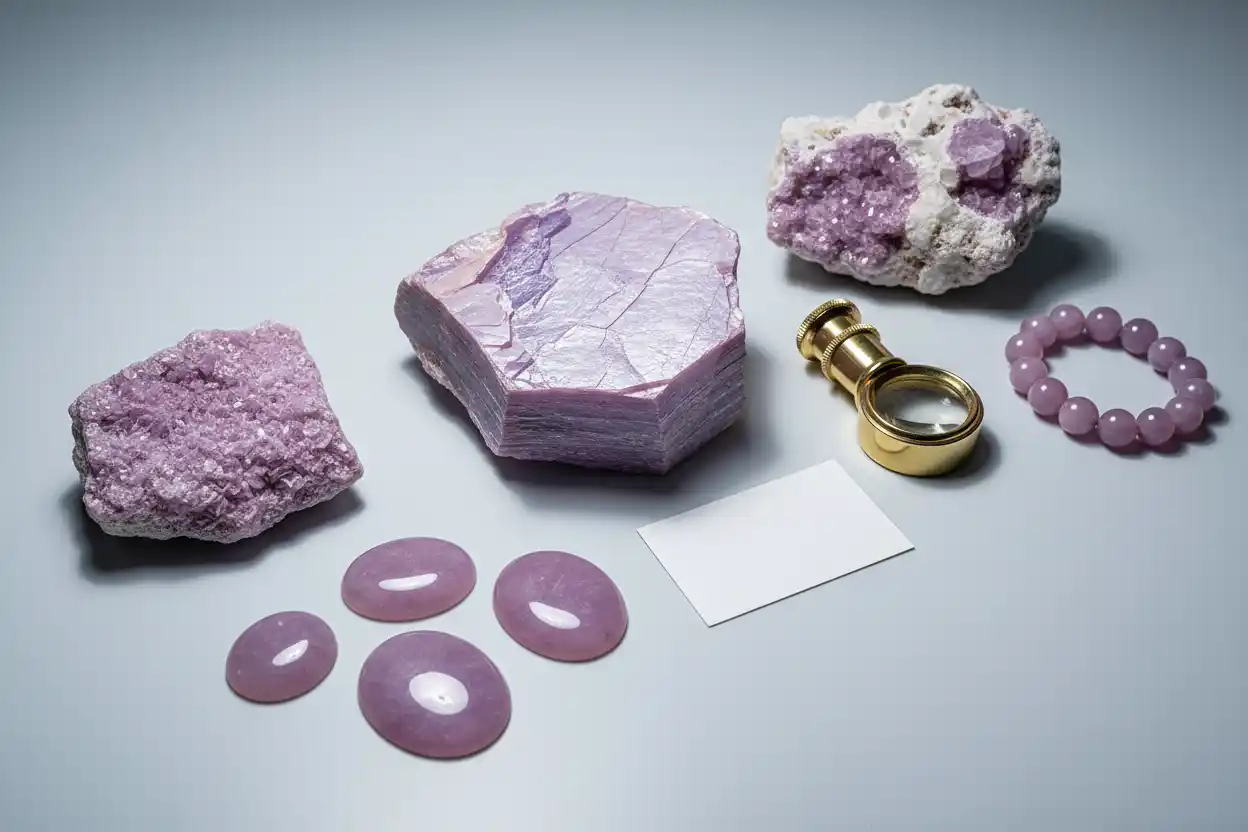
Where to Buy Real Lepidolite and Avoid Dyed Purple Fakes
Real Lepidolite is a lithium-rich mica material commonly found in lilac, lavender, pink, rose-purple, gray or silvery masses. It may form thin platy crystals, stacked mica “books,” granular aggregates or mixed pegmatite rock with quartz, feldspar and Tourmaline.
Modern mineralogy treats Lepidolite as a field or group name for lithium-rich micas rather than one precisely defined mineral species. Much material falls within or near the Polylithionite–Trilithionite compositional series, although exact specimens may contain other lithium micas or Muscovite-related phases.
Consequently, a polished purple stone sold as Lepidolite may not consist entirely of one mica. It may be Lepidolite-rich pegmatite, Lepidolite in quartz, resin-stabilized mica or a multi-mineral decorative rock.
The Lepidolite meaning and properties guide covers its identity and traditional symbolism. This buying guide focuses on mineral terminology, seller selection, mica texture, lithium claims, treatments, lookalikes and realistic durability.
Lepidolite Is a Lithium-Rich Mica Field Name
Lepidolite belongs to the broader mica group, whose members share a layered sheet-silicate structure and perfect basal cleavage.
Rather than identifying one universally fixed formula, the name Lepidolite commonly covers pink, lilac or light-colored lithium-rich mica compositions near the Polylithionite–Trilithionite series.
This distinction matters when a seller claims an exact lithium percentage, mineral formula or species without laboratory analysis.
A careful listing can state:
“Natural Lepidolite-rich mica aggregate”
“Lepidolite with quartz and albite”
“Lithium-mica specimen sold under the traditional Lepidolite name”
The name remains useful in the gem and mining trades, but scientific precision requires compositional testing.
Where Lepidolite Forms
Lepidolite commonly forms in evolved granitic pegmatites enriched in lithium and other uncommon elements.
These pegmatites may also contain:
- Quartz
- Albite and other feldspars
- Muscovite
- Tourmaline
- Kunzite and other spodumene varieties
- Beryl
- Pollucite
- Amblygonite or Montebrasite
- Tantalum-bearing minerals
Therefore, mixed specimens and polished rocks are normal. A seller should not describe every pale grain as Lepidolite merely because purple mica appears somewhere in the piece.
Choose the Product Form First
| Lepidolite product | Best source | Main buying concern |
|---|---|---|
| Mica book or crystal specimen | Specialist mineral dealer | Species certainty, cleavage damage and locality |
| Granular rough | Pegmatite or lapidary supplier | Quartz and feldspar content, resin and usable yield |
| Matrix specimen | Mineral dealer | Correct identification of associated minerals |
| Slab | Lapidary supplier | Mica undercutting, fractures and stabilization |
| Cabochon | Independent cutter | Mixed composition, polish, backing and resin |
| Tumbled stone | Reputable crystal retailer | Dyed quartzite, purple glass and featureless resin |
| Bead strand | Established bead supplier | Polymer, dye and drill-hole delamination |
| Sphere or tower | Experienced carving retailer | Composite construction and weak mica seams |
| Pendant | Jeweler familiar with soft mica-rich rock | Backing, glue and limited wear durability |
| Lithium-ore sample | Geological supplier | Actual analysis rather than color-based lithium claims |
Collector crystals and polished decorative products need different quality standards.
Where to Buy Genuine Lepidolite
Specialist mineral dealers
A mineral dealer is the strongest source for natural mica books, pegmatite specimens and documented localities.
Listings should state whether “Lepidolite” is a field identification or supported by Raman, X-ray or chemical analysis.
Request photographs of the base, edges and associated minerals. Thin plates can split during extraction and shipping.
Ask whether the specimen was consolidated with resin. Fragile mica aggregates may require stabilization, but treatment affects collector value.
Lapidary suppliers
Lapidary suppliers should describe how much Lepidolite the rough contains and which minerals form the remaining matrix.
Request dry sawn-face photographs. Water and oil deepen lavender color and temporarily reduce the visibility of fractures.
A reliable seller should show test cabochons from the same parcel. Mica-rich material often undercuts during polishing because thin plates pull away more easily than quartz or feldspar.
Ask whether resin impregnation was necessary before cutting.
Gem and mineral shows
Shows allow direct comparison with purple Fluorite, Amethyst, Charoite, Phosphosiderite, Sugilite, dyed quartzite and resin.
Use a loupe to look for thin platy mica reflections, layered cleavage and variations between purple mica and pale matrix.
Do not peel, scratch or split the material. Mica cleavage is easy to damage, and loose flakes may detach permanently.
Established online stores
The online gemstone buying guide covers seller identity, payment protection and returns.
Request exact-item photographs and moving-light video. Mica plates should produce irregular pearly or silvery reflections as the piece rotates.
Ask whether saturation was increased. Pale gray-lilac material can become intense purple after heavy editing.
For polished objects, request the back and edges to check whether the purple layer continues through the stone.
Independent cutters and jewelers
A cutter may know whether the material contained enough quartz or feldspar to remain structurally sound.
Ask whether the cabochon is solid Lepidolite-rich rock, backed material or resin composite.
For a closed setting, request photographs before mounting. Dark backing can intensify lavender color and hide weak areas.
What Genuine Lepidolite Looks Like
Natural Lepidolite most commonly appears lilac, lavender, pink, rose-purple, grayish purple or silvery.
However, lithium-rich mica can also be nearly white, gray, yellowish or color-zoned. Purple color alone does not define the material.
Mica crystals show perfect basal cleavage, allowing them to separate into thin flexible or brittle sheets. Large plates can display pearly, vitreous or silvery reflections.
Granular Lepidolite can resemble sparkling sugar-like crystals or dense fine mica distributed through a pegmatite.
Polished stones commonly contain white quartz, cream feldspar, darker Tourmaline, silvery Muscovite or other minerals.
Natural color and texture should vary through the object. A perfectly uniform purple body with evenly distributed glitter may indicate resin or manufactured material.
Mica Books and Crystal Specimens
A mica “book” consists of many stacked sheets resembling pages.
Fine Lepidolite books may show well-developed outlines, pearly surfaces and strong lilac color. Their edges remain delicate.
Inspect for crushed corners, missing sheets, repaired bases and coating. A loose sheet can detach after minor handling.
Do not lift a specimen by one mica plate. Support it from the matrix or base.
A rare large crystal with an exact species claim may justify laboratory analysis because visual appearance cannot reliably separate every lithium mica.
Lepidolite-Rich Rock Versus Pure Mica
Most spheres, towers, beads and cabochons are not cut from one flawless mica crystal.
Instead, they commonly use a rock containing Lepidolite with quartz, albite, Muscovite and other pegmatite minerals.
That mixed composition often improves practical durability. Quartz-rich material may take a better polish than a soft flaky mica aggregate.
The seller should describe the construction honestly rather than claiming that every pale or white area is “high-grade solid Lepidolite.”
A multi-mineral rock can be genuine and attractive without being pure.
Lepidolite Versus Muscovite
Muscovite is a common potassium-aluminum mica that is typically colorless, silver, pale yellow, greenish or light brown.
Lithium-rich Lepidolite can grade compositionally toward related mica phases, and a specimen may contain both.
Purple color supports Lepidolite but does not prove it. Iron staining, inclusions or coatings can alter Muscovite’s appearance.
Raman spectroscopy and chemical analysis provide better separation than visual inspection.
Lepidolite Versus Amethyst
Amethyst is purple quartz with Mohs hardness 7 and no mica-like basal cleavage.
Lepidolite is softer, layered and commonly sparkles through platy reflections rather than transparent quartz brilliance.
Amethyst may occur near mica-bearing pegmatites or be mixed intentionally into decorative products. A purple polished stone can therefore contain more than one material.
The real-versus-fake Amethyst guide owns glass, synthetic quartz and heat-treatment identification.
Lepidolite Versus Purple Fluorite
Purple Fluorite is calcium fluoride with cubic structure and perfect octahedral cleavage.
Fluorite can be transparent or strongly banded, while Lepidolite is usually platy, granular or embedded in pegmatite matrix.
A polished sphere may hide those structures. Refractive testing, Raman spectroscopy or X-ray diffraction provides stronger identification.
The future guide to buying genuine Purple Fluorite owns dye, irradiation and glass issues within that separate mineral market.
Lepidolite Versus Charoite
Charoite is a complex purple silicate rock known for swirling, fibrous and feather-like patterns.
Lepidolite generally displays granular or platy mica reflections rather than Charoite’s flowing fibrous structures.
The completed guide to buying genuine Charoite covers Russian provenance, imitations and polymer treatment.
A generic purple carving should not receive either name without structural evidence.
Lepidolite Versus Kunzite
Kunzite is pink-to-purple gem spodumene. It forms transparent prismatic crystals and can be faceted.
Lepidolite is a mica material with layered cleavage and much lower practical durability.
Both occur in lithium-rich pegmatites, so natural association specimens can contain both.
A seller should identify whether a pink transparent crystal is Kunzite, Tourmaline or another mineral rather than calling every lithium-bearing purple object Lepidolite.
Lepidolite Versus Lithium Quartz
Lithium Quartz is an imprecise commercial term often applied to quartz colored by fine pink, purple or red inclusions believed to involve lithium-bearing minerals.
The host in Lithium Quartz is quartz. In Lepidolite, lithium-rich mica forms the principal named material.
The next guide to buying real Lithium Quartz will own laboratory lithium claims and quartz-host identification.
A seller should not use the names interchangeably solely because both products contain purple coloration and the word lithium.
Dyed Quartzite and Pale Mica Rock
Pale quartzite, quartz-rich pegmatite or ordinary mica-bearing rock can be dyed purple.
Artificial color may gather along fractures, grain boundaries, cleavage and drill holes.
Inspect chipped edges and sawn surfaces. A white or gray interior beneath an intense purple surface supports dye.
However, natural Lepidolite color can be uneven and concentrated in selected mica grains. Several observations and seller disclosure should be combined.
Purple Glass and Resin
Purple glass can imitate cabochons, beads and tumbled stones. Round bubbles, flow lines and mold seams support glass.
Resin can contain mica glitter, stone powder and pigment. It may reproduce Lepidolite’s sparkle more convincingly than plain glass.
Mold marks, soft scratches, repeated patterns and uniform glitter distribution support polymer construction.
The fake-crystal buyer’s guide provides broader glass and resin checks.
Resin Stabilization and Impregnation
Mica-rich material can be fragile, porous and difficult to polish. Resin impregnation may bind loose plates and strengthen cabochons, beads or carvings.
A stabilized piece can be practical, but treatment should be disclosed.
Under magnification, resin may fill spaces between mica grains, contain bubbles or show a different surface reflection.
Some objects contain so much binder that they should be described as composites rather than lightly stabilized rock.
The gemstone treatments guide explains that distinction.
Coatings, Wax and Oil
Wax and oil can deepen purple color and improve temporary luster.
Clear coatings may prevent mica flakes from shedding. Colored lacquer can also intensify lavender or pink tones.
Inspect high points, drill holes and worn edges for a change in gloss or color.
A protective surface coating can be reasonable for a decorative object, but it affects cleaning and value.
How to Evaluate Rough
Request dry photographs of natural and sawn surfaces.
Determine how much of the block consists of Lepidolite-rich mica versus quartz, feldspar and other components.
Mica-rich seams can split or undercut. Quartz-rich zones may provide greater strength but reduce the overall purple appearance.
Ask whether test cabochons polished successfully and whether resin was needed.
Large fractures and crumbly edges reduce usable yield substantially.
How to Evaluate Slabs
Compare both faces and the edges. Purple mica should continue through the slab rather than remain as surface dye.
Tilt the slab under one light to evaluate platy reflections.
Inspect for resin-filled cracks, loose mica pockets and areas where soft material has undercut below harder quartz grains.
A quality slab should offer enough structurally sound material for intentional cuts.
How to Judge Cabochons
A successful cabochon balances color, sparkle, mixed-mineral pattern and structural stability.
The polish may not look as glassy as quartz because mica plates reflect and undercut differently.
Inspect the girdle for loose flakes. A mica-rich edge can chip during setting.
Ask whether the back is reinforced, coated or glued to another stone. Backing can be practical but must be disclosed.
Buying Beads and Bracelets
Drill holes are the weakest part of many Lepidolite beads.
Inspect for radial fractures, resin and loose layers. A hole passing through mica-rich material may enlarge or flake over time.
Natural strands should show variation in purple color, pale matrix and reflective texture.
Perfectly identical purple beads with uniform glitter can indicate resin, glass or reconstructed material.
Buying Spheres, Towers and Carvings
Request a full rotation. One side may show strong purple mica while the reverse consists mainly of pale quartz or feldspar.
A sphere should have no straight joining seam or resin-rich cavity hidden beneath its stand.
Most towers are carved. Lepidolite does not naturally form polished six-sided points in the way quartz does.
Carvings should avoid thin projections and sharp edges. Layered mica can split along detailed features.
Buying Lepidolite Jewelry
Lepidolite-rich material is best suited to pendants, earrings and occasional-wear pieces.
Rings and bracelets face greater impact, abrasion and water exposure. A protective bezel can support a cabochon, but setting pressure must remain low around mica-rich edges.
The gemstone hardness chart provides scratch-resistance context. The gemstone toughness-versus-hardness guide explains why layered cleavage and multi-mineral construction matter.
Ask whether resin, backing or glue stabilizes the stone.
Locality and Provenance
Lepidolite occurs in lithium-rich pegmatites in Brazil, the United States, Canada, Madagascar, Zimbabwe, Namibia, Afghanistan, Pakistan, Russia and other regions.
Brazil and Madagascar supply substantial commercial lapidary material, while historic North American pegmatites have produced important collector specimens.
Color and texture cannot prove a country or mine. Request labels, importer information or direct supplier records when origin affects price.
The ethical gemstone sourcing guide provides practical questions about pegmatite mining, lithium extraction, specimen recovery and cutting labor.
Lithium Content and Misleading Claims
Lepidolite is genuinely lithium-bearing, and lithium-rich micas can serve as lithium ore minerals.
However, purple color does not reveal the lithium percentage. Exact content varies with composition and associated minerals.
A polished stone should not be marketed as a lithium supplement, medical treatment or source of absorbable dietary lithium.
Likewise, the presence of Lepidolite in a quartz-rich rock does not mean the entire object consists of high-grade lithium ore.
Laboratory chemical analysis is necessary when lithium concentration affects the purchase.
Price and Value
Common Lepidolite-rich rough and tumbled stones are affordable.
Value increases with:
- Attractive lilac or pink color
- Well-developed mica books
- Strong pearly luster
- Large intact crystals
- Appealing mixed pegmatite associations
- Stable cutting material
- Good polish
- Limited undisclosed resin
- Documented locality
- Rare or aesthetically important mineral associations
A bright purple sphere can be inexpensive if most of its strength comes from resin. Conversely, a delicate natural mica book may cost more because preserving it during extraction is difficult.
The gemstone pricing guide explains how rarity, treatment, cutting yield and craftsmanship influence price.
Questions to Ask the Seller
Ask whether Lepidolite is being used as a field name for lithium-rich mica and whether testing supports a more precise species identification.
Request the locality and associated minerals.
Confirm whether the product is solid mica, Lepidolite-rich pegmatite, quartz with Lepidolite or a resin composite.
Ask about dye, coating, wax, oil, impregnation, filling, backing and glue.
For rough and slabs, request dry face and edge photographs. For beads, request drill-hole close-ups. For spheres and carvings, obtain a complete rotation.
Finally, obtain a return policy that permits professional identification.
Professional Identification
Raman spectroscopy and X-ray diffraction can identify mica phases and distinguish Lepidolite-rich material from quartz, Fluorite, glass and other purple stones.
Chemical analysis is necessary to quantify lithium and separate closely related lithium micas reliably.
Petrographic microscopy can reveal quartz, feldspar, Tourmaline and other minerals within a multi-mineral rock.
Infrared spectroscopy may detect resin. Several test points are necessary because one reading cannot characterize an entire pegmatite object.
Cleaning and Storage
Use a soft dry cloth for routine cleaning. When necessary, use a barely damp cloth and dry the piece promptly.
Avoid prolonged soaking, steam and ultrasonic cleaning. Water can enter cleavage, loosen mica plates or affect resin and glue.
The crystal water-safety guide provides broader exposure guidance, but dry care remains the safest default for mica-rich Lepidolite.
Store specimens flat or supported from the base. Keep polished stones away from harder quartz, Topaz and corundum.
Frequently Asked Questions
1. Is Lepidolite a recognized mineral species?
Modern mineralogy generally uses Lepidolite as a field name for lithium-rich micas near the Polylithionite–Trilithionite series rather than one precise species.
2. Is Lepidolite always purple?
No. It may be lilac, pink, rose, gray, silver, white or yellowish.
3. What makes Lepidolite sparkle?
Its layered mica structure creates pearly or silvery reflections from thin cleavage plates.
4. Does every polished Lepidolite stone consist of pure mica?
No. Most durable cabochons, spheres and carvings contain Lepidolite with quartz, feldspar and other pegmatite minerals.
5. Is Lepidolite the same as Lithium Quartz?
No. Lepidolite is lithium-rich mica, while Lithium Quartz is a commercial quartz material associated with fine inclusions or lithium-bearing minerals.
6. Is Lepidolite the same as Kunzite?
No. Kunzite is pink-to-purple spodumene, while Lepidolite is a mica material.
7. Can Lepidolite be dyed?
Yes. Pale mica-bearing rock, quartzite and other materials can be dyed purple.
8. Can Lepidolite contain resin?
Yes. Fragile mica-rich material is sometimes impregnated or bound with resin for polishing and carving.
9. Does purple color prove high lithium content?
No. Exact lithium content requires chemical analysis and cannot be determined from color alone.
10. Is Lepidolite suitable for everyday rings?
Generally, no. Layered cleavage, softness and mica-rich edges make exposed daily rings vulnerable.
11. Do ordinary tumbled stones need laboratory reports?
Usually not. Testing becomes more useful for expensive crystals, exact species claims, lithium percentages or suspected composites.
12. What is the biggest warning sign in a listing?
Be cautious when a uniformly purple glittery object is called pure high-lithium Lepidolite but the seller provides no grain texture, treatment disclosure or compositional evidence.
Buy the Mica-Rich Material the Seller Can Describe Accurately
Lepidolite’s value does not depend on pretending that every commercial object is one pure mineral. Natural pegmatite mixtures can be attractive, durable enough for careful lapidary use and scientifically honest.
The L crystal directory, L gemstone directory, purple gemstones guide and pink gemstones guide provide wider comparison points. Choose the piece whose mica identity, associated minerals and stabilization are disclosed clearly.
Safety note: Lepidolite is a lithium-bearing silicate material, not a dietary or medical lithium source. Do not ingest it or place it in drinking water. Cutting, drilling, sanding or grinding can create hazardous mineral dust; use professional wet methods, effective extraction and suitable respiratory and eye protection.