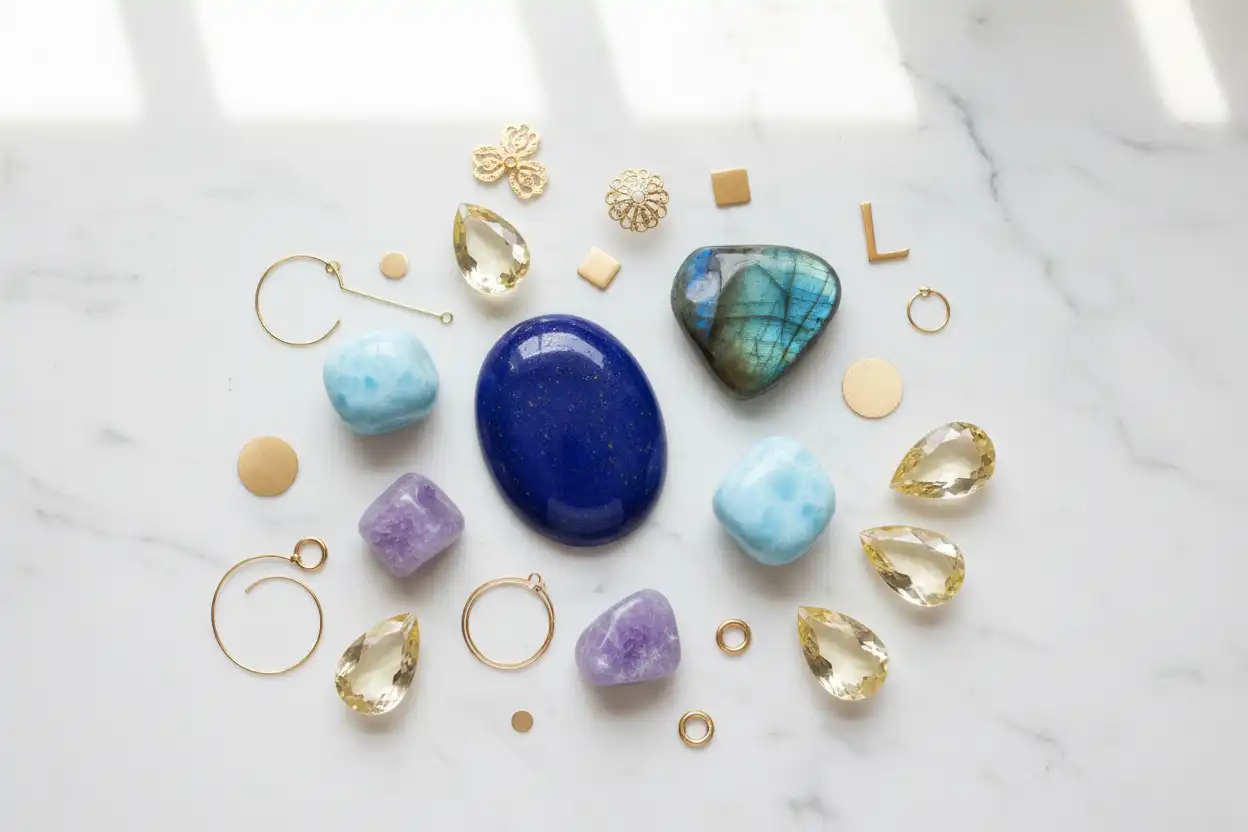
Gemstones That Start With L: A–Z Guide
Gemstones and gem materials that start with L include lab diamond, lab emerald, lab ruby, lab sapphire, labradorite, lapis lazuli, larimar, larvikite, lava stone, lazulite, lemon quartz, Lemurian quartz, lepidolite, Libyan desert glass, lithium quartz and London blue topaz.
The L directory includes laboratory-grown gemstones, natural minerals, ornamental rocks, quartz varieties, mica and natural impact glass.
Traditional gemstone meanings are symbolic associations rather than scientifically proven medical effects.
Continue from Gemstones That Start With K. For specimen-focused information, explore Crystals That Start With L.
L Gemstones at a Glance
| Gemstone or material | Typical appearance | Material type | Common use |
|---|---|---|---|
| Lab Diamond | Colorless or fancy-colored | Laboratory-grown diamond | Rings and fine jewelry |
| Lab Emerald | Transparent green | Laboratory-grown beryl | Rings, earrings and pendants |
| Lab Ruby | Red to purplish red | Laboratory-grown corundum | Fine jewelry |
| Lab Sapphire | Blue or numerous other colors | Laboratory-grown corundum | Rings and everyday jewelry |
| Labradorite | Gray feldspar with colorful flashes | Feldspar mineral | Cabochons and beads |
| Lapis Lazuli | Deep blue with white or gold-colored markings | Multi-mineral rock | Beads, carvings and cabochons |
| Larimar | Pale blue and white | Pectolite variety | Pendants, earrings and cabochons |
| Larvikite | Dark rock with blue-silver flashes | Igneous rock | Beads and polished slabs |
| Lava Stone | Porous black or brown rock | Volcanic rock | Beads and casual jewelry |
| Lazulite | Deep blue to blue-green | Phosphate mineral | Collector gems |
| Lemon Quartz | Pale yellow to greenish yellow | Quartz variety | Faceted jewelry |
| Lemurian Quartz | Clear quartz with horizontal striations | Trade-named quartz | Natural-crystal jewelry |
| Lepidolite | Pink, lilac, purple or silver | Lithium-bearing mica | Cabochons and decorative pieces |
| Libyan Desert Glass | Pale yellow to golden natural glass | Impact-related natural glass | Pendants and collector jewelry |
| Lithium Quartz | Quartz with pink, purple or gray inclusions | Trade-named included quartz | Cabochons and polished stones |
| London Blue Topaz | Deep grayish or inky blue | Treated topaz | Faceted jewelry |
Lab Diamond
A lab diamond is crystalline carbon grown in a controlled environment.
It has the same fundamental composition and crystal structure as a mined diamond and should not be confused with simulants such as cubic zirconia or moissanite.
Lab diamonds may be:
- Colorless.
- Yellow.
- Pink.
- Blue.
- Brown.
- Black or treated fancy colors.
They are traditionally associated with commitment, clarity and modern innovation.
Lab diamonds are suitable for everyday rings, earrings and bracelets. Their origin should be disclosed clearly, and significant purchases should include an independent grading report.
The differences between manufactured and mined gems are covered in Lab-Grown vs. Natural Gemstones.
Lab Emerald
Lab emerald is laboratory-grown green beryl created to reproduce the composition and optical properties of natural emerald.
Its colors range from:
- Pale green.
- Medium green.
- Bluish green.
- Deep saturated green.
Lab emerald is traditionally associated with renewal, wisdom and thoughtful relationships.
Different growth methods can leave characteristic internal features. Lab-created material may still contain inclusions or fractures and should not automatically be treated as flawless or indestructible.
It is suitable for rings, earrings and pendants when the setting protects vulnerable edges.
Lab Ruby
Lab ruby is laboratory-grown red corundum.
Its red color is commonly produced by chromium, as it is in natural ruby.
Lab ruby is traditionally associated with:
- Courage.
- Motivation.
- Confidence.
- Commitment.
- Personal vitality.
It offers excellent scratch resistance and works well in everyday jewelry.
Several production methods exist, and each may create different growth lines, inclusions or color patterns. Sellers should describe the stone as laboratory-grown rather than mined.
Lab Sapphire
Lab sapphire is laboratory-grown corundum available in blue and many other colors.
These include:
- Pink.
- Yellow.
- Green.
- Purple.
- White.
- Orange.
- Color-changing varieties.
Lab sapphire is traditionally associated with discipline, loyalty and clear judgment.
Its hardness makes it suitable for engagement rings and other frequently worn jewelry.
Color origin, manufacturing method and any additional treatments should be disclosed. A laboratory report may be worthwhile for expensive or unusually large stones.
Labradorite
Labradorite is a feldspar mineral known for labradorescence—blue, green, gold, orange or violet flashes that appear when the stone is moved.
Its base color is commonly:
- Gray.
- Dark gray.
- Brownish gray.
- Greenish gray.
- Nearly black.
Labradorite is traditionally associated with adaptability, transformation and recognizing hidden strengths.
The flashing effect comes from light interacting with internal feldspar structures rather than a surface coating.
Labradorite and moonstone are related but show different optical effects. Labradorite vs. Moonstone explains the distinction.
Its cleavage makes pendants and earrings safer than exposed everyday rings.
Lapis Lazuli
Lapis lazuli is a blue rock composed of several minerals.
It may contain:
- Deep blue lazurite-related material.
- White calcite.
- Metallic pyrite.
- Other minor minerals.
Lapis lazuli is traditionally associated with wisdom, confidence and truthful expression.
It is commonly fashioned into beads, carvings, inlay, cabochons and signet-style jewelry.
Lapis may be dyed, waxed, stabilized or imitated with glass and other blue stones. The guide to real and fake lapis lazuli covers common warning signs.
Avoid acids, prolonged soaking and ultrasonic cleaning.
Larimar
Larimar is the blue variety of pectolite associated with the Dominican Republic.
Its colors include:
- Pale sky blue.
- Turquoise blue.
- Blue-green.
- White cloud-like patterns.
- Occasional greenish or reddish areas.
Larimar is traditionally associated with calm communication, emotional balance and adaptability.
It is usually cut into cabochons because transparent faceting material is uncommon.
Larimar can resemble turquoise, dyed howlite and blue glass. Larimar vs. Turquoise compares their appearance, composition and durability.
Protect larimar from heat, intense light, acids and hard impacts.
Larvikite
Larvikite is a dark, coarse-grained igneous rock containing feldspar crystals that may show blue, silver or steel-colored flashes.
It is sometimes marketed as:
- Black moonstone.
- Blue pearl granite.
- Norwegian moonstone.
Larvikite is traditionally associated with grounding, practical judgment and self-awareness.
It is a rock rather than one mineral species. Polished material is used for:
- Beads.
- Cabochons.
- Countertops.
- Decorative tiles.
- Carvings.
Its feldspar grains can cleave after strong impact, particularly along thin jewelry edges.
Lava Stone
Lava stone is a broad commercial term for porous volcanic rock, commonly basaltic in composition.
It is usually:
- Black.
- Dark gray.
- Brown.
- Rough or pitted.
- Lightweight compared with denser stones.
Lava stone is traditionally associated with strength, resilience and renewal.
Its pores make it popular for beads, although they can collect skin oils, fragrance and cleaning residue.
Essential oils are sometimes applied to lava beads, but users should consider skin sensitivity and the durability of the jewelry thread or elastic.
Lazulite
Lazulite is a blue to blue-green phosphate mineral.
It may occur as:
- Deep blue crystals.
- Grainy masses.
- Crystals embedded in quartz.
- Pale blue-green material.
Lazulite is traditionally associated with focus, learning and mental organization.
It should not be confused with lazurite, the blue mineral associated with lapis lazuli.
Transparent gem-quality lazulite is uncommon. The mineral is moderately soft and brittle, making it better suited to collector jewelry than frequently worn rings.
Lemon Quartz
Lemon quartz is pale yellow to greenish-yellow quartz.
Commercial material may acquire its color through:
- Natural geological processes.
- Heat treatment.
- Irradiation.
- A combination of treatments.
Lemon quartz is traditionally associated with optimism, concentration and productive thinking.
Its quartz hardness makes it suitable for rings, earrings and pendants. Treatment disclosure remains important because lemon quartz can resemble citrine, yellow topaz and other pale yellow gems.
Lemurian Quartz
Lemurian quartz is a trade name used for quartz crystals with prominent horizontal striations or ladder-like markings on their faces.
It is traditionally associated with:
- Reflection.
- Personal development.
- Memory.
- Recognizing recurring patterns.
- Intentional growth.
The striations are natural crystal-growth features, but not every striated quartz crystal is marketed under this name.
Lemurian quartz is most often used in natural-crystal pendants, wire-wrapped jewelry and display pieces.
Exposed points should be protected from impact.
Lepidolite
Lepidolite is a lithium-bearing mica material commonly found in:
- Lilac.
- Pink.
- Purple.
- Gray.
- Silvery-white.
It may occur as flaky masses, layered crystals or inclusions within quartz and pegmatite.
Lepidolite is traditionally associated with calm, transition and emotional balance.
Its mica structure makes it soft and easy to split into thin layers. Quartz-rich material can be polished into cabochons, but flaky specimens are better suited to protected display.
Avoid soaking, abrasion and ultrasonic cleaning.
Libyan Desert Glass
Libyan desert glass is a natural silica-rich glass found in the desert region near Libya and Egypt.
It commonly appears:
- Pale yellow.
- Golden yellow.
- Greenish yellow.
- Transparent to translucent.
- Wind-worn or pitted.
Its formation involved an extreme high-temperature event linked to a meteorite impact.
Libyan desert glass is traditionally associated with resilience, transformation and personal independence.
It is natural glass rather than a mineral crystal. Thin edges and existing fractures can chip, so protected pendants are safer than exposed rings.
Lithium Quartz
Lithium quartz is a commercial name for quartz containing pink, lilac, gray or purple inclusions claimed to be associated with lithium-bearing minerals.
It is traditionally associated with:
- Emotional balance.
- Calm reflection.
- Adaptability.
- Self-compassion.
- Releasing accumulated tension.
Appearance alone cannot confirm lithium content. Laboratory analysis is required to verify specific inclusion claims.
Polished pieces may be used for beads, cabochons and pendants. Internal fractures should be inspected before drilling or setting.
London Blue Topaz
London blue topaz is deep grayish-blue, teal-blue or inky-blue topaz.
Its commercial color is normally produced through irradiation followed by heat treatment.
London blue topaz is traditionally associated with:
- Communication.
- Confidence.
- Emotional restraint.
- Clear priorities.
- Responsible decision-making.
The underlying mineral belongs to the topaz family.
Topaz is scratch-resistant but has perfect cleavage. A hard blow can split the stone, making protective settings important for rings.
Which L Gemstones Are Best for Jewelry?
Good choices for frequent wear include:
- Lab diamond.
- Lab ruby.
- Lab sapphire.
- Lab emerald in a suitable setting.
- London blue topaz.
- Lemon quartz.
- Indicolite-quality blue gems are not part of L, but lab-grown equivalents may offer similar durability.
Good choices for pendants, earrings or occasional wear include:
- Labradorite.
- Lapis lazuli.
- Larimar.
- Lazulite.
- Lepidolite.
- Libyan desert glass.
- Included quartz varieties.
Larvikite and lava stone are most common in casual beads, cabochons and larger decorative jewelry.
Natural, Laboratory-Grown and Treated L Materials
The L directory includes several origin categories:
- Lab diamond, lab emerald, lab ruby and lab sapphire are manufactured crystals.
- Labradorite, lazulite, lepidolite and topaz are natural minerals.
- Lapis lazuli and larvikite are rocks.
- Libyan desert glass is natural glass.
- Lemon quartz and London blue topaz are frequently treated.
- Lemurian quartz and lithium quartz are commercial names applied to quartz materials.
Accurate disclosure helps buyers compare value and choose safe care methods.
Care Guide for L Gemstones
- Protect feldspar gems such as labradorite and larvikite from sharp impacts.
- Keep lapis lazuli away from acids and prolonged soaking.
- Protect larimar from heat, sunlight and household chemicals.
- Avoid abrasion on lepidolite’s layered surface.
- Check included quartz for fractures that reach the surface.
- Keep treated topaz away from hard blows.
- Clean laboratory-grown gems according to their mineral species, inclusions and setting.
- Avoid steam or ultrasonic equipment when cleavage, coatings or fractures create risk.
The guide to gemstone cleavage explains why some scratch-resistant stones remain vulnerable to splitting.
Frequently Asked Questions
What is the most valuable gemstone that starts with L?
High-quality lab diamonds can have substantial retail value, while fine natural larimar, lapis lazuli and treated topaz vary widely according to quality and size.
Which blue gemstones start with L?
Labradorite, lapis lazuli, larimar, lazulite, lab sapphire and London blue topaz are notable examples.
Are lab-grown gemstones fake?
No. They are manufactured rather than mined, but lab diamonds, rubies, sapphires and emeralds reproduce the crystal structure and composition of their natural counterparts.
Is lapis lazuli one mineral?
No. It is a rock composed of several minerals.
Is larvikite the same as labradorite?
No. Larvikite is an igneous rock containing feldspar, while labradorite is a feldspar mineral.
Is Libyan desert glass a crystal?
No. It is natural silica-rich glass.
Is London blue topaz naturally blue?
The topaz is natural, but its deep blue color is normally produced through treatment.
Is lepidolite suitable for rings?
Its softness and layered structure make it better suited to pendants, beads and protected occasional-wear designs.
Continue the Gemstone Alphabet
Continue with Gemstones That Start With M, or browse all alphabetical guides through the Crystals 101 collection.