Moldavite: Meaning, Healing Properties & Uses
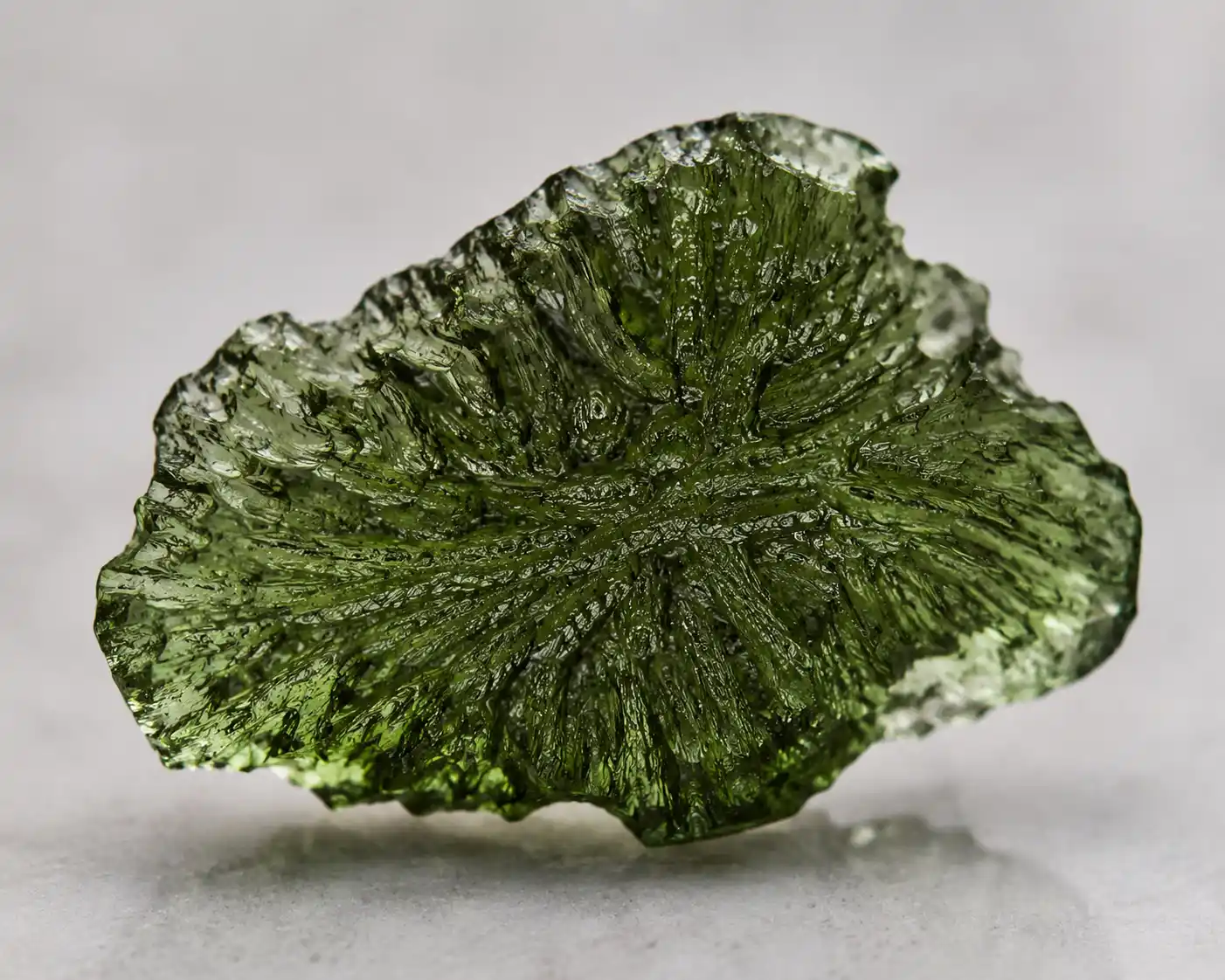
Moldavite is a green natural glass created when a major impact event melted terrestrial material and ejected it across Central Europe. It belongs to the tektite family, yet its olive, bottle-green and occasionally yellow-green color distinguishes it from the brown and black tektites found in other strewn fields.
Its unusual origin, sculpted natural surfaces and restricted distribution have made Moldavite important to collectors, gem cutters and modern crystal practitioners. Spiritual traditions commonly associate it with rapid transformation, intensified self-reflection, synchronicity and personal change.
Those meanings should be separated from the material’s geological identity. Moldavite has no scientifically demonstrated ability to accelerate fate, open chakras, treat disease, attract a partner or force life events to occur. Its genuine importance lies in the fact that it preserves glass formed from terrestrial material during an ancient hypervelocity impact.
Moldavite at a Glance
| Property | Moldavite |
|---|---|
| Material type | Natural tektite glass |
| Origin | Terrestrial material melted and ejected during the Ries impact event |
| Approximate age | About 14.7–14.8 million years |
| Principal composition | Silica-rich natural glass with aluminum and other oxides |
| Structure | Amorphous rather than crystalline |
| Typical colors | Olive green, bottle green, brownish green and yellow-green |
| Transparency | Transparent to translucent; some pieces appear nearly opaque |
| Luster | Vitreous |
| Refractive index | Commonly around 1.486–1.495 |
| Specific gravity | Commonly around 2.33–2.37 |
| Hardness | Variable natural-glass range, commonly around the mid-5s to upper-6s |
| Fracture | Conchoidal |
| Typical internal features | Bubbles, flow lines, schlieren and lechatelierite |
| Primary occurrences | Czech Republic, with smaller Central European occurrences |
| Common uses | Mineral specimens, pendants, faceted gems, carvings and spiritual objects |
| Main care concern | Chipping, surface abrasion, thin edges and imitation glass |
What Is Moldavite?
Moldavite is a type of tektite, a natural glass produced when a large extraterrestrial object strikes Earth at extreme speed.
The impact supplies enough pressure and heat to melt or vaporize near-surface terrestrial rock and sediment. Part of that material is ejected beyond the crater, cools rapidly and lands as glassy fragments across a geographically defined strewn field.
Moldavite is therefore impact-related but is not a meteorite. A meteorite is surviving extraterrestrial material that reaches Earth’s surface. Moldavite consists overwhelmingly of melted Earth material launched by the impact.
This distinction matters because misleading sellers sometimes describe Moldavite as a green meteorite, alien crystal or fragment of an asteroid. Such phrases may sound dramatic, but they obscure the actual geological process.
The Ries Impact Event
Moldavite is linked with the Nördlinger Ries impact structure in southern Germany.
The event occurred approximately 14.7–14.8 million years ago during the Miocene Epoch. A large projectile struck the region and created a crater roughly 24 kilometers across.
High-speed ejecta traveled hundreds of kilometers mainly east and northeast of the crater. The resulting Moldavite strewn field includes principal areas in Bohemia and Moravia, with smaller occurrences elsewhere in Central Europe.
The glass reached the ground as droplets, disks, rods, irregular splash forms and fragmented masses. Later erosion transported many pieces into sediments and gravel deposits, where they experienced weathering, breakage and chemical etching.
The crater and strewn field are related, but a piece of Moldavite does not contain a meaningful proportion of extraterrestrial projectile material. Its chemistry reflects terrestrial source material transformed by the impact.
How Moldavite Formed
Moldavite formation occurred through a sequence of extreme but rapid processes.
The impact compressed and heated target sediments and rocks. Some material melted completely, while other portions vaporized or entered a high-temperature ejecta plume.
Molten droplets traveled through the atmosphere, stretched or rotated during flight and cooled into glass before landing. Rapid cooling prevented atoms from organizing into a regular crystal lattice.
The finished material is amorphous, like other natural glasses. It may contain flow bands, bubbles and silica-rich inclusions produced under the intense conditions of formation.
Not every crater generates tektites. Projectile angle, crater size, target composition, water content and atmospheric interaction all influence whether sufficiently homogeneous glass is ejected over long distances.
Is Moldavite a Crystal?
Moldavite is often called a crystal in retail and metaphysical language, but it is not crystalline in the mineralogical sense.
Crystals have atoms arranged in an orderly repeating lattice. Moldavite cooled too quickly for that arrangement to develop, so its internal structure remains glassy and disordered.
Calling it a Moldavite crystal is understandable as a broad commercial phrase, especially within crystal-collecting communities. However, natural impact glass is the more accurate technical description.
This does not make Moldavite artificial. Obsidian, tektites and other naturally formed glasses are genuine geological materials even though they lack crystal structure.
Moldavite Composition
Moldavite is rich in silica but does not have one fixed chemical formula.
Its composition includes silicon dioxide, aluminum oxide and smaller quantities of iron, calcium, magnesium, potassium, sodium and other elements. Proportions vary among pieces and source regions because the original target sediments were not perfectly uniform.
The glass contains very little water compared with many volcanic glasses. Low volatile content is a general characteristic of tektites and reflects the intense conditions under which they formed.
Some Moldavites contain lechatelierite, a high-silica glass produced from quartz under extreme heat. Flow bands and compositional streaks may surround these inclusions.
Chemical variation can influence color, density, refractive index and translucency. Nevertheless, locality cannot be assigned reliably from color alone.
Why Moldavite Is Green
Iron within the glass is the main contributor to Moldavite’s green color.
Its oxidation state, concentration and interaction with the glass structure influence whether a piece appears yellow-green, olive, bottle green, brownish green or unusually pale.
Thin edges often transmit a brighter green than the thicker center. A dark specimen may look brown or nearly black in reflected light yet reveal green when illuminated from behind.
Color is not an authenticity test by itself. Manufactured bottle glass can reproduce almost any green shade, while genuine Moldavite varies considerably.
The broader Green Crystals guide places Moldavite within a visual color category, but its impact-glass identity differs from green minerals such as Emerald, Peridot and Malachite.
Natural Shapes and Surface Sculpture
Freshly formed Moldavite likely included rounded, elongated, flattened and irregular splash forms.
Many surviving pieces show pits, grooves, ridges, spikes or deeply etched surfaces. These textures are often called sculpture.
The final surface did not arise solely during atmospheric flight. Long exposure to groundwater, soil chemistry and natural acids etched and enlarged irregularities over millions of years.
Some localities produce especially deeply sculpted pieces because of their depositional and weathering history. Sharp projections can be fragile and may break during mining, cleaning, transport or handling.
A smooth natural surface is not automatically fake. Water transport can abrade a genuine piece, while buried specimens may retain different textures according to the surrounding sediment.
Detailed surface authentication belongs to Real vs Fake Moldavite rather than this overview.
Internal Features
Moldavite commonly contains bubbles, flow lines and schlieren.
Bubbles may be round, elongated or distorted by movement in the molten glass. Some contain extremely low-pressure gas because they sealed while the material was hot and airborne.
Flow lines record differences in composition and viscosity as the melt moved. Under magnification, they may create wavy, threadlike or layered internal patterns.
Lechatelierite inclusions can appear as irregular transparent or whitish silica-glass particles.
These features support natural impact-glass interpretation when they occur in the correct combination, but none proves Moldavite alone. Skilled imitation glass can contain bubbles and artificial flow structures.
A buyer examining a piece already owned should follow Is My Moldavite Real?, while the educational profile of genuine natural material belongs to Real Moldavite.
Where Moldavite Is Found
Most commercial Moldavite comes from the Czech Republic.
Southern Bohemia contains the best-known and most productive deposits, including sedimentary areas around the České Budějovice and Třeboň basins. Moravian occurrences form another important part of the strewn field.
Smaller occurrences have been documented in Austria, Germany and neighboring parts of Central Europe. Some pieces found outside the principal field may have been transported naturally or redeposited through geological processes.
A city, village or mining district attached to a sales listing should be supported by provenance. Surface style and color may suggest a regional type, but they do not prove a precise locality.
Collectors often pay more for documented localities and distinctive natural forms. Such premiums belong to provenance and specimen quality rather than metaphysical strength.
Moldavite vs Other Tektites
Tektites occur in several major strewn fields and may be black, brown, gray or green.
Moldavite belongs to the Central European field. Australasian tektites are generally dark brown to black, while Ivory Coast and North American material has its own chemistry, age and distribution.
All tektites are natural impact glasses, but they are not interchangeable. Their target materials and impact events differ.
The broad Tektite guide owns the family comparison.
Moldavite is the tektite most commonly cut for jewelry because its green color and relative translucency give it greater traditional gem appeal.
Moldavite vs Libyan Desert Glass
Libyan Desert Glass is another natural impact-related glass, typically pale yellow to yellow-green and found in the Great Sand Sea of Egypt and Libya.
It is not Moldavite and does not belong to the Ries strewn field.
The two materials differ in color, geography, age, chemistry and formation context. Libyan Desert Glass occurs mainly as silica-rich glass fragments in desert sediments, while Moldavite is a Central European tektite.
Both attract imitation, provenance and spiritual-marketing claims. Identification should therefore rely on material properties and documented source rather than a story about extraterrestrial energy.
Moldavite as a Gem Material
Moldavite can be faceted, carved, drilled or mounted in its natural rough form.
Faceting reveals transparency, flow structures and green color but removes the naturally sculpted exterior that many collectors value.
Rough pendants often use prongs, wire wrapping or custom cages. The setting should protect sharp projections without covering the specimen so tightly that pressure causes a fracture.
Moldavite has conchoidal fracture and can chip like other natural glasses. Thin edges are particularly vulnerable.
The Gemstone Hardness Chart provides scratch-resistance context, but fracture shape and edge thickness are more important than one hardness number in a rough specimen.
Pendants and earrings are safer than rings or bracelets because they receive less impact.
Buying Moldavite
The complete purchase workflow belongs to the Moldavite Buying Guide.
A credible seller should provide weight, dimensions, clear photographs, treatment disclosure and a meaningful source history.
The product should be identified as natural Moldavite rather than meteorite, cosmic crystal or Czech glass without clarification.
Price varies with weight, translucency, color, surface sculpture, damage, shape, locality evidence and whether the material is rough or cut. Current valuation belongs to the Moldavite Price Guide.
Unusually low prices deserve scrutiny, especially when a seller offers many nearly identical large bright-green pieces.
Treatments, Alterations and Imitations
Natural Moldavite may be polished, drilled, faceted, repaired, coated or mounted with glue.
These alterations do not change its underlying origin, but they affect value and should be disclosed.
Products described as synthetic Moldavite are generally imitation glass rather than true laboratory-grown Moldavite. Because Moldavite is defined partly by a specific natural impact event, manufactured green glass cannot reproduce that origin.
The dedicated Treated Moldavite guide owns polishing, repair, coating, artificial etching and disclosure.
A concise side-by-side identification process belongs to Real vs Fake Moldavite. This overview should not replace those diagnostic pages with a shortened checklist.
Moldavite History
People encountered Moldavite long before its origin was understood.
The glass was reported scientifically in the eighteenth century from Bohemia and was initially compared with green gemstones such as Chrysolite.
The name derives from the Moldau, the German name for the Vltava River. Czech speakers commonly use the word vltavín.
During the nineteenth and twentieth centuries, scientists debated whether tektites came from volcanoes, the Moon, meteorites or terrestrial impacts. Modern impact geology established the relationship between Moldavite and the Ries event.
Moldavite has also appeared in regional jewelry and decorative objects. Its modern international popularity expanded considerably through mineral collecting, online crystal culture and New Age spirituality.
Moldavite Meaning and Symbolism
Modern spiritual traditions most often describe Moldavite as a stone of transformation.
Its impact origin supports metaphors involving sudden change, disruption, pressure and new direction. Green color adds themes of growth, the heart and renewal.
Practitioners may also associate it with synchronicity, accelerated spiritual development, releasing old relationships and confronting avoided decisions.
These interpretations are modern and variable. Moldavite does not possess one ancient universal meaning, and its geological age does not prove that it transmits extraterrestrial wisdom.
The Best Crystals for Transformation guide compares its symbolic role with other stones used during major transitions.
Moldavite Healing Properties
Moldavite is sometimes claimed to raise vibration, detoxify the body, heal trauma, stimulate the nervous system or accelerate recovery.
There is no credible scientific evidence for those effects.
Moldavite does not medically treat anxiety, depression, chronic pain, cancer, hormonal conditions, infection or neurological disease. It should not replace medication, psychotherapy, diagnostic testing or urgent care.
A personal ritual may still help someone pause and reflect. Any benefit is more plausibly related to attention, expectation, symbolism, sensory focus and the practical action paired with the object.
Someone might use Moldavite as a prompt to write down a difficult change, identify what is controllable and select one action. The plan creates the practical benefit; the glass does not force the outcome.
The “Moldavite Flush”
The Moldavite flush is a modern term for warmth, tingling, light-headedness, pressure, emotional intensity or a racing heartbeat reported by some users while holding the material.
No controlled evidence shows that Moldavite emits an energy that causes a unique physiological reaction.
Expectation, anxiety, focused attention, room temperature, hand warmth, breathing pattern and autonomic arousal can all produce noticeable sensations.
A person who feels uncomfortable should set the stone down, sit safely and breathe normally. Persistent dizziness, fainting, chest pain, weakness, severe headache or breathing difficulty requires medical evaluation rather than interpretation as spiritual activation.
The experience should never be used as an authenticity test. Genuine and imitation glass can both produce expectation-driven responses.
Transformation and New Beginnings
Moldavite is frequently chosen during career changes, moves, breakups and major personal decisions.
A grounded transformation practice can begin with three questions: what is ending, what remains uncertain and which action can be taken without pretending to control the entire outcome.
The stone can mark a commitment to change, but it cannot cause another person to leave, return, apologize or become compatible.
The Best Crystals for Manifestation guide covers intention-setting traditions. Manifestation should be interpreted through planning, behavior and opportunity rather than a promise that Moldavite will produce a requested event.
Meditation With Moldavite
Moldavite can be used as a visual or tactile meditation object.
Place it on a stable cloth rather than gripping a sharp sculpted piece. Observe the color, bubbles and surface without assigning every sensation a supernatural cause.
A brief session can end with one written observation and one practical next step.
The Best Crystals for Meditation page compares other symbolic meditation objects.
Anyone who becomes panicked, dissociated or physically unwell should stop the session. Intense discomfort is not evidence that the stone is working.
Chakra Associations
Moldavite is commonly linked with the Heart Chakra, Third Eye Chakra and Crown Chakra.
The heart association comes from green color and transformation themes. Third-eye and crown traditions emphasize insight, spiritual perspective and perceived connection beyond the self.
Chakras are spiritual frameworks rather than measurable anatomical organs.
Moldavite cannot open psychic vision, guarantee intuition or treat the heart, brain, eyes, endocrine system or nervous system.
A responsible practice uses the symbolism as a prompt for compassion, reflection or values-based decision-making.
Grounding and Protection
Some practitioners find Moldavite emotionally intense and pair it with darker stones described as grounding.
The Best Crystals for Grounding guide covers that tradition, while Best Crystals for Protection addresses symbolic energetic boundaries.
Grounding is more reliably supported by ordinary actions: eating, resting, slowing the breath, naming visible objects, walking safely and contacting a trusted person.
Moldavite cannot protect against accidents, fraud, violence, electrical hazards or unsafe travel.
Its protective meaning can serve only as a reminder to use practical precautions.
Cleaning and Storage
Natural Moldavite should be handled like a valuable piece of glass.
Use lukewarm water, mild soap and a soft cloth or brush for routine physical cleaning. Avoid sudden temperature changes, abrasive powders and hard scrubbing around sharp etched projections.
A rough specimen should be supported from beneath rather than held by a thin spike.
Do not use acid to strengthen surface texture or perform home authenticity tests. Artificial etching permanently alters the specimen.
Spiritual cleansing practices belong to How to Cleanse and Charge Moldavite. Low-risk methods such as sound, prayer or placing the stone on a clean cloth are safer than salt, chemicals or prolonged exposure to intense heat.
Store Moldavite separately in a padded container. Harder gems and metal edges can scratch or chip it.
The Crystals That Start With M directory provides its wider alphabetical context.
Frequently Asked Questions
1. What is Moldavite?
Moldavite is green natural tektite glass created from terrestrial material during the Nördlinger Ries impact event approximately 14.7–14.8 million years ago.
2. Is Moldavite a meteorite?
No. It is impact glass made mainly from melted Earth material, not a surviving fragment of the extraterrestrial projectile.
3. Is Moldavite a crystal?
It is commonly called a crystal in retail language, but technically it is amorphous natural glass.
4. Why is Moldavite green?
Iron within the silica-rich glass and its oxidation state produce olive, bottle-green, yellow-green and related shades.
5. Where is Moldavite found?
Most commercial material comes from Bohemian and Moravian deposits in the Czech Republic, with smaller occurrences elsewhere in Central Europe.
6. What are the bubbles inside Moldavite?
They are gas cavities trapped while the molten material cooled. Bubbles support natural-glass interpretation but do not prove authenticity alone.
7. What causes Moldavite’s rough surface?
Natural soil and groundwater etching enlarged irregularities over millions of years, while the original splash form also influenced shape.
8. Is Moldavite dangerous?
An intact specimen is generally safe to handle. Sharp edges can cut, and intense physical symptoms should not be dismissed as spiritual effects.
9. Does Moldavite cause the Moldavite flush?
No unique mineral energy has been demonstrated. Warmth or dizziness can result from expectation, anxiety, attention and ordinary physiological responses.
10. Does Moldavite have proven healing properties?
No. Transformation, chakra and healing claims are spiritual beliefs rather than scientifically established medical effects.
11. Can Moldavite go in water?
Brief gentle cleaning is normally acceptable, but avoid thermal shock, harsh chemicals and soaking glued or repaired jewelry.
12. Why is Moldavite frequently faked?
Its limited natural supply, recognizable green color, high demand and relatively high price make manufactured glass imitations commercially attractive.
Moldavite is extraordinary without requiring supernatural exaggeration. It records a moment when an impact melted terrestrial material, launched it across Central Europe and preserved part of that event as green glass. Its transformation symbolism may resonate personally, but the verified story—impact, flight, cooling and millions of years of weathering—is already remarkable.
Moldavite healing, chakra, manifestation, protection, psychic and “flush” claims are spiritual or personal beliefs rather than scientifically established effects. Do not use the material to replace medical or mental-health care, interpret serious symptoms as spiritual activation, make drinking elixirs or guarantee life outcomes.