
Heart Chakra Crystals: The Best Stones for Love and Compassion

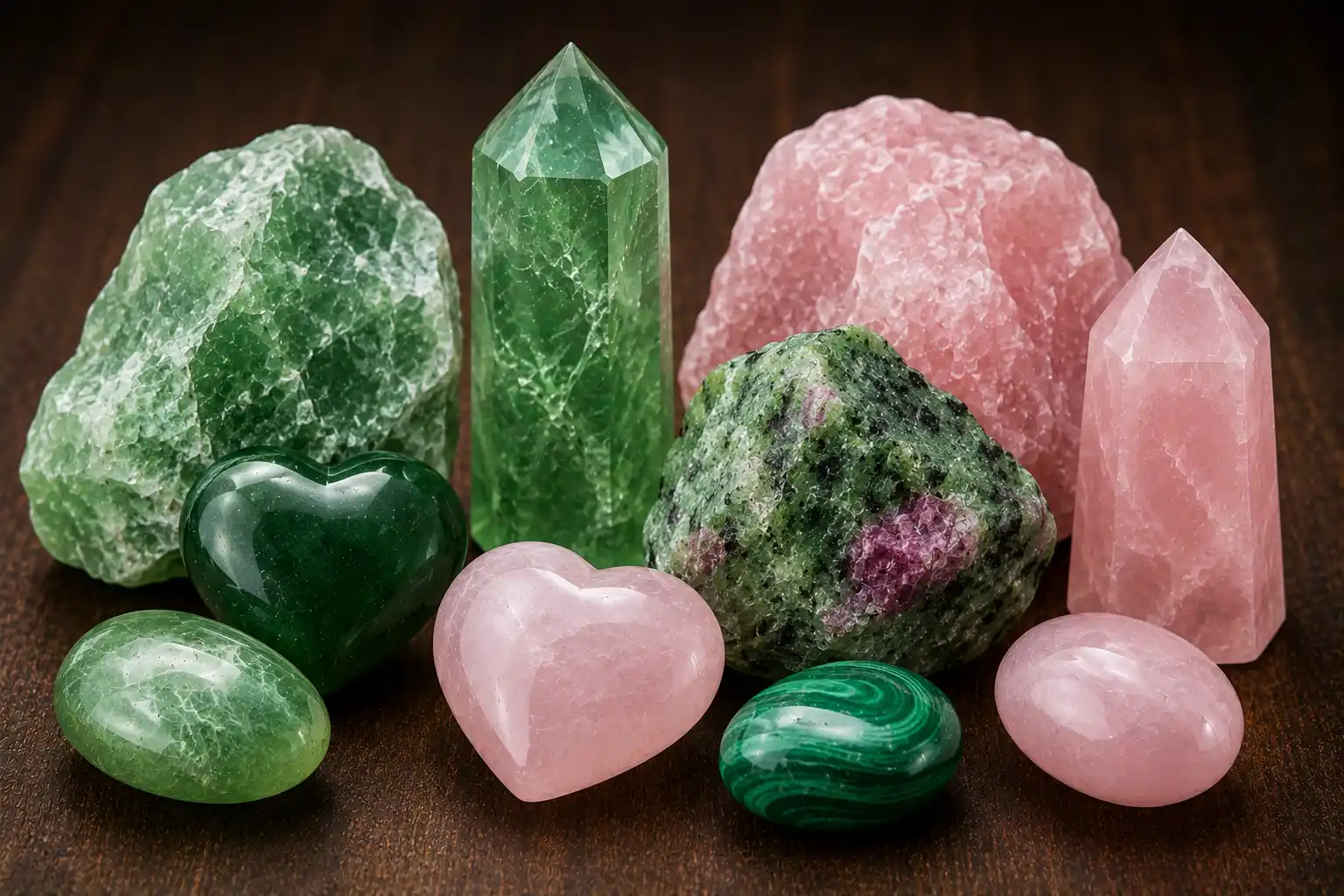
Heart chakra crystal traditions usually center on green and pink stones associated symbolically with compassion, connection, reciprocity, emotional openness and healthy boundaries. Rose quartz and green aventurine are among the most familiar choices, while emerald, malachite, rhodonite, chrysoprase, jade and several other green or pink materials appear frequently in contemporary chakra practice.
These associations are spiritual and symbolic rather than scientifically established effects of the gemstones. A heart chakra stone can still be meaningful as a meditation focus, journaling cue or reminder of a relationship value, provided it is not treated as a medical treatment or as a way to control another person’s feelings.
Heart Chakra Crystals at a Glance
| Crystal | Common Heart-Chakra Symbolism | Useful Reflective Theme |
|---|---|---|
| Rose Quartz | Love, compassion, gentleness | Self-respect and kindness |
| Green Aventurine | Growth, openness, renewal | Healthier new patterns |
| Emerald | Loyalty, renewal, wisdom | Commitment with discernment |
| Malachite | Transformation, boundaries | Changing recurring patterns |
| Rhodonite | Forgiveness, responsibility | Repair without self-abandonment |
| Chrysoprase | Openness, renewal | Becoming receptive again |
| Jade | Harmony, continuity | Stable relationships and values |
| Green Tourmaline | Balance, compassion | Giving and receiving |
| Moss Agate | Growth, patience | Slow relationship development |
| Prehnite | Preparation, calm reflection | Emotional readiness |
| Pink Tourmaline | Affection, emotional expression | Honest vulnerability |
| Green Calcite | Renewal, release | Letting go of outdated assumptions |
The companion Heart Chakra guide explains Anāhata, its historical context and balancing practices. This page stays focused specifically on choosing and using stones within contemporary heart-chakra traditions.
Why Are Green and Pink Stones Used?
Green is the color most commonly assigned to the heart chakra in today’s widely used seven-chakra system.
Because green is visually associated with plants, spring and renewal, modern spiritual traditions often connect it with growth, healing, reciprocity and the ability to begin again.
Pink became another major heart-centered color because it carries modern associations with tenderness, affection and emotional warmth.
However, these correspondences are not universal laws.
Historical chakra systems were more varied than modern rainbow charts suggest, and a gemstone does not need to be green or pink to hold personal heart-centered meaning.
Color provides a symbolic framework rather than evidence of a physical energy emitted by the stone.
1. Rose Quartz — Compassion and Gentle Love
Rose Quartz is arguably the best-known modern heart chakra crystal.
Its pale-to-medium pink color has made it strongly associated with:
love, self-compassion, tenderness and emotional openness.
Unfortunately, crystal marketing sometimes turns that symbolism into promises that rose quartz will make someone fall in love or repair a relationship automatically.
A more useful interpretation keeps the focus on the person using the stone.
Rose quartz can represent asking:
Am I treating myself with the same respect I expect from others?
Am I expressing care clearly rather than expecting someone to guess?
Is kindness possible here without sacrificing an important boundary?
Those questions preserve its heart-centered symbolism while keeping personal agency intact.
Best Ways to Use Rose Quartz
A polished palm stone works well during meditation.
A pendant can represent compassion throughout the day.
Alternatively, place a piece beside a journal and use it as a cue to examine relationship patterns without immediately judging yourself or another person.
The crystal does not create compassion. Instead, it can symbolize the behavior you want to practice.
2. Green Aventurine — Growth and New Possibilities
Green Aventurine is frequently connected with the heart chakra because of its color and its broader symbolism of growth and opportunity.
Within relationship practice, that symbolism can mean something more useful than “luck in love.”
It can represent becoming open to a healthier pattern.
For example, after a difficult relationship ends, green aventurine might symbolize:
allowing new connections to develop slowly, recognizing early warning signs more clearly and refusing to repeat a pattern merely because it feels familiar.
This interpretation connects growth with changed behavior rather than simply hoping for a different result.
Green Aventurine for Relationship Reflection
A practical journaling question is:
What would I need to do differently for the next relationship to be healthier?
The answer may involve clearer communication, slower decision-making, stronger boundaries or greater willingness to receive support.
Green aventurine then becomes a reminder of growth rather than a charm expected to attract a specific person.
3. Emerald — Loyalty, Renewal and Discernment
Emerald has carried symbolism involving love, fertility, renewal and wisdom through different historical traditions.
Modern chakra practitioners frequently place it within heart-centered work because of its rich green color.
For relationship symbolism, emerald works particularly well when love is paired with discernment.
Commitment is valuable only when the relationship itself is worthy of commitment.
Consequently, emerald can symbolize questions such as:
What does loyalty mean when circumstances change?
Does commitment here support both people?
Am I staying because the relationship is healthy, or simply because I have already invested time in it?
That interpretation makes emerald more than a generic “love stone.”
It becomes a symbol of thoughtful devotion.
4. Malachite — Transformation and Boundaries
Malachite is recognizable by its dramatic light- and dark-green banding.
Modern crystal traditions frequently associate it with transformation, emotional honesty and boundaries.
Those themes fit heart-chakra work particularly well because relationship growth often requires changing something rather than simply becoming more open.
A malachite-centered practice could focus on the question:
Which relationship pattern keeps repeating because I have not changed my response to it?
Perhaps the issue involves agreeing to things you resent later.
Maybe it involves ignoring an incompatibility.
Alternatively, it may involve expecting another person to understand a boundary that has never actually been stated.
The stone can represent changing the pattern rather than tolerating it indefinitely.
5. Rhodonite — Forgiveness and Responsibility
Rhodonite is commonly pink with black or dark manganese-rich patterning.
Its modern heart-chakra symbolism emphasizes forgiveness, relationship repair and emotional responsibility.
This does not mean every relationship should be repaired.
Instead, rhodonite can symbolize distinguishing what genuinely belongs to you from what belongs to another person.
Ask:
What part of this conflict am I responsible for?
Then ask separately:
What part is not mine to carry?
That distinction is especially valuable when spiritual language about forgiveness risks becoming pressure to accept repeated harmful behavior.
Forgiveness, accountability and renewed access are different decisions.
6. Chrysoprase — Openness After Disappointment
Chrysoprase is an apple-green variety of chalcedony.
Modern crystal traditions often associate it with openness, renewal and emotional recovery.
That symbolism can be particularly relevant after disappointment.
“Opening the heart” does not require immediately trusting again.
A more realistic goal may be becoming willing to consider new information instead of assuming every future situation will reproduce the past.
Chrysoprase can therefore symbolize openness with evidence.
That approach creates room for connection while preserving discernment.
7. Jade — Harmony and Continuity
Jade traditions are culturally rich and should not be reduced to one modern chakra meaning.
Nevertheless, contemporary heart-chakra practices frequently use green jade because of its color and widespread associations with harmony, prosperity, continuity and virtue.
For personal reflection, jade can represent stability.
Instead of asking how to create more emotional intensity, consider:
What makes a relationship sustainable?
Reliability, honesty, mutual effort and the ability to resolve ordinary disagreements may matter more over time than dramatic emotional highs.
Jade’s toughness also provides a useful metaphor: lasting relationships often depend on resilient structure rather than surface perfection.
8. Green Tourmaline — Giving and Receiving
Green tourmaline is commonly associated in contemporary crystal practice with compassion, growth and heart-centered balance.
One useful symbolic theme is reciprocity.
Some people are comfortable giving support but uncomfortable receiving it.
Others expect care while struggling to offer it consistently.
Green tourmaline can therefore represent examining both directions:
What am I willing to give?
and
What am I willing to receive?
Healthy reciprocity rarely means both people contribute in identical ways every day.
Instead, the relationship should remain broadly mutual over time.
9. Moss Agate — Patient Growth
Moss agate contains green dendritic patterns that often resemble moss, branches or tiny landscapes.
Its natural appearance has encouraged symbolic associations with nature, growth and patience.
For heart-centered practice, moss agate is particularly suited to relationships that need time.
Not every connection should develop quickly.
Trust, friendship and intimacy can become stronger through repeated small experiences rather than immediate intensity.
A moss-agate reflection can therefore ask:
What would happen if I allowed this relationship to develop at a sustainable pace?
Patience does not mean ignoring clear problems. It means allowing healthy information to accumulate before demanding certainty.
10. Prehnite — Emotional Preparation
Prehnite typically appears pale yellow-green to apple green.
Modern crystal traditions often connect it with preparation, reflection and calm anticipation.
Within heart-chakra work, it can symbolize becoming emotionally prepared before entering an important conversation.
Instead of beginning the discussion while overwhelmed, pause and identify:
what you want to communicate, which outcome is actually within your control and which points are negotiable.
The stone’s symbolic role is to mark the preparation phase.
That can make heart-centered practice more deliberate and less reactive.
11. Pink Tourmaline — Honest Vulnerability
Pink tourmaline is frequently used in modern love and heart-chakra traditions.
Its symbolism often emphasizes affection, emotional expression and vulnerability.
However, vulnerability is not the same as revealing everything to everyone.
Healthy vulnerability is selective.
It involves sharing something meaningful when the relationship has enough trust and context to hold it responsibly.
A pink-tourmaline intention could therefore be:
I can communicate honestly without abandoning discernment about whom I trust.
This reframes openness as a choice rather than an obligation.
12. Green Calcite — Reconsidering Old Assumptions
Green calcite is a comparatively soft mineral with a pale, translucent appearance.
Modern crystal traditions commonly connect it with release and renewal.
Within heart-centered reflection, “release” can mean examining an old belief about relationships.
For example:
I always have to be the strong one.
Conflict means the relationship is failing.
If someone loves me, they should know what I need without being told.
The stone can represent questioning whether those assumptions still serve you.
Again, the value comes from the reflection rather than a property scientifically demonstrated in calcite.
Choosing a Heart Chakra Crystal
The most useful choice depends on the theme you want to explore.
If the focus is gentleness, rose quartz makes intuitive sense.
For growth after a setback, green aventurine or moss agate may fit better.
Emerald can represent deliberate commitment.
Malachite works well for changing patterns.
Rhodonite can symbolize accountability and forgiveness.
The related Green Crystals guide provides a broader color-based directory, while Best Crystals for Chakras compares stones across the complete chakra sequence.
You do not need every heart chakra stone.
One stone with one clearly defined intention is usually more coherent than an entire collection assigned overlapping meanings.
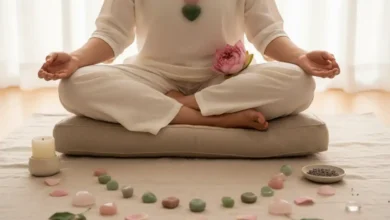
How to Meditate With Heart Chakra Crystals
Sit comfortably and choose one stone.
You can hold it, place it nearby or simply observe it.
Bring attention to your breathing without forcing unusually deep breaths.
Then choose one heart-centered theme.
For example:
Compassion: Where can I respond more gently?
Boundary: What needs to be said clearly?
Receiving: Where am I refusing reasonable support?
Forgiveness: What can I release without reopening access?
Growth: What relationship behavior am I ready to change?
Allow the question to remain present for several minutes.
The goal is reflection, not producing a dramatic bodily sensation.
Wearing Heart Chakra Stones
Jewelry makes a symbolic intention easy to carry.
A rose quartz pendant may represent compassion.
A green aventurine bracelet might symbolize growth.
An emerald ring can represent commitment.
Material durability should still determine how each stone is worn.
Malachite, calcite and some softer materials need more protection than sapphire or quartz.
Likewise, treatments, settings and metal components affect cleaning requirements.
Spiritual meaning does not override gemological care.
Can You Combine Heart Chakra Crystals?
Yes.
There is no scientifically established rule requiring or prohibiting particular combinations.
Symbolically, two stones can work well when their themes complement one another.
Rose quartz and malachite might represent compassion plus boundaries.
Green aventurine and rhodonite might represent growth plus accountability.
Emerald and rose quartz might symbolize commitment plus gentleness.
However, combining many stones can make the intention vague.
If every crystal represents a different relationship goal, choosing one or two may produce a clearer practice.
Heart Chakra Crystals for Love
“Love” should be defined carefully.
No crystal can force another person to develop romantic feelings.
A heart stone cannot guarantee reconciliation, fidelity or marriage.
Instead, use love symbolism to focus on qualities within your control:
communication, respect, reciprocity, patience, boundaries and emotional honesty.
That interpretation protects heart-chakra practice from becoming a claim about controlling someone else’s choices.
Heart Chakra Crystals for Self-Compassion
Rose quartz is the classic choice, although rhodonite and green aventurine can also fit.
Self-compassion does not mean approving of every decision you make.
It means addressing mistakes without unnecessary humiliation and making corrections without treating imperfection as proof of personal worthlessness.
A heart-centered crystal can represent the phrase:
I can take responsibility without using cruelty as motivation.
That is a more specific and useful practice than simply repeating that a stone creates “self-love energy.”
Heart Chakra Crystals and Grief
Green and pink stones are sometimes used during grief rituals because the heart chakra is associated with attachment and relationship.
A crystal may function as a remembrance object or meditation focus.
However, grief is not evidence that someone has failed to keep a chakra “open.”
Loss can hurt precisely because the relationship mattered.
Spiritual practices should allow grief rather than create pressure to resolve it on a schedule.
When grief becomes overwhelming or persistently interferes with daily functioning, appropriate support can coexist with personal crystal rituals.
Spiritual Cleansing of Heart Chakra Stones
Some practitioners cleanse stones symbolically between uses.
The method should match the actual material.
Not every heart chakra stone should be exposed to water, salt, sunlight or harsh substances.
Calcite is soft and chemically sensitive.
Malachite should not be subjected to improvised chemical treatment.
Some colored gemstones can also be affected by prolonged intense light.
Sound, visualization or other non-destructive rituals provide alternatives when physical exposure is unnecessary.
Spiritual cleansing and physical gemstone cleaning remain two different tasks.
Frequently Asked Questions
1. What is the best crystal for the heart chakra?
Rose quartz and green aventurine are two of the most widely used contemporary choices. The best stone depends on whether your focus is compassion, growth, boundaries, forgiveness or another heart-centered theme.
2. Is rose quartz a heart chakra crystal?
Yes. Modern crystal traditions strongly associate rose quartz with love, compassion and emotional gentleness.
3. Is green aventurine good for the heart chakra?
Yes. It is commonly associated with the heart chakra through themes of growth, renewal, opportunity and emotional openness.
4. Is emerald a heart chakra stone?
Emerald is frequently used in contemporary heart-chakra practices because of its green color and longstanding symbolism involving renewal and commitment.
5. Why is malachite used for the heart chakra?
Modern traditions associate malachite with transformation and boundaries, making it useful symbolically when heart-centered work involves changing unhealthy relationship patterns.
6. What does rhodonite symbolize for the heart chakra?
Rhodonite commonly represents forgiveness, accountability, emotional responsibility and relationship repair.
7. Are heart chakra crystals supposed to be green or pink?
Green and pink dominate contemporary heart-chakra crystal systems, but the color correspondence is symbolic rather than a universal physical rule.
8. Can I combine several heart chakra crystals?
Yes. There is no scientific rule against combining them. Symbolically, one or two complementary stones often create a clearer intention than a large collection.
9. Where should I wear a heart chakra crystal?
Pendants are popular because they rest near the chest, but bracelets, rings and earrings can carry the same personal symbolism. Placement does not establish a measurable energetic effect.
10. Can I sleep with heart chakra crystals?
A small stable polished stone can be kept nearby if desired, but avoid placing heavy clusters, sharp crystals or small loose stones where they create injury, choking or pet hazards.
11. Do heart chakra crystals need cleansing?
There is no scientific requirement. Spiritual cleansing is optional, and any ritual should be physically safe for the specific mineral.
12. Can heart chakra crystals heal heart disease or relationship trauma?
No. Chakra stones are spiritual or symbolic tools and should not replace medical treatment, trauma-informed mental-health care or appropriate relationship support.
Conclusion
Heart chakra crystals work best as symbols of specific relationship values rather than as promises of love or healing.
Rose quartz can represent compassion. Green aventurine can symbolize growth. Emerald can stand for thoughtful commitment, while malachite and rhodonite provide useful frameworks for boundaries, change and accountability.
The most meaningful practice begins by defining what “heart healing” actually means in behavior.
Perhaps it means speaking more honestly, receiving support without shame, ending a recurring pattern or offering yourself compassion while still taking responsibility.
Once that intention is clear, a crystal can become a memorable physical cue for the work you have chosen to do.
Disclaimer: Heart-chakra, crystal-healing and metaphysical associations are spiritual, cultural or personal traditions rather than scientifically established medical or psychological effects. Heart chakra stones cannot treat cardiovascular disease, trauma, depression or other health conditions and cannot control another person’s feelings or behavior.