
Third Eye Chakra: Meaning, Healing, Stones and Balancing

The third eye chakra, commonly called Ajna, is the sixth center in the modern seven-chakra system. It is symbolically associated with discernment, inner observation, imagination, intuition and the ability to recognize patterns without abandoning critical judgment.
In most contemporary teaching, the center is placed between or slightly above the eyebrows. This location is symbolic rather than an anatomical organ, and the third eye chakra should not be treated as a medical structure or equated scientifically with the pineal gland.
Within this article, “healing” refers to spiritual reflection and personal practice. It does not mean diagnosing or treating illness.
Third Eye Chakra at a Glance
| Attribute | Common contemporary association |
|---|---|
| Sanskrit name | Ajna |
| Common translation | Command, authority or perception |
| Position in seven-chakra model | Sixth |
| Symbolic location | Brow area between or above the eyebrows |
| Common modern color | Indigo or deep violet-blue |
| Traditional symbol | Two-petaled lotus |
| Element in many modern systems | Light, mind or subtle perception |
| Main themes | Discernment, insight, imagination and intuition |
| Related practices | Meditation, reflection, dream journaling and visualization |
| Neighboring chakras | Throat below and crown above |
| Common crystals | Amethyst, Lapis Lazuli, Sodalite and Labradorite |
| Important caution | Chakra concepts are spiritual rather than anatomical |
What Is the Third Eye Chakra?
Ajna is commonly presented as the sixth chakra, positioned between the throat chakra and crown chakra in the seven-center model.
Its Sanskrit name is often translated as “command” or “authority.” Within yogic and later spiritual interpretations, the center represents disciplined awareness rather than uncontrolled fantasy.
The phrase “third eye” describes inner perception. It can refer to recognizing a pattern, noticing an assumption, reflecting on a dream or considering what lies beneath an immediate reaction.
That symbolism does not establish paranormal vision. A grounded third-eye practice combines imagination with observation, evidence and willingness to revise an interpretation.
The Two-Petaled Lotus
Traditional and modern illustrations often depict Ajna as a lotus with two petals.
The petals have received different interpretations, including duality, complementary channels of awareness and the integration of apparently opposing perspectives.
Contemporary artwork frequently colors the symbol indigo. However, the familiar rainbow sequence assigned to all seven chakras is largely a modern organizational system rather than one unchanging rule across every historical yoga tradition.
A person can use indigo as a visual focus without believing that the body produces a literal indigo energy field.
Is the Third Eye the Pineal Gland?
The third eye chakra and pineal gland are not scientifically interchangeable.
The pineal gland is a physical endocrine structure in the brain involved in melatonin production and sleep-wake timing. Ajna is a spiritual concept developed within yogic and esoteric traditions.
Modern spiritual writers sometimes connect the two because both are discussed in relation to internal awareness, light or sleep. That symbolic comparison does not prove that chakra meditation activates, decalcifies or medically alters the pineal gland.
Claims about “decalcifying the third eye” through supplements, chemicals, fasting or unsafe practices should be approached cautiously.
What Does a Balanced Third Eye Chakra Mean?
In spiritual language, a balanced third eye represents the ability to observe thoughts without accepting every thought as fact.
Intuition may be present, but it is checked against evidence. Imagination remains active without replacing practical judgment.
A balanced person may notice patterns, tolerate uncertainty and distinguish a genuine concern from anxiety-driven prediction.
This balance does not require constant certainty. In fact, being able to say “I do not know yet” can reflect stronger discernment than forcing an immediate spiritual explanation.
Balanced and Imbalanced Patterns
| Reflective balance | Possible underuse | Possible overemphasis |
|---|---|---|
| Curiosity with evidence | Refusing to consider new perspectives | Treating every coincidence as a message |
| Imagination with practical action | Feeling mentally rigid or uninspired | Escaping into fantasy |
| Trusting experience while checking facts | Dismissing personal insight automatically | Assuming intuition is always correct |
| Calm observation | Avoiding reflection | Rumination and obsessive interpretation |
| Learning from dreams without literalism | Ignoring emotional themes | Making major decisions from one dream |
| Tolerating uncertainty | Demanding only concrete answers | Claiming certainty without evidence |
These patterns are spiritual prompts, not diagnostic criteria. Headaches, vision changes, confusion, sleep disruption and mental-health symptoms require appropriate professional assessment rather than chakra interpretation.
“Blocked” Third Eye Chakra Signs
Modern chakra practitioners may describe mental rigidity, difficulty imagining alternatives or avoidance of reflection as signs of an underused third-eye center.
Someone may repeat the same conclusion without reviewing new evidence. Another person may distrust every internal response and rely completely on external approval.
These experiences can have many ordinary causes, including stress, fatigue, lack of information or fear of making a mistake.
The chakra framework can provide a language for journaling, but it should not become a substitute for medical or psychological understanding.
“Overactive” Third Eye Chakra Signs
An overemphasized third-eye practice may appear as constant symbolism, excessive dream interpretation or belief that every coincidence carries a personal instruction.
A person may begin treating assumptions as facts or making major decisions based solely on signs, readings or imagined messages.
Grounding is more useful than trying to intensify the practice further. Sleep, regular meals, ordinary routines, factual verification and conversation with trusted people can restore perspective.
The completed root chakra guide offers a symbolic grounding framework, while the root chakra crystals guide lists stones used for stability and physical awareness.
Opening Versus Balancing the Third Eye
“Opening the third eye” is common spiritual language, but balance is usually a safer and more useful goal.
Trying to force dramatic visions or unusual sensations can encourage anxiety, sleep deprivation and misinterpretation.
A gradual practice focuses on attention, ethical judgment and self-awareness. It allows imagination without demanding extraordinary experiences.
Insight should improve practical decisions and relationships. A practice that creates fear, grandiosity, isolation or inability to function should be paused.
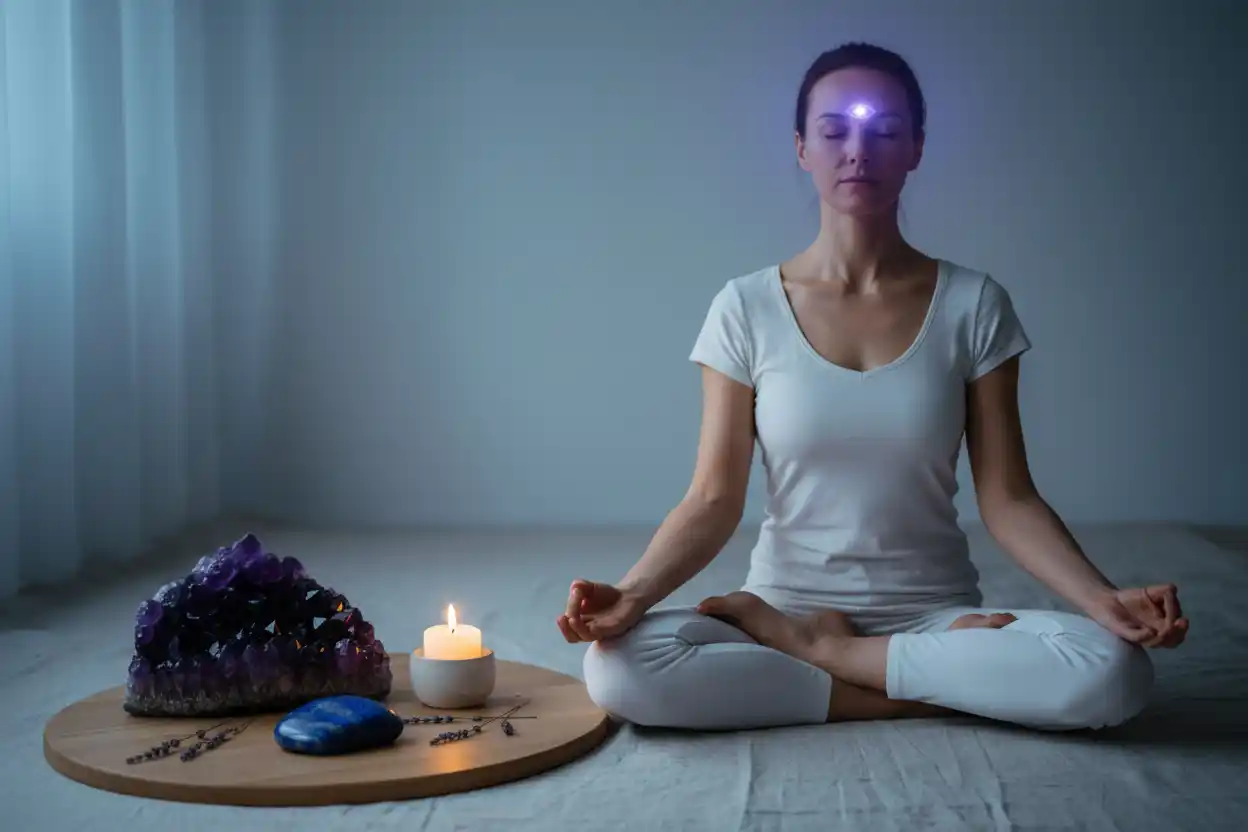
A Grounded Third Eye Meditation
Sit in a stable, comfortable position and allow the eyes to close or rest softly.
Notice the physical contact between the body and the chair or floor. This grounding step reduces the tendency to treat the practice as an escape from the body.
Breathe naturally. Do not use prolonged breath retention, forced hyperventilation or painful techniques.
Bring attention gently to the brow area without pressing, straining the eyes or attempting to create a physical sensation.
Ask one practical question, such as: “What information am I overlooking?” or “What assumption needs to be checked?”
After several minutes, write down observations as possibilities rather than instructions. End by naming one fact you know and one question that remains open.
The planned guide to crystals for meditation provides broader material choices for reflective practice.
Breath and Attention
Slow, comfortable breathing can help create a transition from everyday activity into reflection.
The goal is not to force energy upward or produce dizziness. Lightheadedness is not proof of chakra activation and may indicate overbreathing.
A simple count can provide structure: inhale comfortably, exhale slightly more slowly and stop counting if it creates strain.
People with respiratory, cardiovascular, neurological or mental-health concerns should use appropriate professional guidance before attempting intensive breathwork.
Journaling for Discernment
Third-eye journaling works best when it separates observation from interpretation.
Write what happened first. Then write what you think it might mean. Finally, list at least one alternative explanation.
This method respects intuition without treating it as infallible.
Useful prompts include:
“What evidence supports this feeling?”
“What evidence would change my mind?”
“Am I noticing a pattern or expecting one?”
“What practical action remains useful even if my interpretation is wrong?”
Dreams and the Third Eye
Dreams are often connected with third-eye symbolism because they combine memory, emotion, imagery and unconscious association.
A dream journal can reveal repeated themes, but not every dream predicts an event or carries a supernatural instruction.
Record the dream before interpreting it. Note the emotion, people, setting and current life context.
The planned guide to crystals for dreams explores stones used in dream traditions. The completed guide on whether crystals can be worn or kept near sleep covers physical safety.
Do not place loose, sharp or fragile stones in a bed where they can cause injury or damage.
Intuition and Reality-Checking
Intuition may describe rapid pattern recognition based on previous experience. It can be useful, but it can also be influenced by fear, bias and incomplete information.
A grounded third-eye practice treats intuition as a signal to investigate rather than unquestionable proof.
Before acting, ask whether the decision is reversible, what evidence is available and who else may be affected.
The planned guide to crystals for intuition focuses on symbolic stones. It should not be used to validate claims that bypass evidence or another person’s consent.
Visualization
Visualization uses deliberately created mental imagery.
A simple third-eye visualization may involve imagining an indigo circle becoming clear and steady as attention settles.
The color itself does not need to appear vividly. Some people do not form strong mental images and can instead focus on a word, sensation or written intention.
Visualization can support preparation and creativity. It should not be confused with seeing an objective event that must happen.
Third Eye Chakra Stones
The companion guide to third eye chakra crystals owns the detailed stone list.
Amethyst is used symbolically for calm reflection and moderation. Lapis Lazuli represents truth and considered judgment, while Sodalite is associated with organizing thought.
Labradorite supports symbolism based on imagination and changing perspective. Purple Fluorite is used for mental organization, though its softness and cleavage require careful handling.
The stones are reminders within a reflective practice. They do not physically open a chakra or produce reliable paranormal perception.
Relationship With the Throat Chakra
The third eye concerns interpretation, while the throat chakra concerns expression in the modern seven-center model.
An insight that cannot be communicated clearly may remain private confusion. Conversely, speaking before reflection can turn an incomplete assumption into conflict.
The planned throat chakra crystals guide covers stones associated with careful communication.
A practical sequence is to observe, verify, choose language and then speak.
Relationship With the Crown Chakra
The crown chakra is associated with spiritual meaning, connection and transcendence in contemporary teaching.
The third eye focuses more specifically on discernment and inner perception. The distinction helps prevent every personal insight from being treated as universal spiritual truth.
The planned crown chakra crystals guide explores stones used for spiritual connection.
Grounding remains important whenever upper-chakra practices become abstract or emotionally intense.
Relationship With the Lower Chakras
The lower centers provide symbolic context for putting insight into action.
The sacral chakra represents creativity and emotional movement, while the solar plexus chakra addresses choice and personal responsibility.
The planned heart chakra adds compassion, and the root chakra emphasizes practical stability.
The planned crystals-for-chakras guide compares the complete system without requiring each center to repeat the same stone list.
Using Crystals Safely
Place a stone on a table, hold it loosely or wear it in secure jewelry.
Do not press a sharp crystal point against the forehead. Avoid taping stones to the skin, sleeping with loose specimens or balancing heavy minerals above the face.
Some purple and blue minerals are soft, cleavage-prone, porous or chemically sensitive. Follow material-specific care rather than assuming all chakra stones can be washed or placed in sunlight.
The completed guide to cleansing crystals explains conservative methods, while crystal pairings separates symbolic compatibility from physical hardness.
When to Pause the Practice
Pause third-eye meditation if it repeatedly causes panic, insomnia, dissociation, frightening thoughts or difficulty completing ordinary responsibilities.
Shorter sessions, open eyes and stronger grounding may help. However, persistent or severe symptoms deserve support from a qualified healthcare professional.
A spiritual practice should increase the ability to function, communicate and make responsible decisions. It should not require isolation or unquestioning belief.
The planned healing-crystals beginner guide provides a broader framework for using crystal practices without presenting them as medical treatment.
Frequently Asked Questions
1. What is the third eye chakra?
It is Ajna, the sixth center in the common seven-chakra model, symbolically associated with insight, discernment and inner observation.
2. Where is the third eye chakra located?
Modern teaching places it between or slightly above the eyebrows. This is a symbolic location rather than a medically recognized organ.
3. Is the third eye chakra the pineal gland?
No scientific evidence establishes them as the same structure. The pineal gland is anatomical, while Ajna is a spiritual concept.
4. What color represents the third eye chakra?
Indigo or deep violet-blue is the most common modern association, although chakra color systems vary between traditions.
5. What does a blocked third eye mean?
In spiritual language, it may describe rigidity, avoidance of reflection or distrust of personal insight. It is not a medical diagnosis.
6. Can the third eye become overactive?
Practitioners use this phrase for excessive symbolism, rumination or treating every coincidence as a message. Grounding and reality-checking are more useful than intensifying the practice.
7. How can I balance the third eye chakra?
Use brief meditation, journaling, evidence-checking, adequate rest and grounded daily routines. Avoid forcing visions or extreme breathwork.
8. Which crystal is most associated with the third eye?
Amethyst and Lapis Lazuli are among the most common choices. Sodalite, Labradorite and Purple Fluorite are also widely used.
9. Can third-eye meditation improve intuition?
It may support reflection and attention, but intuition remains fallible and should be checked against evidence.
10. Is seeing lights during meditation proof that the chakra opened?
No. Visual sensations can have ordinary physiological or attentional causes and do not prove spiritual activation.
11. Can third-eye practices replace mental-health treatment?
No. Chakra practices are not substitutes for assessment or treatment from qualified healthcare professionals.
12. How long should third-eye meditation last?
Begin with approximately three to five comfortable minutes. Stop if the practice causes distress, dizziness, panic or persistent sleep disruption.
Third-eye chakra healing, intuition, energy and crystal associations belong to spiritual traditions and are not scientifically established anatomical or medical effects. Meditation can occasionally produce distressing experiences. Pause the practice and seek qualified support if symptoms become frightening, persistent or disruptive.