Rose Quartz vs Rhodonite: Differences, Tests and Identification
Rose quartz and rhodonite are popular pink stones associated with compassion, emotional care and heart-centered symbolism. Their appearance can overlap in beads, cabochons and carvings, especially when rhodonite contains little black matrix or rose quartz contains dark mineral inclusions.
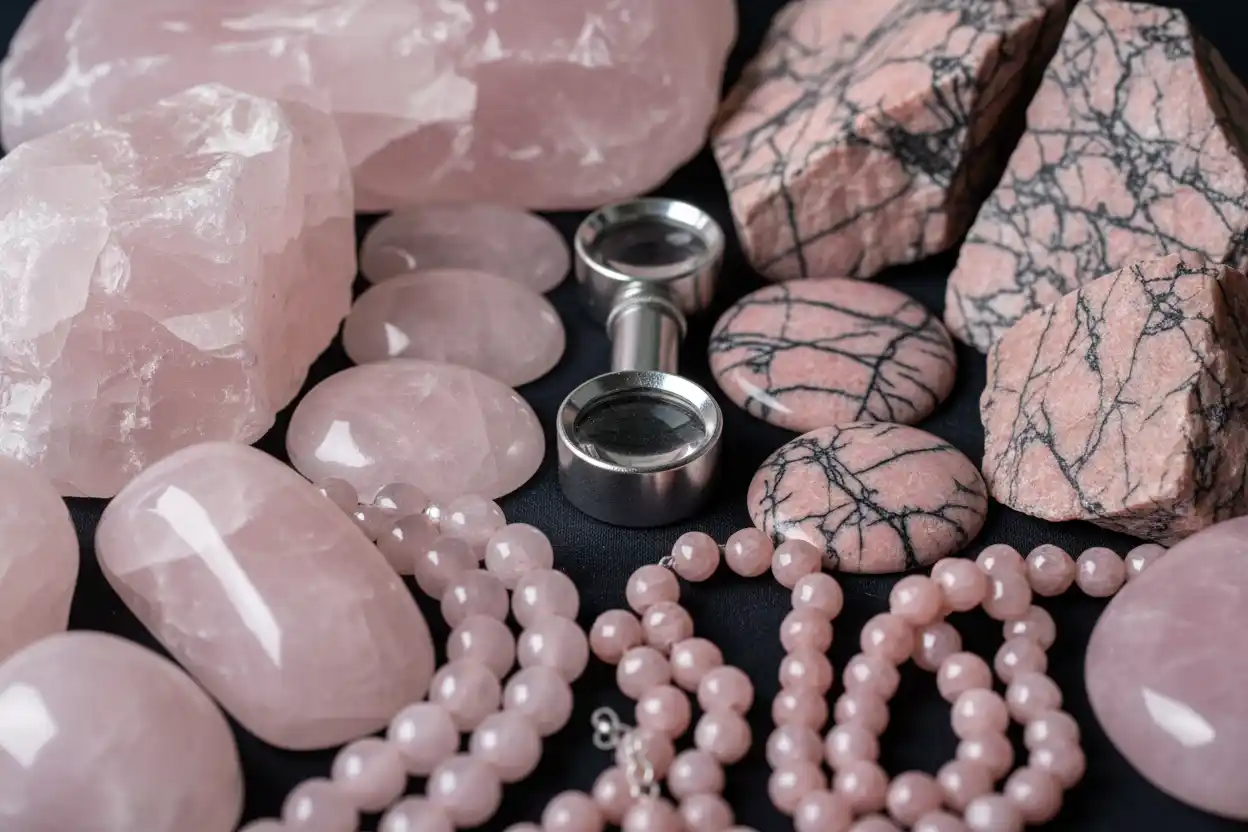
The simplest visual rule is that rose quartz is usually softly cloudy and translucent, while rhodonite is commonly more opaque and crossed by black or dark-brown manganese-oxide veins.
That rule is useful but not absolute. Some rose quartz is opaque, and rare rhodonite can be transparent. Dyed stone, resin and composite material can also reproduce either appearance.
The definitive distinction is mineralogical. Rose quartz is silicon-dioxide quartz. Rhodonite is a manganese-rich chain silicate in the pyroxenoid group. Their hardness, cleavage, density, refractive properties and internal texture therefore differ.
Rose Quartz vs Rhodonite at a Glance
| Feature | Rose quartz | Rhodonite |
|---|---|---|
| Mineral family | Quartz | Pyroxenoid group |
| Simplified composition | SiO₂ | Manganese-rich silicate |
| Crystal system | Trigonal | Triclinic |
| Common color | Pale pink, blush, lavender-pink or medium pink | Rose pink, reddish pink, red or purplish pink |
| Typical pattern | Cloudy, veiled or softly zoned | Black or dark-brown manganese-oxide veins |
| Transparency | Commonly translucent; occasionally transparent or opaque | Commonly opaque to translucent; rarely transparent |
| Mohs hardness | 7 | Approximately 5.5–6 |
| Cleavage | None | Perfect in two directions |
| Fracture | Conchoidal | Uneven to splintery, affected by cleavage |
| Specific gravity | About 2.65 | Commonly about 3.4–3.7 |
| Refractive index | Approximately 1.544–1.553 | Commonly in the low-to-mid 1.70 range |
| Common optical feature | Six-rayed asterism in suitable material | No comparable ordinary star effect |
| Main treatment concerns | Irradiation, dyeing, coating and synthetic quartz | Filling, stabilization, dyeing, coating and composite material |
| Common imitation | Glass, resin and dyed crackle quartz | Dyed howlite, magnesite, resin and painted stone |
| Best confirmation | RI, density, microscopy and Raman spectroscopy | RI, density, Raman spectroscopy and X-ray diffraction |
The difference in density is especially noticeable in accurately measured loose stones, but hand weight alone is not precise enough for authentication.
The Fundamental Mineral Difference
The completed rose quartz meaning guide explains rose quartz’s quartz-family identity.
Quartz consists of silicon and oxygen arranged in a three-dimensional framework.
Rhodonite is a manganese-rich chain silicate whose structure and chemistry are entirely different. Its full profile appears in the completed rhodonite meaning guide.
Both can occur in pink because mineral color does not correspond to one chemical family.
The shared rose appearance explains their commercial confusion, but the stones are no more closely related than many other pink gems.
Color Differences
Rose quartz is commonly blush, pastel pink, pale lavender-pink or medium rose.
Rhodonite often displays stronger rose-red, reddish-pink, purplish-pink or brownish-red color.
Rose quartz color usually appears soft because microscopic inclusions scatter light through the stone.
Rhodonite’s color can look denser and more opaque, particularly in massive ornamental material.
Nevertheless, pale rhodonite can resemble rose quartz, while strongly colored rose quartz can approach rhodonite’s saturation.
Lighting alters both stones. Warm light emphasizes peach and red, while cool light can strengthen purple.
Color should begin the comparison rather than complete it.
Black Veins
Black or dark-brown veins strongly favor rhodonite.
These areas commonly consist of secondary manganese oxides that developed along fractures and grain boundaries.
The lines may branch, widen, cross or form irregular patches.
Natural matrix should have depth and mineral texture.
Rose quartz does not normally show the same characteristic black manganese-oxide network.
However, it may contain tourmaline, hematite, mica or other dark inclusions. One dark line therefore does not prove rhodonite.
Painted resin and dyed stone can imitate black veins. Inspect the edge and back to determine whether the pattern continues naturally.
Cloudiness and Internal Haze
Cloudy translucence strongly favors rose quartz.
Microscopic fibrous inclusions and fractures scatter light, creating a soft glow through the material.
The haze often appears diffuse rather than granular.
Rhodonite may be translucent at thin edges but commonly has a denser mineral texture.
Fine-grained massive rhodonite can look relatively uniform, especially when black matrix is absent.
A cloudy pink stone should still be tested rather than assumed to be quartz, because pink opal, calcite, glass and resin can create similar softness.
White Areas
Rose quartz can contain colorless or milky quartz zones.
Rhodonite can occur with calcite, quartz or paler manganese silicates.
White areas therefore occur in both.
In rose quartz, pale areas often blend gradually with the pink body.
In rhodonite, white material may occur as separate grains, veins or associated mineral patches.
Strong pink-and-white banding may instead suggest rhodochrosite or mangano calcite.
The completed rhodochrosite versus rhodonite guide owns that direct carbonate comparison.
Transparency
Most commercial rose quartz is translucent.
A thin edge often transmits soft pink light even when the center appears cloudy.
Most commercial rhodonite is opaque to translucent.
Rare transparent rhodonite occurs as small red or pink crystals and faceted collector gems.
Transparent rose quartz also requires careful classification because rare crystalline pink quartz and synthetic quartz exist.
Transparency alone cannot separate the materials, but ordinary transparent faceted examples of either deserve stronger documentation than inexpensive opaque beads.
Luster and Polish
Rose quartz normally develops a vitreous polish.
Its surface can look glassy even though the interior remains cloudy.
Rhodonite also takes a vitreous-to-pearly polish, although fine-grained massive material may look slightly softer or more waxy.
A plastic-like surface can indicate resin, coating or heavy stabilization in either product.
Compare polished and chipped areas. Natural mineral texture should continue beneath the surface.
A uniform glossy film that pools in recesses suggests coating.
Hardness
Rose quartz ranks 7 on the Mohs scale.
Rhodonite generally ranks about 5.5–6.
Quartz therefore resists scratching better.
A steel point may scratch rhodonite more readily, but deliberate scratch testing is inappropriate for jewelry or polished specimens.
Coating, filler and mixed rock can also create misleading surface results.
The completed gemstone hardness chart provides comparative context.
Professional testing avoids damaging the object.
Cleavage
Rose quartz has no cleavage.
When it breaks, it commonly shows curved conchoidal fracture.
Rhodonite has perfect cleavage in two directions.
A sharp impact can split rhodonite along flatter structural planes.
Cleavage is not always visible in a polished bead or cabochon, but it affects durability, cutting and setting.
The gemstone cleavage guide explains why cleavage differs from hardness.
Do not strike or pry a stone to expose its breakage pattern.
Toughness and Jewelry Wear
Rose quartz is generally the more practical jewelry stone.
Its higher hardness and lack of cleavage make it suitable for most jewelry forms when internal fractures are limited.
Rhodonite works well in pendants, earrings, beads and protected cabochons, but exposed rings require more caution.
Both materials are brittle enough to chip under a hard blow.
The completed gemstone toughness-versus-hardness guide explains why neither hardness number guarantees resistance to impact.
Density and Heft
Rose quartz has a specific gravity near 2.65.
Rhodonite is significantly denser, commonly around 3.4–3.7.
Two loose stones with identical dimensions should therefore show a measurable weight difference.
Hand comparison is subjective. Shape, hollowness, setting metal and composite construction distort the impression.
Hydrostatic specific-gravity testing provides stronger evidence on a loose solid object.
Dense mineral filler can also make resin feel stone-like, so weight should be combined with other tests.
Refractive Index
Rose quartz occupies the quartz refractive-index range of approximately 1.544–1.553.
Rhodonite generally measures much higher, commonly in the low-to-mid 1.70s depending on composition.
This difference provides a useful professional separation.
Opaque cabochons usually receive a spot reading rather than a full faceted-stone measurement.
Mixed minerals, coatings and curved surfaces can complicate the result.
A refractometer should be used by someone familiar with contact fluid and opaque-stone interpretation.
Double Refraction and Optical Behavior
Quartz is doubly refractive.
Its birefringence is modest and may be difficult to observe in cloudy massive material.
Rhodonite is also anisotropic and doubly refractive, but its optical constants differ substantially.
A polariscope can help determine whether the object behaves consistently with a crystalline mineral rather than ordinary glass.
However, aggregate texture and strain can produce complex reactions.
Optical testing supports identification but does not replace chemistry or spectroscopy in a difficult specimen.
Asterism
Star rose quartz can show a six-rayed star.
Aligned microscopic inclusions create the effect when the stone is cut and oriented correctly.
Rhodonite does not ordinarily produce the same familiar six-rayed asterism.
A strong moving star therefore supports rose quartz identification, although fiber-optic glass and manufactured effects can imitate it.
The star should move across the dome under a focused light.
Absence of a star provides no separation because most rose quartz does not display visible asterism.
Ultraviolet Light
Ultraviolet response is variable in both stones.
Rose quartz can be weak, inert or show responses related to inclusions and treatment.
Rhodonite and associated manganese minerals can also fluoresce differently according to composition.
Dye, resin, glue and filler may create localized reactions.
No single fluorescence color proves either material.
UV is most useful for mapping inconsistent zones rather than providing a pass-or-fail test.
Acid Testing
Acid should not be used as a home identification method.
Rose quartz is generally resistant to ordinary weak acids.
Rhodonite is a silicate rather than a carbonate and is also much less reactive than rhodochrosite or calcite.
Consequently, the dramatic fizz expected from carbonate minerals does not provide a practical rose-quartz-versus-rhodonite test.
Acid can still damage polish, metal, glue, coatings and associated minerals.
Raman spectroscopy provides a non-destructive separation.
Magnification
Use a clean 10× loupe under neutral reflected and transmitted light.
In rose quartz, look for diffuse haze, fine veils, fractures and possible fibrous optical texture.
In rhodonite, look for granular mineral structure, black manganese-oxide veins and distinct mineral boundaries.
Inspect drill holes and chips for dye concentration, resin, coating or a different interior.
Glass may reveal round bubbles and flow lines. Resin may show mold seams and casting swirls.
One inclusion should not determine the conclusion without agreement from physical properties.
Rose Quartz Versus Rhodochrosite
Rhodochrosite is manganese carbonate.
It commonly displays pink-and-white bands and is much softer than rose quartz.
It also has perfect rhombohedral cleavage and is acid-sensitive.
Rose quartz is harder, lacks cleavage and usually has cloudy rather than sharply banded texture.
Rhodonite’s black matrix separates it more readily from both in many ordinary specimens, although all three can occur as relatively plain pink material.
Rose Quartz Versus Mangano Calcite
Mangano calcite is pale-pink calcite colored by manganese.
It is softer than both rose quartz and rhodonite.
It commonly looks waxy, cloudy and delicate and may fluoresce strongly.
Rose quartz is harder and more glassy.
Rhodonite is denser and more likely to contain black oxide.
A visual impression should be confirmed because dyed calcite can imitate stronger pink stones.
Rose Quartz Versus Pink Opal
Pink opal is hydrated amorphous silica.
It commonly appears opaque to translucent with a waxy or porcelaneous surface.
Rose quartz is crystalline, harder and usually more vitreous.
Rhodonite can resemble strongly colored pink opal when black matrix is absent.
Refractive index, density and Raman testing separate all three.
Rose Quartz Versus Morganite
Morganite is pink beryl.
It is commonly transparent, faceted and more brilliant than ordinary rose quartz.
Morganite is also slightly harder and denser.
The completed morganite versus rose quartz guide owns the full comparison.
Rhodonite generally does not resemble fine transparent morganite, although rare faceted rhodonite can enter the same visual color range.
Rose Quartz Versus Pink Tourmaline
Pink tourmaline is a transparent-to-translucent borosilicate gem.
It commonly shows stronger pleochroism, greater brilliance and elongated internal features.
Tourmaline is usually faceted, while ordinary rose quartz and rhodonite are more often cabochon cut.
Rhodonite is substantially denser and usually more opaque.
A transparent faceted pink stone cannot be identified through color alone.
Treatments and Imitations
Rose quartz can be irradiated, dyed, coated or synthetically grown.
The completed treated rose quartz guide owns the detailed enhancement boundary.
Rhodonite may be stabilized, filled, dyed or combined with resin. Transparent fracture filling has been documented, while ordinary beads may contain composite or imitation material.
Dyed howlite and magnesite can imitate rhodonite’s dark-veined appearance.
Pink glass and resin can imitate either stone.
The completed real-versus-fake rose quartz guide covers quartz-specific imitations, while the planned where-to-buy-rhodonite guide owns seller evaluation for rhodonite.
Meaning and Symbolism Differences
Rose quartz is traditionally associated with affection, gentleness and self-compassion.
Rhodonite is commonly associated with compassion supported by boundaries, emotional recovery and constructive response after conflict.
The themes overlap because both are pink stones within modern heart-centered traditions.
Meaning cannot identify a mineral.
The broader pink crystals guide owns the spiritual color family, while pink gemstones owns the gemological list.
A Safe Home Identification Sequence
Begin with the overall pattern.
Soft cloudy pink favors rose quartz. Dense rose-red material with black veins favors rhodonite.
Inspect a thin edge under transmitted light. Rose quartz commonly glows diffusely, while massive rhodonite often remains more opaque or granular.
Use a loupe on drill holes, chips and matrix boundaries.
Compare accurately measured weight only when the stones have similar dimensions and no settings.
Do not scratch, acid-test, burn or solvent-soak the object.
For a valuable specimen, obtain professional refractive-index, density or Raman testing.
The general how-to-identify-crystals guide provides the broader non-destructive workflow.
Laboratory Identification
Raman spectroscopy separates quartz from rhodonite directly.
X-ray diffraction can confirm crystalline phases and distinguish rhodonite from pyroxmangite or related pyroxenoid minerals.
Refractive index and specific gravity provide efficient supporting evidence.
FTIR can reveal polymer filler or coating.
Chemical analysis confirms silica-rich quartz or manganese-rich silicate composition.
The completed gemstone certification guide explains report scope, while how to read a gem-lab report helps determine whether the entire object or one tested area was identified.
Buying Considerations
For rose quartz, use the dedicated buying guide and confirm natural versus treated or synthetic material.
For rhodonite, ask whether the object is solid natural material, rhodonite-rich rock, filled, dyed or composite.
Inspect exact-item photographs rather than relying on a generic listing image.
For remote purchases, follow how to buy gemstones online and preserve enough of the return period for inspection.
Neither a healing card nor a country-of-origin claim substitutes for material identification.
Cleaning and Water Safety
Rose quartz tolerates brief warm-soapy-water cleaning.
Rhodonite should receive a soft cloth or brief gentle cleaning because cleavage, oxide matrix, dye and filler may create additional concerns.
Avoid steam and ultrasonic cleaning for both.
Do not use acids.
The completed crystal water-safety guide explains why washing and direct elixir preparation are different questions.
Store both stones away from harder gemstones. Rose quartz can scratch rhodonite, while diamond, sapphire and ruby can scratch both.
Frequently Asked Questions
1. What is the easiest visual difference between rose quartz and rhodonite?
Rose quartz is usually cloudy and softly translucent, while rhodonite commonly shows black or dark-brown manganese-oxide veins.
2. Can rhodonite occur without black veins?
Yes. Rare transparent crystals and selected massive material may show little visible oxide.
3. Can rose quartz contain black inclusions?
Yes. Dark mineral inclusions can occur, but they usually do not form rhodonite’s characteristic manganese-oxide network.
4. Which stone is harder?
Rose quartz is harder at Mohs 7, while rhodonite is commonly about 5.5–6.
5. Which stone is heavier?
Rhodonite is significantly denser than rose quartz when equal-size loose stones are compared.
6. Which stone has cleavage?
Rhodonite has perfect cleavage in two directions. Rose quartz has no cleavage.
7. Can rose quartz show a star?
Yes. Properly oriented microscopic inclusions can create a six-rayed star.
8. Are rose quartz and rhodonite chemically related?
No. Rose quartz is silicon dioxide, while rhodonite is a manganese-rich silicate.
9. Is rhodonite better than rose quartz for jewelry?
Rose quartz is generally more durable. Rhodonite still works well in pendants, earrings and protected cabochons.
10. Can ultraviolet light separate them?
Not reliably. Both show variable reactions, and treatments can alter fluorescence.
11. Should acid be used to identify them?
No. Neither requires acid testing, and chemicals can damage polish, settings and treatments.
12. Which laboratory test gives the clearest answer?
Raman spectroscopy distinguishes quartz from rhodonite quickly, while X-ray diffraction can resolve related rhodonite-group minerals.
Rose quartz and rhodonite share a pink color family but express it through different structures. Rose quartz is lighter, harder and commonly cloudy; rhodonite is denser, softer, cleavable and frequently marked by black manganese oxides. Pattern provides the first clue, while refractive index, density and spectroscopy provide the final identification.
Rose quartz and rhodonite are indexed in Crystals That Start With R and Gemstones That Start With R.