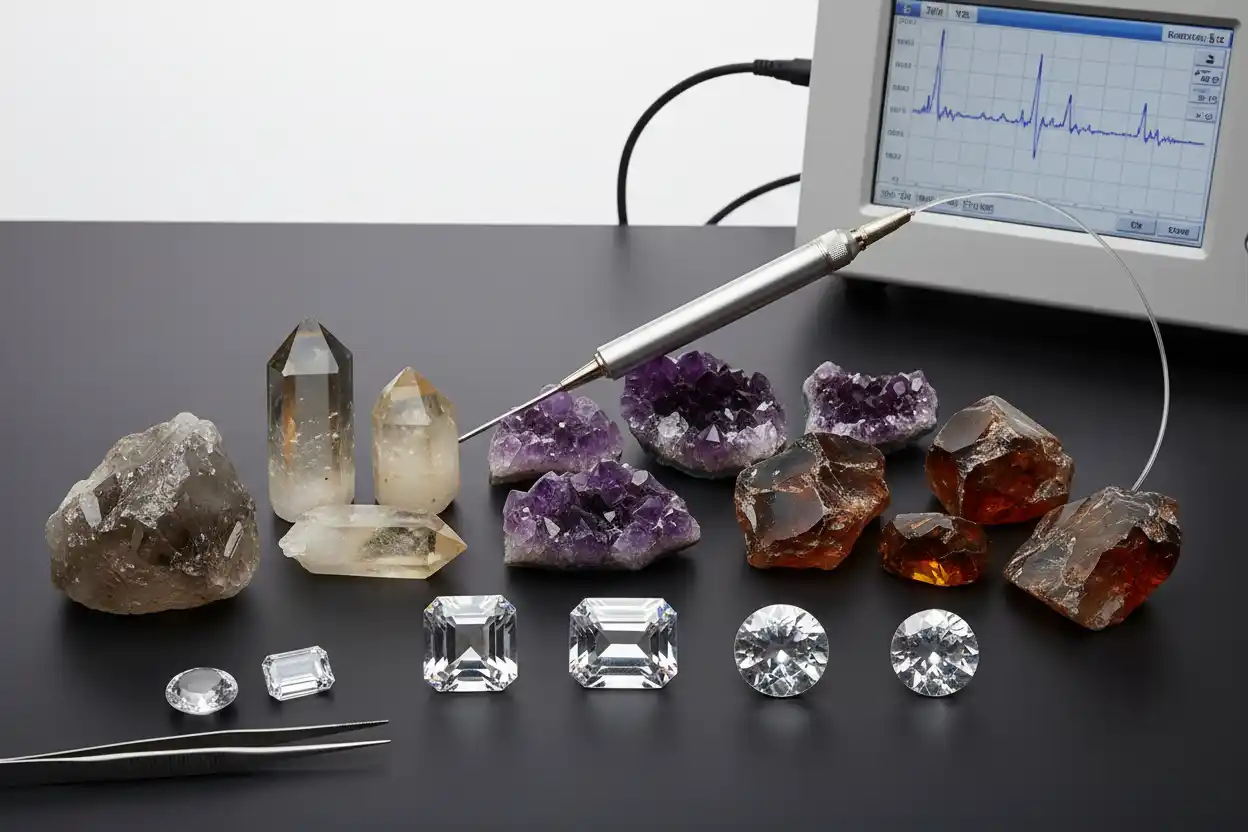
Smoky Quartz vs Citrine: How to Tell Them Apart
Smoky Quartz and Citrine are color varieties of the same mineral species. Both are crystalline quartz with the composition SiO₂, trigonal crystal structure, Mohs hardness 7, specific gravity near 2.65, and the same basic refractive properties.
Their distinction lies primarily in color and the atomic defects that produce it. Smoky Quartz ranges from pale smoky gray through brown to nearly black. Citrine ranges from pale yellow through golden, orange, brownish orange, and reddish orange.
Because the physical properties overlap almost completely, a refractometer, hardness test, or density measurement can confirm quartz but will not necessarily determine whether a borderline yellow-brown stone should be called Smoky Quartz or Citrine. Dominant hue, tone, saturation, zoning, treatment history, and trade convention become central.
Smoky Quartz and Citrine at a glance
| Property | Smoky Quartz | Citrine |
|---|---|---|
| Mineral species | Quartz | Quartz |
| Composition | Silicon dioxide, SiO₂ | Silicon dioxide, SiO₂ |
| Crystal system | Trigonal | Trigonal |
| Main color range | Gray, smoky brown, yellow-brown, dark brown, nearly black | Pale yellow, golden yellow, orange, brownish orange, reddish orange |
| Main color mechanism | Radiation-related color centers associated largely with aluminum substitutions | Iron-related color centers; market material commonly comes from heated Amethyst |
| Mohs hardness | 7 | 7 |
| Specific gravity | About 2.65 | About 2.65 |
| Refractive index | About 1.544–1.553 | About 1.544–1.553 |
| Cleavage | None | None |
| Common treatment | Irradiation can create or deepen smoky color | Heat-treated Amethyst is widespread; irradiation and combined treatment also occur |
| Natural rarity | Common in many localities | Natural-color material is comparatively uncommon |
| Main identification problem | Natural versus artificially irradiated color | Natural Citrine versus heated Amethyst or other yellow quartz |
Both are quartz
Quartz is one of the most abundant minerals in Earth’s crust and occurs in many color varieties.
The broad mineral family includes Clear Quartz, Amethyst, Citrine, Smoky Quartz, Rose Quartz, Ametrine, Prasiolite, and numerous included or microcrystalline forms.
The species-level mineralogy appears in Quartz: Types, Properties & Meaning. The individual material profiles appear in Smoky Quartz: Meaning, Healing Properties & Uses and Citrine: Meaning, Healing Properties & Uses.
Since both comparison stones are quartz, they share hardness, fracture, density, and optical character. A stone that scratches glass and produces quartz refractive readings may still belong to either color category.
Smoky Quartz color
Smoky Quartz ranges from a faint gray or beige haze to deep brown, black-brown, and nearly opaque black.
Pale stones may be called smoky gray, smoky beige, champagne, or light brown. Dark varieties include Cairngorm and Morion in historical or locality-related usage.
The tracker’s Types of Smoky Quartz page owns those color and trade varieties.
A high-quality faceted Smoky Quartz should remain transparent enough to return light. Stones that become nearly black face up may hide inclusions, lose brilliance, and appear lifeless unless the cut is shallow or the lighting is intense.
Citrine color
Citrine occupies the yellow-to-orange side of the quartz palette. It may appear pale lemon yellow, golden, honey yellow, yellow-orange, brownish orange, or reddish orange.
The most desirable shade depends on the buyer and market. Some prefer a pale clean yellow, while others favor saturated reddish-orange or brownish-orange material.
The complete variety breakdown appears in Types of Citrine.
Not every yellow quartz is Citrine. Iron-stained quartz, coated quartz, Lemon Quartz, synthetic material, and quartz containing yellow inclusions may need a more precise description. Those distinctions belong to Yellow Quartz Explained: Citrine, Lemon Quartz and Iron-Stained Quartz.
The color mechanisms differ
Smoky Quartz color is associated with radiation-induced defects in quartz containing suitable aluminum substitutions. Natural radiation from surrounding rocks can create those color centers over geological time.
Artificial irradiation can produce or deepen the same general smoky appearance. Consequently, the presence of smoky color does not prove that the radiation exposure occurred naturally.
Citrine’s color is connected with iron-related defects and structural processes within quartz. Natural Citrine forms under relatively uncommon conditions.
Most Citrine in the commercial market is produced by heating Amethyst. Heat changes the iron-related color centers, shifting purple material toward yellow, orange, or brownish orange.
The starting crystal can still be natural quartz. Heat-treated Amethyst sold as Citrine is treated natural material rather than glass or laboratory-grown quartz.
Natural Citrine is comparatively rare
Natural Citrine is much less abundant than Amethyst or Smoky Quartz.
It commonly appears pale yellow, smoky yellow, golden, or slightly brownish. Strongly saturated material exists, but pale color should not be interpreted as low authenticity.
The rarity of natural Citrine is one reason heated Amethyst dominates the affordable market.
The separate Real vs. Fake Citrine article owns the broad authenticity workflow, including heat-treated Amethyst, glass, coatings, synthetic quartz, and dyed imitations.
This comparison article focuses instead on where Citrine ends and Smoky Quartz begins.
Heated Amethyst indicators
Heat-treated Amethyst commonly enters the market as orange, reddish orange, brownish orange, or dark golden Citrine.
In geode clusters, the color may be concentrated near the crystal tips while the base remains white or pale. The crystals may show a burnt-orange or brown appearance that differs from many naturally pale Citrines.
That pattern is useful but not conclusive. Natural quartz can show zoning, and some treated material is cut into faceted stones that remove the original crystal base.
Likewise, not every evenly colored pale Citrine is natural. Treatment can produce subtle colors, and laboratory-grown quartz can imitate natural appearances.
Detailed treatment indicators belong to How to Spot Treated or Synthetic Citrine.
Artificially irradiated Smoky Quartz
Colorless or pale quartz can be irradiated to produce smoky color. The resulting stone remains crystalline quartz.
Artificially irradiated material may become very dark, nearly black, or unevenly zoned. Nevertheless, natural Smoky Quartz can also be extremely dark.
Standard quartz properties do not separate natural from laboratory irradiation because the treatment alters a color center rather than replacing the mineral.
Sophisticated investigation may use spectroscopy, growth context, residual radiation history, zoning, and comparison with known material. In many commercial cases, definitive separation is difficult or economically impractical.
This distinction belongs within the wider framework of Gemstone Treatments Explained.
Where Smoky Quartz becomes Citrine
There is no new mineral boundary between a brownish-yellow Smoky Quartz and a smoky brown Citrine. Both remain quartz.
The trade generally uses Citrine when yellow or orange is the dominant impression. Smoky Quartz is more appropriate when gray, brown, or smoke-like tone dominates.
Borderline stones may receive descriptions such as smoky Citrine, smoky yellow quartz, champagne quartz, cognac quartz, or golden smoky quartz. These are usually trade terms rather than separate mineral varieties.
A seller should show the actual color and avoid using the more valuable name merely to raise the price.
In difficult borderline material, a descriptive phrase such as yellow-brown quartz may be more scientifically honest than forcing a categorical label.
Smoky Citrine exists naturally
Individual quartz crystals can contain both smoky and Citrine zones. Natural growth sectors may incorporate different impurities and develop different color centers after irradiation or heat.
A crystal may show a smoky outer layer, yellow interior, alternating zones, or a gradual transition from gray-brown to golden yellow.
Such material is not necessarily a composite or dyed product. GIA has documented Ametrine specimens containing natural Smoky Quartz layers within Citrine-bearing sectors.
The wider bicolored quartz context appears in Ametrine: Meaning, Healing Properties & Uses.
Amethyst links the two color families
Amethyst, Citrine, and Smoky Quartz are all quartz varieties whose colors depend on trace impurities, structural defects, radiation, and heat.
Heating Amethyst can create Citrine-like yellow and orange material. Radiation acting on suitable quartz can create smoky or purple color centers.
The individual purple material appears in Amethyst: Meaning, Healing Properties & Uses. Its authenticity boundaries, including synthetic quartz and treatment, appear in Real vs Fake Amethyst.
The close relationship among quartz colors explains why visual appearance alone cannot reconstruct the stone’s entire treatment history.
Crystal habit
Both Smoky Quartz and Citrine can form six-sided prisms with pointed terminations. Both may occur as isolated crystals, clusters, geodes, massive quartz, or faceted stones.
Crystal shape does not separate them because the underlying lattice is the same.
A natural termination can support natural crystal growth, but synthetic quartz also forms crystals and can be cut into natural-looking shapes.
A polished tower has no evidentiary value as a natural termination. It is a manufactured object regardless of whether the raw material is natural quartz.
Inclusions
Both varieties can contain liquid inclusions, gas bubbles within fluid cavities, mineral crystals, needles, veils, healed fractures, growth zoning, and phantoms.
No inclusion is unique to Smoky Quartz or Citrine.
A dark Smoky Quartz may conceal inclusions visually, while pale Citrine often allows easier inspection. Heat can alter included minerals and fractures, although interpretation requires experience.
An eye-clean stone is not automatically synthetic. Quartz commonly forms large clean crystals suitable for sizable faceted gems.
Pleochroism and color direction
Quartz is weakly doubly refractive, but its pleochroism is usually subtle compared with Tanzanite, Tourmaline, or Ruby.
Some Smoky Quartz and Citrine may appear slightly different in tone when viewed along separate directions. This is not a practical consumer separation because both varieties share the same crystal system.
Color zoning provides more useful information. A stone may show straight, angular, phantom-like, or sector-related variations that reflect growth and treatment.
Zoning can support analysis but cannot prove natural color.
Refractive index, density, and hardness
A refractometer should produce the same quartz range for both stones. Specific gravity should also be near 2.65, and each should rank 7 on the Mohs scale.
These measurements are valuable for excluding glass, Topaz, Sapphire, beryl, synthetic Spinel, and other lookalikes. They do not decide between Smoky Quartz and Citrine.
This is a useful example of the difference between mineral identification and variety naming.
The general sequence appears in How to Identify Crystals. First identify quartz. Then analyze color, treatment, and commercial terminology.
Smoky Quartz value factors
Smoky Quartz is widely available, including in large crystals and faceted stones.
Value is driven by transparency, attractive brown or gray color, even tone, cutting, crystal formation, locality, unusual zoning, and specimen aesthetics.
The completed Smoky Quartz Buying Guide owns purchasing priorities, while the Smoky Quartz Price Guide covers its value structure.
Extremely dark material is not automatically more valuable. If the stone appears black under ordinary light, the color may hide brilliance and internal interest.
Citrine value factors
Citrine value depends on color, transparency, cutting, size, treatment representation, natural crystal form, and documentation.
Commercial heated material is abundant and affordable. Credibly documented natural-color Citrine can receive stronger collector interest, especially when preserved as attractive crystals or unusual specimens.
The Citrine Buying Guide owns quality and seller evaluation. The Citrine Price Guide separates common treated material from fine faceted stones, natural-color crystals, and unusual specimens.
Color names such as Madeira, honey, cognac, or lemon are not standardized grades.
Which should you choose?
Choose Smoky Quartz when you prefer gray, brown, earthy, neutral, or near-black tones. It works well in large statement jewelry because sizable clean material is available.
Choose Citrine when you prefer yellow, gold, orange, or warm reddish-orange color. It has a brighter visual presence and a longer-established role as a November birthstone.
The decision should be based on the actual stone rather than a belief that one variety is inherently more natural. Either may be naturally colored or treated.
The shared November context appears in November Birthstone: Topaz & Citrine.
Care and color stability
Both varieties have quartz hardness 7 and no cleavage, making them suitable for many jewelry styles.
Sudden temperature changes can damage heavily included stones, while sharp impact may chip exposed corners.
Strong prolonged heat can alter quartz color centers. Some treated or unstable colors may also fade under intense light over time.
Routine cleaning should use warm water, mild soap, and a soft brush after treatment and setting construction are known. Material-specific guidance appears in How to Clean Smoky Quartz Jewelry Safely and How to Clean Citrine Jewelry Safely.
Laboratory reports
A report can confirm that a stone is quartz, identify synthetic growth in some cases, and document certain treatments or unusual color characteristics.
However, a standard laboratory may not always be able to prove whether a smoky color center formed through natural background radiation or artificial treatment. Similar limitations can apply when separating some naturally heated or irradiated Citrines from equivalent human treatment.
Testing is most worthwhile for exceptional natural-color claims, rare specimens, synthetic-growth concerns, or unusually expensive stones.
The completed Gemstone Certification Labs Compared explains report scope, while How to Read a Gem Lab Report helps interpret cautious wording and testing limitations.
Frequently Asked Questions
1. Are Smoky Quartz and Citrine the same mineral?
Yes. Both are color varieties of crystalline quartz with the composition SiO₂.
2. What is the main difference?
Smoky Quartz is dominated by gray or brown radiation-related color, while Citrine is dominated by yellow-to-orange iron-related color.
3. Can one crystal contain both?
Yes. Natural quartz can contain adjacent or layered Smoky Quartz and Citrine color zones.
4. What is smoky Citrine?
It is a trade description for quartz displaying both yellow-orange and smoky gray-brown color.
5. Is natural Citrine rare?
Natural-color Citrine is comparatively uncommon. Most commercial Citrine is produced by heating Amethyst.
6. Is heated Amethyst fake Citrine?
It remains natural quartz with treatment-created yellow or orange color. The treatment should be disclosed accurately.
7. Can Smoky Quartz be artificially irradiated?
Yes. Irradiation can create or deepen smoky color in suitable quartz.
8. Can hardness distinguish Smoky Quartz from Citrine?
No. Both have Mohs hardness 7 because both are quartz.
9. Can a refractometer separate them?
It can confirm quartz, but both varieties occupy the same refractive-index range.
10. Is dark brown quartz always Smoky Quartz?
Usually the smoky name is more appropriate when brown or gray dominates, but yellow-brown borderline material may receive mixed trade descriptions.
11. Which is generally more valuable?
Citrine often has a higher commercial profile, especially for attractive yellow-orange color, while exceptional Smoky Quartz specimens can also be valuable.
12. Can a laboratory prove natural color?
Sometimes laboratory evidence can support a conclusion, but natural and artificial irradiation or heating can produce overlapping results in quartz.
Conclusion
Smoky Quartz and Citrine are not separate mineral species. They are quartz varieties distinguished primarily by dominant color and the defects responsible for that color.
Smoky Quartz reflects radiation-related color centers associated largely with aluminum-bearing quartz. Citrine reflects iron-related processes, and most commercial Citrine comes from heated Amethyst.
Since hardness, density, refractive index, and crystal habit overlap, a laboratory can easily confirm quartz but may face greater difficulty proving how the color formed. For borderline yellow-brown stones, transparent trade terminology and accurate photographs are often more meaningful than forcing an absolute variety label.