Rutilated Quartz Meaning, Healing Properties, Uses and Care
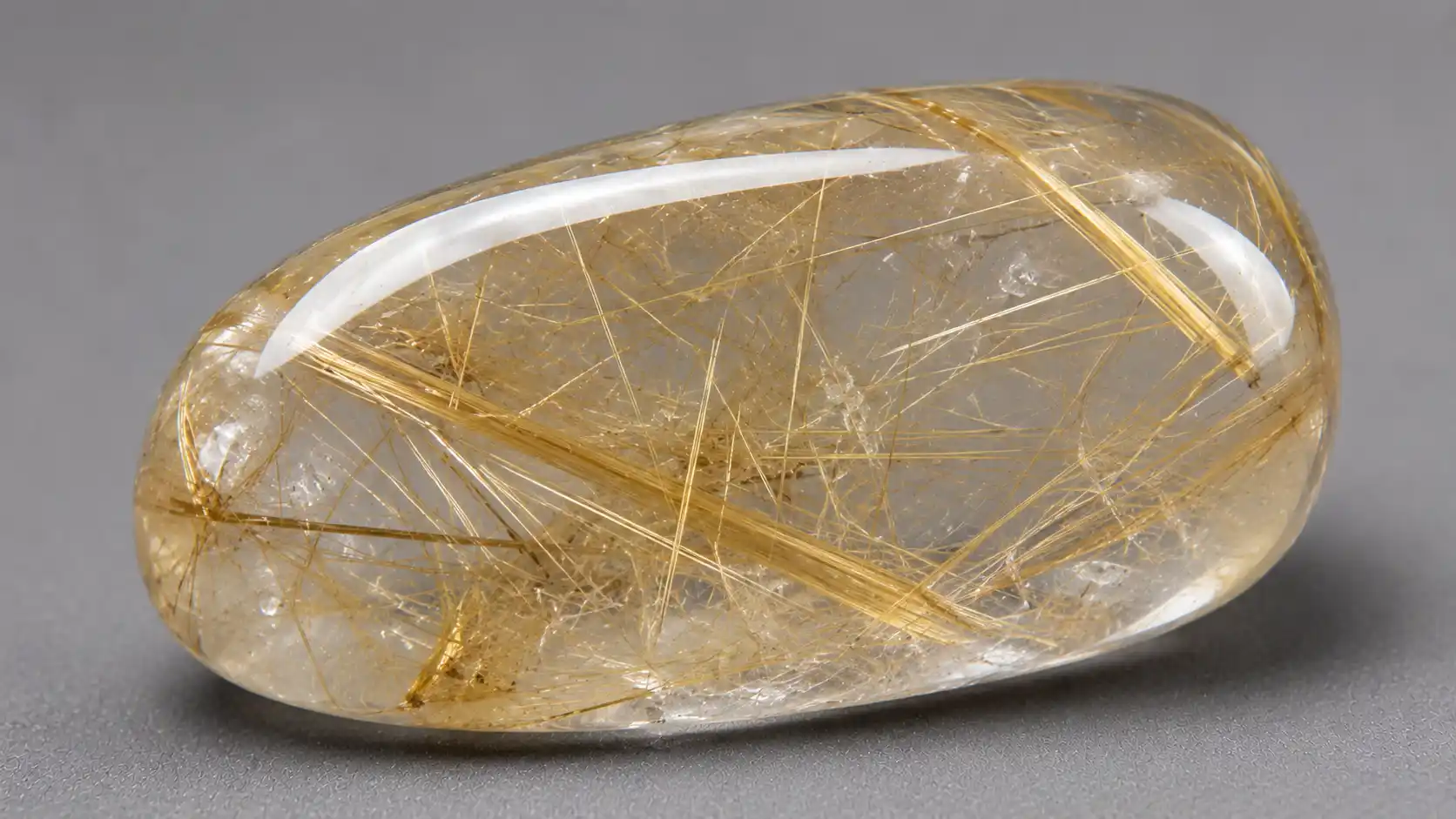
Rutilated quartz is transparent-to-translucent quartz containing visible needle-like crystals of rutile. The inclusions may appear golden, copper-red, reddish brown, silvery gray or almost black, creating patterns that resemble fine hair, threads, arrows, sprays or intersecting stars.
Unlike most included gemstones, rutilated quartz is valued precisely because of its internal minerals. Each piece records a particular episode of crystal growth, with rutile forming before or during the development of the surrounding quartz.
In modern crystal traditions, rutilated quartz symbolizes clarity joined with decisive action. Its transparent host is associated with awareness, while the linear inclusions represent direction, momentum, illumination and the ability to move through complexity without requiring every obstacle to disappear first.
Those meanings are spiritual interpretations rather than scientific effects. Rutilated quartz cannot treat anxiety, depression, respiratory illness, hormonal conditions or any other medical problem.
Rutilated Quartz at a Glance
| Property | Rutilated quartz |
|---|---|
| Material type | Quartz containing visible rutile inclusions |
| Host composition | Silicon dioxide, SiO₂ |
| Inclusion composition | Rutile, titanium dioxide, TiO₂ |
| Common host colors | Colorless, milky, smoky, pale yellow or brownish quartz |
| Inclusion colors | Gold, yellow, copper-red, reddish brown, gray, silver and near-black |
| Crystal system | Trigonal quartz host; tetragonal rutile inclusions |
| Transparency | Transparent to opaque, depending on inclusions and fractures |
| Luster | Vitreous |
| Mohs hardness | Approximately 7 for the quartz host |
| Cleavage | None in quartz |
| Fracture | Conchoidal to uneven |
| Specific gravity | Near 2.65 overall, with local variation from dense inclusions |
| Common cuts | Cabochons, tablets, freeforms, beads, carvings and faceted gems |
| Main care concern | Internal fractures, exposed needles, filler and imitation glass |
| Traditional themes | Clarity, direction, manifestation, confidence and transformation |
What Is Rutilated Quartz?
Rutilated quartz belongs to the larger quartz family described in Quartz: Types, Properties & Meaning.
The host is commonly rock crystal or another transparent-to-translucent form of quartz. The visible needles are crystals of rutile, whose independent mineral identity appears in Rutile: Meaning, Properties & Symbolism.
Rutilated quartz is therefore not a separate mineral species. It is an included variety defined by the relationship between quartz and rutile.
The term should be reserved for quartz whose needle-like inclusions are actually rutile. Black tourmaline enclosed in quartz produces a different material known as Tourmalinated Quartz.
Visual appearance can suggest which inclusion is present, but Raman spectroscopy or another analytical method provides the strongest identification when the distinction matters.
What Is Rutile?
Rutile is a titanium-dioxide mineral with the formula TiO₂.
It commonly forms prismatic, bladed or acicular crystals. Fine needles can become enclosed in quartz, sapphire, ruby and other gemstones.
Pure rutile may be dark red, brown, black or metallic-looking. Trace elements and the thinness of a needle influence the color seen through transparent quartz.
A very fine brownish or reddish rutile crystal may reflect light as brilliant gold. Thicker inclusions often appear darker and more coppery.
Rutile has a lower hardness than its quartz host, but an enclosed needle cannot normally be scratched directly unless it reaches the surface.
How Rutilated Quartz Forms
Many pieces form when rutile crystals develop before the surrounding quartz has finished growing.
Silica-rich fluids later deposit quartz around the rutile, enclosing the needles while preserving their shape.
Some rutile sprays originate from a small hematite crystal or another mineral nucleus. Needles may radiate in several directions, producing a geometric star or sunburst inside the host.
The relationship between inclusion and host can be complex. Rutile may predate the quartz, grow during quartz formation or be affected by later geological changes.
Hydrothermal veins and metamorphic environments can both create suitable conditions.
Because the inclusions formed naturally within the crystal-growth environment, their patterns are rarely perfectly symmetrical or repeated from one stone to another.
Golden Rutilated Quartz
Golden rutilated quartz contains fine yellow, gold or bronze-colored needles.
The apparent gold is an optical effect produced by rutile and reflected light rather than metallic gold.
Thin needles can look bright and delicate, while dense bundles produce a stronger graphic pattern.
Commercial descriptions such as Venus hair, angel hair and golden hair quartz refer to appearance rather than distinct mineral varieties.
Golden material is commonly used in faceted gems, transparent cabochons, beads and polished freeforms.
Color, needle arrangement, host clarity and cutting quality affect visual appeal more than the simple number of inclusions.
Red and Copper Rutilated Quartz
Rutile can appear copper-red, reddish brown, rust or dark orange within quartz.
These colors often become stronger in thicker crystals or in needles viewed along particular directions.
Red rutile may be mistaken for hematite, lepidocrocite or another iron-bearing inclusion.
The visual name red rutilated quartz should not be used as a substitute for analytical identification when a specimen has unusual platelets, flakes or granular inclusions.
Some sellers describe every red inclusion in quartz as rutile. That practice can misidentify included quartz containing hematite or other minerals.
Silver and Gray Rutilated Quartz
Silvery-gray rutile may form tufts, sprays or fine metallic-looking bundles.
The color can result from the rutile’s composition, orientation and reflective behavior rather than from silver metal.
Gray needles should also be distinguished from black tourmaline and other dark inclusions.
Rutile often forms finer, more reflective needles than tourmaline. Tourmaline commonly appears as thicker, straighter prisms with longitudinal striations.
However, those tendencies are not conclusive in a polished stone.
Black Rutilated Quartz
The label black rutilated quartz requires caution.
Natural rutile can appear very dark brown or black, especially in thicker crystals. Yet many black-needle quartz products contain tourmaline rather than rutile.
Some specimens may include several minerals, making one simple trade label incomplete.
A seller should identify the inclusion rather than assuming that every dark line is rutile.
The comparison with tourmaline-bearing material belongs in the tourmalinated-quartz guide, while general testing begins with How to Identify Crystals.
Rutile Stars and Sagenitic Patterns
Rutile needles sometimes intersect or radiate from a central point.
Mineral collectors may use the term sagenite for net-like, lattice-shaped or intersecting rutile growth.
A hematite platelet can act as a nucleus around which rutile develops in several directions.
When enclosed in transparent quartz, the result may look like a six-rayed star suspended inside the stone.
This is an inclusion pattern rather than the surface-moving asterism seen in star ruby or star sapphire. The star remains physically enclosed and can be viewed from different directions.
A cutter may orient the stone to make the pattern appear centered and three-dimensional.
Rutilated Quartz Versus Clear Quartz
Clear Quartz and rutilated quartz share the same host mineral.
The difference is the conspicuous rutile inclusion.
Clear quartz can contain small internal features without qualifying as rutilated. The term is appropriate when rutile needles create a defining part of the appearance.
The host retains quartz’s hardness, refractive properties and lack of cleavage.
The completed Types of Clear Quartz guide places included varieties within the wider transparent-quartz family.
Rutilated Quartz Versus Golden Healer Quartz
Golden Healer Quartz typically shows yellow-to-golden iron-oxide staining, coatings or inclusions distributed through or across quartz.
Its color may appear cloudy, layered or surface-related rather than needle-like.
Rutilated quartz contains distinct rutile crystals with linear form.
A piece can contain both iron staining and rutile, so the categories are not always mutually exclusive.
The correct description should state the visible features rather than forcing a complex specimen into one trade name.
Rutilated Quartz Versus Garden Quartz
Garden Quartz contains scenic inclusions that can resemble moss, landscapes, clouds or underwater gardens.
Those inclusions may include chlorite, iron oxides, clay and other minerals.
Rutilated quartz is defined more narrowly by visible rutile needles.
A quartz specimen containing both rutile and scenic mineral inclusions may be described in more than one way, but the seller should identify the main components accurately.
Rutilated Quartz Versus Phantom Quartz
Phantom Quartz preserves the outline of an earlier crystal-growth stage.
A phantom commonly appears as an internal triangular or pyramidal zone rather than as isolated needles.
Rutilated quartz records included rutile crystals, while phantom quartz records interrupted and resumed quartz growth.
Both features can occur in one specimen.
When they do, the stone’s value depends on how clearly each feature can be seen and how well the cut presents their relationship.
Rutilated Smoky Quartz
Rutile can occur within brown-to-gray smoky quartz.
The darker host creates greater contrast with golden needles but may conceal red, brown or black inclusions.
The host’s color mechanism belongs in Smoky Quartz: Meaning, Healing Properties & Uses.
A smoky host can be natural or produced through irradiation.
Therefore, a specimen may contain natural rutile while the surrounding quartz color has been enhanced.
The treatment status of the host and the natural identity of the inclusions are separate questions.
Rutilated Quartz Meaning
The traditional meaning of rutilated quartz centers on illumination within complexity.
Its transparent host symbolizes awareness, while the visible needles represent paths, decisions and ideas moving through that awareness.
Practitioners frequently use it when they want greater direction rather than simple calm.
The stone may symbolize recognizing that clarity does not always mean an empty or uncomplicated situation. The inclusions make the quartz more visually interesting, which supports interpretations involving growth through experience rather than purity through removal.
Rutilated Quartz and Clarity
Rutilated quartz is often associated with mental clarity.
A responsible interpretation does not claim that the mineral changes cognition biologically.
Instead, the stone can act as a focus during planning, prioritization or reflective writing.
Its intersecting lines can symbolize several concerns becoming visible at once. The practice then involves choosing which line to follow first.
A useful exercise is to write every active task, identify the one with the clearest next action and place the stone beside that task until it is completed.
Rutilated Quartz and Manifestation
Manifestation language is common in rutilated-quartz traditions.
The most practical interpretation treats manifestation as converting an intention into decisions, preparation and repeated action.
The stone does not guarantee money, relationships or opportunities.
It can symbolize direction and follow-through, particularly when an intention has remained abstract.
The completed How to Program Crystals for Your Intentions guide explains how to connect a symbolic object with a measurable action.
Rutilated Quartz and Confidence
The straight and radiating inclusions are often interpreted as symbols of decisiveness.
A person may use rutilated quartz before a meeting, application, presentation or conversation that requires clear expression.
Confidence should be connected with preparation rather than expecting the stone to remove uncertainty.
The ritual might include reviewing facts, writing the opening sentence and deciding which boundary or request needs to be communicated.
Rutilated quartz then marks the intention to act deliberately.
Rutilated Quartz and Transformation
Rutilated quartz contains two visibly different minerals in one object.
That relationship has inspired symbolism involving integration, change and the discovery of value in previously unwanted features.
In ordinary gem grading, inclusions often reduce clarity. Here, the inclusions create the identity and desirability of the stone.
This reversal makes rutilated quartz a useful symbol for reinterpreting a difficult experience without pretending the experience was harmless.
Transformation means deciding what can be learned or carried forward, not claiming that every hardship was necessary.
Rutilated Quartz and Spiritual Practice
Some traditions associate rutilated quartz with heightened intuition, energetic amplification and spiritual communication.
These ideas are not scientifically measurable properties.
The stone can still be used during meditation as a visual object whose internal lines encourage sustained attention.
Practitioners may follow one needle visually, notice where it intersects another and return attention when the mind wanders.
The broader compatibility of different symbolic stones appears in Crystal Pairings.
How to Meditate With Rutilated Quartz
Choose a transparent piece whose inclusions can be seen clearly.
Hold it near a safe light source or place it on a stable surface.
Observe one rutile needle from end to end. Then notice where it crosses other inclusions or disappears into cloudier quartz.
Allow the pattern to become a prompt for one question: What requires a clear direction now?
Write the answer in one sentence and identify a next step.
The exercise uses the stone as an attentional anchor rather than treating it as a source of medical or supernatural instruction.
Jewelry Uses
Rutilated quartz is fashioned into pendants, earrings, rings, bracelets, beads and collector carvings.
Pendants and earrings protect highly included stones better than exposed rings.
Large transparent cabochons can display three-dimensional needle patterns, while faceted cuts create flashes that appear between the inclusions.
A ring should use a setting that protects the girdle, especially when fractures reach the surface.
The cutter must consider both the quartz outline and the orientation of the rutile. A stone with an excellent pattern can lose much of its appeal if the needles are hidden by a poorly placed pavilion.
Cutting and Polishing
Rutilated quartz is challenging because the inclusions and fractures interrupt an otherwise predictable quartz host.
The cutter often sacrifices weight to center a striking spray, preserve a star or avoid exposed cavities.
Faceting can make sparse needles appear to multiply through reflection. Cabochons provide a clearer view of dense three-dimensional patterns.
Needles that reach the surface may leave tiny pits or create weak points during polishing.
Large freeforms and tablets are popular because they preserve more of the natural inclusion scene.
The cutter’s skill should be evaluated through orientation and polish rather than the complexity of the outline alone.
Value Factors
Rutilated quartz value depends on host clarity, needle color, pattern, cutting, size and structural condition.
A transparent host with a well-centered golden spray may command more than a cloudy stone filled with random dark inclusions.
Dense inclusions are not automatically better. If the rutile obscures the host completely, the stone may lose depth.
Rare geometric arrangements, vivid copper-red needles and unusually fine silvery sprays can attract collector interest.
Large size is available, so weight alone does not establish value.
Cracks, exposed needles, resin filling and misleading treatment claims reduce desirability.
The complete seller and imitation workflow appears in Where to Buy Real Rutilated Quartz.
Imitations and Misidentification
Manufactured glass can imitate clear quartz containing golden or black needles.
Glass may show round bubbles, flow lines, mold marks or inclusions that look embedded without natural crystal boundaries.
Resin products can contain metallic threads, wire or synthetic fibers.
Natural clear quartz may also be drilled, assembled or filled with polymer.
The Real vs Fake Clear Quartz guide covers the host-material tests, while How to Spot Treated or Synthetic Clear Quartz explains synthetic growth, coatings and enhancement.
A loupe can identify warning signs, but Raman spectroscopy provides the strongest confirmation of both host and inclusion.
Hardness and Durability
The quartz host ranks 7 on the gemstone hardness chart.
It has no cleavage and generally tolerates jewelry wear.
However, internal fractures may follow or surround rutile needles. A highly included specimen can therefore be less resistant to impact than clean quartz.
The gemstone toughness-versus-hardness guide explains why scratch resistance does not guarantee resistance to chipping.
Avoid deliberate scratch testing. Natural, synthetic and treated quartz can share similar hardness.
Water and Cleaning
Stable untreated rutilated quartz usually tolerates brief cleaning with warm water and mild soap.
Use a soft brush only when the stone has no exposed needles, open fractures or fragile filler.
Avoid steam and ultrasonic cleaning when the inclusion network is dense or structural condition is uncertain.
Prolonged soaking is unnecessary and may affect adhesive, metal settings or polymer-filled fractures.
The crystal water-safety guide distinguishes brief washing from direct elixir preparation.
For belief-based cleansing, How to Cleanse Crystals offers dry and low-risk methods.
Frequently Asked Questions
1. What is rutilated quartz?
It is quartz containing visible needle-like crystals of rutile, a titanium-dioxide mineral.
2. Is rutilated quartz a separate mineral species?
No. The host is quartz, while the inclusions are rutile.
3. Why do the rutile needles look golden?
Thin rutile crystals reflect and transmit light in ways that can produce a bright yellow or gold appearance.
4. Can rutile be red, silver or black?
Yes. Rutile inclusions can appear gold, red, brown, gray, silver or very dark depending on composition, thickness and orientation.
5. Is black rutilated quartz always rutile?
No. Many black-needle quartz specimens contain tourmaline or another mineral and require proper identification.
6. What does rutilated quartz traditionally symbolize?
It is associated with clarity, direction, confidence, manifestation and transformation.
7. Does rutilated quartz have scientifically proven healing properties?
No. Its healing meanings belong to spiritual and symbolic practice rather than established medicine.
8. Is rutilated quartz valuable?
Fine transparent material with attractive color, unusual needle patterns and strong cutting can be valuable, but size alone does not determine price.
9. Can rutilated quartz be faceted?
Yes. Transparent material is faceted, while dense inclusion patterns are often shown better in cabochons, tablets or freeforms.
10. Can rutilated quartz be fake?
Yes. Glass, resin and assembled products can imitate quartz containing rutile needles.
11. Can rutilated quartz go in water?
Brief gentle washing is generally suitable for stable untreated material, but prolonged soaking and direct elixir use are not recommended.
12. How should rutilated quartz be stored?
Keep it in a separate pouch or compartment away from harder gemstones and from impacts that could open internal fractures.
Rutilated quartz is also indexed in Crystals That Start With R and Gemstones That Start With R.
The material’s appeal comes from a feature that conventional clarity grading would normally reject. Rutile does not merely interrupt the quartz; it gives the stone its identity. That relationship makes rutilated quartz a convincing symbol of direction and integration, provided its meanings remain personal and its mineral identity is verified accurately.
Rutilated quartz meanings, manifestation practices and healing associations are spiritual beliefs, not medical or financial guarantees. Do not ingest mineral powders or prepare drinking water with unknown, treated or fractured specimens.