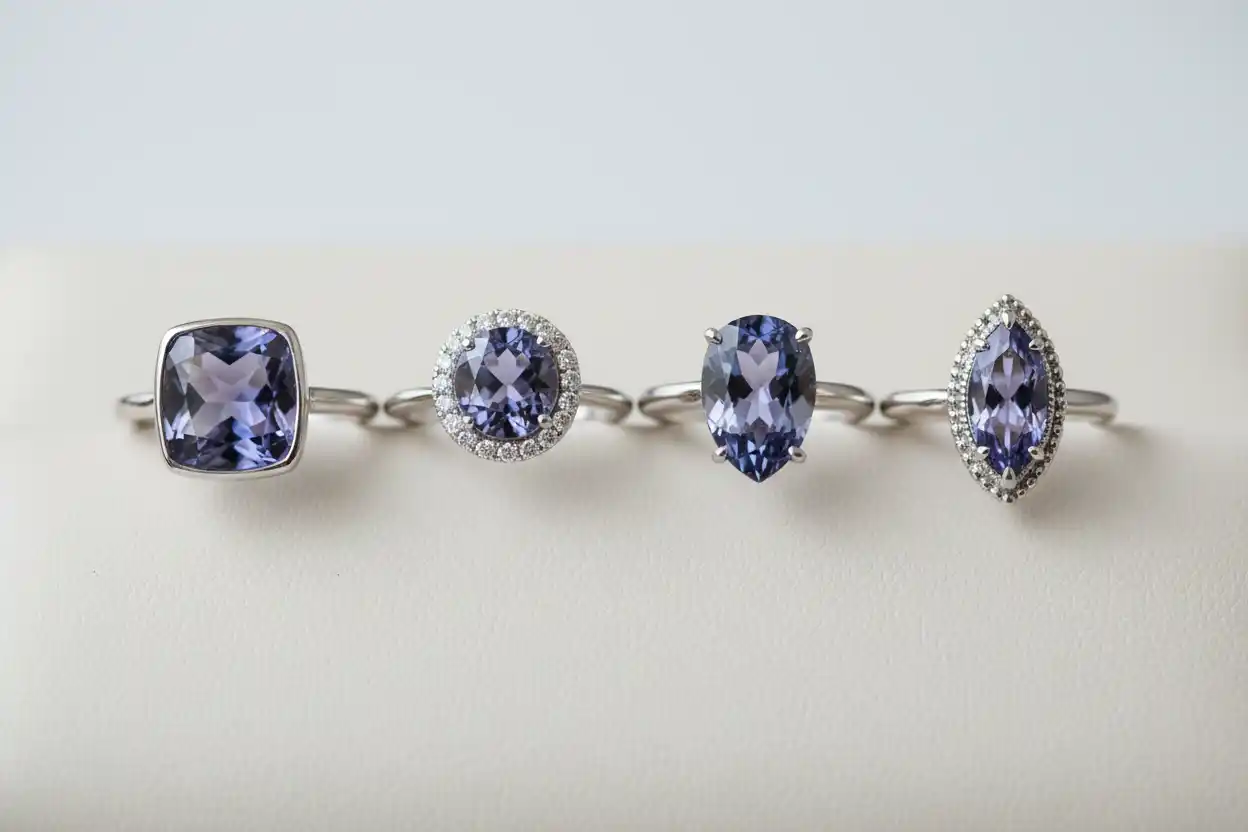
Iolite Rings: Styles and Buying Tips
An iolite ring can show blue, violet, gray, and occasionally faint yellowish tones as the hand moves. That shifting appearance gives the gem a character that static product photographs rarely capture. However, the same crystal structure responsible for iolite’s optical personality also creates a cleavage direction that deserves serious consideration in a ring.
The broader iolite gemstone guide explains the material’s mineral identity and symbolism. Here, the focus is narrower: how iolite behaves in a ring, which settings reduce damage risk, how orientation changes face-up color, and what buyers should inspect before committing to a finished piece.
Is Iolite Suitable for a Ring?
Iolite has a Mohs hardness of approximately 7 to 7.5, so it resists ordinary surface abrasion better than many softer jewelry stones. Nevertheless, hardness describes scratch resistance rather than resistance to chipping or splitting. The distinction becomes especially important with iolite because it has a pronounced cleavage direction.
A sharp impact at an unfavorable angle can open the stone along that structural plane. Therefore, an iolite that remains attractive through years of careful wear may still break from one badly placed knock against a countertop, metal doorframe, or exercise machine.
The gemstone hardness chart provides the numerical context, while the guide to gemstone toughness versus hardness explains why a relatively hard gem can still require a protective mounting.
Iolite rings are most successful when three conditions align:
- The stone has no surface-reaching fracture or vulnerable corner.
- The setting protects the girdle without forcing excessive pressure onto the gem.
- The wearer removes the ring for impact-prone activities.
Consequently, iolite can work as an occasional ring, dress ring, anniversary ring, or carefully worn engagement ring. It is less forgiving as an always-on ring for someone who routinely lifts equipment, gardens, works with tools, or frequently strikes their hands against hard surfaces.
Protective Settings for Iolite Rings
A secure mounting should reduce direct contact between the iolite and surrounding objects. At the same time, the jeweler must avoid applying excessive setting pressure because force concentrated against a cleavage-prone stone can cause damage during manufacture or repair.
| Setting style | Protection level | Best use | Main concern |
|---|---|---|---|
| Full or partial bezel | High | Regular wear, low-profile rings | Poorly executed bezels can place uneven pressure on the stone |
| Halo | Moderate to high | Engagement and dress rings | A high halo can still catch on clothing and objects |
| Six-prong solitaire | Moderate | Classic designs with rounded stones | Exposed girdle sections remain vulnerable |
| Four-prong solitaire | Low to moderate | Occasional-wear rings | Fewer protected points and more exposed edge |
| Flush or gypsy setting | Potentially high | Small calibrated stones | Cutting the seat and tightening metal require an experienced setter |
| Vintage cluster | Variable | Decorative and heirloom-inspired rings | Raised galleries, worn prongs, and old repairs need inspection |
| Cocktail setting | Variable | Statement jewelry | Large, high-set stones receive more leverage during impact |
Bezel-Set Iolite Rings
A bezel surrounds most or all of the stone’s perimeter with metal. This design shields the girdle and prevents exposed corners from striking hard surfaces directly. Low-profile bezels also snag less than tall prong settings.
However, “bezel” does not automatically mean safe. The metal must be moved evenly, and the bearing must fit the stone rather than forcing the iolite into a mismatched seat. A heavy bezel applied by an inexperienced setter can introduce more pressure than a carefully designed prong mounting.
Partial bezels can preserve more light entry and display more of the stone while protecting the most vulnerable sides. They work particularly well with oval, cushion, and round iolites.
Prong-Set Iolite Rings
Prongs expose more of the gemstone, which can make a well-cut iolite appear brighter and more open. For rounded stones, six smaller prongs generally distribute security more evenly than four widely spaced prongs. Cushion, pear, marquise, and trillion cuts benefit from prongs or metal guards that protect pointed corners.
Inspect the ring from the side. The prongs should contact the crown securely without appearing crushed into the stone. Moreover, the girdle should sit inside the mounting rather than above the protective outline of the ring.
Halo Iolite Rings
A halo of diamonds, sapphires, spinel, or other accent stones can act as a protective perimeter. It also increases visual spread, allowing a moderate-size iolite to look more substantial.
The practical benefit depends on the ring’s profile. A low halo that extends slightly beyond the iolite offers meaningful shielding. Conversely, a tall basket with an elevated center stone remains vulnerable even when a halo surrounds it.
Solitaire Iolite Rings
A solitaire places all attention on the center gem, making cut quality and pleochroic orientation especially noticeable. Rounded cushions and ovals are usually more forgiving than shapes with narrow points.
For regular wear, broad shoulders, a low basket, six prongs, or a partial bezel improve the design. Thin, high-set four-prong solitaires suit controlled occasional wear better than active daily use.
Iolite Engagement Rings
Iolite offers an unusual blue-violet alternative to more conventional engagement-ring stones. Its color can resemble some tanzanite and sapphire, yet its strong pleochroism gives it a different visual rhythm.
Still, an iolite engagement ring requires realistic expectations. The wearer should accept that the stone is less impact-resistant than sapphire and may need more cautious handling. The guide to the best gemstones for engagement rings provides a wider durability comparison, while the best gemstones for everyday wear places iolite within a more practical wearability context.
Buyers considering a blue or violet center stone can also compare the options in the guides to blue engagement-ring gemstones and purple engagement-ring gemstones. A sapphire engagement ring generally offers greater resistance to scratching and impact, whereas iolite offers a more accessible, less conventional appearance.
An engagement setting should ideally have a low profile, protected girdle, sturdy shank, and no exposed sharp corner. A wedding band must also fit without rubbing directly against the iolite or its setting.
Vintage and Antique-Style Iolite Rings
Iolite works naturally with Art Deco geometry, Victorian-inspired clusters, milgrain, engraved shoulders, and antique-style halos. Its gray-blue and violet tones pair particularly well with oxidized silver, white gold, platinum, and warm rose gold.
Nevertheless, decorative detailing can conceal construction weaknesses. Before buying a vintage or pre-owned ring, inspect:
- Prongs for thinning, lifting, or previous solder repairs
- Abrasion around the facet junctions
- Chips along the girdle
- Movement when the ring is gently tilted
- Cracks extending from prong-contact points
- Uneven bezels or compressed corners
A genuine antique setting may also have been altered for a replacement stone. If the iolite does not match the original seat, uneven pressure can develop around the girdle.
Cocktail and Statement Rings
Large iolites can create dramatic cocktail rings because the material is available in sizes that would be far more expensive in certain other blue gems. Broad cushion, oval, emerald-style, and fantasy cuts can display striking shifts between violet-blue and gray-blue.
Size alone, however, increases leverage. A large stone set high above the finger is more likely to strike furniture, doors, and other objects. For that reason, large cocktail rings should generally be treated as event jewelry rather than worn during routine work.
Substantial bezels, broad halos, split shanks, and low baskets can improve stability. Even then, the ring should be removed before driving heavy equipment, carrying luggage, exercising, cleaning, or doing manual tasks.
Pleochroism and Face-Up Orientation
Iolite’s most distinctive buying issue is pleochroism. The crystal can show different colors in different directions, including violet, blue, gray-blue, yellowish, brownish, or nearly colorless components.
A cutter must orient the rough to place the most attractive color through the crown. That decision can require sacrificing weight. If the orientation is poor, a technically clean iolite may look washed out, gray, or uneven when viewed from above.
Orientation matters even more in a ring than in a pendant. A pendant usually hangs in a predictable vertical position, whereas a ring rotates as the wrist and fingers move. Those movements reveal more of the stone’s directional color.
When assessing a ring:
- View it straight down through the table.
- Tilt it toward each side.
- Rotate the ring through a full circle.
- Check it in diffused daylight and neutral indoor light.
- Look for a pleasing transition rather than a large dead or colorless zone.
The direct iolite versus tanzanite comparison examines these optical differences more closely. Buyers who simply prefer tanzanite’s richer blue-violet appearance should also consider whether a tanzanite ring fits their budget and wear pattern, although tanzanite has its own substantial durability limitations.
Choosing Iolite Color
The most sought-after faceted iolite usually presents a medium to medium-dark violetish blue or blue-violet face-up color. Extremely dark material can lose transparency, while very pale stones may appear gray or almost colorless under ordinary indoor lighting.
Color should remain reasonably attractive across the face of the ring. Some directional variation is expected and forms part of iolite’s appeal. However, a wide pale window through the center, a strong brown axis, or a dark area covering much of the stone can reduce its visual balance.
Do not judge color from one heavily edited photograph. Request neutral-light video that shows the ring moving. A seller who understands iolite should be willing to demonstrate pleochroism rather than describing every shift as a defect.
Clarity and Inclusions
Transparent faceted iolite is often relatively clean to the unaided eye. Small internal features may be acceptable when they do not interrupt color or threaten durability.
Pay particular attention to feathers, fissures, and reflective fractures near the girdle or beneath prongs. A surface-reaching fracture is more concerning in a ring than a small enclosed crystal because it can expand under pressure or impact.
Certain included iolites are intentionally cut as cat’s-eyes, aventurescent stones, or “bloodshot” iolite. Those are specialist materials with different appearance and valuation criteria. They should not be graded as though they were ordinary transparent faceted stones.
Cut Quality and Shape
A good iolite cut balances color orientation, brightness, symmetry, and retained weight. Because the material is pleochroic, a cutter may accept unusual proportions to preserve the preferred blue-violet direction.
That trade-off does not excuse severe windowing. When the area beneath the table looks transparent enough to read through, light is escaping through the pavilion instead of returning to the viewer. Extinction presents the opposite problem: large areas remain dark even under favorable lighting.
Ovals and cushions are common because they preserve weight and avoid highly vulnerable points. Rounds can perform well but may require greater rough loss. Pears, marquises, trillions, and angular emerald-style cuts demand stronger corner protection.
Carat Weight and Visual Size
Iolite has a lower density than many familiar blue gems, so an iolite can appear physically larger than a heavier gemstone of the same carat weight. Therefore, buyers should compare millimeter measurements rather than relying on carat weight alone.
Fine-color material above approximately five carats becomes less common. Nevertheless, a large stone is not automatically valuable. Face-up color, pleochroic orientation, transparency, cutting quality, and fracture condition remain more important than weight by itself.
The dedicated iolite price guide covers value factors in greater depth. In a finished ring, the metal, accent stones, workmanship, and brand can account for a substantial portion of the retail price, particularly when the center iolite is modest in size.
Metal Choices for Iolite
White metals reinforce iolite’s cooler blue and violet components. Platinum offers strength and good prong security, although it adds cost and weight. White gold creates a similar visual effect but may require maintenance depending on its alloy and surface finish.
Yellow gold forms a warmer contrast and can bring out violet tones. Rose gold produces a softer, more romantic combination, especially with lavender-blue stones. Sterling silver keeps the ring accessible, but lightweight silver mountings may bend or loosen faster than heavier gold or platinum construction.
Metal sensitivity should be considered separately from gemstone quality. The guide to gemstones and metals for sensitive skin explains why alloy composition, nickel content, plating, and surface wear matter.
Ring Sizing, Comfort and Wearability
A comfortable ring should fit securely without requiring force over the knuckle. Excessive spinning exposes the stone to impacts and makes a strongly pleochroic gem appear inconsistent as it repeatedly changes orientation.
Wide bands often feel tighter than narrow bands and may require a slightly different size. Top-heavy cocktail rings may benefit from sizing beads, a wider lower shank, or an interior stabilizing structure.
Ask whether the ring can be resized safely. Traditional torch work near an iolite creates risks from heat and sudden temperature changes. Depending on the construction, a jeweler may remove the gemstone before resizing or use controlled laser work away from the stone.
Eternity-style accent designs, intricate filigree, and engraved shoulders can limit resizing. Buyers should resolve sizing before purchase rather than assuming every mounting can be altered later.
Matching Iolite With Accent Stones
Diamonds provide bright neutral contrast, while white sapphire, spinel, zircon, or moissanite can create a similar visual structure at different price points. Blue sapphire accents deepen the palette, whereas pink sapphire and ruby produce stronger color contrast.
The accents should not sit where they can abrade the iolite. In stacked rings, a neighboring diamond girdle can scratch softer metal and damage exposed gemstone edges over time. A contoured band or small spacer may prevent direct contact.
For a coordinated jewelry set, compare the proportions and wear conditions of an iolite bracelet, iolite earrings, and an iolite necklace or pendant. Earrings and pendants generally expose the stone to fewer impacts than rings and bracelets.
Buying Checks for an Iolite Ring
The iolite buying guide covers loose-stone quality in detail. For a finished ring, the mounting deserves equal scrutiny.
| Buying check | What to look for |
|---|---|
| Face-up color | Attractive blue-violet appearance without a dominant gray, brown, or colorless zone |
| Movement | Pleochroic changes that remain appealing as the ring tilts |
| Clarity | No threatening fracture under a prong or near a corner |
| Cut | Even outline, balanced facet pattern, limited windowing and extinction |
| Setting | Protected girdle, secure prongs, no uneven pressure |
| Profile | Low enough for the intended wear pattern |
| Metal | Proper hallmark, suitable alloy, adequate shank thickness |
| Sizing | Correct current size and realistic future resizing options |
| Disclosure | Natural or laboratory-grown status, treatment information, repairs, replacement stone, and metal details |
| Return terms | Enough time to inspect the ring in several lighting conditions |
When purchasing remotely, follow the safeguards in How to Buy Gemstones Online Without Getting Scammed. Request unedited video, exact dimensions, treatment disclosure, metal weight, return terms, and close photographs of the girdle and setting.
A laboratory report is not necessary for every modestly priced iolite, but it may be appropriate for an unusually expensive, large, or disputed stone. The guide to gemstone certification laboratories explains what identification reports can and cannot establish.
Cleaning and Storage
Use lukewarm water, mild soap, and a soft brush. Clean beneath the setting gently because accumulated lotion and soap can reduce brilliance. Rinse carefully and dry with a soft lint-free cloth.
Avoid ultrasonic and steam cleaning. Also keep the ring away from sudden temperature changes, high heat, hard knocks, and aggressive chemicals. The complete procedure appears in How to Clean Iolite Jewelry Safely.
Store the ring in an individual fabric-lined compartment or soft pouch. Harder gems, particularly diamonds and sapphires, can scratch iolite if pieces rub together. Separate storage also protects prongs from catching chains and other jewelry.
Repair and Maintenance
Have frequently worn rings inspected periodically. A jeweler should check prong tension, metal wear, movement in the setting, cracks near contact points, and damage to the shank.
Tell the jeweler that the center stone is iolite before any work begins. Heat, pressure, polishing equipment, and tightening methods suitable for tougher gems may be inappropriate. If the stone must be reset, the jeweler should examine its cleavage orientation and existing fractures before applying pressure.
A chipped iolite may sometimes be repolished, but weight loss and altered proportions can affect color orientation. Replacement may be more practical for inexpensive calibrated stones, whereas a custom-cut or unusually fine gem may justify specialist recutting.
Frequently Asked Questions
1. Can an iolite ring be worn every day?
It can be worn regularly by a careful owner, but it is not an ideal no-compromise everyday stone. Its scratch resistance is respectable, yet cleavage makes sharp impacts dangerous. A low protective setting and removal during manual activities materially improve its prospects.
2. Is iolite strong enough for an engagement ring?
Iolite can be used in an engagement ring when the wearer accepts additional care. A bezel, low halo, or protected six-prong setting is preferable. Someone who never removes a ring or works heavily with their hands may be better served by a tougher stone.
3. What is the safest setting for an iolite ring?
A well-made low bezel usually provides the greatest perimeter protection. Partial bezels and low halos can also work well. The setter’s skill remains critical because uneven metal pressure can damage a cleavage-prone gem.
4. Are four prongs enough for iolite?
Four prongs can secure an iolite, particularly in an occasional-wear ring, but they leave more of the girdle exposed. Six prongs or protective side structures generally provide better security for regular wear.
5. Why does my iolite ring change color?
Iolite is strongly pleochroic. Different crystal directions transmit different color components, so hand movement can reveal blue, violet, gray, yellowish, or nearly colorless appearances. This directional change is natural.
6. Why does an iolite look blue online but gray in person?
Lighting, camera processing, background color, and the angle used for the photograph can emphasize the strongest blue direction. Under ordinary indoor lighting or from another angle, gray or pale components may become more visible.
7. Is a dark iolite ring more valuable?
Not automatically. Medium to medium-dark saturation can be attractive, but an overly dark gem may show extensive extinction and weak transparency. Balanced color, brightness, orientation, and cut usually matter more than darkness alone.
8. Can an iolite ring be resized?
Many can be resized, although the stone’s sensitivity to heat and temperature change complicates the work. The jeweler may need to remove the iolite or use a carefully controlled technique. Intricate settings and eternity bands can further restrict resizing.
9. Does iolite need treatment disclosure?
Yes. Iolite is rarely treated, which makes any known coating, filling, dye, or unusual enhancement important to disclose. The seller should also disclose whether the stone is natural, synthetic, assembled, or an imitation.
10. Can an ultrasonic cleaner damage an iolite ring?
Yes. Ultrasonic vibration can aggravate fractures or cleavage-related weaknesses. Warm soapy water and gentle hand cleaning are safer.
11. What should I do if my iolite is loose?
Stop wearing the ring and place it in a padded container. Do not squeeze the prongs yourself. A jeweler familiar with colored stones should inspect the gem and setting before tightening it.
12. Are large iolite cocktail rings practical?
They are practical as controlled occasional-wear jewelry. Large high-set stones receive more leverage during impact, so a low protective mounting and deliberate removal during routine tasks are essential.
An iolite ring succeeds when its design respects the gemstone rather than treating it like sapphire. Choose the face-up color while the stone is moving, examine the girdle and mounting as closely as the crown, and favor protection over unnecessary height. Those decisions preserve the optical shifts that make iolite compelling without ignoring the structural limits that matter on the hand.