Lapis Lazuli Necklaces and Pendants: Buying Guide
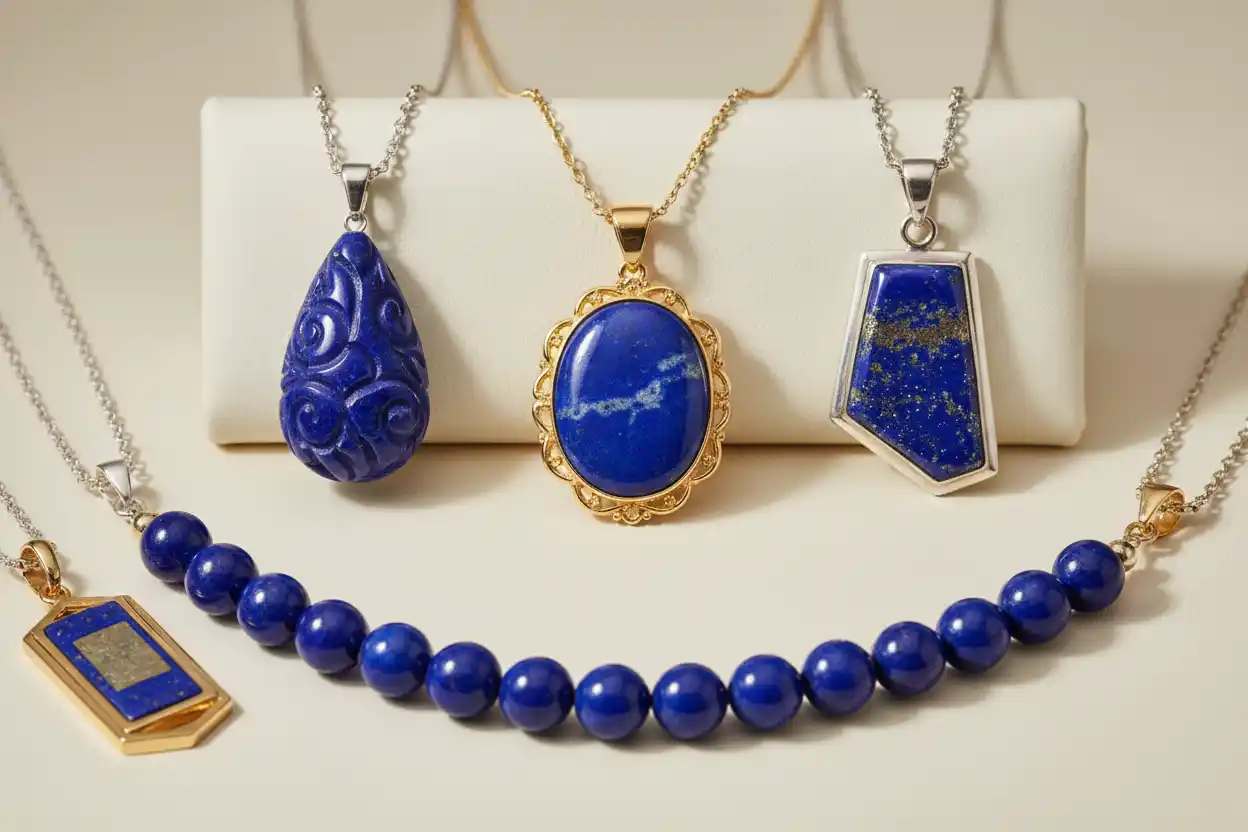
Lapis lazuli necklaces place one of the gem world’s most recognizable blues in a relatively protected position. Deep royal-blue cabochons, pyrite-flecked pendants, carved tablets, inlay work, and graduated bead strands can all display the stone effectively without exposing it to as much impact as a ring or bracelet.
The material still needs careful evaluation. Lapis lazuli is a rock composed mainly of lazurite, calcite, and pyrite rather than a single uniformly hard mineral. Its color, polish, structural strength, and response to cleaning can vary across one pendant or even one bead.
Treatments also matter. Commercial lapis may be dyed, waxed, oiled, resin-filled, reconstructed, coated, or backed. Those processes can improve appearance, but they should be disclosed because they affect durability, price, and repair.
The broader lapis lazuli gemstone guide explains the material’s geology, history, composition, and symbolism. This article focuses specifically on necklace design, pendant construction, chains, matching, treatment, buying, wear, and care.
Lapis Lazuli Necklaces at a Glance
| Feature | What to evaluate |
|---|---|
| Material | Natural lapis lazuli rock rather than dyed substitute or glass |
| Main minerals | Lazurite, calcite, and pyrite |
| Preferred color | Saturated medium-dark blue to violetish blue |
| Mohs hardness | Approximately 5–6, depending on composition |
| Toughness | Fair |
| Best pendant setting | Low bezel or supportive framed construction |
| Common necklace styles | Solitaire pendants, carvings, beads, inlay, stations, and tablets |
| Desirable pyrite | Fine, attractively distributed metallic flecks |
| Less desirable feature | Large white calcite areas or dull greenish patches |
| Common treatments | Dye, wax, oil, resin, coating, and reconstruction |
| Main mechanical concern | Bail, chain, clasp, drill hole, or adhesive failure |
| Safest cleaning | Gentle warm soapy water after checking treatment stability |
Why Necklaces Suit Lapis Lazuli
Necklaces protect lapis better than rings and bracelets because the chest encounters fewer desks, tools, doors, and other hard surfaces.
A pendant can therefore use a larger cabochon or carving without facing constant hand-level impact. Bead strands still rub against clothing and one another, but they generally suffer fewer sharp blows than wrist jewelry.
The material’s hardness varies around 5–6 because its mineral composition changes from one area to another. Lazurite-rich blue sections, softer calcite veins, pyrite grains, and associated minerals may not polish or wear identically.
The gemstone hardness chart provides numerical context, while Gemstone Toughness vs Hardness explains why surface resistance and resistance to breaking are separate concerns.
A well-made necklace should protect the stone’s edges, distribute its weight correctly, and avoid placing stress on weak veins or drill holes.
Main Lapis Lazuli Necklace Styles
| Necklace style | Visual advantage | Main concern |
|---|---|---|
| Solitaire cabochon pendant | Focuses attention on one blue stone | Bail and setting security |
| Full-bezel pendant | Protects most of the edge | Closed back may hide treatment or construction |
| Prong-set pendant | Shows more of the stone | Exposed edges and pressure points |
| Carved pendant | Displays craftsmanship and symbolism | Thin sections, drill holes, and glue |
| Tablet pendant | Bold geometric surface | Corners and edge chipping |
| Inlay pendant | Smooth patterned design | Thin material and adhesive failure |
| Bead strand | Broad field of blue | Drill holes, stringing, and bead abrasion |
| Station necklace | Lightweight modern arrangement | Flipping stations and connector wear |
| Multi-stone necklace | Graduated color and pattern | Matching and numerous settings |
| Locket or framed plaque | Strong metal support | Hidden backing and replacement material |
| Tassel or sautoir | Dramatic movement | Weight, swinging, and strand wear |
| Historical-style necklace | Traditional blue-and-gold appearance | Age, restoration, and material attribution |
Solitaire Lapis Lazuli Pendants
A solitaire pendant uses one main cabochon, tablet, carving, or polished freeform stone.
Fine material usually shows strong blue color without large white calcite patches. Small pyrite flecks can add visual interest, although uninterrupted blue is also highly valued.
Examine the pendant from the side and back. A face-up photograph may conceal:
- A thin lapis layer
- A dark backing
- Glue
- Resin
- A doublet
- A repaired fracture
- An unfinished reverse
- A deep cavity beneath the setting
A solid cabochon should have enough thickness to resist ordinary handling without becoming unnecessarily heavy.
The pendant should hang face-forward. If the bail is attached off-center, the stone may rotate or tilt toward the body.
Bezel-Set Lapis Pendants
A bezel surrounds the stone’s perimeter with metal and usually provides the strongest edge protection.
This setting is especially useful for lapis because calcite veins, corners, and uneven mineral boundaries can chip when exposed.
Inspect the bezel for smooth contact around the complete outline. Gaps, rough folds, glue seepage, rippled metal, or a stone that moves under gentle pressure indicate weak workmanship.
A full metal back can support a relatively thin tablet. However, the seller should disclose whether the visible stone is:
- A solid cabochon
- A backed slab
- An inlay component
- A doublet
- A reconstructed product
- A thin lapis layer over another material
A closed back is not automatically deceptive, but it reduces what the buyer can inspect.
Prong-Set Pendants
Prongs expose more of the lapis and can make a small stone appear larger.
The stone should sit in a supportive basket rather than balance only between prong tips. Pressure should remain evenly distributed and should not fall directly over a white calcite vein or surface-reaching crack.
Rounded ovals and cushions generally tolerate prong settings better than pointed pears, marquises, or sharp rectangles.
A prong-set lapis pendant is best suited to controlled wear because the edges remain more vulnerable than those in a bezel.
Carved Lapis Lazuli Pendants
Lapis has a long history as a carving material. Modern pendants may feature scarabs, moons, stars, leaves, animals, faces, symbols, geometric motifs, or abstract forms.
The mixed mineral composition makes carving technically demanding. Calcite can undercut, pyrite can interrupt fine details, and fractures may follow natural veins.
Inspect thin projecting areas such as:
- Horns
- Wings
- Leaf tips
- Openwork
- Drilled loops
- Narrow bridges
- Fine edges
- Suspended drops
A metal cap may strengthen the top of a carving, but it can also hide glue or a previously broken drill hole.
The carving should remain smooth against clothing and skin. Sharp untreated edges can catch fabric or chip further.
Lapis Tablet and Plaque Pendants
Flat tablets create a bold field of blue and work well in signet-like, geometric, or architectural designs.
Corners deserve protection because they receive impact more easily than rounded cabochons. A complete metal frame usually performs better than four isolated prongs.
Thin tablets may be backed with metal or another material. That construction should be disclosed, especially when the pendant is represented as a large solid piece of lapis.
Plaques with engraved or painted surfaces require additional care. Polishing may remove surface decoration, and solvents can affect paint, wax, or resin.
Lapis Lazuli Inlay Necklaces
Inlay uses thin pieces of lapis fitted into metal channels or combined with shell, turquoise, coral, onyx, malachite, or other materials.
The surface should feel even. Raised, sunken, or missing sections suggest adhesive or structural failure.
Inspect every seam for:
- Gaps
- Cloudy adhesive
- Discoloration
- Cracks crossing several pieces
- Uneven polish
- Lifting edges
- Replaced components
- Surface coating wear
Inlay should not be soaked, steamed, or ultrasonically cleaned. Water and cleaning chemicals can enter the seams and weaken adhesive.
A dark blue inlay may contain natural lapis, reconstructed material, dyed stone, or synthetic substitutes. The seller should specify the actual material rather than relying on “lapis style.”
Lapis Lazuli Bead Necklaces
Bead strands create a continuous field of blue and can range from small uniform rounds to large graduated beads.
Evaluate the strand as a complete suite. Beads should coordinate in hue, tone, pyrite content, calcite distribution, diameter, polish, and treatment.
One bead with a large white calcite patch can disrupt an otherwise uniform necklace. Conversely, a deliberate pattern using visibly mottled beads can look cohesive when the variation repeats.
Drill holes are critical. Inspect for:
- Chipped rims
- Cracks radiating from the hole
- Off-center drilling
- Rough interiors
- White calcite weakness
- Dye concentrated within the opening
- Cord abrasion
- Thin bead walls
Knots between beads reduce contact and limit loss if the strand breaks. Large or valuable strands generally benefit from knotting.
Graduated Lapis Strands
A graduated necklace increases bead size toward the center.
The progression should remain smooth rather than jumping abruptly between diameters. Central beads should retain the same color quality as smaller side beads rather than becoming more calcite-rich or dull.
Large beads occupy more interior circumference and add significant weight. A strand should lie comfortably across the chest without pulling the clasp forward.
Graduated designs require strong stringing material and reinforced connections at the clasp.
Station Necklaces
Station necklaces place small lapis cabochons, tablets, beads, or inlay elements at intervals along a chain.
Two-point connections help flat stations remain face-up. A single connector allows greater movement but may cause frequent flipping.
The chain should pass through or connect to metal rather than rub directly against a vulnerable lapis edge.
Stations need enough spacing that they do not collide when the necklace curves around the neck.
Matching Multiple Lapis Stones
A multi-stone necklace should be judged for visual rhythm rather than absolute uniformity.
| Matching factor | What to evaluate |
|---|---|
| Blue hue | Royal, violetish, indigo, medium, or greenish blue |
| Tone | Consistent darkness or deliberate graduation |
| Saturation | Strength and purity of blue |
| Calcite | Similar absence or intentionally repeated pattern |
| Pyrite | Balanced distribution and grain size |
| Shape | Uniform or purposefully varied outlines |
| Dimensions | Accurate progression or matched size |
| Polish | Consistent gloss and texture |
| Treatment | Shared dye, wax, oil, or resin disclosure |
| Condition | No isolated cracked, chipped, or heavily worn component |
Natural variation adds character, but one substantially greener or paler stone should not appear accidental.
Choosing the Best Blue
Color is the most important lapis quality factor.
Fine material generally appears highly saturated medium-to-dark blue or slightly violetish blue. It should remain visibly blue under normal indoor light rather than turning black or gray.
Large white calcite patches generally lower value because they interrupt the blue. Greenish color may reflect mineral composition, abundant pyrite, or lower lazurite concentration.
Photographs can exaggerate blue saturation. Request continuous video under diffused daylight and ordinary indoor light.
The Lapis Lazuli Buying Guide owns the full quality-selection process, while the lapis lazuli price guide covers value.
Pyrite in a Necklace
Pyrite appears as gold-colored metallic flecks or veins.
Small, evenly scattered particles can create a visually appealing night-sky effect. Yellow-gold settings often echo the metallic color.
Heavy pyrite may interrupt the blue, produce an uneven surface, or make the rock appear dull and greenish.
Pyrite is not gold and should not be marketed as precious-metal inclusion.
Metallic particles can also be added to glass or resin, so pyrite alone does not prove natural lapis.
Calcite and Structural Weakness
Calcite commonly appears white and is softer than lazurite-rich areas.
Large veins may wear or polish differently. A calcite seam crossing a drill hole, pendant bail, corner, or narrow carved section can create a weak point.
A little calcite is a natural part of many lapis specimens. The issue is whether it affects color, durability, polish, and price.
A pendant with visible matrix may be attractive as an artistic choice, but it should not be priced as uniform fine-grade material.
Treatments
Treatment disclosure is particularly important in lapis.
Dye
Dye can deepen pale material and reduce the visibility of calcite. It may collect in pores, fractures, drill holes, and lighter areas.
Unstable dye can transfer to skin or fabric or react with moisture, cosmetics, alcohol, and solvents.
Wax and Oil
Wax and oil can deepen color and improve surface luster. Their stability is only fair, and heat or solvents may alter the finish.
Resin and Plastic Sealing
Resin may stabilize porous or fractured material, seal dye, or create a glossy surface.
A coating can scratch, peel, cloud, or wear around edges and drill holes.
Reconstruction
Small pieces or lapis powder may be combined with resin and formed into beads, tablets, or cabochons.
Reconstructed material can be attractive but should not be represented as one solid natural rock section.
The treated lapis lazuli guide owns treatment detection and disclosure.
Imitations and Lookalikes
Common substitutes include dyed howlite, dyed magnesite, dyed marble, sodalite, glass, ceramic, resin, reconstructed products, and synthetic blue materials.
The Real vs Fake Lapis Lazuli guide owns the broader authenticity workflow.
Sodalite is a natural blue mineral that can look similar when lapis contains little pyrite. The direct Lapis Lazuli vs Sodalite comparison should guide that question.
Do not perform acetone, alcohol, acid, scratch, flame, or hot-needle testing on a finished necklace. Those methods can permanently damage the stone, treatment, metal, or adhesive.
Bail Construction
The bail carries the pendant’s full weight.
Check:
- Opening size
- Chain compatibility
- Metal thickness
- Solder joints
- Alignment
- Articulation
- Wear around jump rings
- Glue
- Cracks near drilled holes
- Clearance above the stone
A heavy carved pendant on a thin decorative bail is mechanically unbalanced.
An articulated bail allows the pendant to hang naturally. A fixed bail can keep a tablet facing forward when it is aligned correctly.
Choosing a Chain
The chain should match the pendant’s weight and dimensions.
Cable, box, wheat, curb, rope, and snake chains vary substantially in strength. Width alone does not reveal how well a chain carries a heavy pendant.
A large lapis cabochon should not be placed on the thinnest chain merely because the combination appears delicate.
The chain’s end fitting must pass through the bail. When the pendant is sold separately, request the bail’s internal dimensions.
Necklace Length
| Necklace position | Typical use | Lapis consideration |
|---|---|---|
| Collar | High on the neck | Best for articulated designs rather than heavy pendants |
| Choker | Base of the neck | Greater contact with skin and cosmetics |
| Princess | Upper chest | Versatile and relatively protected |
| Matinee | Mid-chest | More movement and possible desk contact |
| Opera | Lower chest | Greater swing and leverage |
| Rope | Long or doubled | Higher risk of tangling and collision |
Princess length suits many medium and large lapis pendants. It provides enough movement to show the stone without placing it near a tabletop.
Exact placement depends on the wearer’s proportions and clothing. Request the actual chain length rather than relying only on style names.
Metal Choices
Yellow gold creates a traditional blue-and-gold contrast and visually complements pyrite.
Sterling silver and white gold produce a cooler appearance. Oxidized silver can emphasize the blue without changing the stone.
Rose gold may soften the contrast but can make greenish-blue material appear warmer.
The metal must be strong enough for the necklace’s weight. Heavy beads and tablets require substantial clasps, end fittings, jump rings, and bails.
The guide to gemstones and metals for sensitive skin explains why chain alloy, solder, plating, and clasp materials matter separately from lapis.
Clasps and Safety
Small pendants may use a spring-ring clasp, while heavy strands and tennis-style necklaces need a substantial lobster, box, toggle, or fold-over closure.
Bead necklaces should use reinforced end connections. French wire or comparable protection can reduce abrasion where the strand meets the clasp.
Test the clasp several times. It should close positively without a visible gap.
A safety chain can reduce loss risk on valuable necklaces, provided it does not tangle or strike the stones.
Styling Lapis Lazuli Necklaces
Royal-blue lapis pairs naturally with white, cream, black, gray, denim, camel, and warm earth tones.
A small gold-framed pendant can work in professional or formal settings. Large carvings and graduated strands create stronger statement pieces.
Coordinating lapis lazuli earrings do not need identical pyrite patterns. Matching the metal and general blue tone is often sufficient.
A lapis lazuli bracelet adds more blue but receives greater impact. A lapis lazuli ring requires stricter protection.
The blue gemstones guide provides alternatives when the wearer needs a different level of durability or transparency.
Buying Online
Use the transaction safeguards in How to Buy Gemstones Online Without Getting Scammed.
Request:
| Buying detail | What to confirm |
|---|---|
| Material | Natural lapis lazuli or disclosed substitute |
| Treatment | Dye, wax, oil, resin, coating, or reconstruction |
| Stone data | Dimensions, thickness, and weight where available |
| Construction | Solid cabochon, slab, bead, inlay, doublet, or carving |
| Pendant data | Total length, width, depth, and weight |
| Chain | Length, gauge, alloy, hallmark, and clasp |
| Bail | Opening, attachment, and repair history |
| Condition | Chips, fractures, scratches, lifting inlay, and glue |
| Origin | Evidence for Afghan, Chilean, or Russian claims |
| Returns | Time for non-destructive inspection |
An independent report can help with a valuable historical necklace, disputed treatment, or important origin representation. The gemstone certification guide explains its limits.
Wearing and Care
Put the necklace on after perfume, hairspray, sunscreen, and cosmetics have dried.
Remove it before swimming, showering, exercise, sleep, household cleaning, and activities where a long pendant can strike furniture.
Follow How to Clean Lapis Lazuli Jewelry Safely.
Use lukewarm water, mild soap, and a soft cloth or brush only after confirming that the color is stable. Do not use steam or ultrasonic cleaning.
Avoid acids, acetone, alcohol, bleach, jewelry dips, abrasive powders, and strong heat. Do not soak beads, inlay, glued pieces, or treated stones.
Store the necklace flat or in a broad curve. Keep the pendant in its own padded compartment away from harder gemstones.
Repair and Maintenance
Inspect the bail, clasp, chain, jump rings, bezel, prongs, drill holes, knots, and adhesive connections periodically.
A bead strand should be restrung when cord stretches, knots loosen, or wire kinks. Preserve the bead order when the color or pyrite pattern is graduated.
Tell the jeweler that the material is lapis lazuli and disclose known dye, wax, oil, resin, coating, or reconstruction. Heat and solvents used during routine repair can damage treatments.
Replacing one component may be difficult because the new lapis must match blue tone, calcite, pyrite, cut, and polish.
Frequently Asked Questions
1. Is lapis lazuli suitable for necklaces?
Yes. Necklaces and pendants are among the safer jewelry forms because the stone receives less impact than it does in rings or bracelets.
2. What is the best lapis pendant color?
Fine material is generally saturated medium-dark blue to violetish blue with little visible calcite.
3. What is the safest pendant setting?
A well-fitted bezel usually provides the strongest edge protection.
4. Are gold flecks in lapis real gold?
No. They are usually pyrite.
5. Does white calcite mean the pendant is fake?
No. Calcite is a natural component, although large white areas generally lower material value.
6. Can a lapis necklace be dyed?
Yes. Dye is common and may be combined with wax, oil, resin, or plastic sealing.
7. Is a backed lapis pendant genuine?
It may contain genuine lapis, but backing can enhance contrast or conceal thin construction and should be disclosed.
8. Are lapis bead necklaces durable?
They can be worn carefully, but drill holes, stringing, bead contact, and treatments require maintenance.
9. What chain length works best?
Princess length is versatile for many pendants and keeps the stone relatively protected on the upper chest.
10. Can lapis necklaces be cleaned ultrasonically?
No. Ultrasonic cleaning can damage the rock, treatments, inlay, adhesive, and settings.
11. Does an expensive necklace need certification?
A report can be useful for valuable, historic, disputed, or strongly represented material, though ordinary commercial pieces rarely require one.
12. What should I do if a bead strand begins stretching?
Stop wearing it and have the necklace restrung before the cord or wire breaks.
A successful lapis lazuli necklace balances blue color with physical construction. The stone may provide the visual focus, but the bail, chain, clasp, stringing, treatment disclosure, and protection around vulnerable edges determine whether the piece remains beautiful and secure through years of careful wear.