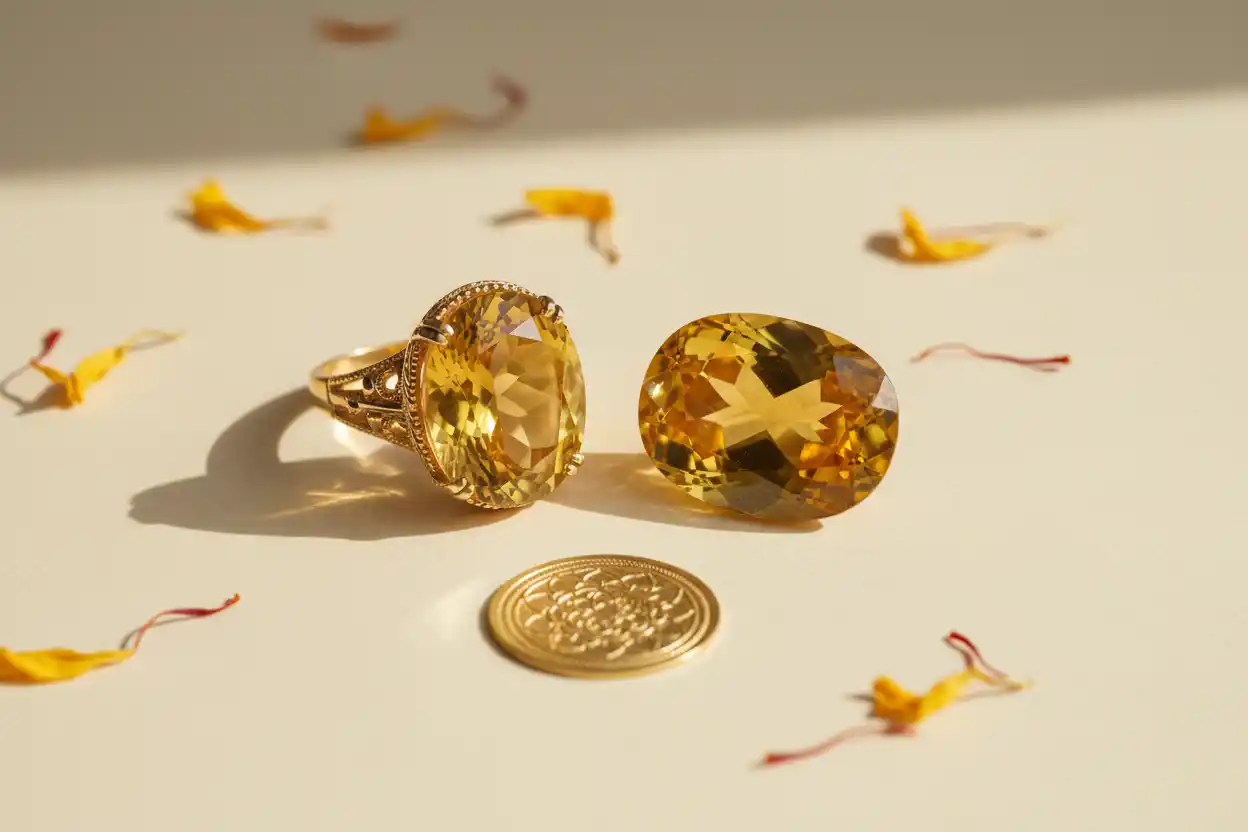
Pukhraj Yellow Sapphire: Vedic Meaning, Rules and Buying
Pukhraj, also spelled Pokhraj, is the South Asian trade and astrological name most commonly used for yellow sapphire. In Jyotish, or Indian astrology, it is associated with Guru or Brihaspati—the planetary principle represented by Jupiter.
Traditional practitioners connect Pukhraj with wisdom, education, ethical judgment, prosperity, children, teachers, spiritual guidance and constructive expansion. These are astrological and religious associations rather than effects established by gemology or experimental science.
The name also creates an important buying risk. Yellow topaz, citrine, glass, synthetic sapphire and diffusion-treated corundum may be sold in markets serving astrological buyers. A Pukhraj purchase should therefore satisfy two separate questions: does it meet the buyer’s tradition, and has a qualified laboratory confirmed what the stone actually is?
Pukhraj at a Glance
| Aspect | Pukhraj / yellow sapphire |
|---|---|
| Modern gemological identity | Yellow corundum |
| Composition | Aluminum oxide |
| Crystal system | Trigonal |
| Mohs hardness | 9 |
| Typical color | Pale yellow, lemon, golden yellow, canary yellow and orangy yellow |
| Common color causes | Iron-related chromophores and color centers |
| Common treatments | Heating and beryllium diffusion; synthetic material also exists |
| Vedic planetary association | Guru or Brihaspati, represented by Jupiter |
| Common traditional themes | Wisdom, learning, prosperity, guidance, marriage, children and growth |
| Common traditional day | Thursday, with variations among lineages |
| Frequently prescribed metal | Gold, although prescriptions vary |
| Frequently prescribed finger | Index finger in many modern practices, but not universally |
| Main buyer concern | Natural versus synthetic origin and treatment disclosure |
| Scientific status | Astrological effects have not been scientifically demonstrated |
The Jyotish gemstones guide explains the wider planetary-gem system. This page remains focused on Pukhraj and should not repeat the full Navaratna framework.
What Does Pukhraj Mean?
Pukhraj is used in Hindi, Urdu and related South Asian gem markets for a yellow stone associated with Jupiter. In modern fine-jewelry and gemological use, a genuine Pukhraj is expected to be yellow sapphire.
Older names such as pushparaga, pushyaraga and regional spelling variants do not always map neatly onto one modern mineral species. Historical gem names were often based on color, source, appearance or religious use before laboratory mineral identification existed.
For that reason, an old textual reference to a yellow sacred gem should not automatically be translated as proof of modern corundum. Contemporary sellers should identify the material through gemology rather than relying on the traditional name alone.
The completed yellow sapphire guide owns the gemstone’s full formation, physical properties, localities and general symbolism.
Yellow Sapphire as Corundum
Yellow sapphire belongs to the corundum family, whose red variety is ruby and whose other colors are classified as sapphire.
The broader sapphire guide explains corundum mineralogy. The types of sapphire guide covers blue, yellow, pink, white, padparadscha, star and other varieties.
Corundum’s hardness of 9 makes yellow sapphire suitable for frequently worn rings. Nevertheless, it can still chip from a sharp blow, particularly at exposed corners or where fractures reach the surface.
The yellow color may be caused by different iron-related mechanisms. Natural, conventionally heated, beryllium-diffused and synthetic yellow sapphires can look similar enough to require laboratory testing.
Pukhraj and Jupiter
In Jyotish, Jupiter is called Guru or Brihaspati and is traditionally treated as a teacher, counselor and source of expansive knowledge.
Pukhraj is therefore associated with education, judgment, generosity, ethics, children, spiritual study, prosperity and the guidance received from teachers or elders.
These themes vary with the practitioner, lineage and interpretation of an individual horoscope. Wearing a yellow sapphire does not scientifically increase intelligence, guarantee wealth or change planetary radiation.
A grounded symbolic use may connect the ring with study, financial planning, teaching, ethical decision-making or keeping a commitment to personal development.
Pukhraj in the Navaratna Tradition
The Navaratna system brings together nine gems associated with nine planetary influences. In the commonly used modern correspondence, yellow sapphire represents Jupiter.
Other familiar associations include ruby for the Sun, pearl for the Moon, red coral for Mars, emerald for Mercury, diamond for Venus, blue sapphire for Saturn, hessonite for Rahu and cat’s-eye chrysoberyl for Ketu.
The separate Neelam blue sapphire guide owns Saturn-related blue sapphire traditions. Pukhraj should not inherit Neelam’s warnings, rituals or astrological conclusions automatically.
Navaratna jewelry may place all nine materials into one composition. The identity and treatment of every component should still be disclosed accurately.
Who Is Traditionally Advised to Wear Pukhraj?
Many modern Jyotish practitioners consider yellow sapphire when Jupiter is believed to be supportive, important or in need of strengthening within a natal chart.
Sagittarius and Pisces are traditionally ruled by Jupiter, so people with those ascendants or prominent placements are frequently discussed in Pukhraj recommendations. The Sagittarius birthstone guide and Pisces birthstone guide cover sign-level gemstone traditions without replacing chart interpretation.
A Sun sign alone is not generally considered enough for a traditional prescription. House rulership, ascendant, planetary condition, aspects, periods and the objectives of the wearer may alter a practitioner’s recommendation.
The crystals for Sagittarius guide and crystals for Pisces guide are optional modern roundups, not substitutes for classical astrological analysis.
Who Should Not Wear Pukhraj?
There is no scientific evidence that yellow sapphire becomes physically harmful because of a horoscope.
Within Jyotish practice, however, some astrologers advise against strengthening Jupiter when they believe it functions unfavorably in a particular chart. Their conclusions may differ substantially.
A seller should not diagnose a chart merely to close a gemstone sale. Anyone following the tradition should seek an independent practitioner whose advice is not financially dependent on selling the recommended stone.
A person should also avoid wearing a ring that causes an allergic reaction, restricts circulation or interferes with work, regardless of astrological recommendations.
Thursday, the Index Finger and Gold
Many contemporary Pukhraj rituals prescribe wearing the stone on a Thursday, traditionally associated with Guru or Brihaspati.
Gold is frequently chosen because of its warm color and ceremonial associations. Some traditions use a yellow-metal alloy, while others allow different metals according to budget or chart interpretation.
The index finger is a common recommendation. Nevertheless, the preferred hand, finger, time and ritual vary by practitioner, region, family tradition and gender convention.
These instructions are not gemological requirements. A yellow sapphire remains corundum whether it is mounted in gold, platinum or silver and whether it touches the skin.
Does the Stone Need to Touch the Skin?
Some astrologers recommend an open-backed setting that allows the gemstone or culet area to touch the wearer’s skin.
Gemology does not provide evidence that skin contact transmits planetary energy. From a jewelry perspective, the important issues are secure support, sufficient metal, protected edges and cleaning access.
An overly open gallery can expose the pavilion to blows, skin oils and accumulated residue. A well-made ring should balance the wearer’s traditional preference with safe engineering.
The broader sapphire ring guide owns ring styles, settings and construction.
Pukhraj Weight and Ratti Recommendations
Traditional prescriptions may express gemstone weight in ratti rather than carats. The exact conversion depends on the regional standard used, and recommendations vary widely.
Universal statements such as “everyone needs at least five carats” should be treated as sales claims rather than gemological rules.
A larger sapphire does not automatically provide better color, clarity or astrological suitability. Deep stones can retain weight beneath the setting while appearing small from above.
Buyers should request both carat weight and millimeter dimensions and should understand which ratti conversion the seller is using.
Traditional Rituals and Safe Practice
Some Pukhraj traditions include washing or soaking the ring in milk, honey, sacred water or mixtures of ceremonial substances before it is worn.
Sapphire itself is durable, but prolonged soaking can affect dirt-filled fractures, adhesives, plated metals and intricate settings. Milk and sweet liquids can also leave residue inside the mounting.
A safer symbolic approach is to clean the jewelry physically with an appropriate method, place it on a clean cloth and perform prayers or intentions without prolonged immersion.
Mantra wording, repetition counts and ceremonial timing vary by tradition. A practitioner should not present one modern retail ritual as the only authentic Vedic method.
Pukhraj Symbolism
Yellow sapphire is associated with wisdom, disciplined learning, ethical leadership, prosperity, generosity and constructive expansion.
The sapphire color-meaning guide owns the wider symbolism of blue, yellow, pink, white and other sapphire colors.
The sapphire healing-properties guide covers contemporary spiritual claims across the family. Pukhraj-specific astrology should not be expanded into unsupported medical promises.
A yellow sapphire may function as a personal reminder to study, teach responsibly, budget carefully or make decisions that can be defended ethically.
Pukhraj and Marriage Traditions
Some Jyotish practitioners associate Jupiter and yellow sapphire with marriage, family growth or a supportive spouse, particularly in readings concerning women.
Such gendered prescriptions reflect particular traditional frameworks and are not universal across all schools or modern practitioners.
A gemstone cannot compel marriage, secure another person’s consent or guarantee compatibility. Relationship outcomes depend on communication, behavior, circumstance and the independent choices of everyone involved.
Pukhraj symbolism can be used to mark a commitment, but it should not replace practical relationship judgment.
Pukhraj and Education or Career
Because Jupiter is associated with teachers and knowledge, Pukhraj is often recommended for students, educators, counselors, judges, religious scholars and people seeking professional growth.
No gemstone has been shown to improve memory, pass examinations or create employment.
A grounded ritual might connect wearing the stone with scheduled study, ethical professional conduct or seeking mentorship.
The useful change comes from preparation and action rather than the market value of the sapphire.
Pukhraj and Prosperity
Yellow sapphire is strongly associated with prosperity in modern Vedic gemstone marketing.
Prosperity symbolism should not be converted into a promise of guaranteed income, investment return or debt relief.
Anyone buying an expensive Pukhraj should keep the purchase within a realistic budget. Borrowing beyond one’s means to buy a “wealth stone” contradicts the practical financial stability the gem is supposed to represent.
Detailed sapphire market information belongs in the sapphire price guide, not in astrological sales claims.
Natural, Heated and Diffusion-Treated Pukhraj
Natural-color yellow sapphire exists, but heating is common. Conventional heat may deepen, even or create a more attractive yellow color in responsive corundum.
Beryllium diffusion is a more extensive treatment in which beryllium enters the corundum during high-temperature heating and alters the color-producing chemistry. The treatment may penetrate deeply and cannot be judged reliably from ordinary photographs.
The treated-sapphire guide owns the full distinctions among heating, diffusion, filling and synthetic growth.
A heated sapphire remains natural corundum, but its treatment should be disclosed. A diffusion-treated stone occupies a different market position from a comparable natural-color or conventionally heated sapphire.
Astrological opinions about treated stones vary. Gemological disclosure should not vary.
Synthetic Yellow Sapphire
Laboratory-grown yellow sapphire has essentially the same corundum structure and hardness as natural sapphire but forms through a manufacturing process.
Flame-fusion, flux and hydrothermal methods can produce synthetic corundum. Growth features, inclusions and trace chemistry help laboratories separate it from natural material.
Synthetic sapphire should not be sold as natural Pukhraj. Whether an individual tradition accepts laboratory-grown material is a religious or personal question, but the seller must disclose its origin.
The real-versus-fake sapphire guide owns the wider authenticity workflow.
Pukhraj Substitutes
Citrine, yellow topaz, yellow zircon and other golden stones are sometimes recommended or sold as lower-cost substitutes.
They are not yellow sapphire. Their composition, hardness, density, refractive behavior, treatments and market values differ.
The citrine-versus-yellow-sapphire guide covers one of the most common identification confusions.
The yellow gemstones guide compares additional yellow materials, while the yellow crystals guide owns their modern belief-based meanings.
A substitute may carry personal symbolism, but it should not be invoiced or certified as corundum.
Choosing Pukhraj Color
Yellow sapphire ranges from pale lemon to medium golden yellow, canary yellow and orangy yellow.
For jewelry, the strongest color is not necessarily the darkest. A well-balanced stone remains bright in indoor light and does not show broad brown, gray or black areas.
Vedic sellers sometimes insist on one exact shade, such as lemon yellow or golden yellow. Preferences vary, and no scientific measurement establishes an astrologically superior hue.
Color should be judged face-up under several light sources. Digital images may exaggerate saturation.
Clarity and Astrological Quality Claims
Natural yellow sapphire may contain crystals, healed fissures, growth zoning, color bands and other internal features.
Many astrological retailers prefer a visually clean stone, yet flawless appearance does not prove natural origin. Synthetic sapphire can be exceptionally clean, and diffusion-treated material can also appear attractive.
Some traditions reject stones with visible cracks, cavities or dark inclusions. From a physical perspective, surface-reaching fractures also create legitimate durability concerns.
The buyer should separate traditional preferences from laboratory facts and avoid paying a premium for vague claims such as “100% astrological quality.”
Cut and Face-Up Appearance
Oval, cushion, round and emerald cuts are common in yellow sapphire.
A good cut distributes yellow across the face while avoiding a large transparent window. Excessive depth can retain weight without increasing visible size.
Color zoning may be positioned to improve face-up saturation, but severe unevenness can remain visible as pale and dark sections.
Traditional prescriptions sometimes prioritize carat weight over cutting. A balanced purchase considers weight, dimensions, color and optical performance together.
Buying a Real Pukhraj
Use the complete sapphire buying guide to assess color, clarity, cut, carat weight, treatment and documentation.
For an online purchase, follow the online gemstone buying guide. Request video of the exact stone in ordinary lighting, not only a saturated stock photograph.
The invoice should state whether the sapphire is natural or laboratory-grown and identify known treatment. “Certified Pukhraj” means little unless the document comes from a competent independent laboratory.
Do not rely on water tests, milk tests, scratch tests, fogging, horoscope cards or claims that a genuine stone will immediately change the wearer’s mood.
Laboratory Reports
The gemstone certification guide explains the difference between independent laboratory reports, retailer certificates and appraisals.
A suitable report should identify the material as natural corundum or laboratory-grown corundum and should comment on detectable treatments.
The guide to reading a gem lab report helps interpret cautious wording about heat, diffusion and origin.
A report does not certify astrological power. It confirms gemological observations within the laboratory’s scope.
Yellow Sapphire as a September Birthstone
Sapphire is the recognized modern birthstone for September. That calendar association is separate from Pukhraj’s Jupiter role.
The September birthstone guide owns sapphire’s monthly tradition and historical context.
A person does not need to be born in September, Sagittarius or Pisces to wear yellow sapphire as jewelry.
Likewise, being born under one of those signs does not prove that Pukhraj is astrologically advisable under every Jyotish system.
Cleaning Pukhraj Jewelry
Untreated and conventionally heated sapphire is generally durable, but jewelry care should account for fillings, diffusion treatments, inclusions and setting construction.
Warm water, mild soap and a soft brush are appropriate for many pieces. Avoid aggressive heat, strong chemicals and ultrasonic cleaning when treatment or fracture condition is uncertain.
The complete procedure appears in how to clean sapphire jewelry safely.
Have prongs inspected periodically, especially when the ring is worn every day or uses an open-backed astrological setting.
Respectful Use of the Tradition
Jyotish is a living South Asian astrological tradition with regional, linguistic and lineage differences.
A responsible article should not present every modern online recommendation as ancient, universal or scripturally identical. Nor should it dismiss the personal and religious meaning the practice holds for many people.
Gemology can determine what the stone is, whether it is natural or synthetic and whether it was treated. Astrology interprets symbolic significance. Keeping those roles separate protects both cultural respect and consumer accuracy.
Frequently Asked Questions
1. What is Pukhraj?
Pukhraj is the South Asian trade and Jyotish name most commonly used for yellow sapphire, the yellow variety of corundum.
2. Which planet is Pukhraj associated with?
In Jyotish, Pukhraj is associated with Guru or Brihaspati, represented by Jupiter.
3. What benefits are traditionally attributed to Pukhraj?
Traditional practitioners associate it with wisdom, education, prosperity, marriage, children, ethical judgment and spiritual guidance. These effects are not scientifically proven.
4. Can anyone wear yellow sapphire?
Anyone can wear it as jewelry. Within Jyotish practice, recommendations usually depend on the complete birth chart rather than a Sun sign alone.
5. Which finger is Pukhraj worn on?
The index finger is common in modern prescriptions, but hand, finger and setting rules vary among practitioners and traditions.
6. Why is Pukhraj often worn on Thursday?
Thursday is traditionally associated with Guru or Brihaspati. This is an astrological and ritual convention rather than a gemological requirement.
7. Must Pukhraj be set in gold?
Gold is frequently prescribed, but traditions differ. The gemstone’s mineral identity does not change when it is mounted in another metal.
8. Does Pukhraj need to touch the skin?
Some practitioners recommend skin contact, but no scientific evidence demonstrates energy transfer. Setting security should not be sacrificed to create contact.
9. Is heated yellow sapphire acceptable as Pukhraj?
Astrological opinions vary. Gemologically, heated natural sapphire remains natural sapphire, but the treatment must be disclosed.
10. Is citrine a genuine Pukhraj substitute?
Citrine may be used symbolically as a lower-cost substitute in some traditions, but it is quartz rather than sapphire and must be sold under its correct identity.
11. How can I verify a Pukhraj?
Obtain an independent laboratory report identifying natural or laboratory-grown corundum and describing detectable treatment. Avoid destructive home tests.
12. Can Pukhraj guarantee wealth or marriage?
No. Those are traditional astrological beliefs, not scientifically established outcomes, and a gemstone cannot control financial markets or another person’s choices.
Pukhraj carries two identities that should remain clear. It is yellow sapphire—a durable corundum gemstone whose treatment and origin require professional disclosure—and it is a Jupiter-associated stone within Jyotish. Respecting the tradition does not require accepting vague certificates, hidden diffusion treatment or guaranteed-life-change claims. A sound purchase combines cultural intention with independent gemological evidence.
Pukhraj’s astrological effects, planetary associations and wearing rules belong to Jyotish and related cultural traditions. Yellow sapphire does not guarantee wealth, marriage, fertility, education, health or protection, and astrological advice should not replace medical, legal, financial or mental-health care.