Sunstone Earrings: A Style Guide
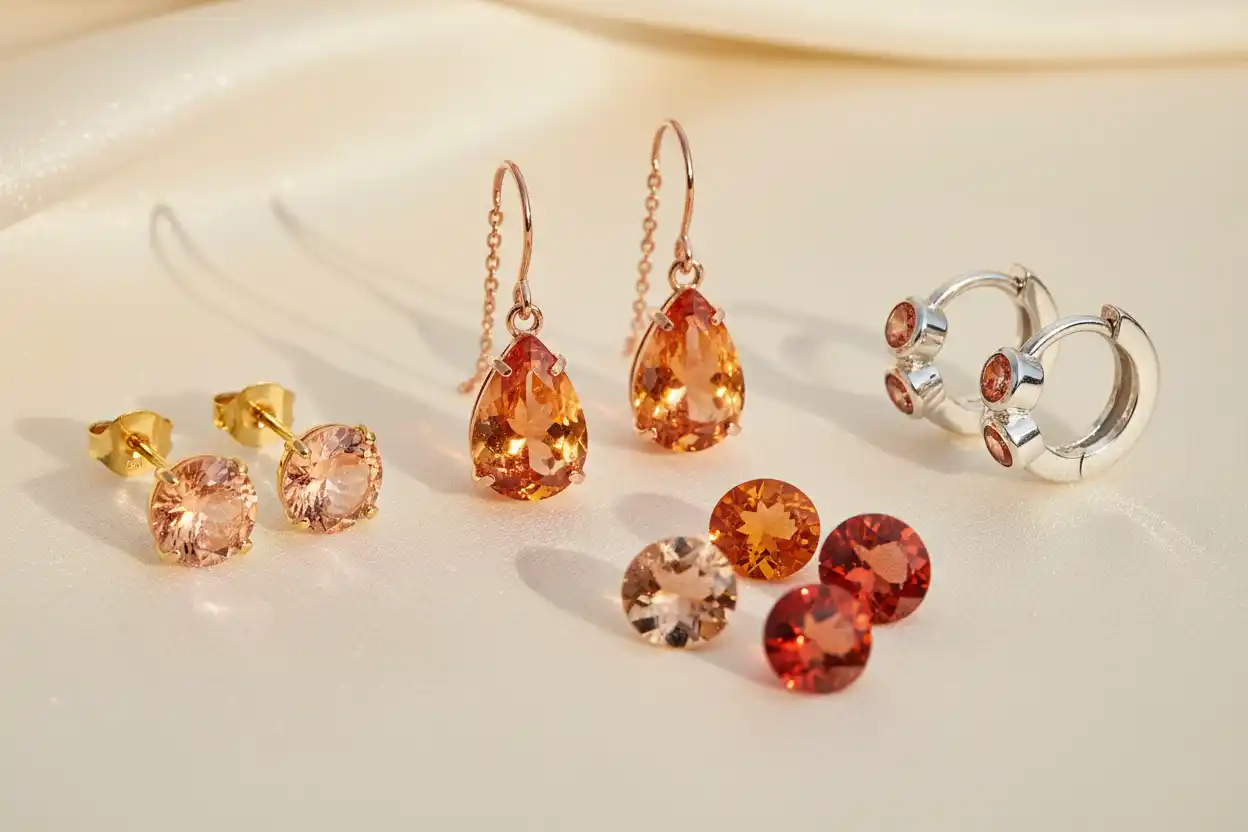
Sunstone earrings place warm peach, orange, red, gold and coppery flashes close to the face, where natural movement helps the stones catch changing light. They can range from casual opaque cabochon studs to rare transparent Oregon Sunstone drops with vivid body color and copper schiller.
Earrings are one of the safest ways to wear this feldspar because they receive less impact than rings or bracelets. Even so, pair matching, setting security, total weight, backing style and the orientation of the aventurescence all influence the quality of the finished jewelry.
Sunstone Earrings at a Glance
| Feature | What to Consider |
|---|---|
| Gem family | Feldspar |
| Common colors | Peach, orange, gold, red, pink, brown, green and colorless |
| Optical effect | Aventurescence or metallic schiller |
| Mohs hardness | Approximately 6–6.5 |
| Cleavage | Two significant directions |
| Popular styles | Studs, bezels, halos, drops, dangles, hoops and clusters |
| Best everyday format | Small bezel studs or compact drops |
| Most difficult quality factor | Matching color and schiller orientation |
| Premium material | Transparent copper-bearing Oregon Sunstone |
| Main care concern | Scratching, cleavage and impact |
| Safest cleaning | Lukewarm water, mild soap and a soft brush |
| Gift advantage | No ring or wrist sizing required |
Why Sunstone Works Well in Earrings
Sunstone is softer and more cleavage-prone than many everyday ring stones, but earrings avoid most desk contact, household impact and hand washing.
The stone’s aventurescence also benefits from movement. As an earring turns, the reflective platelets catch light from different angles and create changing flashes.
The broader Sunstone meaning guide explains the mineral’s feldspar identity and symbolism. The types of Sunstone guide covers the major varieties, colors and inclusion effects.
This page focuses on matching, style, comfort and earring construction.
Sunstone Stud Earrings
Studs sit close to the earlobe and provide the most practical format for regular wear.
Round and oval cabochons display aventurescence over a broad smooth surface. Faceted transparent gems produce more conventional brilliance while still showing copper or hematite flashes.
Four-prong baskets create an open look but leave more of the girdle exposed. A bezel provides stronger edge protection and reduces snagging in hair or clothing.
Large studs may tilt forward. A broad backing or supportive disc can help the earring sit flat against the lobe.
For everyday use, a moderate stone with lively color often performs better than an oversized but dark or heavily fractured gem.
Bezel-Set Earrings
A bezel surrounds most or all of the Sunstone’s edge with metal. It is an excellent choice for feldspar because it protects vulnerable girdles and cleavage-related weaknesses.
Full bezels create a clean modern outline. Partial bezels expose more of the stone but leave some edges available to impact.
The setting should not press against a visible fracture. A skilled jeweler needs to adjust the metal gradually because feldspar can chip during setting.
Bezel studs and short bezel drops are among the most reliable choices for frequent wear.
Sunstone Halo Earrings
Halo earrings surround each Sunstone with Diamonds, white Sapphires, Zircon or other colorless accents.
The bright surround can increase apparent size and emphasize peach, pink or red color. It may also help a medium-dark center gem appear livelier.
A halo introduces more maintenance. Hair products, skin oils and cosmetics can collect beneath the stones and reduce sparkle.
The accent gems should not touch the Sunstone directly. Hard Diamond or Sapphire girdles can abrade the softer feldspar if the settings allow repeated contact.
Sunstone Drop Earrings
Drop earrings suspend one or more stones beneath the lobe. Their movement can reveal aventurescence more effectively than a fixed stud.
Pear, oval and elongated cushion cuts suit this vertical format. Cabochon drops may show broad schiller, while transparent gems create sharper flashes.
Short drops remain comfortable for regular use. Longer designs can tangle in hair, scarves and high collars.
Every connecting ring should be soldered or securely closed. A weak open link presents a greater loss risk than the gemstone’s ordinary wear.
Sunstone Dangle Earrings
Dangles may use several linked Sunstones or combine the gem with other colors and metals.
A multistone design should account for hardness. Quartz, Sapphire and Diamond components should not strike directly against the feldspar.
The reverse side needs smooth finishing because moving settings can touch the neck. Exposed culets or rough metal edges quickly become uncomfortable.
Long dangles should be stored flat or suspended separately to prevent tangling and stone-to-stone impact.
Sunstone Hoop Earrings
Sunstone may appear as small charms on hoops or as gems set directly along the front of the curve.
Removable charms provide flexibility, allowing one hoop to support several gemstone options. The charm must not slide off when the hoop opens.
Front-facing bezel or prong settings keep the stones visible. Inside-out hoops require more stones and setting points, increasing cost and maintenance.
A hinged hoop should close with a clear click. Misaligned or weak hinges are a common loss risk.
Sunstone Cluster Earrings
Clusters arrange several small Sunstones into floral, geometric or asymmetrical designs.
This format can create strong color without requiring two large matched stones. It also allows natural variations in peach, orange and red to become part of the design.
A cluster should look intentionally graduated. One gray, heavily windowed or weakly polished stone can disrupt an otherwise harmonious pair.
Inspect the gallery for strong connecting metal and accessible cleaning spaces. Thin unsupported links can distort with wear.
Matching Sunstone Pairs
Matching Sunstone is more complex than matching a uniformly colored transparent gem.
The two stones should coordinate in body color, tone, visible dimensions, transparency and overall brightness. Their aventurescence should also face in compatible directions.
If one cabochon flashes strongly when viewed straight on while the other requires an extreme angle, the pair may look uneven during wear.
Exact patterns do not need to be identical. Natural schiller is rarely perfectly symmetrical, but the earrings should feel balanced at normal viewing distance.
Transparent Oregon Sunstone pairs can command a premium because matching color zoning and copper inclusion orientation requires substantial sorting.
Choosing Body Color
Peach and apricot Sunstone creates a soft, wearable look. Orange and reddish-orange material produces greater warmth and contrast.
Deep red Oregon Sunstone is rarer and can resemble Spinel or Ruby in strong lighting, although its hardness and optical properties differ.
Green and red-green Oregon gems are especially unusual. Color zoning may be centered, directional or distributed across the stone.
Pale colorless and yellow feldspar can display dramatic copper schiller even when the body color remains restrained.
The Oregon Sunstone guide covers this locality variety without requiring the general earring page to repeat its full geology.
Warm comparisons appear in the orange gemstones guide and red gemstones guide.
Choosing Aventurescence
Aventurescence may appear as fine glitter, broad metallic flash or a concentrated coppery cloud.
For stud earrings, the effect should be visible from the front. Drops can tolerate more directional schiller because their movement reveals several angles.
Dense inclusions may reduce transparency. This can be attractive in a cabochon, but a faceted gem needs enough open material to return light.
A seller’s photographs should include more than one angle. One carefully positioned image can exaggerate a highly directional effect.
The Sunstone buying guide explains how color, schiller, clarity and cutting affect quality.
Cabochon or Faceted Sunstone
Cabochons work well for opaque, translucent and strongly included material. Their curved surfaces show broad color and reduce vulnerable facet junctions.
Faceted Sunstone is normally more transparent. Proper proportions create brightness around the inclusion effect.
A shallow faceted stone may show a central window. Excessive depth makes the gem appear smaller and darker.
Cabochons should have even domes and smooth polish. Flat spots, pits and undercut inclusions weaken the presentation.
The choice depends on the material. A fine copper-schiller gem may work beautifully in either format when the cutter orients it correctly.
Cut Shapes
Rounds are easiest to match and provide a classic stud shape. Ovals conserve rough efficiently and produce greater visible length.
Cushions create a softer geometric outline. Pears suit drops, while trillions and marquises give a more modern appearance.
Pointed shapes require protective prongs. Feldspar corners can chip when left exposed.
Freeform cabochons can display unusual color zoning but must still form a balanced pair.
Clarity and Structural Condition
Sunstone may contain reflective platelets, mineral crystals, veils, cleavage fractures and color zones.
Inclusions responsible for aventurescence are desirable. Large open fractures are not, especially near a prong or drilled component.
Check each stone from the side. A fracture hidden beneath the top view may reach the girdle and weaken the setting area.
Resin, filling or coatings should be disclosed. Treatment can affect cleaning and repair even when it improves appearance.
Sunstone Versus Similar Sparkling Materials
Sunstone is sometimes confused with Goldstone. Goldstone is manufactured glass with numerous metallic crystals that often appear unusually even.
Aventurine is usually Quartz containing reflective inclusions. Its hardness and internal texture differ from feldspar Sunstone.
Moonstone belongs to the feldspar family but displays a floating adularescent glow rather than metallic aventurescence.
Labradorite produces broad spectral labradorescence from internal feldspar structures. Oregon Sunstone is itself a labradorite composition, but its copper inclusions create a different visual phenomenon.
The broader feldspar guide explains how these related materials fit within the mineral family.
Earring Size and Weight
Small studs provide visible warmth without pulling on the lobe. Larger cabochons may require supportive backs.
Carat weight alone does not show how large the earrings will appear. Compare millimeter dimensions and total setting weight.
Drops distribute weight differently from studs because the gem hangs below the ear. Even so, a heavy drop can become uncomfortable over several hours.
Wear statement earrings briefly at first and verify comfort before the return period expires.
Earring Backs
Friction backs work well for small studs when they grip the post securely.
Screw backs offer additional security for valuable earrings but require more time to fasten. The threaded post can feel uncomfortable to some wearers.
Locking backs combine strong retention with a larger support surface, making them useful for heavier studs.
Lever backs suit drops and dangles. Open hooks should include silicone stoppers when loss is a concern.
The back should match the earring’s weight and value rather than being selected only for convenience.
Metal Choices
Yellow gold intensifies peach, orange, red and coppery Sunstone.
Rose gold creates a soft tonal combination with salmon and pink stones. It may reduce contrast when the gem is pale.
White gold, platinum and silver provide a cooler border that can emphasize red, green and strongly glittering material.
Metal sensitivity matters because earring posts pass through the skin. Ask about alloy content when nickel or other reactions are known.
Styling Sunstone Earrings
Peach studs work well with neutral clothing and minimal jewelry. Coppery drops complement warm browns, navy, cream and olive.
Red or green Oregon Sunstone can carry a formal design without requiring a large halo.
Long hair may conceal small pale studs, while bright schiller or movement helps drop earrings remain visible.
The recipient’s existing earring collection provides the best style guide. Match normal metal color, preferred length and level of formality.
Comparing Other Sunstone Jewelry
A Sunstone bracelet remains visible to the wearer but receives more impact.
A Sunstone necklace allows larger gems while keeping them away from the hand.
A Sunstone ring places the gem in the most prominent position but requires a protective setting.
Earrings offer one of the strongest balances between visibility and physical safety.
Price and Documentation
Commercial peach cabochon earrings are usually more affordable than transparent matched Oregon Sunstones.
Price rises with vivid body color, attractive copper schiller, transparency, cutting and close matching.
An independent report may be worthwhile for large or expensive transparent pairs, especially when the price depends on natural copper-bearing Oregon origin.
The Sunstone price guide explains value factors without reducing every pair to one fixed rate.
Cleaning and Care
Clean Sunstone earrings with lukewarm water, mild soap and a soft brush.
Work gently around posts, galleries and earring backs where cosmetics and skin oils collect. Rinse briefly and dry completely.
Avoid ultrasonic and steam cleaning. Feldspar cleavage, hidden fractures and possible treatment make mechanical cleaning unnecessarily risky.
The dedicated guide to cleaning Sunstone jewelry provides a more detailed procedure.
Apply hairspray, perfume and cosmetics before wearing the earrings. Remove long designs before sleeping.
For belief-based maintenance, the guide to cleansing and charging Sunstone emphasizes gentle methods.
Storage
Keep each earring in a separate padded compartment. Allowing the pair to strike each other can chip edges or bend prongs.
Store the backings with the earrings. Small locking mechanisms and friction backs are easy to misplace.
Keep Sunstone away from harder gems. The gemstone hardness chart shows why Quartz, Spinel, Topaz, Sapphire and Diamond require separation.
Sunstone is also listed in the crystals beginning with S and gemstones beginning with S directories.
Final Perspective
Sunstone earrings should be evaluated as pairs rather than as two attractive stones sold together. Compatible color, schiller direction, dimensions and brightness create the visual balance.
Once the match is right, select a setting and backing that suit the weight. A modest bezel pair with lively aventurescence will often receive more wear than oversized earrings with exposed edges, weak backs or uncomfortable movement.
Frequently Asked Questions
1. Is Sunstone suitable for earrings?
Yes. Earrings expose the gem to relatively little impact, making them one of the safest Sunstone jewelry formats.
2. Are Sunstone studs good for everyday wear?
Small bezel or secure prong studs can be worn regularly with reasonable care. Remove them before sports, bathing and sleeping.
3. What makes Sunstone earrings sparkle?
Reflective mineral or copper platelets create aventurescence. The effect changes as the earrings move.
4. How closely should Sunstone earrings match?
They should coordinate in body color, size, transparency, brightness and the direction of the schiller effect.
5. Is Oregon Sunstone better for earrings?
It can provide exceptional color, transparency and copper schiller, but the best choice depends on budget and personal style.
6. Are Sunstone earrings heavy?
Weight depends on stone size, density and setting construction. Large cabochons and halos may require supportive backs.
7. Can Sunstone earrings be cleaned in an ultrasonic machine?
Ultrasonic cleaning is not recommended because vibration can affect cleavage fractures, fillings and settings.
8. Which metal looks best with Sunstone?
Yellow gold emphasizes warm orange and peach tones, while white metal provides stronger contrast. Rose gold suits salmon and pink material.
9. How can Sunstone earrings be distinguished from Goldstone?
Sunstone has natural directional inclusions and feldspar properties. Goldstone is manufactured glass with more uniformly distributed metallic sparkle.
10. Are transparent Sunstone earrings more valuable?
They may be, particularly when they show vivid natural color and copper schiller. Opaque material can still be attractive and well made.
11. Do Sunstone earrings need laboratory reports?
Small commercial earrings usually do not. Reports become more useful for large, expensive or premium Oregon Sunstone pairs.
12. How should Sunstone earrings be stored?
Place each earring in a separate padded compartment with its backing. Keep them away from harder gemstones and heavy jewelry.