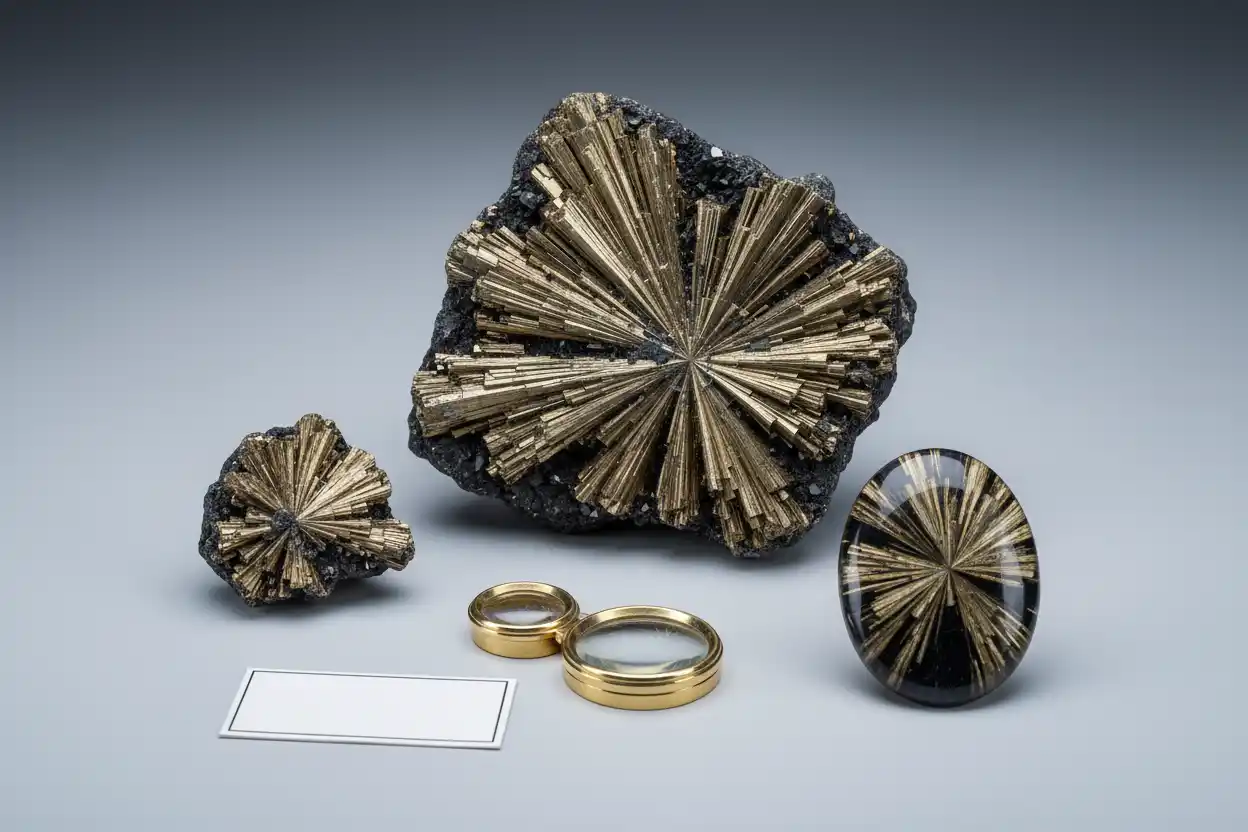
Where to Buy Real Astrophyllite: Trusted Sellers and Fake-Spotting Tips
Real astrophyllite is best bought from a seller who understands mineral specimens, not merely from a listing that promises “golden starbursts.” The mineral is a complex iron-titanium silicate that usually appears as bronze, golden-brown or coppery blades within a contrasting host rock. Most retail pieces are therefore not single crystals or pure gemstones; they are composite rocks whose appeal comes from the distribution of astrophyllite across the matrix.
That distinction affects identification, value and care. Astrophyllite has Mohs hardness around 3, perfect cleavage in one direction and brittle tenacity. Thin blades can split, polished surfaces can undercut, and a cabochon may contain several associated minerals. Begin with the astrophyllite mineral guide to understand its identity before comparing sellers.
Choose the Right Astrophyllite Format
Astrophyllite reaches the market in several forms, and each one requires a different buying approach.
| Format | What you are actually buying | Main concern |
|---|---|---|
| Crystal specimen | Blades, sprays or radiating aggregates on matrix | Broken or reattached blades, unstable matrix and weak locality documentation |
| Rough lapidary slab | Astrophyllite-bearing rock cut to expose patterns | Misidentification, hidden fractures and low astrophyllite content |
| Cabochon | Polished composite stone, often with feldspar or other alkaline-rock minerals | Surface resin, poor orientation, undercutting and misleading “gem-grade” claims |
| Beads or bracelet | Small polished sections of mixed host rock | Cracks at drill holes, coatings, inconsistent material and low durability |
| Sphere, tower or carving | Decorative object cut from astrophyllite-bearing rock | Filler, glued fractures, weak points and trade-name confusion |
| Pendant or brooch | Polished stone in a setting | Fragile edges, adhesive construction and unsuitable everyday-wear claims |
For a scientific specimen, use a specialist mineral dealer. For jewelry or decorative objects, choose an experienced lapidary seller who discloses host rock, stabilization and repair.
Where to Buy Real Astrophyllite
Specialist mineral dealers
A reputable mineral dealer is the best source for natural blades, radiating aggregates and locality specimens. The listing should name astrophyllite as the mineral species, identify associated minerals where possible, describe condition and state whether crystals have been repaired.
Astrophyllite was first described from Låven in Norway, while notable material also occurs in alkaline complexes such as the Khibiny and Lovozero massifs of Russia and Mont Saint-Hilaire in Québec. A locality claim can add value, but appearance alone does not establish origin. Ask for an original label, collection history or supplier documentation.
Type-locality material deserves particular scrutiny. Låven is a protected classic mineral site, so newly collected claims should not be accepted casually. Older specimens may be legitimate, but they should carry credible collection provenance.
Gem and mineral shows
Shows provide the best opportunity to inspect how blades enter the matrix. Under moving light, genuine astrophyllite should show irregular, plate-like or bladed reflections that change with viewing angle. You can also check whether the piece is structurally sound and whether polished surfaces contain pits, soft areas or filler.
Compare astrophyllite with other metallic-looking materials before buying. Bronzite and hypersthene can show bronze or silvery sheen, while rutilated quartz contains needle-like inclusions inside quartz. Their textures, host materials and optical effects differ, but online photographs can flatten those differences.
Online mineral shops
A strong online listing includes the exact item, dimensions, weight, front and back views, a moving-light video and close-ups of any repaired area. For polished pieces, request an unedited wet-look and dry-look comparison only if the seller can do so without applying oils; some surfaces appear far richer under temporary moisture than in normal display conditions.
The seller should explain whether “astrophyllite” refers to identified crystals or a commercial name for a mixed decorative rock. Follow the broader online gemstone buying checklist for payment protection, seller verification and return terms.
Lapidary sellers and jewelry makers
A skilled lapidary can orient the slab so radiating blades cross the cabochon face and reflect strongly. However, polishing a mixed rock is technically demanding because constituent minerals can differ in hardness and cleavage. Ask whether the stone has been impregnated, backed, coated or filled to improve the surface.
Jewelry makers should describe the setting and intended wear. A pendant with a protective bezel is more realistic than an exposed ring marketed for daily use.
What Genuine Astrophyllite Looks Like
Astrophyllite commonly appears as bronze-yellow, golden-brown, brown or reddish-brown blades with pearly, greasy or submetallic luster. Crystals can be tabular, lamellar or radiating, and attractive specimens often resemble starbursts embedded in a pale, gray, cream, reddish or dark matrix.
The pattern should be integrated into the rock rather than printed or painted on top. Under magnification, blades may show cleavage, irregular edges, small steps and natural intersections with the matrix. Reflections usually vary from one blade to another because their orientations differ.
Most polished “astrophyllite stones” contain more than one mineral. In alkaline host rocks, associated species may include aegirine, eudialyte, nepheline, arfvedsonite and feldspar. Those associations can be natural and desirable, but sellers should not imply that the entire object consists of astrophyllite.
Some Norwegian material may occur in rocks related to larvikite-type alkaline complexes. The larvikite guide helps distinguish a feldspar-rich ornamental rock with blue-silver flash from an astrophyllite-bearing piece with bronze blades.
Astrophyllite, Kupletskite and Group-Level Identification
One of the most important buying limits is that astrophyllite belongs to a chemically complex mineral group and supergroup. Closely related species can look similar, and visual identification may not separate them. Material sold in the decorative-stone market may be labeled “astrophyllite” based on appearance or trade convention rather than full chemical analysis.
For an inexpensive cabochon, a cautious trade identification may be acceptable. For a high-value specimen, a claimed rare locality or a scientifically important crystal, ask whether the identification was confirmed by Raman spectroscopy, X-ray diffraction or compositional analysis. Energy-dispersive X-ray spectroscopy can help characterize chemistry, although exact species assignment may require more than a simple elemental scan.
A seller who says “astrophyllite-group mineral” may be more credible than one who claims absolute species certainty from a photograph. Precise mineral identification is not a weakness; it is a sign that the dealer understands the limits of visual inspection.
Common Fakes, Lookalikes and Misleading Listings
Metallic paint or foil in resin
Low-quality imitations may use metallic pigment, foil flakes or painted lines to mimic golden blades. Surface pigment can collect in pores, rub onto a cloth or appear to sit above the matrix. Resin may show mold seams, round bubbles, uniform gloss or repeated patterns.
Do not scrape or use solvents to test the surface. Request magnified photographs and use the return policy if the construction was not disclosed.
Mica-rich rock sold as astrophyllite
Mica can create bright platy reflections and may occur naturally with other minerals. However, a glittering mica schist is not automatically astrophyllite. Review the mica types and properties guide and ask the seller how the identification was made.
Bronzite and hypersthene
Bronzite usually shows bronzy schiller across broader patches, while hypersthene can show a silvery, bronze or reddish sheen. Astrophyllite more often displays distinct blades or radiating starbursts in a contrasting matrix. Nevertheless, polished cabochons can be confusing, and photographs alone may not settle the question.
Rutilated quartz
Rutilated quartz contains needles enclosed within transparent or translucent quartz. Astrophyllite generally occurs as blades in an opaque to translucent host rock. If the entire stone is glassy quartz with internal needles, the material is more likely rutilated quartz than astrophyllite.
Goldstone and other man-made glass
Goldstone is manufactured glass containing abundant glittering crystals. Its sparkle is usually highly uniform and distributed through a glassy body. Astrophyllite shows irregular mineral blades, natural matrix relationships and less uniform reflection.
Reconstructed, glued or filled material
Genuine slabs may be glued across fractures, backed with another material or impregnated with resin before cutting. A specimen can also be repaired after blades detach. These practices are not automatically deceptive, but undisclosed assembly changes value and care.
The general fake-crystal guide explains how to evaluate molded, coated, assembled and mislabeled products without destructive testing.
Treatments and Surface Enhancement
Astrophyllite is not known for a single standardized treatment regime comparable to heat-treated corundum. Instead, buyers should watch for lapidary stabilization and cosmetic enhancement.
Resin impregnation can strengthen fractures and improve polish. Wax or oil can deepen dark matrix colors and temporarily increase contrast. Clear coatings may hide undercutting, while colored filler can disguise pits. Slabs may also be backed for support before cutting.
Ask whether the object is untreated, surface-waxed, resin-impregnated, fracture-filled, backed or assembled. If the seller uses “stabilized,” request the stabilizing material and whether the treatment reaches the interior. The gemstone treatments overview provides useful disclosure terminology.
How to Evaluate a Natural Specimen
Pattern and crystal development
Look for blades that radiate naturally rather than forming a mechanically repeated motif. Strong contrast between bronze crystals and the host rock improves display appeal, but the pattern should still look mineralogical rather than printed.
Condition
Thin blades can cleave or detach. Inspect for fresh breaks, crushed edges and loose crystals. A repaired blade may show a glossy adhesive line or a slight mismatch at the join. Ask the dealer to identify every known repair.
Matrix stability
Some host rocks are tough enough for display, while others contain weak seams or friable zones. Check the base, corners and any saw-cut surface. A large specimen should stand securely without pressure on the astrophyllite.
Locality and label quality
A precise label adds scientific value. “Kola Peninsula, Russia” is more informative than “Russia,” while a mine, mountain or massif is better still. However, a detailed label is only as good as its chain of custody.
Aesthetic balance
Collector value often comes from the arrangement of the blades rather than their total mass. A smaller specimen with one complete starburst, clean matrix and strong luster may be more desirable than a large piece with scattered, damaged fragments.
How to Evaluate Slabs and Cabochons
A quality cabochon should display recognizable blades across the face, not merely a few metallic specks. Turn it under a single light source and watch whether reflections follow different blade orientations. The best cut normally places the radiating pattern near the center or uses it intentionally in an asymmetrical design.
Inspect the polish at several angles. Soft blades and harder matrix can polish unevenly, producing shallow pits or rippled surfaces. Minor texture may be normal, but a thick glossy coating should be disclosed.
Check the back. A natural unbacked cabochon reveals the host rock, whereas a black resin layer, metal plate or second stone indicates backing or assembly. Backing may improve durability, yet it should not be hidden.
For beads, examine each drill hole. Cracks radiating from the hole can worsen during stringing. Large round beads are particularly vulnerable because the material may contain internal seams.
Jewelry Suitability
Astrophyllite is a collector and lapidary material rather than a durable everyday gemstone. Its low hardness, perfect cleavage and brittle nature make exposed rings risky. Pendants, brooches and earrings are safer, especially when a bezel protects the perimeter.
The gemstone hardness chart describes scratch resistance, while toughness versus hardness explains cleavage and impact failure. Those concepts are essential because a soft stone can also be structurally fragile.
Avoid tension settings, thin unsupported cabochons and designs that place drill holes close to an edge. Ask whether the maker used adhesive and whether replacement or repair is possible if the stone splits.
Questions to Ask the Seller
A serious seller should answer these questions directly:
- Is the material confirmed as astrophyllite or described at group level?
- What is the exact locality?
- Does the price include a specimen or provenance label?
- Which visible parts are astrophyllite, and what is the host rock?
- Has the piece been repaired, backed, glued, filled or stabilized?
- Has wax, oil, resin or coating been applied?
- Are the photos and video of the exact item?
- Are any blades loose or any corners fractured?
- Is the polished surface naturally textured or coated?
- What is the return period after inspection?
An honest “unknown host rock” is preferable to an invented list of associated minerals.
Price and Value Factors
Astrophyllite value is shaped by crystal form, contrast, pattern, locality, specimen condition, size, documentation, lapidary quality and treatment disclosure. The mineral is uncommon enough to attract specialty buyers, but “rare” does not automatically mean expensive. Much retail material is cut from astrophyllite-bearing rock, and the proportion of visible astrophyllite can vary widely.
For specimens, complete blades, distinct sprays and credible labels support value. For cabochons, orientation, polish and structural stability matter more than weight alone. Large spheres and towers command higher prices partly because of material loss and cutting labor, not because every gram contains high-grade astrophyllite.
Use the guide to gemstone pricing to compare material quality rather than relying on arbitrary “grade A” labels. A seller should be able to explain the price in observable terms.
Professional Identification
Professional testing is worthwhile for high-priced specimens, disputed species, unusual color, rare-locality claims and important collection pieces. Raman spectroscopy can help identify mineral phases, X-ray diffraction can characterize crystal structure, and electron-microprobe or related compositional methods may be needed to separate closely related group minerals.
Standard gemological measurements can be difficult on mixed, opaque rock. Refractive index and specific gravity may represent several minerals at once, so a single spot reading may not prove the astrophyllite component. A qualified mineral laboratory is more appropriate than a basic jewelry appraisal when species accuracy matters.
Shipping and Returns
Astrophyllite specimens should be immobilized without placing pressure on blades. Small crystals need a rigid specimen box, soft support around the matrix and a second outer box. Large slabs require corner protection and separation from heavy objects.
Polished pieces should be wrapped individually because harder stones can scratch them. Beads should not be shipped loose in a bag where they strike one another.
Choose tracked, insured shipping for valuable material. Photograph the package while opening it, then inspect the piece under neutral light. A written return policy is essential when the listing depends heavily on color-enhanced photographs or does not show the back.
Responsible Provenance
Ask sellers to distinguish a documented locality from a wholesaler’s country-level claim. For classic or protected localities, old collection labels, dealer records and acquisition dates become particularly important. Avoid pieces represented as recently collected from reserves or prohibited sites.
Responsible buying also includes realistic labor and environmental questions. The ethical crystal sourcing guide helps evaluate traceability claims without assuming that every small dealer can document each transfer back to the mine.
Safe Cleaning and Storage
Use a soft dry cloth, hand air blower or very soft brush. Do not soak astrophyllite, and avoid steam, ultrasonic cleaning, acids, bleach, abrasive powders and uncontrolled solvents. Mixed matrix and resin treatments may react differently, while thin blades can detach under vibration.
The planned ultrasonic-cleaner guide is especially relevant because a mineral’s apparent hardness does not make a fractured composite safe for vibration. Store astrophyllite in a padded compartment away from quartz and other harder stones. Never dry-grind or sand unknown mineral material without professional dust control.
Build Context Around the Specimen
Astrophyllite becomes easier to recognize when viewed alongside the minerals and rocks that occur in similar alkaline environments. The A crystal directory, A gemstone directory and types of gemstones guide provide useful reference points, while the general crystal identification guide explains how habit, luster, cleavage and associations work together.
A strong astrophyllite purchase should remain convincing after the marketing language disappears. You should be able to identify the visible mineral, understand the host rock, see any repair or stabilization, trace the stated locality and return the item if those claims do not hold up.
Frequently Asked Questions
1. Is most astrophyllite sold online pure astrophyllite?
No. Most polished products are astrophyllite-bearing rock that contains a substantial host matrix and may include several associated minerals. Sellers should describe the object as a composite natural rock rather than implying that every part is astrophyllite.
2. What color should real astrophyllite be?
Typical crystals are bronze-yellow, golden-brown, brown or reddish-brown with pearly to submetallic luster. The host rock may be pale, gray, reddish or dark, so the complete piece can show many color combinations.
3. Can astrophyllite be identified from a photograph?
A photograph can support a tentative identification when distinct blades and associations are visible, but it cannot reliably separate astrophyllite from every related group mineral or metallic lookalike. Laboratory testing is appropriate when species certainty affects value.
4. Is astrophyllite commonly dyed?
Dyeing is not the main concern. Surface coatings, wax, resin impregnation, colored filler, backing and incorrect trade labels are more relevant to polished material.
5. How is astrophyllite different from bronzite?
Astrophyllite commonly forms discrete bronze blades or starbursts in a contrasting matrix. Bronzite more often shows broad bronzy schiller across a pyroxene-rich stone. Polished examples can still be confusing, so ask for mineral identification.
6. How is astrophyllite different from rutilated quartz?
Rutilated quartz contains needles enclosed in a transparent or translucent quartz body. Astrophyllite usually occurs as blades within an opaque or mixed host rock and has much lower hardness and stronger cleavage.
7. Is Russian astrophyllite better than material from other countries?
Not automatically. Russian material is common in the lapidary market and can show excellent patterns, but quality depends on blade development, contrast, condition and treatment. Locality should be documented rather than inferred from appearance.
8. Can I wear an astrophyllite ring every day?
Daily ring wear is not advisable. Astrophyllite is soft, brittle and cleavable, while mixed host rock may contain fractures. A protected pendant, brooch or occasional-wear piece is safer.
9. Does a repaired specimen still have collector value?
Yes, when the repair is limited, stable and fully disclosed. The price should reflect the repair, and a reconstructed specimen should not be represented as completely intact.
10. Should an astrophyllite cabochon be perfectly smooth?
Not always. Different minerals in the rock can polish unevenly, causing slight texture. However, deep pits, loose grains, thick coating or concealed filler should be disclosed.
11. What documentation matters most?
A precise locality label, prior collection label, treatment statement, repair note, exact dimensions and invoice description are the most useful records. Expensive pieces may justify a laboratory report.
12. What is the clearest warning sign in a listing?
Be cautious when a seller calls a stone “rare gem-grade astrophyllite” but provides no moving-light video, no back view, no host-rock description, no treatment disclosure and no return policy.