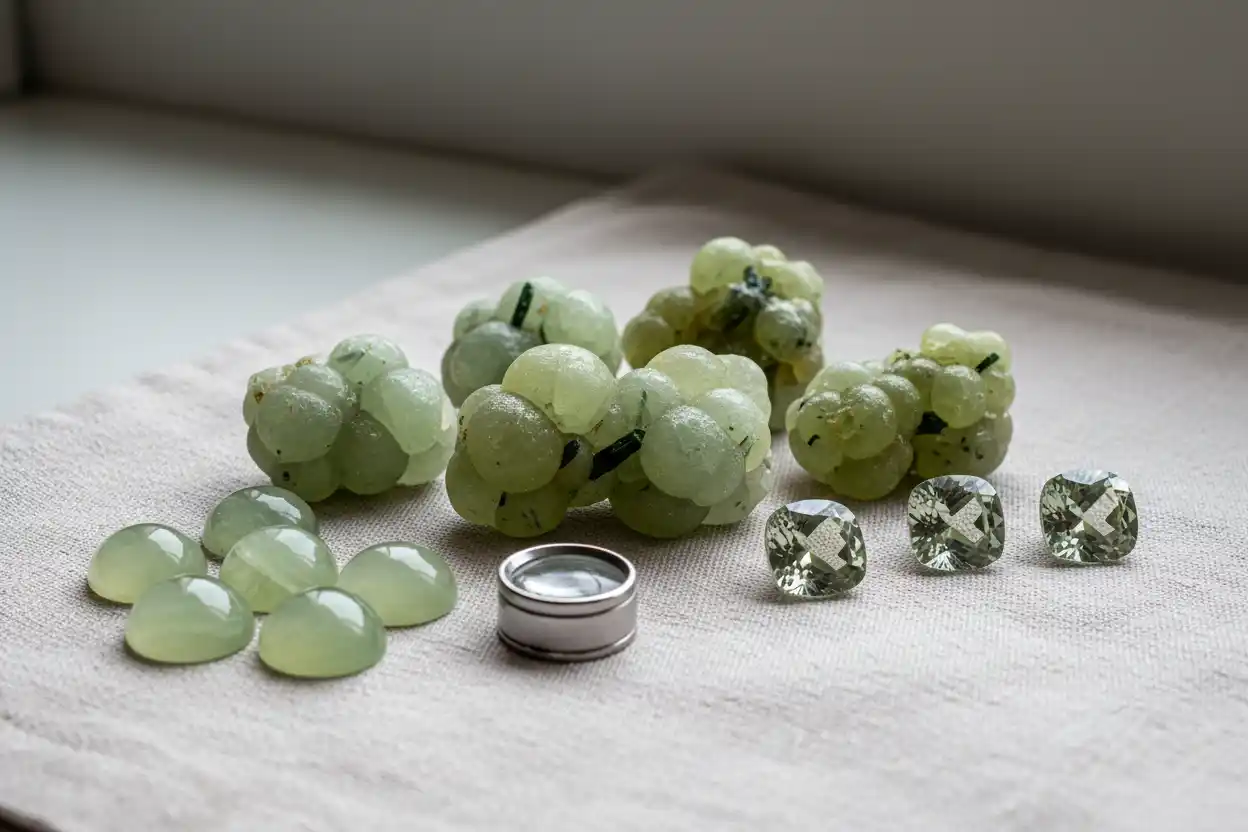
Where to Buy Real Prehnite and Avoid Glass or Jade Fakes
Real Prehnite is a calcium-aluminum silicate commonly found in pale green, yellow-green, apple green, gray-green, yellow, white or nearly colorless material. It often forms botryoidal, globular, stalactitic or radiating aggregates, while transparent facetable crystals are comparatively uncommon.
Polished Prehnite is valued for its misty translucency and soft inner glow rather than intense brilliance. Some cabochons also display silky chatoyancy or a Moonstone-like moving light caused by fibrous or radiating structure.
The market contains green glass, resin, Serpentine, Chalcedony, Green Calcite, Fluorite, Prasiolite and dyed pale stone sold as Prehnite. In addition, green Prehnite has historically appeared among Jade simulants, especially when polished into smooth cabochons.
The Prehnite meaning and properties guide covers its mineral identity and traditional symbolism. This guide focuses on sellers, natural habits, optical quality, treatment, lookalikes, durability and value.
What Prehnite Is
Prehnite is a calcium-aluminum silicate hydroxide with the commonly cited formula Ca2Al(AlSi3O10)(OH)2.
It crystallizes in the orthorhombic system. Nevertheless, retail material rarely appears as simple, sharply formed individual crystals.
Instead, Prehnite commonly forms:
- Rounded botryoidal crusts
- Globular aggregates
- Stalactitic growths
- Radiating fibrous masses
- Reniform surfaces
- Cavity linings
- Crusts associated with Epidote
- Translucent massive lapidary rough
The mineral commonly develops in low-temperature hydrothermal or metamorphic environments, particularly within altered basaltic rocks and related cavities.
Prehnite may occur with Epidote, Calcite, Apophyllite, Zeolites, Quartz and other secondary minerals.
Prehnite Is Not a Zeolite
Prehnite often occurs in the same cavities as Zeolite minerals, and retail sellers sometimes call it a Zeolite.
However, it belongs to a separate silicate structure and mineral group.
This distinction matters for identification and care. Association with Zeolites does not make every green cavity mineral Prehnite, and a mixed specimen can contain several different phases.
A seller should describe the individual minerals rather than labeling the entire association “Prehnite Zeolite.”
Choose the Product Form Before Shopping
| Prehnite product | Best source | Main buying concern |
|---|---|---|
| Botryoidal specimen | Specialist mineral dealer | Natural growth, repair, coating and locality |
| Epidote-associated specimen | Mineral dealer | Glued crystals, correct association and matrix stability |
| Massive rough | Lapidary supplier | Internal fractures, dye and cutting yield |
| Slab | Lapidary dealer | Color distribution, resin and fibrous structure |
| Cabochon | Established gem dealer | Translucency, glow, filler and backing |
| Cat’s-eye cabochon | Phenomenal-gem specialist | Centered eye, fiber orientation and treatment |
| Faceted gem | Collector-gem dealer | Transparency, chips and correct identity |
| Bead strand | Established bead supplier | Glass, Serpentine, resin and drill-hole fractures |
| Sphere or carving | Experienced retailer | Weak reverse color, filling and assembly |
| Jewelry | Jeweler familiar with Prehnite | Protective setting, glue and cleavage-related fractures |
Collector specimens and polished jewelry should not be graded by the same criteria. A botryoidal crust gains value from natural form, while a cabochon is judged for color, translucency and cutting.
Where to Buy Genuine Prehnite
Specialist mineral dealers
A mineral dealer is the strongest source for botryoidal specimens, crystal associations and documented localities.
The listing should state dimensions, weight, locality, condition and associated minerals.
Request photographs of the base, reverse and all mineral contacts. Prehnite crusts can be reattached to matrix, while individual Epidote crystals may be glued into decorative clusters.
Ask whether the specimen was cleaned with acid, coated or stabilized.
Specialist gem dealers
Transparent or highly translucent Prehnite belongs to a smaller collector-gem market.
Request refractive-index or laboratory identification for an expensive faceted stone. Macro photographs should show the girdle and facet junctions.
Ask whether the green color is natural and whether oil, resin, dye or backing is present.
Lapidary suppliers
Prehnite rough can be cloudy, fibrous and internally fractured.
Request dry images and polished test windows. Water and oil can deepen the color and temporarily hide surface abrasion.
Ask whether sample cabochons show an even glow and whether resin was required.
A large rough piece may contain only a narrow translucent layer suitable for cutting.
Gem and mineral shows
Shows let you compare Prehnite with Green Calcite, Fluorite, Serpentine, Jade, Prasiolite and glass.
Rotate cabochons beneath one white light. Natural fibrous material may display a soft moving sheen or narrow cat’s-eye.
Use a loupe to inspect radial texture, dye, resin, backing and bubbles.
Do not scratch the stone. The crystal identification guide explains safer methods.
Established online stores
The online gemstone buying guide covers seller identity, protected payment methods and returns.
Request exact-item video under neutral light. Pale yellow-green Prehnite can appear vivid apple green after saturation adjustment.
Ask whether photographs were taken while the stone was wet or strongly backlit.
The seller should show both the front and reverse because color and fracture density often vary.
What Genuine Prehnite Looks Like
Typical colors include:
- Pale mint
- Yellow-green
- Apple green
- Gray-green
- Olive-yellow
- Lemon yellow
- White
- Colorless
- Rare orange or unusual green-yellow material
Transparency ranges from transparent to translucent and nearly opaque.
Many polished pieces have a hazy, cloudy or mist-filled body. That appearance may result from fibrous aggregate structure and fine inclusions rather than poor polishing alone.
Botryoidal surfaces consist of rounded forms that merge into one another. Broken sections can reveal radiating or fibrous internal texture.
Luster ranges from vitreous to pearly. The material can take a useful polish, although fibrous areas may undercut.
Natural black or dark green Epidote crystals are common associations in some deposits.
Prehnite Versus Green Calcite
Green Calcite can share Prehnite’s pale mint, yellow-green and cloudy appearance.
Calcite has Mohs hardness 3, strong birefringence and perfect rhombohedral cleavage. Prehnite is harder and has different optical properties.
The completed guide to buying real Green Calcite owns dye and carbonate-specific care.
Do not use acid to distinguish them. Refractive index, Raman spectroscopy and microscopy provide safer evidence.
Prehnite Versus Green Fluorite
Green Fluorite may appear pale mint, grass green or emerald-like.
Fluorite commonly shows cubic zoning and perfect octahedral cleavage. Prehnite more often forms botryoidal or fibrous aggregates.
The completed guide to buying genuine Green Fluorite covers irradiation, cleaved octahedra and glass.
Polished spheres can remain difficult to separate visually. Instrumental testing is preferable to scratching.
Prehnite Versus Green Aventurine
Green Aventurine is quartz-rich and commonly sparkles because of reflective Fuchsite mica.
Prehnite generally has a soft cloudy glow without widespread glitter.
The completed guide to buying real Green Aventurine covers aventurine glass and polymer impregnation.
A non-sparkling pale-green object should not automatically receive the Prehnite name, but the absence of aventurescence separates it from typical Aventurine.
Prehnite Versus Prasiolite
Prasiolite is transparent green quartz, commonly produced through heat treatment or irradiation of suitable quartz.
Prasiolite is harder and normally appears cleaner and more glassy than cloudy Prehnite.
Faceted stones can resemble one another in pale yellow-green shades. Refractive index, birefringence and inclusion structure provide separation.
Prehnite Versus Peridot
Peridot is gem-quality olivine with yellow-green to green body color.
Fine Peridot generally shows stronger transparency, higher luster and more conventional faceted brilliance.
Prehnite commonly appears softer, hazier and more pastel.
A vivid transparent green faceted stone should receive laboratory confirmation before being sold as either material.
Prehnite Versus Jade
Jade refers properly to Jadeite or Nephrite.
Prehnite can imitate pale green Jade in cabochons and carvings. However, Jade has a distinctive tough interlocking structure and different optical properties.
The completed Jade buying guide and real-versus-fake Jade guide own the Jade-specific treatment and species workflow.
A seller should never use “Australian Jade” or “Prehnite Jade” without clearly identifying Prehnite as the actual mineral.
Prehnite Versus Serpentine
Serpentine can be pale yellow-green, olive or apple green and is widely carved.
It often has a waxier appearance and lower hardness than Prehnite.
Because both can be cloudy and massive, visual identification from photographs may be unreliable.
Raman spectroscopy or refractive testing is appropriate when the trade name affects value.
Prehnite Versus Chrysoprase
Chrysoprase is translucent nickel-colored Chalcedony with an even apple-green body.
Prehnite may show a paler yellow component, fibrous texture and botryoidal origin.
Chrysoprase is harder and usually lacks Prehnite’s misty radiating structure.
The completed guide to buying genuine Chrysoprase covers nickel-related color and treated substitutes.
Prehnite Versus Glass
Pale green glass can imitate faceted stones, beads and translucent cabochons.
Round bubbles, flow lines, mold seams and conchoidal chips support glass.
However, natural Prehnite can contain rounded fluid inclusions or cavities. One bubble-like feature is not conclusive.
Standard gemological testing separates the materials readily.
Prehnite Versus Resin
Resin can be molded into cloudy green beads, spheres and carvings.
Casting seams, soft scratches, numerous round bubbles and repeated internal patterns support polymer construction.
Stone powder may be added to increase weight. Therefore, density by hand is not sufficient.
The fake-crystal buyer’s guide provides broader resin and glass checks.
Dyed Prehnite and Dyed Lookalikes
Pale stone, Chalcedony and other porous materials can be dyed green.
Artificial color may concentrate in fractures, pores and drill holes.
Prehnite itself can also contain surface-reaching cracks that accept color or filler.
A chipped edge may reveal a paler body. However, natural zoning and iron-related color variation can also be uneven.
Ask for a treatment statement rather than relying on color intensity.
Resin Filling and Stabilization
Fibrous or fractured Prehnite can be stabilized with polymer.
Clear resin may reduce the visibility of cracks and help a cabochon maintain polish. Colored filler can strengthen green appearance.
Under magnification, filler may contain bubbles or show a different surface luster.
Limited stabilization can improve wearability, but it should be disclosed.
The gemstone treatments guide explains filling, impregnation and reconstruction.
Coatings and Backing
A clear coating can enhance gloss or reduce abrasion. Green coating can intensify pale color.
Inspect the girdle, drill holes and worn edges for peeling or changes in reflection.
A dark or reflective backing can make translucent Prehnite look greener and more luminous.
Backing may be practical in jewelry when disclosed, but the stone’s appearance can change after removal from the setting.
Glued Prehnite and Epidote Specimens
Prehnite commonly occurs naturally with dark Epidote crystals, creating attractive contrast.
However, loose Epidote crystals can be glued onto Prehnite or matrix.
Inspect each crystal base for glossy adhesive, bubbles and sockets that do not match.
A repaired original association differs from a fully fabricated specimen, but both require disclosure.
How to Evaluate a Mineral Specimen
Natural habit
Look for rounded botryoidal crusts, globular forms, radiating structure or credible cavity growth.
Color
Assess the specimen under neutral light. Very intense emerald green is atypical and requires closer examination.
Condition
Inspect rounded surfaces for bruising, fractures and missing sections.
Associated minerals
Epidote, Calcite, Quartz and Zeolites may occur naturally. Their relationship should appear geologically coherent.
Coating
A uniformly plastic gloss or pooled surface film may indicate lacquer or resin.
Repairs
Request views of the reverse and every major mineral contact.
Locality
A mine-level claim needs an original label or a trustworthy dealer chain.
How to Evaluate Rough
Request dry photographs and at least one polished test window.
Determine whether attractive color and translucency continue through the material.
Fibrous and radiating structure can create chatoyancy, but only when cut in the correct orientation.
Inspect fractures and weak seams. A large piece may produce little gem-quality material.
Ask whether test cabochons required resin or showed undercutting.
How to Judge Cabochons
A quality cabochon should display even color, a soft inner glow and a smooth polish.
Cloudiness can be attractive when it creates depth rather than chalky opacity.
If chatoyancy is present, the eye should remain centered and move continuously beneath one light.
Inspect the back for resin, backing and pale color. The girdle should not contain open fractures or flaking fibrous areas.
Buying Faceted Prehnite
Transparent facetable Prehnite is less common than cabochon material.
A good stone should show appealing yellow-green color, reasonable transparency and balanced cutting.
Inspect facet junctions for abrasion and chips. Internal fibers and clouds may reduce brilliance while remaining characteristic.
A shallow stone may window, while excessive depth can make the color appear dull.
Request independent identification for an expensive faceted gem because several pale-green species overlap.
Buying Beads and Bracelets
Natural strands should show variation in color, cloudiness and internal texture.
Inspect drill holes for radial cracks, resin and color concentration.
Perfectly identical transparent-green beads may indicate glass or heavily processed material.
Prehnite beads are wearable with care, though impact and chemical exposure can affect filled or coated products.
Buying Spheres, Towers and Carvings
Request a complete rotation. The display face may show the strongest green color or best fibrous glow.
A sphere should not have a straight joining seam or a resin-rich cavity hidden beneath its stand.
Most towers are carved. Their pointed form did not grow naturally.
Carvings should avoid thin projections across radiating or fractured areas.
Buying Prehnite Jewelry
Prehnite has useful scratch resistance for pendants, earrings and protected rings, but it remains brittle and may have cleavage or fibrous weaknesses.
The gemstone hardness chart, gemstone cleavage guide and toughness-versus-hardness guide explain why hardness does not guarantee impact resistance.
A bezel protects cabochon edges more evenly than narrow prongs.
Remove Prehnite jewelry before strenuous activity, household cleaning and sudden temperature exposure.
Locality and Provenance
Prehnite was first described from South African material and occurs in many regions.
Important gem and specimen sources include Australia, Mali, South Africa, Namibia, India, China, Pakistan, Canada and the United States.
Australia has supplied notable yellow-green cabochon and faceting material, while Mali has produced translucent crusts, spheres and Epidote associations.
Appearance alone cannot prove origin. A locality premium requires labels, invoices or direct supplier information.
The ethical gemstone sourcing guide provides practical questions about mining, cutting labor and traceability.
Price and Value
Common Prehnite cabochons, beads and small specimens are affordable.
Value increases with:
- Attractive natural yellow-green or green color
- Transparency
- Even misty glow
- Strong chatoyancy
- Fine botryoidal form
- Aesthetic Epidote association
- Large usable size
- Minimal fractures
- Good cutting
- Treatment disclosure
- Documented locality
A smaller transparent cabochon may be more valuable than a large opaque carving.
Similarly, an undamaged natural specimen can command more than a dramatic cluster assembled with glue.
The gemstone pricing guide explains how rarity, cutting yield and documentation influence price.
Questions to Ask the Seller
Ask whether the item was identified as Prehnite through testing, crystal association or appearance alone.
Request the locality and basis for that claim.
Confirm dye, resin, coating, backing, oil, glue and fracture filling.
For specimens, ask whether Epidote or other crystals were reattached. Request views of every base and contact.
For cabochons, request front, back and girdle views. For faceted stones, obtain magnified images and gemological properties.
Finally, confirm that the return policy allows professional identification.
Professional Identification
Refractive index, birefringence, specific gravity and microscopy can separate Prehnite from glass, quartz, Calcite and many green gems.
Raman spectroscopy and X-ray diffraction confirm mineral identity.
Microscopy may reveal fibrous aggregate structure, dye, filler, backing and glued specimen contacts.
Chemical analysis can assist in distinguishing related silicates and identifying iron-related composition.
Confirming Prehnite does not automatically prove natural color, treatment status or geographic origin.
Cleaning and Storage
Clean sound untreated Prehnite with lukewarm water, mild soap and a soft cloth.
Avoid prolonged soaking when fractures, dye, coating, filler or glue are present.
Do not use steam or ultrasonic cleaning on fibrous, fractured, filled or assembled pieces.
Store Prehnite separately from harder gemstones that can scratch its polish.
Frequently Asked Questions
1. What color is natural Prehnite?
Natural Prehnite is commonly pale green, yellow-green, apple green, gray-green, yellow, white or colorless.
2. Is Prehnite a Zeolite?
No. It often occurs with Zeolite minerals but belongs to a different silicate structure.
3. Why does Prehnite look cloudy?
Its fibrous or radiating aggregate structure and fine inclusions can create a hazy, misty appearance.
4. Can Prehnite show a cat’s-eye?
Yes. Properly oriented fibrous material may show chatoyancy or a broader Moonstone-like sheen.
5. Is Prehnite the same as Jade?
No. Prehnite is a separate calcium-aluminum silicate and does not have Jade’s composition or exceptional toughness.
6. Is Prehnite the same as Green Calcite?
No. Calcite is much softer, strongly birefringent and has rhombohedral cleavage.
7. Is Prehnite the same as Prasiolite?
No. Prasiolite is green quartz, while Prehnite is a different silicate mineral with different optical properties.
8. Can Prehnite be dyed?
Yes. Dye can enter fractures and porous areas, and other pale stones may be dyed to imitate it.
9. Can Prehnite contain resin?
Yes. Fractured or fibrous material may be stabilized or filled with polymer.
10. Are Prehnite and Epidote always naturally associated?
They can occur together naturally, but decorative specimens may also be repaired or artificially assembled.
11. Is Prehnite suitable for daily rings?
Protected cabochons can be worn carefully, but brittleness, fractures and setting pressure make exposed daily use risky.
12. What is the biggest warning sign in a listing?
Be cautious when an intensely emerald-green, perfectly clear stone is sold as untreated Prehnite without gemological identification or moving-light evidence.
Buy the Soft Glow and the Correct Mineral Identity
Prehnite should not need a Jade, Emerald or Moonstone label to justify its appeal. Its strongest qualities are its pale green color, misty translucency, natural rounded growth and occasional fibrous optical effects.
The green gemstones guide, P crystal directory, P gemstone directory and visual gemstone guide provide broader comparisons. Choose the piece whose structure, treatment and source remain as convincing as its color.
Safety note: Prehnite and associated matrix rocks are silicate materials. Cutting, drilling, sanding or grinding may generate hazardous mineral dust. Use professional wet methods, effective local extraction and appropriate eye and respiratory protection.