Where to Buy Real Snowflake Obsidian and Avoid Painted Fakes
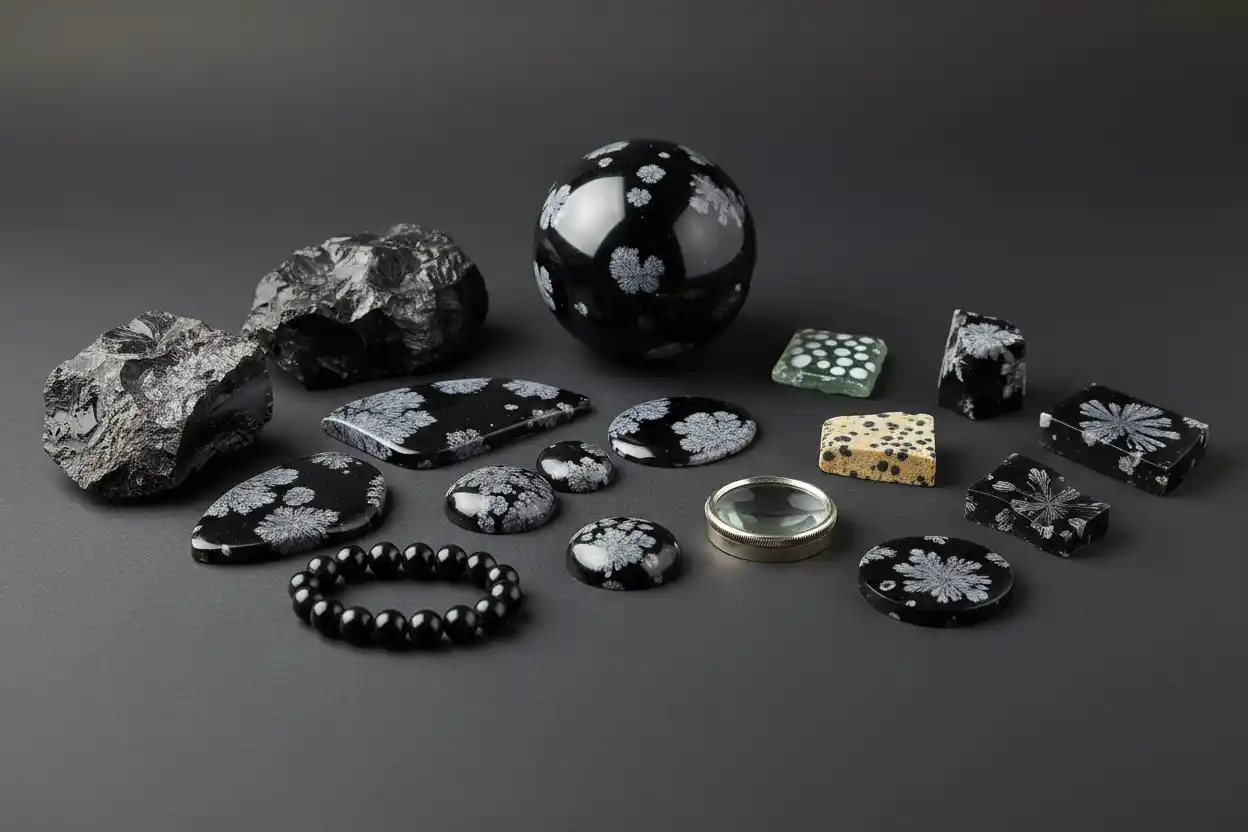
Real Snowflake Obsidian is natural volcanic glass containing gray, white or pale spherulites that resemble snowflakes, flowers or stars against a black-to-dark-brown background.
The pale structures formed when parts of the volcanic glass began to devitrify, meaning that the noncrystalline glass reorganized into radiating microscopic crystals. Cristobalite and other silica-rich or feldspathic phases can occur within these spherulites.
The “snowflakes” are therefore mineral aggregates rather than trapped snow, paint or fossil material. Their shapes continue into the stone and change as rough is cut at different depths.
Imitations include painted Black Obsidian, spotted glass, ceramic, resin, Dalmatian Stone, Howlite and ordinary dark rock with printed white patterns. Natural material may also be coated, resin-filled or assembled.
The Snowflake Obsidian meaning and properties guide covers formation and traditional symbolism. This buying guide focuses on spherulite structure, sellers, treatment, lookalikes, cutting quality and value.
Snowflake Obsidian Is Partly Devitrified Volcanic Glass
Obsidian forms when silica-rich lava cools so quickly that extensive crystals cannot grow.
The result is an amorphous volcanic glass rather than one crystalline mineral species.
The Obsidian meaning and properties guide provides the parent-material context, while the types of Obsidian guide separates black, mahogany, rainbow, golden-sheen, silver-sheen and snowflake varieties.
Obsidian is metastable over geological time. Parts of the glass can begin to crystallize through devitrification.
In Snowflake Obsidian, those crystallizing areas form pale radial spherulites within the remaining dark glass.
What Are the Snowflakes?
A spherulite is a rounded or irregular aggregate of crystals radiating outward from a nucleation point.
When a cut passes through a spherulite, the polished surface may display:
- A round snowflake
- A star
- A flower
- A pale ring
- A partial fan
- A branching gray patch
- A layered circular structure
- An irregular radiating cluster
The pattern depends on the cut’s angle and depth.
Cristobalite is commonly associated with Snowflake Obsidian’s pale structures, but the complete spherulite can contain multiple silica or silicate phases.
Therefore, a seller should avoid claiming that every visible white patch is one pure Cristobalite crystal.
Choose the Product Form Before Shopping
| Snowflake Obsidian product | Best source | Main buying concern |
|---|---|---|
| Natural rough | Obsidian or lapidary supplier | Source, pattern depth and fractures |
| Slab | Specialist lapidary dealer | Spherulite continuity, coating and cutting yield |
| Cabochon | Independent cutter | Pattern composition, polish and backing |
| Tumbled stone | Reputable crystal retailer | Painted glass, Dalmatian Stone and resin |
| Bead strand | Established bead supplier | Printed spots, coating and drill-hole chips |
| Sphere | Experienced carving retailer | Total pattern coverage, assembly and filler |
| Tower | Seller with exact-item video | Carved point, repaired tip and surface decoration |
| Carving | Skilled lapidary seller | Thin edges, resin and reconstructed material |
| Jewelry | Jeweler familiar with Obsidian | Edge protection, glue and solid construction |
| Locality specimen | Geological dealer | Source records and natural exterior |
The pattern differs from piece to piece, making exact-item photography essential.
Where to Buy Genuine Snowflake Obsidian
Obsidian and volcanic-rock specialists
A specialist seller should show both natural rough and polished surfaces.
Request the source, importer and photographs of the unprocessed material.
Natural rough commonly has dark glassy fracture and pale inclusions entering the stone. A freshly cut face should reveal additional spherulites at different depths.
Ask whether the material came from the United States, Mexico or another documented volcanic source rather than assuming locality from appearance.
Lapidary suppliers
Request dry photographs of both slab faces and all edges.
Water and oil deepen the black glass, increase contrast and temporarily hide scratches.
Ask whether spherulites continue through the rough. A dramatic patterned exterior can surround a weakly spotted interior.
Inspect curved fractures, which can reduce cutting yield substantially.
Gem and mineral shows
Shows allow direct comparison with Black Obsidian, Dalmatian Stone, Howlite, spotted glass and ceramic.
Use a loupe to inspect pattern depth, bubbles, paint, resin and seams.
Natural pale structures should merge into the dark glass rather than sit as raised white dots.
Do not chip or scratch the material. Fresh Obsidian edges can be exceptionally sharp.
Established online retailers
The online gemstone buying guide explains protected payments, seller identity and returns.
Request a continuous rotation for spheres, towers and carvings. The seller may photograph the side with the densest and most complete snowflakes.
Ask whether contrast and black levels were adjusted. Heavy editing can turn soft gray inclusions into stark white patterns.
Request the base, reverse and chipped edges when present.
Independent cutters and jewelers
A cutter may orient the spherulites to create balanced cabochon scenes.
Ask to see the original slab for a premium stone.
Closed-back jewelry can hide filler, backing or a thin patterned layer over plain glass. Inspect the loose cabochon before mounting when possible.
What Genuine Snowflake Obsidian Looks Like
The host is commonly black, charcoal, smoky brown or very dark gray.
Snowflakes may appear:
- White
- Pale gray
- Blue-gray
- Cream-gray
- Brown-gray
- Softly mottled
- Sharply radial
- Diffuse and partly merged
Natural patterns vary in size and completeness.
Some pieces contain numerous small round snowflakes. Others display a few large branching forms.
The pale structures should occupy different depths. A polished cabochon may cut through one spherulite’s center and another’s edge.
The dark glass can contain bubbles, flow bands and fractures. These features do not automatically indicate manufactured glass because natural Obsidian can preserve volcanic flow structures and gas cavities.
Snowflake Obsidian Versus Black Obsidian
Black Obsidian lacks the prominent pale spherulites expected in Snowflake Obsidian.
The completed guide to buying real Black Obsidian owns general volcanic-glass, slag and resin identification.
A Snowflake Obsidian stone may contain broad plain-black areas. That does not make it fake, provided genuine spherulites occur elsewhere in the same piece.
Snowflake Obsidian Versus Mahogany Obsidian
Mahogany Obsidian contains red-brown or mahogany iron-rich areas in dark volcanic glass.
The completed guide to buying genuine Mahogany Obsidian covers paint, brown glass and Jasper confusion.
A stone can show both pale spherulites and reddish-brown body zones. Sellers should describe both features instead of inventing a separate variety.
Snowflake Obsidian Versus Rainbow Obsidian
Rainbow Obsidian contains thin internal layers that display directional green, purple, gold, red or blue iridescence.
The completed guide to buying real Rainbow Obsidian owns coating, dichroic glass and optical orientation.
Snowflake Obsidian’s pale patches remain visible as body structures rather than appearing only at one reflective angle.
Snowflake Obsidian Versus Dalmatian Stone
Dalmatian Stone is a pale feldspar–quartz rock with dark amphibole spots.
It has the opposite general color arrangement: a cream or tan host with black spots.
Snowflake Obsidian usually has a black glass host with pale radial inclusions.
Painted products can reverse these colors, so inspect the rock texture and edges rather than relying on the spot pattern alone.
Snowflake Obsidian Versus Howlite
Howlite is a white borate mineral commonly marked by gray or black veins.
It is lighter-colored, softer and lacks Obsidian’s dark volcanic-glass body.
The completed guide to buying genuine Howlite covers dye and white-stone substitutes.
Black-dyed Howlite with pale patches can imitate Snowflake Obsidian superficially. Drill holes may reveal the original white core.
Snowflake Obsidian Versus Black-and-White Jasper
Black-and-white Jasper or jasper-like rock can contain spots, veins and brecciation.
Such material generally has a microcrystalline or granular rock texture rather than a volcanic-glass host.
The completed general Jasper buying guide explains why Jasper names cover several opaque rocks.
A natural black-and-white Jasper is not fake, but it should not receive an Obsidian description.
Snowflake Obsidian Versus Glass
Manufactured black glass can contain white particles, swirls or printed spots.
Warning signs include:
- Mold seams
- Identical repeated snowflakes
- Uniform round bubbles
- White particles with no radial structure
- Perfect factory-calibrated patterns
- Surface-only decoration
- No natural rough evidence
Natural Obsidian can also contain bubbles and conchoidal fracture, so glass-versus-Obsidian separation may require chemical analysis and geological provenance.
The glass-versus-crystal guide provides broader comparison principles.
Painted Snowflakes
Plain Black Obsidian, glass, resin or stone can receive painted white spots.
Under magnification, paint may:
- Sit above the polish
- Bridge scratches
- Pool in pits
- Have sharp artificial edges
- Stop at the girdle
- Repeat across several objects
- Wear away on raised areas
Natural spherulites enter the stone and should appear in chips and edges.
Do not scrape the pattern. Use magnification, professional testing and the return policy.
Printed Ceramic Imitations
Ceramic can reproduce Snowflake Obsidian’s black-and-white appearance through glaze, decals or body pigment.
A chip may reveal a uniform gray, white or clay-colored interior beneath the printed surface.
Ceramic objects may also show mold seams and repeated designs.
They can be durable decorative products when labeled accurately, but they are not volcanic glass.
Resin and Reconstructed Material
Black resin can contain white fibers, mineral fragments or mica powder.
Casting seams, soft scratches and numerous bubbles support polymer manufacture.
Obsidian fragments and pale mineral powder can also be molded together with binder.
The object may contain natural stone while lacking the continuous structure of one volcanic flow.
The fake-crystal buyer’s guide provides wider resin and composite checks.
Coatings and Lacquer
Clear lacquer can improve gloss and conceal shallow scratches.
Black coating may deepen the host, while white paint strengthens weak spherulites.
Inspect high points, edges and drill holes for peeling or a change in luster.
A clear coating over genuine Snowflake Obsidian is a treated natural product. It should be disclosed because it affects repair and cleaning.
The gemstone treatments guide explains coating, filling and reconstruction.
Fracture Filling
Natural Obsidian can contain curved fractures and cavities.
Clear or black resin may stabilize weak areas in spheres and carvings.
White filler could also conceal missing spherulite material or strengthen a pale design.
Under magnification, resin may contain bubbles, form glossy pools or reflect differently from the glass.
Limited repair can make a carving usable but should reduce an untreated-solid premium.
Glued and Assembled Objects
Two patterned slices can be joined to produce a thicker cabochon or sphere.
Inspect the full circumference for straight seams, adhesive bubbles and pattern mismatch.
A thin Snowflake Obsidian cap can also be attached to ordinary black glass or backing.
Closed jewelry settings may conceal the seam.
A repaired natural object differs from a purpose-built composite, but both require disclosure.
How to Evaluate Rough
Request dry photographs of the natural exterior and a fresh cut face.
Assess whether the snowflakes occur through the block rather than only near one surface.
Inspect curved fractures and weathered areas. Obsidian can break unpredictably during cutting.
Ask whether representative cabochons from the parcel show complete radial spherulites.
A large plain-black block with sparse patches should not receive the same price as evenly patterned rough.
How to Evaluate Slabs
Compare both faces and all edges.
Natural snowflakes should change size and shape through the slab.
A complete circle on one face may become a smaller spot or partial fan on the reverse.
A strong slab provides several balanced cutting areas without major fractures.
Check whether the surface is wet, oiled or coated.
How to Judge Cabochons
A skilled cutter frames the most attractive spherulites within the outline.
Good composition may include a few complete snowflakes, smaller partial structures and enough black background for contrast.
The dome should have an even mirror-like polish.
Inspect the girdle for chips and the back for pattern continuity, backing and filler.
A smaller well-composed cabochon can be more attractive than a large stone crowded with diffuse gray areas.
Buying Beads and Bracelets
Natural strands should show variation in snowflake size, shape and placement.
Inspect drill holes for paint, resin and chipped glass.
Identical white star patterns on every bead suggest printed or molded material.
Obsidian beads can chip around drill holes, especially when heavy beads strike one another.
Ask whether the strand contains only Snowflake Obsidian or mixes other black-and-white stones.
Buying Spheres, Towers and Carvings
Request a complete rotation.
A sphere should have pattern across more than one display face and no straight equatorial seam.
Most towers are carved rather than naturally crystallized points.
Inspect tower tips for repairs and carvings for thin projections that could break into sharp edges.
The underside may conceal resin, cavities or plain unpatterned material.
Buying Snowflake Obsidian Jewelry
Obsidian generally has Mohs hardness around 5 to 5.5 and brittle glassy fracture.
The gemstone hardness chart and gemstone toughness-versus-hardness guide explain why polished Obsidian scratches and chips more readily than Quartz-family stones.
Pendants, earrings and brooches are practical.
Rings should use low protective bezels and avoid thin sharp corners.
Inspect the spherulite boundaries for fractures, especially when they reach the girdle.
Locality and Provenance
Snowflake Obsidian occurs in several volcanic regions.
Commercial material is commonly associated with the western United States, particularly Utah and neighboring volcanic areas, as well as Mexico and other Obsidian-producing countries.
However, pattern alone cannot establish locality.
Request original labels or supplier records when a specific mine or state affects price.
The completed general Obsidian buying guide covers broader volcanic provenance and manufactured-glass concerns.
Price and Value
Snowflake Obsidian is generally affordable.
Value depends on:
- Natural volcanic-glass identity
- Complete radial spherulites
- Strong black-and-white contrast
- Balanced pattern
- Pattern depth
- Solid construction
- Minimal fractures
- Even polish
- Treatment disclosure
- Size
- Cutting quality
- Locality documentation
A large sphere with one patterned side should not automatically cost more than a smaller cabochon with several complete snowflakes.
The term “rare” needs context. Common commercial material is not rare simply because no two patterns are identical.
The gemstone pricing guide explains how usable pattern and craftsmanship influence retail price.
Questions to Ask the Seller
Ask whether the material is natural Snowflake Obsidian, manufactured glass, ceramic, resin or another black-and-white rock.
Request the country or volcanic source and the evidence supporting it.
Ask whether the snowflakes continue through cut edges and the reverse.
Confirm paint, coating, resin, filling, backing, glue and reconstruction.
For rough and slabs, request dry images. For cabochons, request front, back and girdle views.
For spheres and carvings, obtain a complete rotation.
Finally, confirm a return policy that permits professional material identification.
Professional Identification
Microscopy can reveal glass texture, radial spherulites, paint, resin and assembly seams.
Raman spectroscopy can identify Cristobalite and other crystalline phases within accessible pale structures.
Chemical analysis can help distinguish natural volcanic glass from many manufactured glasses.
Petrographic examination provides the strongest explanation of spherulite structure and devitrification.
Confirming Obsidian does not prove one locality, so provenance records remain necessary.
Cleaning and Storage
Clean Snowflake Obsidian with lukewarm water, mild soap and a soft cloth.
Avoid abrasive cleaners that can dull the glassy polish.
Do not use steam or ultrasonic equipment on fractured, filled, coated or assembled pieces.
Store the stone separately from Quartz, Topaz, Sapphire and other harder gems.
Handle broken rough with cut-resistant gloves because fresh edges can be extremely sharp.
Frequently Asked Questions
1. Is Snowflake Obsidian natural?
Yes. It is natural volcanic glass containing pale crystalline spherulites.
2. What are the white snowflakes made from?
They commonly contain Cristobalite and other silica-rich or silicate crystalline phases formed through devitrification.
3. Are the snowflakes trapped snow or fossils?
No. They are radiating mineral aggregates that crystallized inside volcanic glass.
4. Is Snowflake Obsidian a mineral?
No. It is a volcanic rock or natural glass containing crystalline inclusions.
5. Is Snowflake Obsidian the same as Black Obsidian?
It has the same general volcanic-glass host, but Snowflake Obsidian contains visible pale spherulites.
6. Is it the same as Dalmatian Stone?
No. Dalmatian Stone usually has a pale feldspar–Quartz host with dark amphibole spots.
7. Can the snowflakes be painted?
Yes. Painted and printed imitations exist, so inspect edges and the reverse for pattern depth.
8. Can glass imitate Snowflake Obsidian?
Yes. Manufactured glass can contain white particles or printed patterns, though natural Obsidian is itself volcanic glass.
9. Can Snowflake Obsidian contain resin?
Yes. Fractures may be filled, and fragments can be reconstructed with polymer.
10. Do bubbles prove it is fake?
No. Natural Obsidian can contain gas bubbles. Mold seams, pattern repetition and provenance provide better evidence.
11. Is Snowflake Obsidian suitable for everyday jewelry?
Protected pieces can be worn regularly, but exposed edges scratch and chip more readily than Quartz.
12. What is the biggest warning sign in a listing?
Be cautious when identical bright-white snowflakes repeat across several pieces or stop abruptly at a painted edge.
Buy the Devitrification Pattern, Not a Printed Snowflake
Genuine Snowflake Obsidian records the early crystallization of natural volcanic glass. Its pale structures should have radial texture, depth and variation rather than factory repetition.
The black crystals guide, black gemstones guide, S crystal directory and S gemstone directory provide wider comparisons. Choose the piece whose snowflakes remain geological when viewed through the front, edge and reverse.
Safety note: Freshly fractured Obsidian can produce extremely sharp cutting edges. Wear cut-resistant gloves and eye protection around rough or broken material. Cutting and grinding require wet methods, secure guarding and effective control of glass fragments and silica-containing dust.