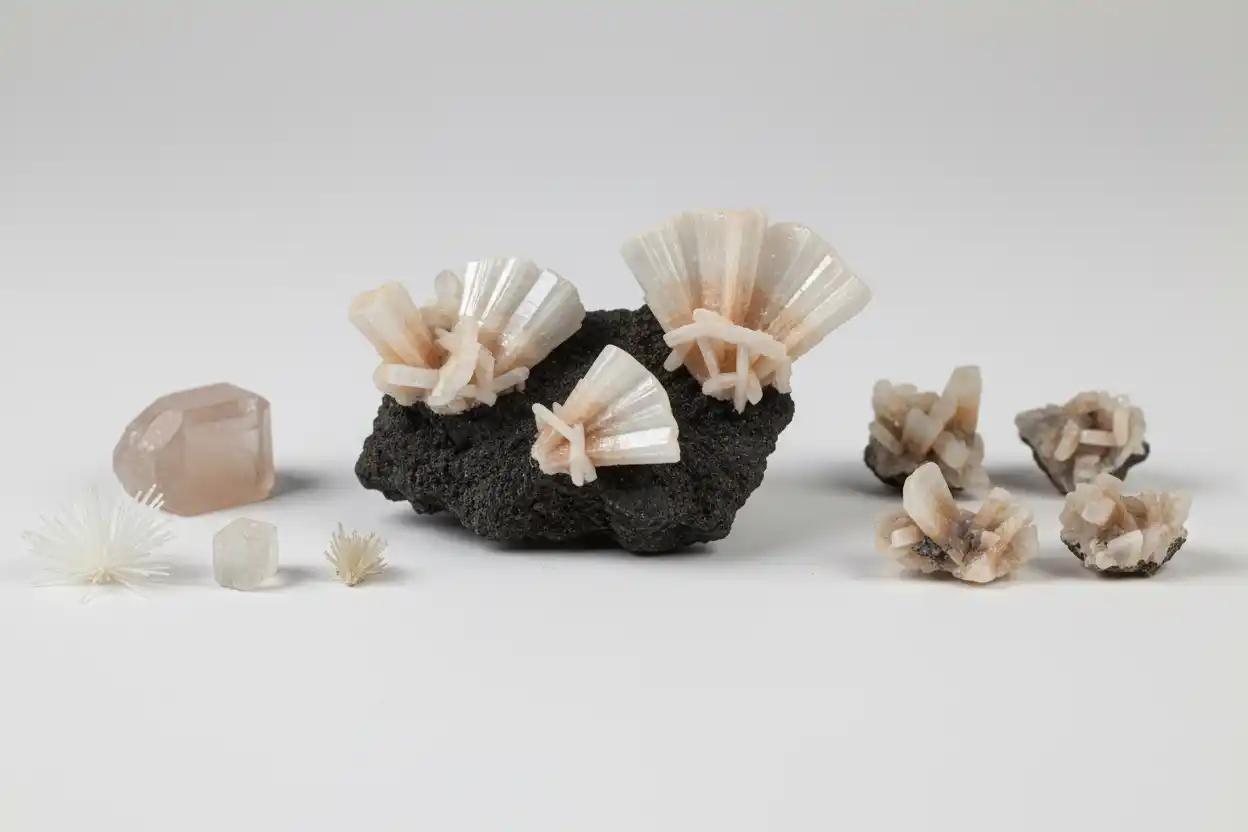
Where to Buy Real Stilbite and Avoid Glued Zeolite Fakes
Real Stilbite is a hydrated sodium-calcium aluminosilicate in the Zeolite group. It commonly forms pearly white, cream, peach, pink, yellowish or colorless crystals shaped like sheaves, fans, bow ties and flattened blades.
The retail name Stilbite usually covers two closely related mineral species: Stilbite-Ca and Stilbite-Na. Stilbite-Ca is substantially more common, while exact species identification depends on chemical composition rather than color or crystal shape alone.
Most specimens are natural, but Zeolite-group minerals can be difficult to distinguish visually. Stilbite may be confused with Heulandite, Stellerite, Scolecite, Natrolite, Mesolite, Epistilbite, Calcite and Apophyllite.
Additional buying risks include crystals glued onto matrix, repaired sheaves, dyed peach specimens, resin consolidation, mislabeled mixed-mineral clusters and fragile pieces photographed before significant shipping damage.
The Stilbite meaning and properties guide covers identity and traditional symbolism. This buying guide focuses on mineral species, crystal habit, sellers, Zeolite associations, treatment, condition and care.
Stilbite Belongs to the Zeolite Group
Zeolites are hydrated framework aluminosilicates with channels and cavities that contain water molecules and exchangeable cations.
The Zeolite group guide provides the wider mineral context.
Stilbite commonly contains calcium and sodium. Modern mineral nomenclature separates:
- Stilbite-Ca, in which calcium is the dominant relevant cation
- Stilbite-Na, in which sodium is dominant
A specimen cannot be assigned reliably to one species from peach color, bow-tie habit or locality alone.
Most commercial labels simply say Stilbite. That is acceptable for ordinary retail use when the seller does not make unsupported exact-composition claims.
Typical Crystal Habits
Stilbite commonly forms:
- Thin tabular crystals
- Flattened blades
- Sheaf-like aggregates
- Bow-tie twins
- Radiating fans
- Bundles
- Rosettes
- Globular aggregates
- Fibrous masses
- Crusts lining cavities
Individual crystals may widen toward their ends, producing the familiar wheat-sheaf appearance.
The broad cleavage face often shows pearly luster, while other surfaces appear vitreous.
Natural clusters can combine several habits. A specimen may contain flat bladed crystals at one side and radiating sheaves elsewhere.
Physical Durability
Stilbite generally has Mohs hardness around 3.5 to 4.
It has perfect cleavage and brittle tenacity. Thin blades and fan edges can break under very little pressure.
The mineral also contains structural water. Excessive heat can drive water from the Zeolite framework and change or damage the specimen.
These properties make Stilbite primarily a collector mineral rather than a practical jewelry stone.
The gemstone hardness chart, gemstone cleavage guide and gemstone toughness-versus-hardness guide explain the separate risks.
Choose the Product Form Before Shopping
| Stilbite product | Best source | Main buying concern |
|---|---|---|
| Natural sheaf specimen | Specialist Zeolite dealer | Exact identity, broken tips and locality |
| Matrix cluster | Fine-mineral dealer | Glue, reconstruction and associated minerals |
| Peach bow-tie specimen | Mineral specialist | Natural color, dye and repairs |
| Large bladed crystal | Provenance-focused dealer | Cleavage, restoration and species claim |
| Mixed Zeolite association | Experienced mineral dealer | Correct identification of each component |
| Individual loose crystal | Educational supplier | Stilbite versus Heulandite or Stellerite |
| Polished stone | Lapidary specialist | Mixed mineral rock, resin and uncertain purity |
| Sphere or carving | Experienced retailer | Composite construction and mislabeling |
| Jewelry | Specialist artisan | Extreme fragility, backing and glue |
| Historic locality specimen | Mineral dealer | Original labels and collection history |
A delicate natural sheaf should be evaluated as a mineral specimen. A sphere labeled Stilbite may contain several Zeolites, host rock and resin.
Where to Buy Genuine Stilbite
Specialist Zeolite dealers
A Zeolite specialist should recognize common associations and the limits of visual identification.
Ask whether the specimen was identified as Stilbite through habit, locality, Raman spectroscopy, X-ray diffraction or chemical analysis.
A responsible dealer may label a complex cluster “Stilbite-Ca with Heulandite and Calcite” rather than calling every pale crystal Stilbite.
Request photographs of the base, reverse and all major crystal contacts.
Fine-mineral dealers
Fine sheaves, twins and locality specimens require complete condition reporting.
Ask how many crystal tips are damaged and whether any large aggregate was reattached.
A repair can be difficult to see when clear adhesive follows a cleavage surface.
Request older labels and provenance documents for classic Icelandic, Indian or European material.
Gem and mineral shows
Shows allow direct comparison with Heulandite, Scolecite, Natrolite, Calcite and Apophyllite.
Use a loupe to inspect cleavage, luster, crystal cross-section, glue and coating.
Do not touch exposed fans or blades without permission. A finger can remove several crystals from a fragile cluster.
Avoid acid, heat and scratch tests.
Established online sellers
The online gemstone buying guide explains protected payments and returns.
Request exact-item photographs at high resolution. Stock images cannot represent edge damage or the number of intact blades.
Ask how the specimen will be packed. It should be secured by its matrix without pressure against crystal tips.
Request a pre-shipping photograph so new damage can be separated from existing condition.
What Genuine Stilbite Looks Like
Natural Stilbite is commonly:
- Colorless
- White
- Cream
- Pale peach
- Salmon-peach
- Pinkish
- Pale yellow
- Brownish or gray from inclusions
- Transparent at thin edges
- Translucent through thicker crystals
The luster is often pearly on cleavage surfaces and vitreous elsewhere.
Natural color can be uneven. Peach may be strongest near crystal edges, inclusions or associated iron-bearing material.
Crystal surfaces can show fine growth lines, stepped forms and minor etching.
Contact areas, broken fan edges and incomplete sheaves are common.
A perfectly symmetrical bright-peach bow tie can be natural, but identical clusters repeated across several listings deserve scrutiny.
Stilbite Versus Heulandite
Heulandite is another common Zeolite that frequently occurs with Stilbite.
Heulandite commonly forms tabular, coffin-shaped, wedge-shaped or platy crystals. Its pearly cleavage can resemble Stilbite.
Stilbite more often forms sheaves, bow ties and fans.
However, habit overlaps, and both minerals can be white, peach or pink.
Raman spectroscopy, X-ray diffraction and chemical analysis provide safer separation than color or seller tradition.
Stilbite Versus Stellerite
Stellerite is closely related to Stilbite and can form similar sheaf-like or radiating aggregates.
The two minerals differ in symmetry and composition, but visual separation can be extremely difficult.
Material historically labeled Stilbite may prove to be Stellerite after analysis.
A seller should not promise exact species identity for an expensive pale sheaf without supporting data.
For ordinary specimens, a cautious Zeolite-group description may be more defensible.
Stilbite Versus Epistilbite
Epistilbite is another Zeolite that can occur in basalt cavities.
It generally forms prismatic or bladed crystals rather than the classic broad Stilbite sheaves, but appearance can overlap.
The similarity of their names does not mean that Epistilbite is merely a variety of Stilbite.
Instrumental identification remains appropriate when a rare-species premium is involved.
Stilbite Versus Scolecite
Scolecite commonly forms slender white prismatic needles and radiating sprays.
The completed guide to buying real Scolecite covers Natrolite, Mesolite and artificial crystal clusters.
Stilbite crystals are generally broader, flatter and more sheaf-like.
Dense Scolecite sprays look spiky, while Stilbite fans often appear softer and bladed.
Mixed specimens can contain both minerals.
Stilbite Versus Natrolite
Natrolite commonly develops slender needle-like or prismatic crystals.
It can form sprays and spherical aggregates but usually lacks Stilbite’s flattened pearly blades.
Color does not separate them because both are commonly white.
A seller should not identify a white radiating cluster as Stilbite solely because it came from a Zeolite-producing basalt quarry.
Stilbite Versus Mesolite
Mesolite is a related sodium-calcium Zeolite that commonly forms extremely fine fibers or needles.
It can occur with Stilbite, Natrolite and Scolecite.
Dense intergrowths may require several X-ray diffraction or Raman measurements because one visual cluster contains multiple species.
A seller should describe the uncertainty rather than assigning every hair-like crystal to Stilbite.
Stilbite Versus Apophyllite
Apophyllite commonly forms glassy square, blocky or pyramidal crystals.
It frequently occurs with Stilbite on Indian basalt matrix.
The completed guide to buying genuine Apophyllite addresses glass imitations, cleavage and repaired clusters.
Apophyllite is not a Zeolite, despite its frequent association with them.
A mixed cluster should name both minerals rather than use “Stilbite crystal” for the entire specimen.
Stilbite Versus Prehnite
Prehnite commonly forms pale green botryoidal crusts, rounded aggregates and translucent masses.
The completed guide to buying real Prehnite covers its Epidote associations and Jade confusion.
White Prehnite can occur, but it usually lacks Stilbite’s pearly sheaf habit.
Both minerals may occur in low-temperature alteration environments and can appear on related basaltic matrix.
Stilbite Versus Cavansite
Cavansite is a vivid blue calcium vanadium silicate commonly found on white Stilbite or related Zeolite matrix in India.
The completed guide to buying genuine Cavansite owns blue-crystal authenticity and glued-specimen risks.
A specimen sold as Cavansite on Stilbite should be inspected at both mineral contacts. Blue crystals can be reattached to attractive white matrix.
Stilbite Versus Calcite
Calcite can form white, cream and peach crystals beside Zeolites.
The completed Calcite buying guide covers Aragonite, glass and carbonate treatments.
Calcite commonly shows rhombohedral or scalenohedral forms and strong birefringence, while Stilbite has pearly bladed sheaves.
Do not use acid as a test. It damages Calcite and may affect mixed mineral specimens.
Stilbite Versus Selenite
Selenite is Gypsum and can form white, pearly blades.
The completed guide to buying real Selenite owns Satin Spar terminology and Gypsum care.
Selenite is softer and has a different crystal structure, while Stilbite commonly forms Zeolite sheaves on basalt.
Polished or broken fragments may require Raman testing.
Natural Peach Color Versus Dye
Peach, salmon and pink Stilbite can be natural.
Color may relate to fine inclusions, iron-bearing material, surface staining or other associated phases.
Artificial dye can also enter fractures, cleavage and porous matrix.
Warning signs include:
- Strong color in cracks
- Pale broken tips
- Intense uniform neon pink
- Colored glue
- Dye on matrix
- Identical saturation across unrelated minerals
A natural peach specimen should not be rejected merely because the color is vivid. Evaluate structure, depth and seller history together.
Coatings, Oil and Lacquer
Clear coatings can strengthen fragile surfaces or improve luster.
Peach or pink coatings may intensify color.
Inspect protected recesses, broken edges and the matrix for a film or pooling.
Oil can temporarily deepen color and hide minor cleavage.
Treatment may be practical for a fragile decorative specimen, but it should be disclosed and should affect care advice.
The gemstone treatments guide explains coating, impregnation and consolidation.
Glued Crystal Clusters
Stilbite sheaves can detach from matrix during extraction or shipping.
A repaired natural aggregate can remain collectible, but the repair location must be disclosed.
Completely fabricated clusters may combine crystals from different specimens.
Inspect for:
- Glossy adhesive at the base
- Bubbles in glue
- Crystals sitting on smooth filler
- Matrix sockets that do not match
- Identical alignment
- Several unrelated crystal habits glued together
- Paint concealing contact areas
Natural crystals should emerge from cavities or penetrate matrix coherently.
Reconstructed Matrix
Broken basalt, Zeolite fragments and resin can be molded into a display base.
A reconstructed matrix may support genuine Stilbite crystals but does not preserve their original geological relationship.
Inspect the underside for uniform resin, molding marks and artificial coloring.
The seller should distinguish a repaired matrix from a manufactured display assemblage.
Resin Consolidation
Fragile fibrous or weathered matrix may be treated with clear consolidant.
Polymer can reduce shedding and support crystals during shipping.
Under magnification, resin may pool between blades, trap bubbles or create a plastic luster.
A limited conservation treatment can be reasonable. Nevertheless, its extent and reversibility matter to collectors.
How to Evaluate a Stilbite Sheaf
Examine whether the blades widen naturally from a shared base.
Check the fan edges for chips and freshly broken white surfaces.
Assess the luster. Pearly reflections on broad faces are characteristic, though coatings can exaggerate them.
Inspect the base for glue.
Look for plausible associated minerals and matrix.
Finally, request the locality and identification method.
How to Evaluate Mixed Zeolite Specimens
Do not assume every white or peach crystal is Stilbite.
Ask the seller to label each visible mineral separately.
A strong listing may describe Apophyllite on Stilbite with Heulandite and Calcite rather than using one general Zeolite name.
Several minerals can overlap or grow on one another. Consequently, one Raman reading may not identify the whole specimen.
Pay a rare-association premium only when the individual components have been analyzed or are morphologically convincing.
Buying Polished Stilbite
Solid gem-quality Stilbite is uncommon in mainstream jewelry and lapidary markets.
Many polished objects labeled Stilbite may consist of mixed Zeolite rock, Calcite, basalt and resin.
Request laboratory identification and edge views.
A sphere or tower should show natural internal mineral texture rather than one white or peach molded body.
Because Stilbite is soft and cleavable, extensive resin stabilization may be needed for carving.
Buying Stilbite Jewelry
Stilbite is poorly suited to rings, bracelets and everyday necklaces.
Thin blades and cleavage surfaces scratch and break easily.
Small cabochons or protected specimens may be mounted as occasional pendants, but backing and glue often form part of the construction.
Ask whether the stone is solid Stilbite, mixed Zeolite rock or resin-stabilized material.
Earrings and brooches experience less abrasion than rings.
Indian Stilbite
Maharashtra, India, is one of the world’s most important sources of Stilbite and associated minerals from basalt cavities.
Fine Indian specimens commonly occur with Apophyllite, Cavansite, Calcite, Heulandite and other Zeolites.
A generic India label is useful, but a quarry or district claim requires more specific records.
Because Indian mixed-mineral specimens are widely traded, reattached crystals and reconstructed clusters should always be considered.
Icelandic and Other Localities
Stilbite occurs in Iceland, Scotland, the Faroe Islands, Canada, the United States, Italy and many other volcanic or hydrothermal regions.
Classic older specimens may carry historic handwritten labels and collection history.
A locality cannot be established by peach color or sheaf habit alone.
Older labels should remain with the specimen even when modern analysis changes the species name to Stilbite-Ca or another related Zeolite.
Price and Value
Most small Stilbite specimens are affordable.
Value increases with:
- Large intact sheaves
- Symmetrical bow-tie growth
- Transparency
- Pearly luster
- Attractive peach or white color
- Sharp crystal edges
- Aesthetic matrix
- Unusual associations
- Minimal repair
- Treatment disclosure
- Locality
- Provenance
A smaller undamaged cluster can be worth more than a large display piece with glued fans.
An exact Stilbite-Na claim should add value only when supported by chemical analysis.
The gemstone pricing guide explains how condition, rarity and documentation affect collector prices.
Questions to Ask the Seller
Ask whether the specimen is Stilbite-Ca, Stilbite-Na or broadly identified Stilbite.
Request the method used to distinguish it from Heulandite, Stellerite, Scolecite and other Zeolites.
Ask for the locality and associated minerals.
Confirm glue, repairs, resin, consolidant, dye, oil and coating.
Request high-resolution images of the base, reverse and every major crystal contact.
Ask how the specimen will be immobilized during shipping.
Finally, obtain a return policy covering undisclosed repairs or incorrect mineral identification.
Professional Identification
Raman spectroscopy can distinguish Stilbite from many common associates and lookalikes.
X-ray diffraction is particularly useful for Zeolite identification and distinguishing closely related structural species.
Chemical analysis may be required to determine whether calcium or sodium is dominant.
Microscopy can reveal cleavage, glue, resin and dye.
Several test points are often necessary because one matrix specimen can contain multiple Zeolite species.
Cleaning and Storage
Use a hand-operated air bulb or an extremely soft dry brush.
Do not soak Stilbite. Water may disturb fragile matrix, glue or consolidant even when the mineral itself does not dissolve immediately.
Avoid steam, ultrasonic cleaners, acids and household chemicals.
Do not expose the specimen to strong heat because Zeolites contain structural water.
Store delicate sheaves inside a covered case. Support the specimen from the matrix and never lift it by the crystals.
Frequently Asked Questions
1. Is Stilbite a Zeolite?
Yes. Stilbite-Ca and Stilbite-Na are hydrated framework aluminosilicate minerals in the Zeolite group.
2. What is the difference between Stilbite-Ca and Stilbite-Na?
The names indicate whether calcium or sodium is the dominant relevant cation. Chemical analysis is required for reliable separation.
3. What color is natural Stilbite?
It is commonly colorless, white, cream, peach, pink or pale yellow.
4. What shape does Stilbite form?
It commonly forms flattened blades, sheaves, fans, bow ties and radiating aggregates.
5. Is Stilbite the same as Heulandite?
No. They are separate Zeolite minerals, though their appearance and localities can overlap.
6. Is Stilbite the same as Scolecite?
No. Scolecite generally forms slender prismatic needles, while Stilbite more often forms broad pearly sheaves.
7. Can Stilbite occur with Apophyllite?
Yes. The minerals commonly occur together in basalt cavities, especially in Indian specimens.
8. Can peach Stilbite be dyed?
Yes. Peach can be natural, but dye may also concentrate in cleavage, fractures and matrix.
9. Are Stilbite crystals ever glued onto matrix?
Yes. Natural clusters may be repaired, and artificial specimens can be assembled from separate crystals.
10. Can Stilbite contain resin?
Yes. Fragile matrix may be consolidated, and polished mixed-mineral products can contain substantial resin.
11. Is Stilbite suitable for everyday jewelry?
Generally, no. Low hardness, perfect cleavage and brittle crystal habits make it primarily a collector mineral.
12. What is the biggest warning sign in a listing?
Be cautious when every crystal contact contains glossy adhesive or when an exact rare-species claim has no X-ray or chemical analysis.
Buy the Zeolite Habit and Its Condition Report Together
Stilbite’s value comes from delicate pearly sheaves, natural associations and well-documented locality. Those same features require careful mineral identification, repair disclosure and shipping.
The pink crystals guide, white crystals guide, S crystal directory and S gemstone directory provide wider comparisons. Choose a seller who can explain each crystal on the matrix rather than assigning one name to the whole cluster.
Safety note: Stilbite and associated Zeolite specimens should not be ingested, burned or deliberately heated. Fragile blades can form sharp fragments. Cutting, drilling or grinding requires wet methods, effective mineral-dust extraction and suitable respiratory and eye protection.