Where to Buy Real Tiger’s Eye and Avoid Fiber-Optic Glass
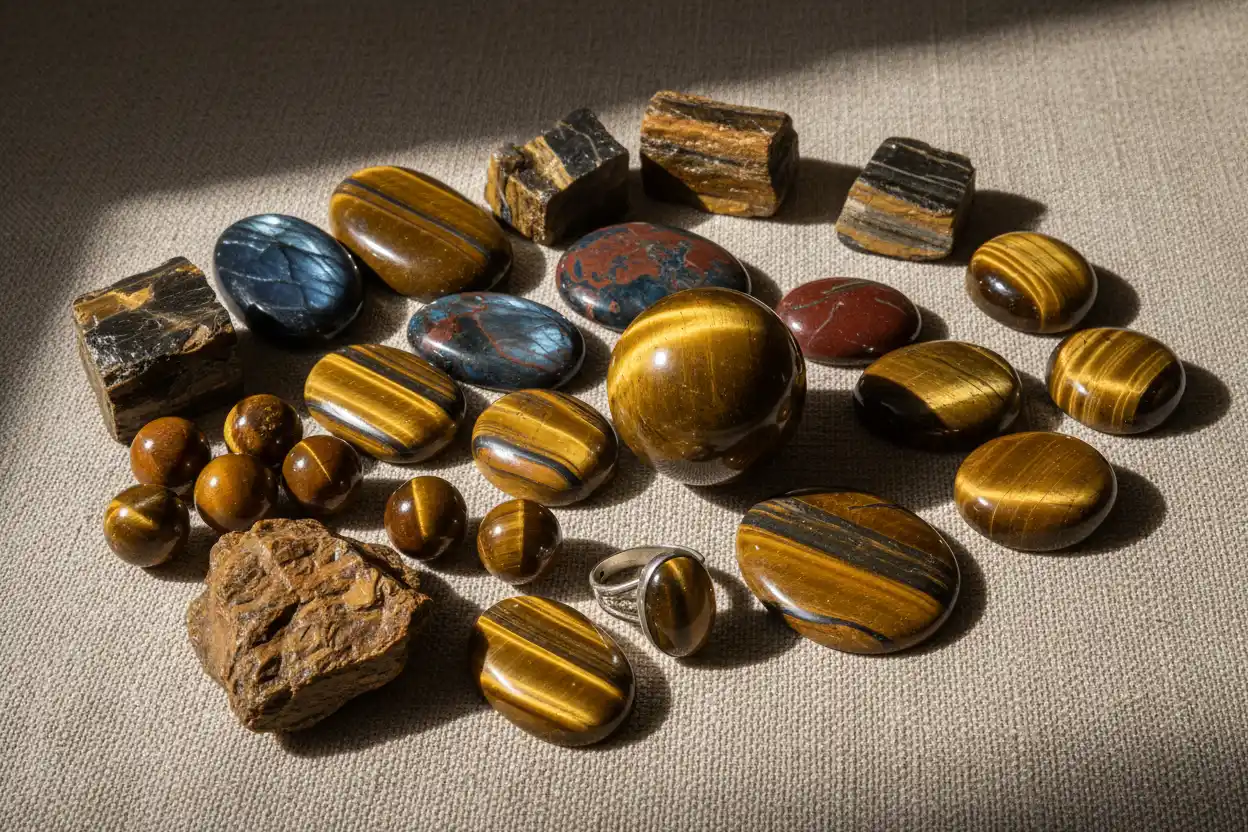
Real Tiger’s Eye is a chatoyant quartz-rich material with parallel fibrous structures that produce a bright moving band of reflected light. Classic material combines golden yellow, honey, brown and dark bronze layers, although related blue, red and mixed-color varieties belong to the wider Tiger’s Eye family.
The optical band is called an eye or chatoyant line. It should move across a properly oriented polished surface as the stone or light source changes position.
Most ordinary Tiger’s Eye is genuine because commercial material is abundant and affordable. Nevertheless, buyers may encounter fiber-optic glass, dyed quartz, resin, coated beads, reconstructed composites and stones with weak chatoyancy exaggerated through lighting.
Treatment disclosure also matters. Red Tiger’s Eye is commonly produced by heating golden material, while blue and unusually colored products may be dyed or otherwise enhanced.
The Tiger’s Eye meaning and properties guide covers identity and traditional symbolism. This buying guide focuses on family-wide quality, chatoyancy, sellers, treatment, imitations, durability and value without duplicating the dedicated blue and red buying pages.
What Tiger’s Eye Is
Tiger’s Eye is a polycrystalline quartz material whose aligned fibrous inclusions create chatoyancy.
Historically, it was often described as Quartz replacing fibrous Crocidolite while preserving the original structure. Modern research shows a more complex growth and alteration history involving columnar Quartz and altered amphibole fibers rather than one simple complete pseudomorphic replacement process.
The chatoyancy comes primarily from the parallel fibrous inclusions and their contrast with the Quartz-rich host.
Golden and brown colors commonly relate to oxidation of iron-bearing amphibole material and associated iron oxides.
The Quartz family guide provides the parent-mineral context. The types of Tiger’s Eye guide separates golden, blue, red and mixed varieties.
Choose the Product Form Before Shopping
| Tiger’s Eye product | Best source | Main buying concern |
|---|---|---|
| Natural rough | Quartz or lapidary supplier | Fiber direction, treatment and usable yield |
| Slab | Specialist lapidary dealer | Chatoyant orientation, fractures and dye |
| Cabochon | Independent cutter | Eye sharpness, centering and polish |
| Tumbled stone | Reputable crystal retailer | Weak eye, glass and generic brown stone |
| Bead strand | Established supplier | Fiber-optic glass, dye and drill-hole cracks |
| Sphere | Experienced carving retailer | Total chatoyancy coverage and resin |
| Tower | Seller with exact-item video | Carved point, coating and dead optical zones |
| Carving | Skilled lapidary seller | Pattern orientation and composite construction |
| Ring stone | Jeweler familiar with chatoyant gems | Centered eye, backing and setting |
| Collector specimen | Mineral or geological dealer | Natural fibrous structure and provenance |
A rough block should be evaluated for orientation. A finished cabochon should be judged by its face-up moving eye rather than rough weight.
Where to Buy Genuine Tiger’s Eye
Specialist lapidary suppliers
A lapidary supplier should show the rough dry and under one directional light.
Request images across and along the fibers. The best cutting direction is generally perpendicular to the aligned structure so the finished dome displays a narrow moving band.
Ask whether test cabochons from the parcel produce sharp eyes.
The seller should disclose heat, dye, bleaching, resin and coating.
A large slab can have impressive golden stripes but still produce weak chatoyancy if the fibers are cut at an unfavorable angle.
Gem and mineral shows
Shows allow direct comparison with Hawk’s Eye, Red Tiger’s Eye, Pietersite, Tiger Iron, Rutilated Quartz and fiber-optic glass.
Move the stone beneath one small stationary white light. A genuine eye should travel continuously across the surface.
Use a loupe to inspect fibers, dye concentrations, bubbles, resin and mold seams.
Do not scratch the stone or heat it. Those tests damage merchandise and do not establish treatment history reliably.
Established online retailers
The online gemstone buying guide explains seller identity, payment protection and returns.
Request a continuous video beneath one stationary light.
A seller can exaggerate chatoyancy by moving several lamps around a stationary stone. Therefore, confirm whether the stone itself is rotating or whether the lighting is creating multiple false bands.
Ask whether saturation, warmth and contrast were adjusted. Warm editing can turn dull brown material into vivid gold.
Independent cutters and jewelers
An independent cutter should understand fiber orientation and dome geometry.
Ask to see the slab or preform for a premium cabochon.
Before mounting, inspect the loose stone’s back and girdle for backing, filler, dye and open fractures.
The eye should remain visible from normal wearing angles rather than only when the ring is tilted sharply.
What Genuine Tiger’s Eye Looks Like
Classic material commonly combines:
- Golden yellow
- Honey
- Bronze
- Caramel brown
- Dark brown
- Black-brown
- Gray-brown
- Blue-gray remnants
- Rust or red-brown zones
Parallel bands can be straight, wavy or gently folded.
A polished surface has silky luster rather than widespread glitter.
When the stone turns, a bright line should move perpendicular to the fiber direction.
Natural fiber density and eye strength vary. One section may be sharply chatoyant while another appears dull.
The body is usually opaque, although thin areas can transmit brownish or yellowish light.
Natural pieces may contain Quartz-rich white zones, Hematite, blue Hawk’s Eye remnants or red oxidized areas.
How to Judge Chatoyancy
Use one small focused light against a neutral background.
A high-quality eye generally shows:
- A narrow, well-defined line
- Strong contrast against the body
- Continuous movement
- Broad face-up visibility
- Correct centering
- Minimal interruption from fractures
- Good symmetry
- No large dead zone
The eye should appear embedded within the stone rather than painted onto its surface.
A wide diffuse sheen can still be genuine but normally commands less than a sharp, centered band.
The cut matters greatly. A flat surface can weaken the eye, while an appropriately curved dome gathers reflected light into a distinct line.
An excessively tall dome adds weight without necessarily improving the phenomenon.
Golden Tiger’s Eye
Golden-brown material represents the classic commercial variety.
Fine pieces balance rich body color with a bright gold-to-cream eye.
Very dark material may show a strong line but lose much of its golden body. Conversely, pale material can look attractive while producing weak contrast.
The best choice depends on whether the buyer values dramatic movement, warm color or a balanced combination.
A seller should not call every bright golden example untreated. Wax, oil, dye and image warmth can influence appearance.
Blue Tiger’s Eye
Blue Tiger’s Eye, also called Hawk’s Eye, preserves more blue-gray, green-blue or dark amphibole-related coloration.
The completed Blue Tiger’s Eye buying guide owns blue-color authenticity, dye, glass and treatment concerns.
One piece can contain blue and golden zones where oxidation affected the fibrous material unevenly.
A small amount of blue does not automatically create a rare mixed variety.
The alias Hawk’s Eye should route to Blue Tiger’s Eye rather than support a duplicate page.
Red Tiger’s Eye
Red Tiger’s Eye ranges from brick red and rust to mahogany and reddish brown.
Most commercial red material has been heated to alter iron-related coloration.
The completed Red Tiger’s Eye buying guide owns heat-treatment disclosure, natural-red claims and red fiber-optic glass.
Heat-treated Red Tiger’s Eye remains genuine natural Tiger’s Eye with enhanced color.
A family-wide listing should identify the treatment rather than calling the material synthetic or completely natural-red without evidence.
Tiger’s Eye Versus Pietersite
Pietersite is a brecciated chatoyant material containing broken and reoriented Tiger’s Eye or Hawk’s Eye fragments in Quartz.
Its fibers commonly point in several directions and create stormy, patch-like flashes.
Tiger’s Eye usually has orderly parallel fibers and one coherent moving band.
The dedicated Tiger’s Eye versus Pietersite guide owns the full structural comparison.
A chaotic multi-directional stone should not receive a premium for an unusually complex Tiger’s Eye eye when Pietersite is the more accurate identity.
Tiger’s Eye Versus Tiger Iron
Tiger Iron is a banded rock commonly combining Tiger’s Eye, red Jasper and metallic Hematite.
It may show golden chatoyancy beside opaque red and silver-black bands.
A piece containing all three components should be described as Tiger Iron rather than pure Tiger’s Eye.
The material is natural and often attractive, but its mixed composition affects weight, polishing and durability.
A seller should disclose how much of a sphere or carving consists of actual chatoyant Tiger’s Eye.
Tiger’s Eye Versus Rutilated Quartz
Rutilated Quartz is generally transparent-to-translucent Quartz containing separate Rutile needles.
The completed Rutilated Quartz buying guide owns needle identity, inserted wires and composite construction.
Tiger’s Eye is an opaque, fibrous aggregate with a continuous moving band.
Visible golden needles suspended inside clear Quartz indicate Rutilated Quartz rather than Tiger’s Eye.
Tiger’s Eye Versus Cat’s-Eye Quartz
Cat’s-eye Quartz can contain aligned fibrous inclusions that produce one moving eye in a translucent Quartz host.
Tiger’s Eye is a specific opaque fibrous quartz material with characteristic golden, brown or blue layers.
A transparent or milky cabochon with a pale eye should not be called Tiger’s Eye solely because it is chatoyant.
The seller should identify the host and inclusion type when the distinction affects value.
Fiber-Optic Glass
Fiber-optic glass is the most convincing common imitation.
It consists of aligned manufactured glass fibers fused into a solid material. When cut as a cabochon or bead, those fibers create a remarkably sharp moving eye.
It is sold in red, blue, green, yellow, pink, brown and many unnatural colors.
Warning signs include:
- Perfectly uniform fibers
- An exceptionally narrow bright line
- Identical eye width across every bead
- Bright synthetic color
- Mold seams
- Bubbles
- No geological rough
- Repeated factory-calibrated patterns
- Uniform transparency at edges
The material is legitimate when labeled cat’s-eye fiber-optic glass. It should not be sold as natural Tiger’s Eye.
Ordinary Glass and Resin
Swirled brown glass can imitate the color bands without producing convincing fibrous chatoyancy.
Resin can contain metallic pigment, mica or glass fibers.
Casting seams, numerous bubbles, soft scratches and repeated designs support manufactured material.
Stone powder may be added to resin to increase weight.
The glass-versus-crystal guide and fake-crystal buyer’s guide provide broader manufactured-material checks.
Dyed Tiger’s Eye
Natural Tiger’s Eye can be dyed blue, red, green, purple or black.
Dye may concentrate in:
- Fractures
- Fiber boundaries
- Drill holes
- Pits
- Weathered surfaces
- Chipped edges
Artificial color can remain stable, but it should be disclosed.
An intense blue, green or pink color does not automatically prove glass because genuine quartz-rich material can also be dyed.
Inspect the core and ask for a treatment statement.
Heat Treatment
Heating can alter golden-brown Tiger’s Eye toward red and may modify other iron-related colors.
The treatment is common and generally stable.
However, heat may worsen existing fractures or create uneven tones.
A seller should not charge an untreated premium for red material without credible evidence.
Conversely, heat-treated material should not be dismissed as fake. The correct description is natural Tiger’s Eye with treated color.
Bleaching and Recoloring
Some material may be lightened before dyeing or treated to change its iron-related color.
Treatment history can be difficult to reconstruct once the stone has been polished.
A laboratory may confirm Tiger’s Eye structure without proving every color-processing step.
Therefore, known upstream treatment should be disclosed even when final detection is difficult.
Coating, Wax and Oil
Wax or oil can deepen golden and brown colors and reduce the visibility of surface scratches.
A clear coating may improve luster, while colored lacquer can alter the body.
Inspect high points, drill holes and worn edges for peeling or residue.
Treatment affects cleaning, repair and long-term appearance.
The gemstone treatments guide explains heat, dye, coating and impregnation.
Resin Filling and Reconstruction
Fractured or porous rough can be stabilized with polymer.
Clear resin may improve polishing, while colored filler can conceal weak areas.
Fragments and powder can also be molded into composite beads and carvings.
Under magnification, resin may show bubbles, a different luster or concentrations inside fractures.
Limited stabilization and fully reconstructed material should receive different descriptions.
How to Evaluate Rough
Request dry images under one directional light.
Identify the fiber direction before assessing cutting yield.
The best rough should show continuous parallel structure through enough thickness for the intended cabochons.
Inspect fractures running along or across the fibers.
Ask whether sample stones from the parcel have produced sharp eyes.
Usable optical area matters more than total block weight.
How to Evaluate Slabs
Compare both slab faces and every edge.
The fibers should continue through the thickness.
Tilt the slab under a focused light. Broad moving sheen should appear across areas cut near the correct orientation.
A slab with attractive static stripes may still produce weak cabochons if the fibers are misaligned.
Check for oil, resin and surface coating.
How to Judge Cabochons
A strong cabochon centers the eye across the crown.
The line should move smoothly without breaking around pits or fractures.
Inspect the dome for flat spots that interrupt the optical band.
The girdle should remain stable and suitable for setting.
Check the back for dye, filler, backing and mixed Tiger Iron components.
The price should reflect face-up performance rather than hidden weight.
Buying Beads and Bracelets
Natural strands should show modest variation in band width, color and eye strength.
Inspect drill holes for dye, resin and fractures.
Perfectly identical beads with an intense white line can indicate fiber-optic glass.
Ask whether the strand contains golden Tiger’s Eye only or mixes blue, red and Tiger Iron material.
The completed Tiger’s Eye bracelet guide covers size, stringing and wear considerations.
Heavy beads should be restrung periodically because rough drill holes can weaken elastic.
Buying Rings, Earrings and Pendants
The Tiger’s Eye ring guide covers cabochon orientation, setting and buying tips.
The Tiger’s Eye earrings guide and Tiger’s Eye necklace guide own form-specific style considerations.
A bezel protects the cabochon’s edge while allowing the eye to move across the crown.
Pairs of earrings should have reasonably matched eye direction and body color, though exact natural patterns rarely match perfectly.
Closed-back settings can hide filler or a weak reverse, so ask to inspect the loose stones.
Durability and Care
Quartz-rich Tiger’s Eye generally has Mohs hardness around 6.5 to 7 and useful toughness.
However, fibrous boundaries, fractures, Hematite-rich zones and composite construction can create weak areas.
The gemstone hardness chart and gemstone toughness-versus-hardness guide explain the distinction.
The completed Tiger’s Eye jewelry cleaning guide provides physical care instructions.
Use mild soap, lukewarm water and a soft cloth on sound untreated pieces. Avoid steam or ultrasonic cleaning when fractures, resin, dye or glue are present.
Locality and Provenance
South Africa is the dominant commercial source of classic Tiger’s Eye.
Important material also occurs in Australia, Namibia, India, the United States and other regions.
Color and eye pattern cannot prove one country.
Ask for supplier records when locality affects price, especially for unusual natural blue, red or mixed material.
The ethically sourced gemstones guide provides broader questions about mining, cutting labor and traceability.
Price and Value
Tiger’s Eye is generally affordable.
Value depends on:
- Eye sharpness
- Contrast
- Continuous movement
- Body color
- Band pattern
- Correct orientation
- Polish
- Structural condition
- Size
- Treatment disclosure
- Cutting quality
- Solid construction
- Provenance
A smaller cabochon with a centered sharp eye can be more valuable than a large dark sphere with weak movement.
Blue or natural-red premiums require better evidence than an unusual color alone.
Undefined “AAA” and “AAAA” labels add little information. Ask the seller to describe eye width, coverage, color, treatment and fractures.
The gemstone pricing guide explains how optical quality and workmanship affect price.
Questions to Ask the Seller
Ask whether the material is golden Tiger’s Eye, Blue Tiger’s Eye, heated Red Tiger’s Eye, Pietersite, Tiger Iron or fiber-optic glass.
Request a moving-light video under one stationary lamp.
Confirm heat, dye, bleaching, coating, wax, oil, resin and reconstruction.
Ask whether the pictured item is the exact stone that will ship.
For beads, request drill-hole close-ups.
For cabochons, request front, back and girdle views.
Finally, confirm that the return policy permits nondestructive gemological testing.
Professional Identification
Microscopy can reveal natural fibrous texture, dye, coating, resin and glass fibers.
Refractive-index and Raman testing can confirm quartz-rich material and separate most glass and resin.
Fiber-optic glass can usually be recognized through its uniform manufactured fibers and glass properties.
Chemical or mineral analysis can identify Hematite, amphibole-related material and associated phases.
Confirming Tiger’s Eye does not always prove whether red color was natural or heat-induced.
Frequently Asked Questions
1. What causes Tiger’s Eye chatoyancy?
Aligned fibrous inclusions reflect light as a moving band across the quartz-rich material.
2. Is Tiger’s Eye a type of Quartz?
Yes. It is a polycrystalline quartz-rich material containing aligned altered amphibole fibers and iron-related phases.
3. Is Blue Tiger’s Eye natural?
Natural blue-gray Hawk’s Eye exists, although blue dye and glass imitations also occur.
4. Is Red Tiger’s Eye naturally red?
Natural red-brown material can occur, but most commercial Red Tiger’s Eye has been heat-treated.
5. Is heat-treated Tiger’s Eye fake?
No. It is genuine natural Tiger’s Eye with altered color when the treatment is disclosed.
6. Is Tiger’s Eye the same as Pietersite?
No. Pietersite contains brecciated, reoriented chatoyant fragments and usually shows more chaotic flashes.
7. Is Tiger Iron the same as Tiger’s Eye?
No. Tiger Iron is a rock combining Tiger’s Eye with Red Jasper and metallic Hematite.
8. Can glass imitate Tiger’s Eye?
Yes. Fiber-optic glass can produce an exceptionally sharp moving eye.
9. Can Tiger’s Eye be dyed?
Yes. Dye can intensify or create blue, red, green, purple and black colors.
10. Does a sharp eye prove the stone is natural?
No. Manufactured fiber-optic glass can display an even sharper eye than natural material.
11. Is Tiger’s Eye suitable for daily jewelry?
Sound natural cabochons are generally durable enough for regular wear in protective settings.
12. What is the biggest warning sign in a listing?
Be cautious when every bead has the same bright eye, perfect fiber spacing and vivid synthetic color without a natural-material disclosure.
Buy the Moving Eye Before the Variety Story
Tiger’s Eye quality begins with coherent fibrous structure, correct cutting and continuous chatoyancy. Color names and rarity claims should matter only after the optical effect and treatment history have been established.
The brown crystals guide, brown gemstones guide, T crystal directory and T gemstone directory provide wider comparisons. Choose a stone whose eye remains sharp under ordinary lighting rather than only in a promotional video.
Safety note: Finished Tiger’s Eye is suitable for normal handling. However, rough material can contain crystalline silica and amphibole-related fibers. Never dry-cut, drill or grind it. Use professional wet methods, effective extraction and appropriate respiratory and eye protection.