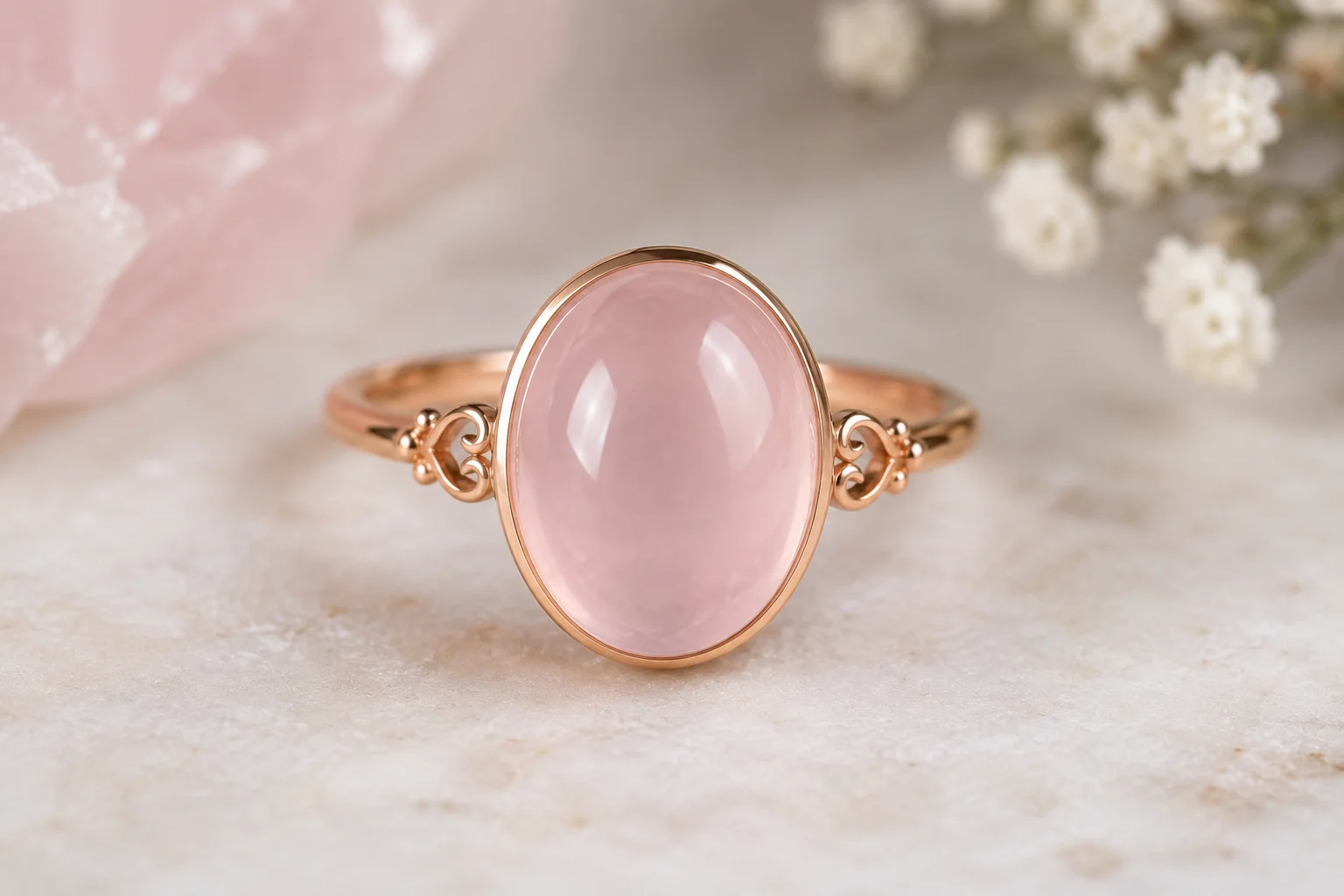
Rose Quartz Rings: Styles, Durability and Buying Tips
A rose quartz ring places soft pink color in one of the most visible but physically demanding jewelry positions. The stone’s Mohs hardness of 7 gives it reasonable resistance to everyday scratches, while its lack of cleavage removes the risk of splitting along one perfect structural plane.
Nevertheless, rose quartz can contain internal fractures, thin carved areas and exposed edges that chip under impact. Rings also encounter desks, handles, tools, cleaning chemicals and other jewelry more often than necklaces or earrings.
The most successful design therefore combines attractive color with a low, protective setting. This guide owns ring styles, settings, daily-wear suitability, sizing, wedding-band compatibility and purchase decisions. Loose-stone quality remains within the rose quartz buying guide, while current market values stay within the completed rose quartz price guide.
Rose Quartz Rings at a Glance
| Ring style | Appearance | Practical advantage | Main concern |
|---|---|---|---|
| Cabochon solitaire | Smooth, softly glowing center | Suits typical translucent material | High domes can receive impact |
| Faceted solitaire | More surface reflection | Contemporary or formal appearance | Pale color and windowing |
| Bezel ring | Stone surrounded by metal | Strong edge protection | Thick metal can reduce visible color |
| Halo ring | Rose quartz with bright accents | Larger visual footprint | Numerous small prongs require inspection |
| Cluster ring | Several small pink stones | Strong surface color at moderate cost | Cleaning and setting maintenance |
| Signet ring | Stone recessed into substantial metal | Low profile and protection | More metal and less side light |
| East–west ring | Oval or elongated stone set horizontally | Broad modern look | End protection and finger comfort |
| Cocktail ring | Large center or carving | Strong statement piece | Greater projection and impact exposure |
| Star rose quartz ring | Domed stone showing asterism | Distinctive optical effect | Correct orientation and surface protection |
| Carved ring | Heart, flower or sculptural stone | Symbolic and decorative | Thin points and unsupported areas |
| Three-stone ring | Center with two side stones | Milestone or relationship symbolism | Adjacent stones may rub |
| Vintage-inspired ring | Engraving, filigree and milgrain | Detailed romantic styling | Fine metalwork wears over time |
Is Rose Quartz Suitable for Rings?
Rose quartz is durable enough for rings, but it is not maintenance-free.
Its hardness is similar to other quartz varieties, making it more scratch-resistant than opal, calcite, fluorite and pearl.
However, quartz is softer than topaz, sapphire, ruby, moissanite and diamond.
An exposed rose quartz ring worn every day will gradually collect scratches and edge wear.
A bezel, recessed setting or low halo reduces risk considerably.
Occasional-wear cocktail rings can use larger or more delicate stones because they do not experience constant hand contact.
The completed gemstone hardness chart explains scratch resistance, while gemstone toughness versus hardness explains impact and fracture risk.
Rose Quartz Engagement Rings
Rose quartz can be used in an engagement ring when the wearer understands its care requirements.
Its color, affordability and symbolism appeal to buyers who prefer a gentle pink center and do not require diamond-level durability.
A low full bezel is the strongest choice. A protective halo can also shield part of the perimeter.
Large internal fractures, thin points and high cathedral settings are poor choices for continuous wear.
The stone should be removed before exercise, cleaning, gardening and manual work.
The broader pink gemstones for engagement rings guide compares rose quartz with sapphire, spinel, morganite, tourmaline and other pink options.
The best gemstones for engagement rings guide provides a durability-first comparison.
Rose quartz suits an informed wearer who accepts eventual surface wear rather than someone expecting an unchanged heirloom stone without maintenance.
Cabochon Solitaire Rings
Cabochons are the most natural fit for ordinary massive rose quartz.
Their rounded surfaces display cloudiness, bodycolor and internal veils without requiring exceptional transparency.
A low dome is less vulnerable than a very high cabochon.
The stone’s girdle should sit fully supported within the setting.
A bezel protects the edge better than widely spaced prongs.
Inspect the dome for flat polish, scratches and pits. These flaws become highly visible under reflected light.
A translucent stone may appear warmer or cooler depending on the metal beneath it.
Faceted Rose Quartz Rings
Faceted rose quartz needs more transparent rough.
A good cut creates reflection without producing a large colorless window.
Pale stones may almost disappear against the finger, especially in open prong settings.
Rose-gold baskets can strengthen warmth, while a reflective white backing may make a stone appear lighter.
Transparent crystalline pink quartz is less common than massive rose quartz and can overlap with synthetic quartz or other pink gems.
The completed real-versus-fake rose quartz guide owns the material-identification workflow.
Faceting should be judged by symmetry, polish and balanced light return rather than the number of facets alone.
Bezel-Set Rings
A full bezel surrounds the stone’s edge with metal.
It is the most practical rose quartz ring setting for frequent wear.
The smooth profile reduces snagging and shields the girdle from direct impact.
An open back allows more light and makes cleaning easier.
A very thick bezel can make pale stone look smaller, while a dark oxidized bezel can create strong contrast.
The metal rim should be even without gaps or ripples.
A partial bezel provides more visible quartz but leaves selected edges exposed.
Prong-Set Rings
Prongs allow more light to enter the stone.
Four-prong settings create an open appearance. Six provide additional redundancy around large rounds and ovals.
The prongs should cover enough of the girdle to hold the stone without overwhelming the pale color.
Pear, marquise and heart shapes need V-prongs or protective end bezels.
A tall prong setting is more vulnerable to impact and catching.
Any prong that feels sharp, catches fabric or no longer contacts the stone needs professional repair.
Halo Rings
A halo surrounds rose quartz with diamonds, white sapphires, cubic zirconia or another contrasting gem.
The border increases apparent size and can strengthen the center’s perceived pink.
Hard accent stones must not contact the exposed quartz directly. Diamond girdles can abrade rose quartz over time.
The halo should remain evenly spaced with no tilted or missing accents.
A low halo protects the center better than a high open design.
The underside should allow cleaning, since residue can make a pale center appear gray.
Cluster Rings
Cluster designs use several small stones rather than one large center.
They can create stronger visible pink because several surfaces return light from different directions.
Round cabochons, faceted rounds and small carved stones may form floral or geometric patterns.
Shared prongs reduce visible metal but increase maintenance needs.
A damaged shared support can loosen more than one gemstone.
Clusters collect lotion and soap readily, so accessible galleries are important.
Star Rose Quartz Rings
Star rose quartz can produce a six-rayed moving star.
The stone must be cut as a cabochon and oriented correctly.
A strong star requires suitable inclusions, good dome shape and a focused light source.
A bezel protects the perimeter, while a high dome still remains exposed at the top.
The star should move across the surface rather than staying painted or fixed.
Fine star material may deserve a custom setting, especially when the effect is centered and the pink bodycolor is strong.
Signet and Flush-Set Rings
A signet-style ring can recess a rose quartz cabochon into substantial metal.
This creates a low profile and strong protection.
The stone may receive less side light, so medium-pink material works better than an extremely pale specimen.
The metal should support the entire perimeter without pressing unevenly on an internal fracture.
Flush-style settings work best with smaller stones.
A broad band also affects sizing and may feel tighter than a narrow ring with the same measured circumference.
East–West Rings
An east–west design places an oval, marquise or elongated cushion horizontally across the finger.
This creates broad visual coverage and a modern appearance.
The ring can often sit lower than a vertical solitaire.
Both ends need protection, particularly on marquise and oval stones.
A wide setting may rub neighboring fingers, so comfort should be tested before purchase.
The orientation also affects wedding-band fit and may require a curved or open companion band.
Cocktail Rings
Rose quartz is available in large sizes, making it popular for cocktail rings.
A substantial cabochon, carved flower or sculptural freeform can create a dramatic result without the cost of a rare transparent pink gem.
Large stones project farther from the finger and are more likely to strike hard surfaces.
Cocktail rings should be treated as occasional jewelry rather than worn during ordinary physical tasks.
The shank and setting must be strong enough to support the stone’s leverage.
A large top-heavy ring also needs accurate sizing to prevent constant spinning.
Choosing Rose Quartz Color
Look for a pink shade that remains attractive under ordinary lighting.
Pale blush creates a delicate ring. Medium pink offers greater visibility, while lavender-pink produces a cooler effect.
Gray areas can make the stone look dull.
Natural zoning and cloudiness are acceptable if they contribute to the design.
Small rose quartz stones often appear paler than large ones.
A vivid neon-pink ring offered inexpensively may contain dyed crackle quartz, coated material, glass or resin.
The completed treated and synthetic rose quartz guide owns detailed treatment identification.
Clarity and Internal Fractures
Cloudiness is normal in massive rose quartz.
For ring durability, distinguish soft internal haze from open fractures.
A fracture that reaches the surface near a prong or thin edge can expand under impact.
The stone should not rock within the setting.
Transparent stones deserve examination for growth origin and treatment rather than being assumed superior automatically.
A clean stone can be natural, while an included stone can still be synthetic or composite.
Cut Quality
A cabochon should have a symmetrical dome and even polish.
Faceted stones should avoid large windows and heavy extinction.
The outline needs balanced shoulders and centered geometry.
Pears, hearts and marquises require well-finished points.
A poorly cut large stone may look less attractive than a smaller well-proportioned one.
View the ring under diffused daylight-equivalent and ordinary indoor light instead of relying on one jewelry-store spotlight.
Carat Weight and Visible Size
Carat measures weight.
Millimeter dimensions indicate how large the stone looks from above.
Rose quartz is less dense than sapphire, garnet and several other ring stones, so equal carat weights do not face up equally.
The completed carat-versus-millimeter size chart explains this relationship.
A broad bezel or halo increases visual coverage without increasing center-stone weight greatly.
High settings look substantial from the side but do not necessarily provide more face-up area.
Choosing the Metal
Rose gold produces the most tonal result.
Yellow gold adds warmth and can emphasize peach undertones.
White gold, platinum and silver create greater contrast and can make pale pink easier to see.
Metal strength matters as much as color.
Thin silver prongs may wear faster than substantial gold or platinum settings.
Ask about metal fineness and alloy sensitivity. Some white gold contains nickel, while plated finishes require eventual renewal.
Ring Sizing
Measure the finger when it is neither unusually cold nor swollen.
Wide bands generally feel tighter than narrow ones.
A large top-heavy ring needs a secure fit to prevent spinning, although it should not restrict circulation.
Some carved, eternity, pavé and fully patterned designs have limited resizing ranges.
Rose quartz should be removed or protected carefully during soldering and resizing because heat and pressure can affect the stone, fillers and setting.
Confirm resizing possibilities before buying an unusual or antique design.
Wedding-Band Compatibility
A low basket or broad bezel may prevent a straight wedding band from sitting flush.
Curved, contoured or open bands can accommodate the center setting.
Direct rubbing between two rings wears metal and may expose the quartz to harder accent stones.
A narrow spacer can reduce contact.
Try the rings together before purchase instead of assuming that standard dimensions will align.
The combined width should remain comfortable when the fingers close.
Rose Quartz Versus Morganite Rings
Morganite is pink beryl and is generally more transparent and brilliant.
It is slightly harder and commonly appears in faceted engagement-ring designs.
Rose quartz is more affordable, cloudier and often cut as a cabochon or carving.
The completed morganite versus rose quartz guide owns the full material comparison.
A morganite-style ring photograph should not be used to imply that rose quartz has the same optical performance.
The coordinated morganite ring guide illustrates a separate gemstone category rather than a substitute identity.
Coordinating Rose Quartz Jewelry
A ring can be paired with the completed rose quartz bracelet guide for a stronger matching look.
The rose quartz earrings guide offers a protected way to repeat the color.
A rose quartz necklace creates visual balance away from the hands.
Exact pink matching is not necessary. Repeating the metal, shape or general tone creates cohesion.
Avoid stacking the ring directly against exposed diamond or sapphire girdles that can scratch the quartz.
Symbolism and Meaning
Rose quartz is traditionally associated with affection, compassion and self-kindness.
A ring keeps the stone visible and may serve as a reminder of a personal commitment or boundary.
It does not guarantee engagement, reconciliation or another person’s affection.
The stone’s complete symbolism remains in the dedicated meaning article rather than the ring-buying workflow.
A symbolic ring can remain meaningful while being evaluated honestly for durability, construction and treatment.
Treatments and Imitations
Rose quartz may be irradiated, dyed, coated or synthetically grown.
Dyed crackle quartz often shows intense color along fractures. Glass can contain bubbles and flow lines, while resin may show seams or casting swirls.
Synthetic quartz shares many physical properties with natural quartz and may require laboratory examination.
The broader gemstone treatments guide explains disclosure terminology.
A seller should identify the base material and treatment rather than relying on names such as healing pink crystal or natural-style quartz.
Buying a Rose Quartz Ring
Choose the setting before focusing on carat weight.
For regular wear, prioritize a bezel, low halo or recessed design.
Inspect color, polish, internal fractures, girdle condition and how evenly the stone sits.
Request millimeter dimensions, metal fineness, ring size and treatment disclosure.
Check whether the setting can be resized and whether it accommodates a wedding band if relevant.
For online purchases, follow how to buy gemstones online and use the return period to evaluate fit and durability.
A formal report is rarely necessary for an ordinary cabochon, but the gemstone certification guide explains when unusual transparent or valuable material deserves testing.
Cleaning and Maintenance
Use warm water, mild soap and a soft brush.
Clean beneath the stone and around the shoulders, then rinse briefly and dry thoroughly.
Avoid steam and ultrasonic cleaning.
The completed rose quartz jewelry cleaning guide owns the detailed process.
Remove the ring before exercise, cleaning, gardening, swimming and manual work.
Store it separately from harder gemstones and inspect the setting whenever the stone moves or a prong catches.
Frequently Asked Questions
1. Is rose quartz durable enough for a ring?
Yes, but it wears better in a low protective setting and should be removed for physical work.
2. Can rose quartz be used in an engagement ring?
Yes, provided the wearer accepts more maintenance and surface wear than sapphire, ruby or diamond would require.
3. Which setting protects rose quartz best?
A low full bezel provides the strongest perimeter protection and minimizes snagging.
4. Is a cloudy rose quartz ring poor quality?
Not necessarily. Cloudiness is characteristic of ordinary massive rose quartz.
5. Are transparent pink rings always rose quartz?
No. They may contain synthetic quartz, morganite, tourmaline, glass or another pink gemstone.
6. Can a rose quartz ring show a star?
Yes. Correctly oriented included material can produce six-rayed asterism in a domed cabochon.
7. Does rose gold make rose quartz look pinker?
It often strengthens the warm pink impression, while white metal provides greater contrast.
8. Is rose quartz suitable for daily wear?
It can be worn regularly with care, although exposed settings will collect scratches and chips more quickly.
9. Is rose quartz commonly treated?
Occasional irradiation occurs, and dyed, coated and synthetic materials are also sold.
10. Can rose quartz rings be resized?
Many can, but design, metal and treatment determine the safe resizing range.
11. Can rose quartz be cleaned ultrasonically?
Ultrasonic and steam cleaning should be avoided. Warm soapy water is safer.
12. What does a rose quartz ring symbolize?
It is traditionally associated with affection, compassion and self-kindness, but it cannot guarantee a relationship outcome.
Rose quartz rings are most successful when their design acknowledges how hands actually move. A large pale stone may look impressive in a photograph, but a well-supported cabochon in a low bezel is more likely to remain attractive through real wear. Setting, fit and fracture condition deserve at least as much attention as color or symbolic meaning.
Rose quartz is indexed in Crystals That Start With R and Gemstones That Start With R.
Rose quartz symbolism is a cultural and spiritual interpretation rather than medical or relationship treatment.