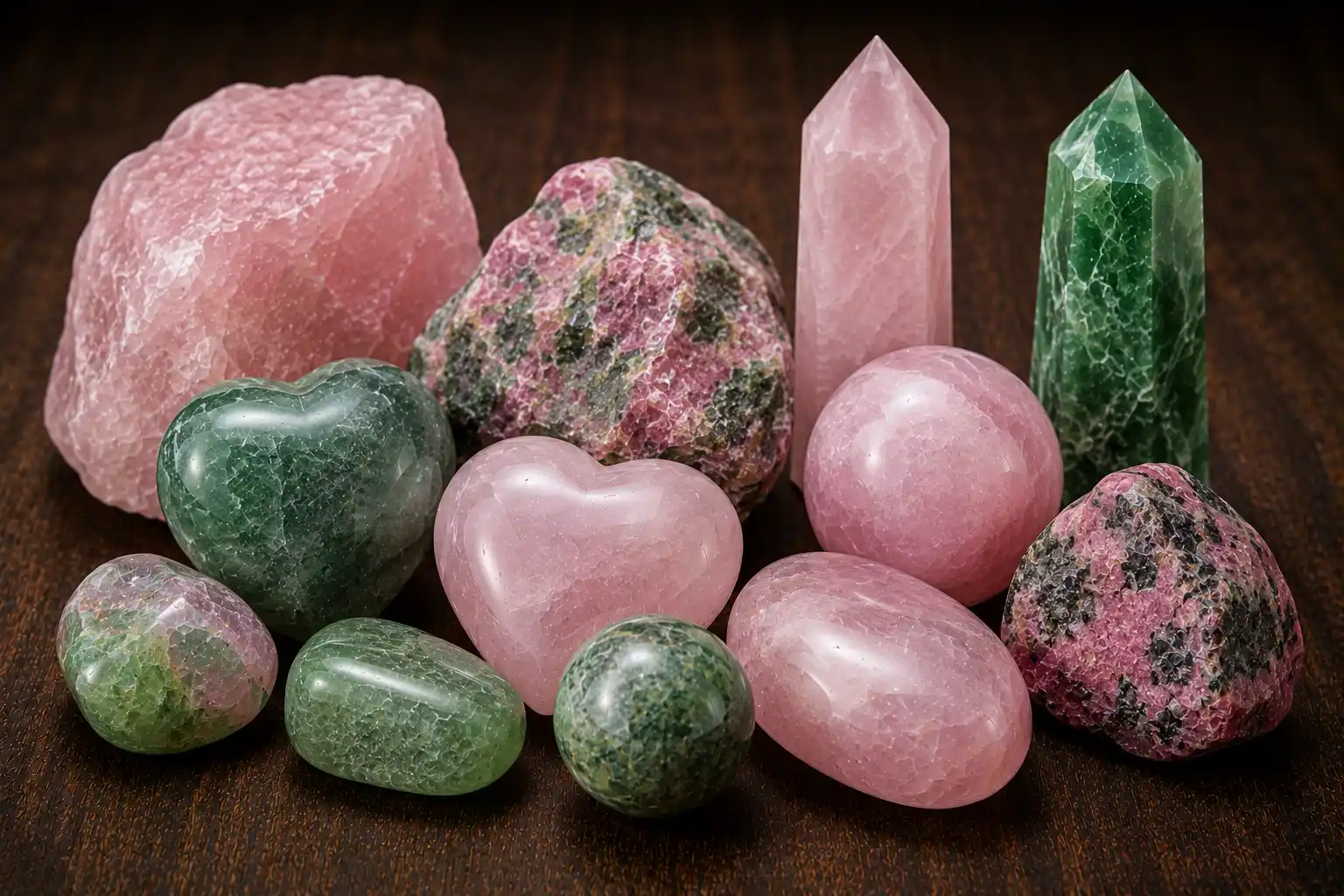
Best Crystals for Self Love: Top 10 Picks and Meanings
Crystals for self love are traditionally used as reminders of compassion, self-respect, emotional honesty and care that does not depend entirely on external approval. They cannot create self-worth automatically or treat depression and trauma, but they may help connect a reflective intention with practical behavior.
Rose quartz is the most familiar self-love stone, while rhodochrosite supports honest attention to emotional needs. Rhodonite brings accountability and repair, pink opal represents gentleness during vulnerable periods, and tiger’s eye reinforces decisions based on self-respect.
Top 10 Self-Love Crystals at a Glance
| Rank | Crystal | Traditional self-love theme | Best practical use |
|---|---|---|---|
| 1 | Rose quartz | Compassion, affection and gentleness | Replacing harsh self-talk with a fair response |
| 2 | Rhodochrosite | Emotional honesty and tenderness | Identifying needs beneath strong reactions |
| 3 | Rhodonite | Accountability and emotional repair | Correcting mistakes without permanent self-condemnation |
| 4 | Pink opal | Comfort and emotional softness | Supporting rest during vulnerable periods |
| 5 | Chrysoprase | Renewal, hope and openness | Beginning again after disappointment |
| 6 | Moonstone | Emotional cycles and self-awareness | Accepting changing capacity |
| 7 | Clear quartz | Intention and clarity | Defining one observable self-care commitment |
| 8 | Smoky quartz | Grounding and practical perspective | Interrupting repetitive self-criticism |
| 9 | Carnelian | Initiative and authentic expression | Acting on personal interests and values |
| 10 | Tiger’s eye | Discernment and confident judgment | Making choices that protect self-respect |
What Self Love Actually Means
Self love is not constant admiration, unlimited indulgence or the belief that every personal choice is correct. A more grounded definition includes treating yourself with dignity while remaining willing to learn, change and take responsibility.
It can appear through ordinary actions: eating regularly, seeking medical care, keeping a boundary, resting when capacity is reduced or completing an uncomfortable responsibility that supports future wellbeing.
Self love also involves separating worth from performance. A disappointing result may require review and adjustment, but it does not make the complete person worthless.
A crystal may represent one of those principles. However, the value comes from the behavior attached to it rather than from expecting the mineral to change identity or emotional patterns independently.
1. Rose Quartz for Compassionate Self-Talk
Rose quartz is the most widely recognized crystal for love and compassion. Within self-love practices, it is most useful as a reminder to respond fairly after difficulty.
Notice language that turns one event into a permanent identity. “I handled that conversation poorly” identifies a behavior that can change. “I ruin every relationship” makes a much broader claim.
Use rose quartz while rewriting the statement in accurate language. Include responsibility where it belongs without adding punishment that does not support repair.
Compassion does not mean avoiding difficult feedback. It creates enough emotional stability to hear the feedback, correct what is possible and continue.
The broader guide to crystals for love and romance focuses on mutual relationships. Here, rose quartz remains centered on the relationship a person has with themselves.
2. Rhodochrosite for Emotional Honesty
Rhodochrosite is traditionally associated with tenderness, emotional awareness and recognition of unmet needs.
Strong reactions sometimes contain more than one feeling. Anger may accompany disappointment, while withdrawal may hide fear of rejection or exhaustion.
Use rhodochrosite beside a journal and complete three statements:
“What I feel is…”
“What contributed to it was…”
“What I need now is…”
The answer should remain practical. A need might involve information, rest, support, a boundary or time to process.
Emotional honesty does not require sharing every feeling immediately. It means understanding the response well enough to choose what should happen next.
3. Rhodonite for Accountability Without Self-Hatred
Rhodonite carries traditional associations with responsibility, repair and forgiveness. It is especially valuable because self love should not become an excuse to avoid accountability.
When a mistake has occurred, identify the exact action, its impact and the repair still available. That repair may involve an apology, correction, repayment or changed behavior.
Then separate responsibility from permanent self-condemnation. A person can acknowledge harm without concluding that improvement is impossible.
Rhodonite supports the idea that accountability is an expression of self-respect. It treats the person as capable of acting differently rather than defining them forever by one failure.
4. Pink Opal for Gentleness During Vulnerability
Pink opal is traditionally connected with emotional softness, comfort and compassionate reflection. Its opaque pastel appearance suits self-love practices during periods of reduced capacity.
Use pink opal when the body or mind needs a quieter form of care. Simplify the day, reduce unnecessary decisions and choose one manageable responsibility.
Gentleness does not require complete withdrawal. It may involve communicating that capacity is limited or asking another person to share a task.
Opal requires thoughtful care. Avoid harsh chemicals, strong heat, rapid temperature changes and impact.
5. Chrysoprase for Beginning Again
Chrysoprase is traditionally associated with renewal, hope and emotional openness. It suits self-love work after rejection, disappointment or a plan that did not succeed.
Beginning again does not require describing the difficult event as beneficial. Instead, ask which possibility remains available now.
Choose a small exploratory action rather than demanding an immediate replacement for the lost goal. The next step may involve gathering information, returning to an interest or testing a revised plan.
Chrysoprase can symbolize the belief that one outcome does not define every future opportunity.
6. Moonstone for Changing Capacity
Moonstone is traditionally associated with cycles, transition and emotional awareness. It may help someone accept that energy and emotional capacity vary.
One productive day does not create a permanent standard. Likewise, one difficult day does not erase earlier progress.
Track sleep, workload, physical symptoms and emotional demands when changing capacity causes confusion. The pattern may reveal a practical need, a medical concern or an unrealistic expectation.
Moonstone should support observation rather than judgment. It cannot diagnose the reason capacity has changed.
7. Clear Quartz for a Self-Love Commitment
Clear quartz is commonly used for intention-setting. It becomes useful when self love is translated into one observable commitment.
Examples include:
“I will attend the appointment I have been postponing.”
“I will not answer work messages after the agreed time.”
“I will eat before beginning another long task.”
“I will ask for clarification rather than assuming rejection.”
Place the crystal beside the related planner, journal or reminder. Clear quartz does not amplify self-worth scientifically; it simply keeps the commitment visible.
8. Smoky Quartz for Interrupting Self-Criticism
Smoky quartz carries traditional associations with grounding, release and practical perspective.
It may be useful when self-criticism repeats long after the useful information has been identified. Write what happened, what was learned and what action remains.
Once those points are clear, smoky quartz can mark the decision to return attention to the present task.
The aim is not to suppress every uncomfortable thought. Instead, it limits rumination that no longer supports repair or learning.
The completed guide to crystals for emotional healing explores emotional processing and integration more broadly.
9. Carnelian for Authentic Self-Expression
Carnelian is traditionally associated with initiative, creativity and expressive courage. Self love includes allowing personal interests to occupy real time rather than treating them as rewards that must always be earned.
Choose one activity that reflects genuine curiosity or enjoyment. Begin with a small action and avoid requiring a polished result.
Carnelian can also support speaking openly about preferences. Expressing a preference does not require demanding that everyone else share it.
Authenticity remains connected with context and responsibility. The goal is not impulsive expression but participation that reflects personal values.
10. Tiger’s Eye for Self-Respecting Decisions
Tiger’s eye is traditionally associated with confidence, discernment and practical judgment.
Use it when a decision involves approval, boundaries or competing priorities. Ask whether the preferred choice protects long-term wellbeing or only reduces immediate discomfort.
Tiger’s eye may represent declining an unsuitable request, negotiating a fair term or leaving a situation that repeatedly ignores a stated limit.
Self-respect does not require certainty or aggression. It means including your own needs and values in the decision.
The completed guide to crystals for confidence and self-esteem focuses more directly on self-belief and performance. This article keeps tiger’s eye centered on respectful personal decisions.
Choosing a Self-Love Crystal by Need
| Present need | Suggested crystals | Grounded self-love action |
|---|---|---|
| Harsh self-talk | Rose quartz and smoky quartz | Replace global criticism with accurate language |
| Emotional confusion | Rhodochrosite and moonstone | Name the feeling, trigger and need |
| Repair after a mistake | Rhodonite and clear quartz | Complete one appropriate corrective action |
| Reduced emotional capacity | Pink opal and rose quartz | Simplify expectations and seek support |
| Beginning again | Chrysoprase and carnelian | Take one exploratory step |
| Weak boundaries | Tiger’s eye and black tourmaline | State a limit and follow through |
| Approval-seeking | Carnelian and tiger’s eye | Check personal values before agreeing |
| Inconsistent self-care | Clear quartz and moss agate | Attach one behavior to a schedule |
| Persistent rumination | Smoky quartz and sodalite | Separate facts, lessons and unresolved actions |
| Difficulty accepting change | Moonstone and chrysoprase | Update expectations for the current phase |
Self Love Versus Self-Esteem
Self-esteem concerns how positively or negatively someone evaluates themselves. Self love is broader and includes behavior, compassion and self-respect even when confidence is low.
A person may feel uncertain about their ability while still eating, resting, asking for help and maintaining a boundary.
Therefore, self-love practices should not depend on generating constant positive beliefs. They can remain useful on days when confidence is limited.
Tiger’s eye and carnelian may support confident action, while rose quartz and moonstone emphasize fair care regardless of performance.
Self Love Versus Romantic Love
Romantic love involves another person’s autonomy, needs and choices. Self love concerns the standards and behavior an individual applies to themselves.
The two can support each other, but one cannot replace the other. A romantic partner should not be expected to create complete self-worth, and self-love language should not be used to avoid mutual responsibility.
Healthy closeness includes both connection and individuality. Rose quartz can represent affection in either context, but the practical intention determines its role.
Self Love and Boundaries
Boundaries protect time, privacy, finances, physical safety and emotional capacity. They are not punishments designed to control another person.
The completed guide to crystals for boundaries explains how to state limits through personal action.
Within self-love work, begin by noticing where agreement is being given despite insufficient capacity. Then communicate a clear alternative or decline.
A boundary may disappoint someone. That reaction does not automatically make the boundary unkind.
Self Love and Accountability
Self love is sometimes misunderstood as accepting every behavior without criticism. In practice, avoiding accountability can damage relationships, goals and self-trust.
A compassionate review asks what happened, what responsibility belongs to the person and what repair is possible. It avoids humiliation because humiliation rarely provides a clear behavioral plan.
Rhodonite and clear quartz form a useful combination here. Rhodonite represents repair, while clear quartz defines the next action.
A Simple Self-Love Crystal Practice
Choose one crystal and one present need. Sit somewhere private and physically comfortable.
Write one accurate statement about the situation. Then identify the response you would consider fair if someone you respected were in the same circumstances.
Choose one action that reflects that standard. It might involve rest, communication, repair or professional support.
Complete the action when possible. The ritual should finish with behavior rather than remaining entirely within affirmations.
Self-Love Journaling Without Forced Positivity
Self-love journaling does not require writing statements that feel unbelievable.
Use four grounded prompts:
- What happened?
- What am I saying to myself about it?
- Which part is factual, and which part is judgment?
- What fair action should happen next?
A journal can contain anger, disappointment and uncertainty. Honest writing is more useful than turning every difficult event into a positive lesson.
The completed guide to crystals for gratitude may support appreciation, but gratitude should not replace direct attention to pain or unmet needs.
Creating a Self-Love Crystal Set
A balanced three-stone set may include one crystal for compassion, one for accountability and one for action.
Rose quartz, rhodonite and carnelian form a practical combination. Rose quartz represents gentleness, rhodonite supports repair and carnelian encourages movement.
For emotional transition, pink opal, moonstone and smoky quartz may be more suitable. Their roles involve comfort, observation and grounding.
Distinct purposes make a small set easier to use than a large collection in which every stone is described only as loving.
Wearing Self-Love Crystals
A pendant, bracelet or pocket stone can provide a discreet reminder. Choose jewelry that is physically comfortable and suited to the stone’s durability.
Moonstone and opal require greater impact protection than quartz varieties. Remove jewelry around machinery, sports equipment and tasks where it may catch.
The crystal should not become a test of whether you are practicing self love correctly. Forgetting or removing it does not reduce personal worth.
Placing Self-Love Crystals at Home
Place the stone near the behavior it represents. Rose quartz may remain beside a compassionate journal, while clear quartz can sit near an appointment calendar or self-care checklist.
Carnelian may belong near creative materials, and tiger’s eye can accompany planning or boundary notes.
Keep heavy, pointed and fragile specimens on stable surfaces. A self-love arrangement should support daily life rather than create clutter or maintenance pressure.
Cleansing Self-Love Crystals
Physical cleaning depends on the mineral. Pink opal and moonstone need gentler care than durable quartz, while treated jewelry may have additional restrictions.
The completed guide to cleansing crystals safely explains low-contact symbolic methods.
A symbolic reset may simply involve changing the crystal’s purpose when the original issue has been resolved. Water, salt and sunlight are not universally appropriate.
When Self-Love Practices Are Not Enough
Persistent hopelessness, severe self-criticism, disordered eating, trauma symptoms or thoughts of self-harm require qualified support.
A crystal ritual cannot diagnose or treat those concerns. Therapy, medical care, crisis assistance and community support may all be relevant.
Seeking help is compatible with self love. In many situations, it is the clearest practical expression of it.
Conclusion
The best crystals for self love support compassion without abandoning honesty or accountability. Rose quartz encourages fair self-talk, rhodochrosite helps identify emotional needs and rhodonite supports repair after mistakes. Pink opal provides gentleness, while tiger’s eye and carnelian connect self-respect with decisions and action.
Self love does not require feeling confident every day. It becomes visible through how a person responds to needs, limits, errors and opportunities for growth.
Frequently Asked Questions
1. What is the best overall crystal for self love?
Rose quartz is the most versatile choice because it symbolizes compassion and emotional gentleness. Rhodochrosite may be more suitable for deeper emotional honesty.
2. Which crystal supports self-worth?
Tiger’s eye and rose quartz are popular choices for self-respect and compassionate self-evaluation. Crystals cannot create self-worth automatically.
3. Which stone helps after making a mistake?
Rhodonite suits accountability and repair, while rose quartz can prevent responsibility from turning into permanent self-condemnation.
4. Are self-love crystals the same as love crystals?
The categories overlap, but self-love practices focus on the individual’s care, boundaries and self-respect rather than attracting or maintaining romance.
5. Can crystals improve self-esteem?
Crystals have not been shown to change self-esteem directly. They may provide reminders for behaviors that support confidence and self-respect.
6. Can I combine several self-love crystals?
Yes. A balanced set might include rose quartz for compassion, rhodonite for accountability and carnelian for action.
7. Where should self-love crystals be placed?
Place them near the behavior they represent, such as a journal, planner, creative area or boundary reminder.
8. Can I sleep with a self-love crystal?
Keep stones on a stable bedside surface rather than loose in the bed. Heavy, sharp and fragile specimens may cause injury or damage.
9. How should self-love crystals be cleansed?
Use a method appropriate to the mineral. Pink opal, moonstone and treated jewelry require gentler care than many quartz stones.
10. Does self love mean accepting every personal behavior?
No. Self love includes accountability, correction and learning without treating mistakes as proof of permanent worthlessness.
11. Can self-love crystals replace therapy?
No. Crystals cannot replace therapy, medication, medical care or crisis support.
12. When should someone seek professional help?
Seek support when self-criticism, depression, trauma symptoms, eating problems or thoughts of self-harm become persistent, severe or dangerous.
Disclaimer: Crystals are not treatments for depression, trauma, eating disorders, low self-esteem or another mental-health condition. Self-love practices should not replace therapy, medication, medical care or crisis support.