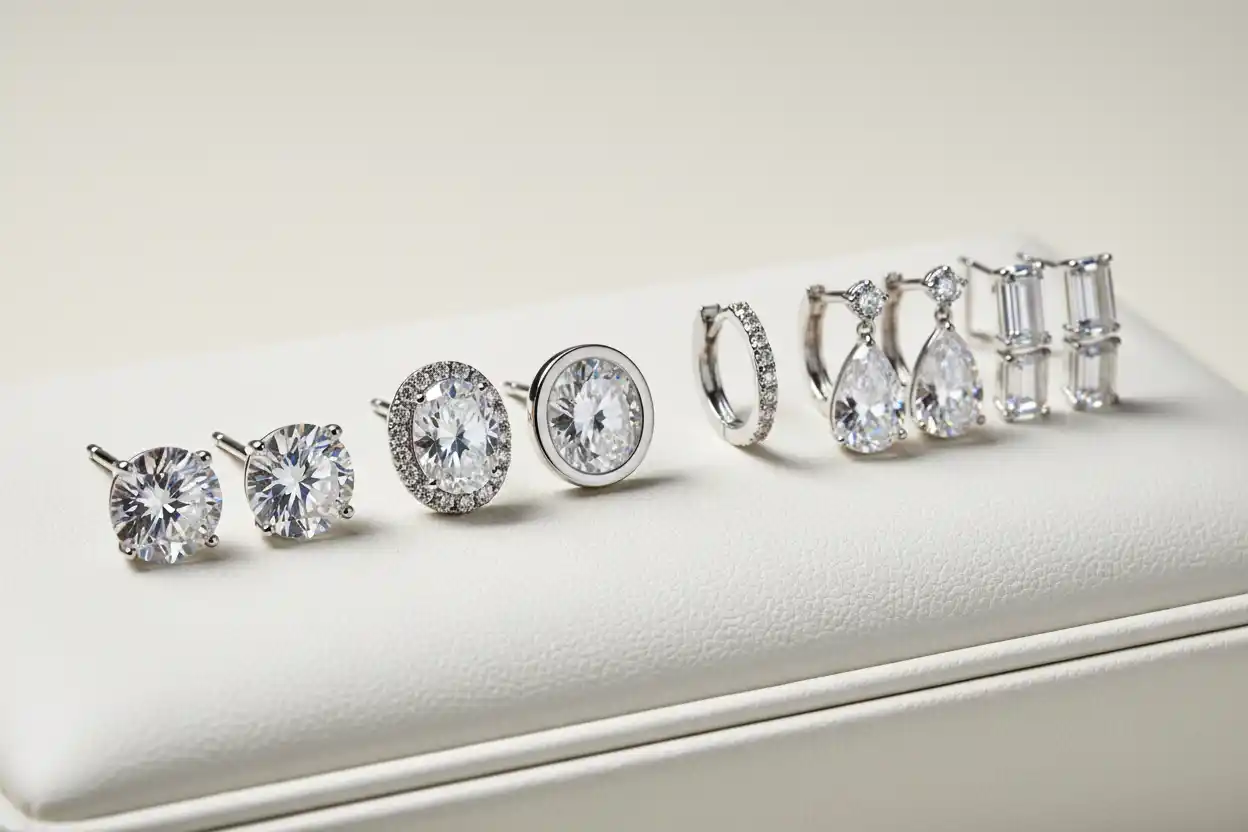
Moissanite Earrings: Styles, Quality and Buying Guide
Moissanite earrings combine high brilliance, pronounced rainbow fire and excellent durability in a jewelry format that receives relatively little impact. Small solitaire studs can resemble classic diamond earrings from normal viewing distance, while larger halos, drops and elongated cuts reveal Moissanite’s more colorful optical character.
Nearly every Moissanite used in modern earrings is laboratory-grown silicon carbide. It is not a mined diamond, laboratory-grown diamond or cubic zirconia. The material should be identified clearly on the listing, invoice and any accompanying warranty.
Choosing a good pair involves more than selecting a total carat equivalent. Cut matching, face-up dimensions, color, optical character, setting height, post alloy, closure and weight determine whether the earrings look balanced and remain comfortable.
The broader Moissanite gemstone guide explains the material’s composition, discovery and symbolism. This page focuses specifically on earring styles, matching, construction, comfort and purchase decisions.
Moissanite Earrings at a Glance
| Feature | What to evaluate |
|---|---|
| Gem material | Laboratory-grown silicon carbide |
| Mohs hardness | Approximately 9.25 |
| Main optical effect | Strong brilliance and high rainbow dispersion |
| Optical character | Doubly refractive |
| Common earring forms | Studs, halos, bezels, hoops, drops, climbers and jackets |
| Most versatile style | Round solitaire studs |
| Smoothest everyday setting | Low bezel stud |
| Main pair-quality issue | Matching cut, dimensions, color and optical pattern |
| Main comfort issue | Stone size, setting weight, post position and back type |
| Main disclosure issue | Moissanite must not be represented as diamond |
| Common color categories | Colorless, near-colorless, warm, gray and fashion colors |
| Routine cleaning | Warm water, mild soap and a soft brush |
Why Moissanite Works Well in Earrings
Earrings protect gemstones better than rings and bracelets because they rarely strike desks, doorframes or tools. That lower-impact position allows larger Moissanites to be worn without exposing them to constant mechanical stress.
The material itself is highly scratch-resistant. Its position near 9.25 on the Gemstone Hardness Chart makes it suitable for frequent wear, while its good toughness reduces the risk of ordinary chipping.
Hardness does not make the complete earring indestructible. Posts bend, prongs loosen, backs wear and delicate halos catch hair. The distinction between gemstone hardness and complete-jewelry durability is explained in Gemstone Toughness vs Hardness.
A properly made pair can be worn regularly, but it should still be removed before sleep, swimming, exercise and hair treatments.
Main Moissanite Earring Styles
| Earring style | Visual character | Main advantage | Main concern |
|---|---|---|---|
| Solitaire stud | Clean and classic | Versatile and easy to wear | Setting height and forward tilt |
| Bezel stud | Smooth metal outline | Low snagging and strong protection | Slightly smaller visible stone area |
| Halo stud | Larger face-up spread | Strong visual impact | More prongs and greater weight |
| Martini stud | Minimal three-prong profile | Stone sits close to the ear | Pavilion may press against the lobe |
| Basket stud | Structured four-prong setting | Stable and serviceable | May sit higher |
| Huggie hoop | Small line of stones around the ear | Secure contemporary style | Hinge and clasp wear |
| Inside-out hoop | Stones visible from front and inner back | Continuous brilliance | Many settings and greater maintenance |
| Drop earring | One suspended center stone | Movement enhances fire | Connector and weight |
| Chandelier earring | Several articulated stones | Formal dramatic appearance | Snagging and comfort |
| Earring jacket | Removable halo or drop behind stud | Converts one pair into several looks | Post length and component fit |
| Climber | Line of stones following the ear | Modern appearance | Correct curvature and support |
| Colored Moissanite pair | Fashion color or contrast | Distinctive alternative to colorless | Coating disclosure and matching |
Solitaire Moissanite Studs
Solitaire studs are the most familiar Moissanite earrings. One stone sits on each ear with little surrounding decoration, making cut, size and matching immediately visible.
Round brilliant cuts produce the strongest traditional brilliance and are easiest to match. Ovals, cushions, pears, radiants and emerald cuts offer a more individual appearance but reveal shape differences more clearly.
A stud should sit upright rather than tipping downward. Post position, stone size and setting weight all influence balance. A large center with a post attached too high can pull forward even when the back fits securely.
The face-up dimensions matter more than a carat-equivalent label. Two stones advertised with the same diamond-equivalent weight may have different millimeter measurements, depths and visual spread.
Basket and Martini Settings
A basket setting surrounds the pavilion with a metal framework and generally uses four or six prongs. It provides a stable base and is relatively straightforward for a jeweler to inspect or repair.
A martini setting normally uses three prongs and a narrow conical profile. It can sit closer to the ear and show more of the stone.
However, the pointed lower setting or exposed pavilion may press into the earlobe. This becomes more noticeable as the stone grows larger.
A basket may look slightly more substantial but often distributes pressure more comfortably. Neither style is automatically superior; the wearer’s ear shape, stone size and desired profile determine the better choice.
Bezel-Set Moissanite Studs
A bezel surrounds the girdle with a continuous metal rim.
This style creates a smooth outline, protects the stone and reduces snagging on hair or knitwear. It is particularly practical for someone who wears studs frequently.
The metal adds a visible frame and may make the total earring look larger while covering a small part of the Moissanite’s edge. Because light enters primarily through the face, a well-cut stone can remain highly brilliant.
A complete bezel also makes girdle inscriptions harder to inspect and stone replacement more labor-intensive. The setting should include an opening beneath the gem so dirt can be cleaned from the pavilion.
Halo Moissanite Earrings
Halo earrings surround a center Moissanite with smaller accent stones.
The design increases face-up size without requiring one very large center. A near-colorless halo can also reduce the visual contrast around a slightly warm Moissanite.
The center and halo stones should share a compatible optical appearance. Mixing Moissanite with diamond accents may produce different patterns of fire, especially under bright lighting. Some buyers enjoy the contrast, while others prefer all-Moissanite construction for consistency.
A halo introduces many small prongs and joints. Each one should remain smooth enough not to catch hair or fabric.
The basket should support the center without making the earring excessively deep or heavy.
Moissanite Hoop and Huggie Earrings
Huggies sit close to the earlobe and usually contain a short line of small Moissanites. Their compact shape works well for regular wear and layered ear styling.
The hinge should move smoothly, while the post or locking bar should engage with a clear click. A loose hinge can allow the hoop to twist, while a weak closure increases loss risk.
Inside-out hoops place stones along the visible front and the inner rear section. This arrangement creates brilliance across more viewing angles.
However, every stone adds settings and maintenance. The lower interior stones may also collect skin oil more quickly.
The hoop should close without forcing the stone-set section to flex.
Drop and Dangle Earrings
Moissanite’s strong dispersion becomes especially visible in moving earrings.
A drop design may suspend one round, pear, oval or emerald-cut gem beneath a post, hook or leverback. Longer dangles can combine several stones in articulated sections.
The connector should allow movement without letting stones collide. Repeated contact can damage the metal settings even though the Moissanite itself is hard.
Request the weight of each earring. A pair can look delicate in photographs while combining large stones with substantial gold.
The lowest component should clear the shoulder. Continuous contact with clothing or skin can twist links and pull on the ear.
Secure leverbacks or locking post backs are generally preferable for valuable drops.
Earring Jackets and Convertible Designs
An earring jacket sits behind a solitaire stud and adds a halo, lower arc or suspended drop.
This format allows one pair of Moissanite studs to create several looks. The stud can be worn alone for everyday use and combined with the jacket for formal occasions.
The post must be long enough to pass through the earlobe, jacket and back without becoming unstable. A jacket designed for a small stud may sit unevenly beneath a much larger stone.
The curvature should follow the ear rather than creating a visible gap.
Both components should use compatible metal alloys. Mixing plated and solid-metal parts can create different wear rates and colors.
Choosing the Best Cut
Round brilliant Moissanite produces a familiar symmetrical pattern and strong fire.
Oval, pear, marquise and radiant cuts create greater apparent spread for their weight-equivalent description. They may also show bow-tie areas or variations in facet pattern.
Cushions can be cut with crisp brilliant facets, modified patterns or a softer crushed-ice appearance. Emerald and Asscher cuts produce broad flashes and reveal double refraction more easily than small brilliant facets.
The Types of Moissanite guide explains cut styles and color varieties in greater depth.
A pair must match not only in shape but also in facet pattern. One crisp oval beside one crushed-ice oval will look uneven even when their measurements are identical.
Rainbow Fire and Everyday Appearance
Moissanite has stronger dispersion than diamond. It separates light into visible spectral colors readily, producing flashes of red, blue, green and yellow.
In small studs, the effect may look subtle from ordinary conversational distance. Larger stones and moving drops show it more clearly.
Jewelry-store spotlights exaggerate spectral fire. View the pair under daylight, diffused indoor light and ordinary household lighting before deciding.
The Moissanite vs Diamond vs Lab Diamond guide owns the full optical comparison. The direct Lab Diamond vs Moissanite page focuses on the two laboratory-produced options.
A buyer seeking strong rainbow flashes may prefer Moissanite. Someone seeking more restrained diamond-like scintillation should compare the materials in person.
Moissanite Color
Modern Moissanite is sold in colorless, near-colorless, warm, gray and fashion-color categories.
Seller grades that resemble diamond letters may not come from an independent grading system. A label such as D–F equivalent should be treated as the manufacturer’s appearance description rather than a GIA diamond color grade.
The two earrings should match face-up. A slight difference in bodycolor becomes visible because the stones sit on opposite sides of the face under the same light.
White gold and platinum emphasize cool color. Yellow and rose gold can make mild warmth less noticeable.
Gray, yellow, blue and green Moissanites should be described according to whether the color is intrinsic, treated or coated.
Coated and Treated Moissanite
Some fashion colors are created through surface coatings.
A coating may produce pink, purple, blue or other colors that are difficult to grow consistently throughout the material. It can wear at exposed facet junctions or be damaged during repolishing.
The dedicated treated-Moissanite guide owns treatment and color-stability questions.
A treated stone can remain attractive, but the pair should share the same process so their color ages consistently.
The seller should disclose coatings in writing and provide care restrictions. Harsh abrasives and repair heat may affect the treated surface.
Matching a Pair
A refined pair should coordinate in face-up dimensions, outline, facet pattern, color, brilliance and setting position.
Actual scale weight is less important than visual equality because Moissanite is often sold by diamond-equivalent size.
Measure both stones in millimeters. Small differences in an oval’s length-to-width ratio or a cushion’s corner shape can become obvious when the earrings are worn.
The settings should also match. One basket should not sit higher, lean farther forward or contain thicker prongs than the other.
A continuous video showing both earrings together provides stronger evidence than separate optimized photographs.
Earring Size
Small Moissanite studs offer understated brilliance and generally remain comfortable for long wear.
Medium stones provide greater visible fire without requiring unusually heavy settings. Very large studs can tip forward, dominate a small earlobe or resemble costume jewelry depending on the wearer’s style.
Millimeter dimensions are more useful than total carat equivalent. The term total weight may describe the combined diamond-equivalent size of both earrings rather than actual Moissanite scale weight.
Request the dimensions of each center stone separately.
Posts and Earring Backs
Friction backs are common and convenient. They should fit the post firmly without requiring excessive force.
Screw backs provide additional security but take longer to insert and can irritate some wearers if the threaded post rubs the piercing.
Locking backs combine convenience with mechanical security. Large studs may benefit from broad supportive disks that help prevent forward tilt.
The post should be soldered to a substantial part of the setting rather than attached to a thin decorative edge.
The Best Gemstones and Metals for Sensitive Skin guide explains why nickel, plating, solder and back composition matter independently from the Moissanite.
Moissanite vs Diamond Earrings
Moissanite offers greater rainbow fire and usually more visible size within a comparable purchase budget.
Diamond has a different balance of brilliance, fire and scintillation, as well as a distinct natural or laboratory-grown market identity.
The Diamond Earrings guide owns diamond-specific settings and value.
A buyer should not compare Moissanite and diamond through carat weight alone. Their densities differ, so the same millimeter size does not produce the same scale weight.
Both materials are durable enough for everyday earrings. The decision is primarily about optics, identity, budget and long-term market expectations.
Moissanite vs Cubic Zirconia Earrings
Cubic zirconia can provide a bright initial appearance at a very low price.
Moissanite is harder, generally more durable and more resistant to long-term surface abrasion. CZ is denser and usually produces a different optical pattern.
The direct Moissanite vs Cubic Zirconia guide owns that comparison.
A basic thermal diamond tester may react to Moissanite in ways that confuse an inexperienced user. Appropriate multi-testing or professional examination is more reliable.
Authenticity and Documentation
The Real vs Fake Moissanite guide owns the complete identification workflow.
A seller should state that the earrings contain Moissanite and whether the stones are coated or otherwise treated.
A report is not necessary for every small commercial pair. It becomes more useful for large centers, expensive branded material or a dispute involving diamond or laboratory-grown diamond.
The Gemstone Certification guide explains that reports identify material and detectable features but do not guarantee resale value.
Buying online also requires a written return policy, exact dimensions and clear metal disclosure. The safeguards in How to Buy Gemstones Online Without Getting Scammed apply directly.
Price and Value
The Moissanite Price Guide owns current material value.
Finished earring price depends on stone size, cut matching, color, brand, treatment, metal weight, setting labor and back construction.
A larger total carat-equivalent label does not automatically indicate better value. Poorly matched cuts, weak posts and lightweight settings can reduce the pair’s usefulness.
Branded Moissanite may cost more because of cutting, warranties, replacement policies and marketing. Generic stones can also perform well when their dimensions and optical quality are verified.
Wearing and Styling Moissanite Earrings
Solitaire studs coordinate easily with most jewelry. They do not need to match a Moissanite bracelet stone for stone.
A Moissanite engagement ring can be paired with studs of a similar shape, while a Moissanite necklace may repeat the metal or general cut.
The broader Moissanite Rings guide covers non-bridal ring styles.
Remove earrings before sleep, swimming, contact sports and salon chemical treatments. Long dangles should also be removed before changing tight-necked clothing.
Cleaning and Maintenance
Follow How to Clean Moissanite Jewelry Safely.
Warm water, mild dish soap and a soft brush remove the oil and styling products that reduce brilliance. Clean carefully behind the stone, where film accumulates.
Rinse over a closed or lined basin and dry with a lint-free cloth.
Moissanite itself tolerates routine cleaning well, but coatings, delicate halos, glue and other gemstones may require stricter care.
Inspect prongs, posts and backs periodically. Stop wearing an earring when the stone moves, a prong catches or the closure feels looser than usual.
Frequently Asked Questions
1. Are Moissanite earrings suitable for everyday wear?
Yes. Moissanite is highly scratch-resistant and durable, while earrings receive relatively little impact.
2. Do Moissanite studs look like diamond studs?
They can look similar, particularly in small sizes, but Moissanite generally shows stronger rainbow fire and double refraction.
3. What is the best Moissanite earring cut?
Round brilliant is the most versatile and easiest to match. Ovals, cushions, pears and emerald cuts provide different visual styles.
4. What is the safest setting for Moissanite studs?
A low bezel offers strong protection and reduced snagging. A well-made basket is another practical option.
5. Why do large studs tilt forward?
Stone size, setting weight, high post placement and small backs can pull the earring away from the ear.
6. Are screw backs better than friction backs?
They provide additional security but take longer to use. High-quality friction or locking backs can also be dependable.
7. Does Moissanite look too rainbow-like in earrings?
Larger stones and moving drops show more spectral fire. Small studs usually appear more restrained at normal viewing distance.
8. Are color grades such as D–F official?
They are commonly seller or manufacturer categories and should not be assumed equivalent to an independent diamond color grade.
9. Can Moissanite earrings be coated?
Yes. Some fashion colors come from coatings that should be disclosed and protected from abrasion.
10. Is Moissanite the same as laboratory-grown diamond?
No. Moissanite is silicon carbide, while laboratory-grown diamond is carbon with the diamond crystal structure.
11. Do Moissanite earrings need certificates?
Most small pairs do not. Documentation is more useful for large, expensive or disputed stones.
12. How often should the earrings be inspected?
Frequently worn pairs should be checked whenever a prong catches, a post bends, a stone moves or a back begins fitting differently.
Moissanite earrings deliver their strongest result when the pair is evaluated as two pieces of precision jewelry rather than two bright stones. Matching dimensions, compatible facet patterns, balanced settings and dependable backs determine whether the fire looks intentional and whether the earrings remain comfortable after the first hour of wear.