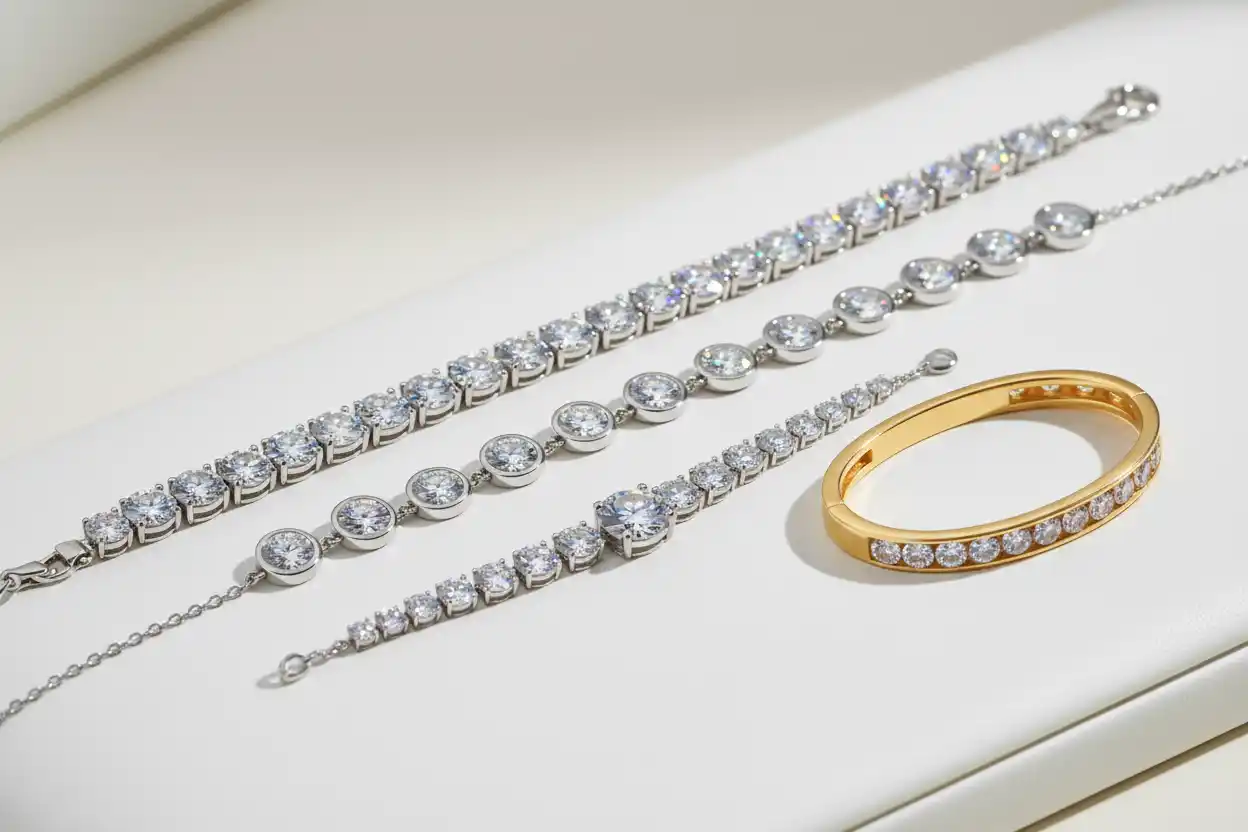
Moissanite Bracelets: Styles, Quality and Buying Guide
Moissanite bracelets combine strong brilliance, pronounced rainbow fire and high durability in a jewelry format that can range from a delicate station chain to a continuous tennis-style line. Because the wrist is constantly moving, Moissanite’s dispersion becomes particularly visible as individual stones pass through changing light angles.
Nearly all Moissanite used in modern jewelry is laboratory-grown silicon carbide. It is not diamond, laboratory-grown diamond or cubic zirconia. It is a distinct gem material with its own optical properties, durability, pricing and identification characteristics.
The stone itself is highly durable, but a bracelet is only as secure as its links, settings, clasp and articulation. A line of well-cut gems can still fail if the metal is too light, the prongs catch clothing or the clasp opens unexpectedly.
The broader Moissanite gemstone guide owns the material’s identity, properties and symbolism. This page focuses specifically on bracelet construction, matching, fit, metals, security, buying and care.
Moissanite Bracelets at a Glance
| Feature | What to evaluate |
|---|---|
| Material | Laboratory-grown silicon carbide |
| Mohs hardness | Approximately 9.25 |
| Optical character | Doubly refractive with very strong dispersion |
| Common bracelet forms | Tennis, line, station, bezel, bangle, cuff and charm |
| Best everyday construction | Low articulated settings with secure clasp |
| Main visual factor | Cut consistency and matched face-up color |
| Main durability concern | Metal, prongs, links and clasp rather than the stone |
| Common colors | Colorless, near-colorless, yellow, green, gray, blue and coated colors |
| Main identification issue | Confusion with diamond, lab diamond and cubic zirconia |
| Main fit concern | Excessive looseness and wrist rotation |
| Safest cleaning | Warm water, mild soap and a soft brush |
| Main disclosure requirement | Clear identification as Moissanite |
What Is Moissanite?
Moissanite is silicon carbide.
Natural Moissanite exists but is extremely rare and is not the practical source of commercial jewelry stones. Modern gems are created through controlled laboratory processes.
Laboratory-grown origin does not make Moissanite a synthetic diamond. Diamond consists of carbon and has a different crystal structure, refractive behavior, density and hardness.
Moissanite is frequently used as a diamond alternative because it is colorless or near-colorless, highly brilliant and durable. It should still be sold under its own name rather than through language that implies it is diamond.
The Best Diamond Alternatives guide places Moissanite beside Sapphire, Spinel, White Topaz, Cubic Zirconia and other options.
Why Moissanite Works Well in Bracelets
A bracelet exposes stones to movement, desk contact and occasional impact. Moissanite’s hardness of approximately 9.25 provides excellent scratch resistance for this environment.
The Gemstone Hardness Chart places it below diamond but above Sapphire, Topaz and most common jewelry materials.
Moissanite also has good toughness and thermal stability under normal wear. The primary vulnerabilities usually lie in the setting rather than the gem.
A bracelet containing dozens of stones creates dozens of prongs, links and connection points. Each component must remain secure and flexible.
For that reason, a moderately sized Moissanite line bracelet with substantial construction can be a better long-term purchase than a larger design built with very light metal.
Main Moissanite Bracelet Styles
| Bracelet style | Visual effect | Main advantage | Main concern |
|---|---|---|---|
| Classic tennis bracelet | Continuous line of equal stones | Timeless and highly brilliant | Prong count, clasp and link wear |
| Graduated line bracelet | Larger stones toward the center | Strong central focus | Matching and balanced weight |
| Bezel bracelet | Smooth metal-framed stones | Fewer snags and strong girdle protection | More visible metal |
| Station bracelet | Individual gems spaced on chain | Light, modern and adjustable | Flipping stations and chain strength |
| Bangle | Structured circular design | Clean shape and easy stacking | Hinge, clasp and wrist fit |
| Cuff | Open rigid construction | Strong contemporary look | Repeated bending and exposed ends |
| Multi-row bracelet | Several parallel gem lines | Maximum visual impact | Weight, flexibility and servicing |
| Charm bracelet | Movable Moissanite accents | Personalization | Charm collision and jump-ring security |
| Mixed-stone bracelet | Moissanite with colored gems | Customized color contrast | Hardness differences and matching |
| Illusion or floating bracelet | Minimal visible metal | Delicate appearance | Fine chain and difficult repair |
Moissanite Tennis Bracelets
The classic tennis bracelet uses one articulated line of similarly sized stones.
Every link should bend independently. A stiff section can twist around the wrist, place pressure on adjacent settings and create an uncomfortable flat spot.
The stones should remain face-up through normal movement. Shallow baskets may allow pavilion tips to contact the skin, while very deep settings add unnecessary height.
Four-prong settings are common because they expose more of each stone. Shared-prong construction can reduce visible metal but creates greater dependence between neighboring stones.
A lost or bent shared prong may affect two gems at once. Individual baskets provide more separation but use additional metal.
The related Diamond Bracelets guide explains conventional line-bracelet construction in diamond jewelry without changing Moissanite’s gem identity.
Bezel-Set Moissanite Bracelets
A bezel surrounds each stone with metal.
This construction protects the girdle, creates a smooth surface and reduces snagging on knitwear or hair. It works particularly well for someone who plans to wear the bracelet frequently.
Bezel settings show slightly less of the stone and may reduce the airy appearance of a prong line. However, Moissanite’s strong brilliance and fire remain visible through the face.
Full bezels can also conceal girdle inscriptions or make stone replacement more labor-intensive. A well-made setting should leave the pavilion cleanable from the reverse whenever possible.
Partial bezels provide a compromise between protection and openness.
Station Bracelets
A station bracelet spaces several Moissanites along a chain.
It offers a subtler appearance than a continuous tennis bracelet and usually requires less total stone weight.
Each station should connect at two balanced points if it is intended to remain face-up. A one-point connection permits more movement but can cause the gem to turn backward.
The chain must be proportionate to the station weight. Extremely fine chains may stretch or break even though the Moissanite remains undamaged.
An adjustable sliding clasp adds flexibility, but the mechanism should hold firmly without slipping during wear.
Graduated and Multi-Row Bracelets
Graduated bracelets increase stone size toward the center of the wrist.
The change should appear smooth. Abrupt jumps can make the line look assembled from unrelated sizes.
Larger center stones may show more rainbow fire than smaller side stones. The effect is natural but should remain visually balanced.
Multi-row bracelets create substantial brilliance but require flexible construction so the rows move together without crossing or buckling.
More rows also mean more prongs and greater maintenance. Such designs deserve periodic professional inspection.
Round, Oval and Other Shapes
Round brilliant Moissanite remains the most common bracelet cut because it provides high brilliance and is easy to match across a long line.
Ovals, cushions, emerald cuts, pears and radiants create more distinctive designs.
Fancy shapes are harder to match because small differences in length-to-width ratio, bow-tie appearance and facet pattern become obvious when repeated side by side.
Emerald-cut Moissanite produces broader flashes and less rainbow scintillation than a round brilliant. A buyer who prefers a diamond-like restrained appearance may find step cuts appealing.
Mixed-shape bracelets can work when the pattern repeats deliberately rather than appearing random.
Fire and Brilliance
Moissanite has greater dispersion than diamond, so it separates white light into spectral colors strongly.
On a moving bracelet, this fire can appear as red, blue, green and yellow flashes.
Some buyers love the lively rainbow effect. Others prefer the more restrained balance of brilliance and dispersion associated with diamond.
Stone size, cut, lighting and viewing distance influence how obvious the fire appears. Larger stones usually display it more readily.
The direct Moissanite vs Diamond vs Lab Diamond guide owns the full optical and market comparison. The Lab Diamond vs Moissanite guide focuses specifically on separating those laboratory-produced choices.
Double Refraction
Most jewelry Moissanite is optically doubly refractive.
When viewed through certain directions, back facets may appear doubled. Modern cutting orientation and facet design reduce how noticeable this feature appears face-up.
The doubling can help a gemologist distinguish Moissanite from singly refractive diamond.
It is not a defect created by poor manufacturing. It arises from the material’s optical structure.
In a small bracelet stone, doubling is usually difficult to see without magnification. Cut quality and cleanliness influence the everyday appearance more than the feature itself.
Color Grades and Matching
Moissanite may be marketed as colorless, near-colorless or within proprietary letter-grade systems.
These descriptions are not necessarily equivalent to the GIA diamond color scale. A seller’s D–F or G–H terminology should be understood as an internal appearance category rather than an independent diamond grade.
A bracelet requires consistent face-up color. One warm or gray stone can be noticeable within an otherwise near-colorless line.
Compare the complete bracelet against a white background and against skin. Yellow gold may make slight warmth less visible, while white metal can emphasize it.
The Moissanite Buying Guide owns complete evaluation of cut, color, clarity and seller grading.
Colored Moissanite
Laboratory-grown Moissanite is available in yellow, green, blue, gray and other shades.
Some color is intrinsic to the grown material, while other products use surface coatings. Coated pink, purple or unusual fashion colors may be less durable than bulk-colored stones.
The seller should state whether color is grown through the material, treated after growth or produced by coating.
A coating can scratch or wear along exposed edges. Repolishing may remove it.
Colored Moissanite can work well as a bracelet accent, but all stones should share consistent treatment and stability.
Clarity and Inclusions
Commercial Moissanite is usually clean enough that inclusions are not visible without magnification.
Possible internal features include needles, growth structures, cavities and small dark or reflective inclusions.
In a bracelet, matching matters more than obtaining the highest theoretical clarity. One visibly included stone can interrupt a line, while microscopic differences among clean-looking gems have little practical effect.
Surface damage should not be confused with inclusions. Abraded prongs, polishing residue and oily film can reduce brilliance even when the stone remains internally clean.
Bracelet Length and Fit
A line bracelet should sit comfortably without compressing the wrist or hanging so loosely that it repeatedly strikes surfaces.
Measure the wrist with a flexible tape and add enough allowance for movement. The correct amount depends on personal preference, stone size and setting depth.
Large stones occupy space inside the bracelet, so the wearable circumference may be smaller than the laid-flat length suggests.
A loose tennis bracelet can rotate continuously, placing the clasp beneath the wrist and increasing desk impact. A tight bracelet stresses the links and catches skin.
Request wearable length and width rather than relying only on small, medium or large labels.
Clasps and Safety
The clasp is one of the most important components in a valuable bracelet.
Box clasps are common in tennis bracelets because they create a clean line and can include one or two safety latches. A tongue should engage positively without requiring excessive force.
Lobster clasps may work in station bracelets, while hinged bangles often use integrated box or push-button systems.
A safety chain can reduce loss risk but should remain short enough not to catch on objects.
Inspect the first links beside the clasp. These areas receive repeated stress and may wear faster than the center of the bracelet.
Metal Choices
White gold and platinum create a continuous bright appearance around colorless Moissanite.
Yellow gold adds warmth and can reduce the visibility of slight bodycolor. Rose gold creates softer contrast and works well with near-colorless or pale-gray stones.
Sterling silver provides a lower-cost option but can tarnish and may require more frequent maintenance.
The metal’s purity and weight matter. An extremely lightweight setting can bend, allowing stones to loosen even when the gems remain intact.
The bracelet should be compared by total weight, setting dimensions and construction rather than metal color alone.
Moissanite vs Diamond Bracelets
A Diamond bracelet generally carries greater natural rarity, conventional market recognition and resale familiarity.
A Moissanite bracelet can provide larger visual coverage and stronger rainbow fire within a lower purchase budget.
Diamond ranks 10 in hardness, while Moissanite ranks approximately 9.25. Both are highly suitable for bracelets, so construction usually matters more than the small difference in scratch resistance.
The natural Diamond Buying Guide and Diamond Price Guide should not be used to value Moissanite.
A buyer should decide whether the priority is material identity, traditional diamond optics, visual size, price or reduced concern about replacing a lost stone.
Moissanite vs Laboratory-Grown Diamond
Laboratory-grown diamond is diamond produced through a manufacturing process. It has the same carbon crystal structure and fundamental properties as mined diamond.
Moissanite is laboratory-grown silicon carbide and remains a different gemstone.
Lab diamond usually shows diamond-like optical behavior with less rainbow dispersion, while Moissanite displays more fire.
The Lab Diamond Buying Guide covers laboratory-grown diamonds rather than Moissanite.
Both can be appropriate bracelet choices, but the invoice should identify the material clearly. A Moissanite bracelet should not be described as a lab-diamond bracelet or synthetic-diamond bracelet.
Moissanite vs Cubic Zirconia
Cubic Zirconia is another manufactured diamond simulant, but it is softer, denser and generally less durable than Moissanite.
CZ can provide strong initial brilliance at very low cost, although surface abrasion may reduce its appearance over time.
The direct Moissanite vs Cubic Zirconia guide owns identification, durability and optical differences.
The Cubic Zirconia Buying Guide is appropriate when the bracelet is confirmed as CZ.
A low price alone does not identify the material. Testing may be necessary when seller disclosure is unclear.
Price and Value
The Moissanite Price Guide owns current value and cost.
Bracelet price reflects stone size, number of stones, cutting consistency, color, brand, metal weight, setting labor, clasp quality and warranty.
Moissanite carat equivalents are often based on visual dimensions rather than actual weight because silicon carbide and diamond have different densities.
A “ten-carat equivalent” bracelet may therefore not weigh ten carats as measured on a scale.
Price comparisons should use millimeter dimensions, total stone count, metal weight and construction rather than carat-equivalent marketing alone.
Buying Online
Follow How to Buy Gemstones Online Without Getting Scammed.
Request a continuous video of the complete bracelet moving under neutral light. Highly concentrated jewelry-store lighting can exaggerate rainbow fire.
The listing should provide wearable length, width, stone dimensions, stone count, metal alloy, total weight, clasp type and color-treatment disclosure.
Ask whether stones can be replaced individually and whether the manufacturer supplies matched replacements.
An independent report may be useful for an expensive center or unusual colored stone, but complete bracelet verification often requires testing more than one gem. The Gemstone Certification guide explains documentation limits.
Wearing and Stacking
Moissanite is durable enough for frequent wear, but the bracelet should still be removed before exercise, mechanical work, cleaning and activities likely to bend the links.
A tennis bracelet can be stacked with plain metal bangles when their edges do not strike the settings.
Stacking beside a diamond bracelet is physically possible because both materials are hard, but their metal settings can scratch or deform one another.
Leave enough space for movement without allowing several bracelets to collide continuously.
The related Moissanite Earrings, Moissanite Necklace and Moissanite Rings guides cover coordinating formats without requiring a perfectly matched set.
Cleaning and Maintenance
Follow How to Clean Moissanite Jewelry Safely.
Warm water, mild dish soap and a soft brush remove skin oil, lotion and debris that collect beneath the stones.
Moissanite itself tolerates normal cleaning well, but the setting, coatings and other gemstones may impose stricter limits.
Rinse carefully and dry with a lint-free cloth. Pay attention to the underside of the stones, where film most strongly reduces brilliance.
A jeweler should inspect prongs, links and clasp periodically, especially in a bracelet worn several times per week.
Frequently Asked Questions
1. Is Moissanite durable enough for a bracelet?
Yes. Its hardness of approximately 9.25 and good toughness make it highly suitable. The links, prongs and clasp are usually the greater concerns.
2. Is Moissanite a laboratory-grown diamond?
No. Moissanite is laboratory-grown silicon carbide, while laboratory-grown diamond is carbon with the diamond structure.
3. What is the best Moissanite bracelet style?
A well-made articulated tennis bracelet is the classic choice. Bezel and station designs provide smoother, lower-snag alternatives.
4. Does Moissanite look too rainbow-like in a bracelet?
Its strong dispersion can create noticeable spectral fire, particularly in larger stones and bright light. Whether that is desirable is personal.
5. Which metal is best?
Platinum and gold provide strong long-term construction. Sterling silver can work for lower-cost designs but needs more maintenance.
6. How should a tennis bracelet fit?
It should move comfortably without rotating excessively or sliding over the hand. Ask for wearable circumference rather than only total length.
7. Is a bezel bracelet safer than a prong bracelet?
Bezels protect the girdles and snag less. Prongs show more of each stone but require more frequent inspection.
8. Can Moissanite bracelets contain coated stones?
Yes. Some fashion colors come from surface coatings, which should be disclosed and protected from abrasion.
9. What does carat equivalent mean?
It usually describes how large a Moissanite appears compared with a diamond of similar dimensions, not the Moissanite’s actual scale weight.
10. Can a diamond tester identify Moissanite?
Basic thermal testers may misidentify Moissanite as diamond. Appropriate multi-testing or professional examination is needed.
11. Can Moissanite be cleaned ultrasonically?
The gem generally tolerates ultrasonic cleaning, but the setting, coatings and accompanying stones must also be suitable. Gentle hand cleaning is the safest routine option.
12. How often should a Moissanite bracelet be inspected?
A frequently worn line bracelet should receive periodic professional inspection, particularly when a prong catches, a link stiffens or the clasp feels different.
A Moissanite bracelet delivers its best value when brilliance is supported by engineering. Matching stones and strong fire create the initial impression, but articulated links, substantial metal, a secure clasp and replaceable settings determine whether the line remains intact. The gemstone can tolerate daily life remarkably well; the bracelet around it must be built to do the same.