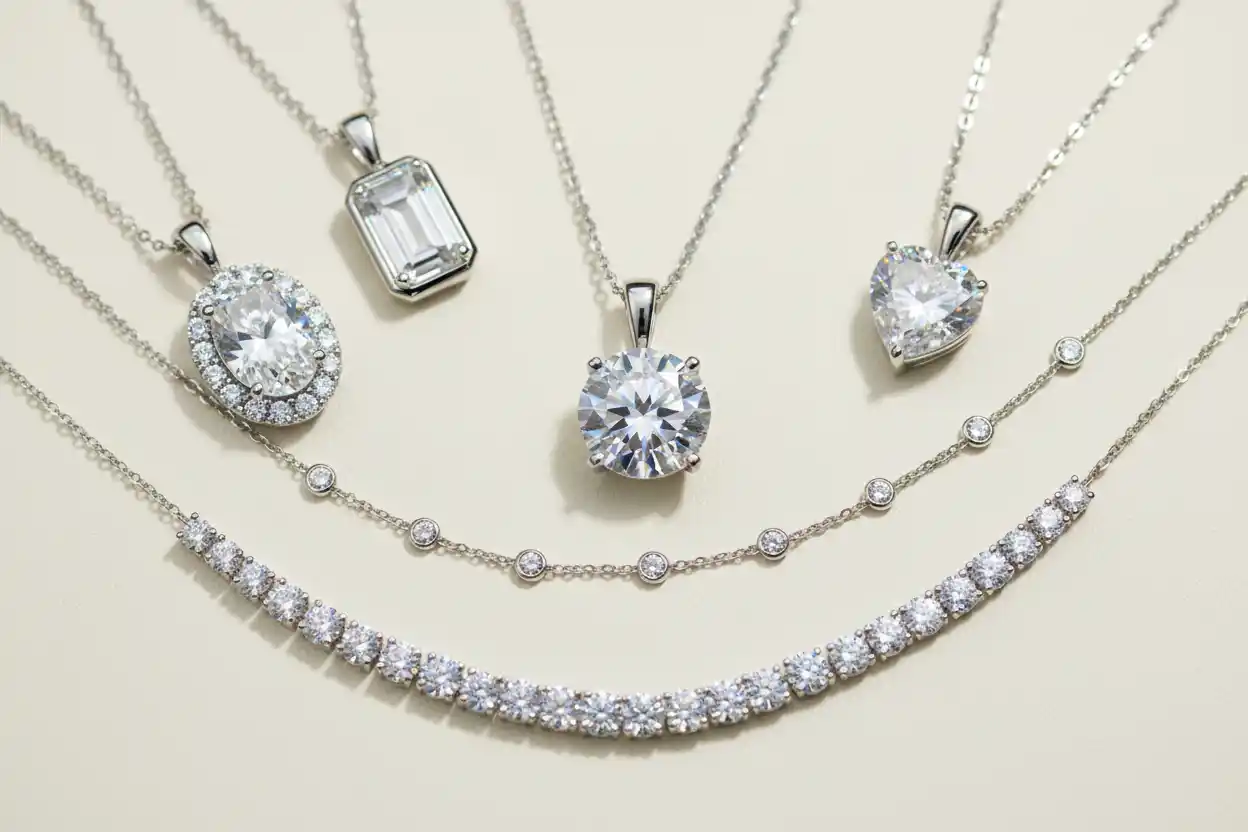
Moissanite Necklaces and Pendants: Buying Guide
Moissanite necklaces place the material’s brilliance and rainbow fire in a relatively protected position. A small solitaire pendant provides a restrained point of light, while a graduated line necklace can create continuous spectral flashes across the neckline.
Modern jewelry Moissanite is laboratory-grown silicon carbide. It should be identified under its own name rather than described as mined diamond, laboratory-grown diamond or synthetic diamond.
Necklace quality depends on more than the center stone. Pendant balance, bail dimensions, chain gauge, station orientation, clasp strength and setting access determine whether the piece hangs correctly and remains serviceable.
The broader Moissanite gemstone guide owns composition, discovery and general properties. This article focuses on necklace formats, construction, sizing, matching, purchase checks and maintenance.
Moissanite Necklaces at a Glance
| Feature | What to evaluate |
|---|---|
| Gem material | Laboratory-grown silicon carbide |
| Mohs hardness | Approximately 9.25 |
| Optical appearance | Strong brilliance and high rainbow dispersion |
| Common necklace forms | Solitaire, halo, bezel, station, line, lariat and charm |
| Most versatile choice | Round or oval solitaire pendant |
| Smoothest setting | Full or partial bezel |
| Main pendant concern | Balance, flipping and bail attachment |
| Main chain concern | Gauge, length, clasp and end-fitting compatibility |
| Main line-necklace concern | Stone matching and link articulation |
| Main disclosure issue | Must be represented clearly as Moissanite |
| Common color options | Colorless, near-colorless, gray and fashion colors |
| Routine care | Warm water, mild soap and soft brushing |
Why Moissanite Suits Necklaces
A necklace receives less impact than a ring or bracelet, making it an easy format for large Moissanites and elongated shapes.
The stone’s hardness of approximately 9.25 also provides excellent resistance to scratches. Its position on the Gemstone Hardness Chart makes it suitable for regular wear.
A pendant can still chip through a severe blow, but the greater practical risks are usually bent bails, weak chains, open jump rings and worn clasps.
Long necklaces swing more than short ones and can strike desks or furniture. The wearer should therefore choose length and setting height according to the pendant’s size.
Main Moissanite Necklace Styles
| Necklace style | Visual effect | Main advantage | Main concern |
|---|---|---|---|
| Solitaire pendant | One central point of brilliance | Versatile and easy to wear | Flipping and chain balance |
| Bezel pendant | Smooth metal-framed gem | Low snagging and strong protection | More visible metal |
| Halo pendant | Larger apparent spread | Strong formal presence | Numerous small prongs |
| Three-stone pendant | Vertical or horizontal sequence | Symbolic and balanced design | Matching and articulation |
| Station necklace | Gems spaced along a chain | Light contemporary appearance | Stations turning backward |
| Tennis or line necklace | Continuous brilliance | Formal visual impact | Weight, flexibility and clasp |
| Graduated rivière | Larger stones at the center | Natural neckline emphasis | Smooth size matching |
| Lariat | Adjustable vertical drop | Flexible styling | Sliding mechanism and swing |
| Heart pendant | Romantic symbolic shape | Familiar gift choice | Cut symmetry and cleft protection |
| Initial or motif necklace | Personalized design | Everyday sentimental use | Small-stone setting quality |
| Cross or geometric pendant | Structured arrangement | Multiple design traditions | Numerous joints and prongs |
| Colored Moissanite pendant | Gray, green, blue or fashion color | Distinctive focal point | Treatment and coating disclosure |
Solitaire Moissanite Pendants
A solitaire places one stone at the center of the necklace.
Round brilliant remains the most versatile cut. Oval, pear, cushion, marquise, radiant and emerald cuts create different proportions and levels of spectral fire.
The pendant should hang face-forward rather than rotating continuously toward the chest. Balance depends on bail placement, center of gravity, chain attachment and setting depth.
A fixed bail can hold a geometric pendant in a consistent direction, while an articulated bail allows freer movement.
The back should include enough opening to clean the pavilion. A fully enclosed basket can trap oil and reduce brilliance.
Four-Prong and Six-Prong Pendants
Four-prong settings show more of the stone and produce a clean outline.
Six prongs provide greater redundancy and may suit larger rounds. They create a more visually enclosed perimeter but reduce the chance that one damaged prong releases the stone immediately.
Pear and marquise cuts need protection over their points. A V-shaped prong or bezel is safer than a standard rounded prong placed beside the tip.
The prongs should remain smooth enough not to catch clothing or hair.
A large pendant should have a substantial gallery beneath the stone rather than a delicate wire basket that can twist.
Bezel-Set Pendants
A bezel surrounds the Moissanite’s girdle with metal.
It creates a smooth profile, protects the edge and reduces snagging. The style works particularly well for daily necklaces, children’s keepsakes and active wearers.
A complete bezel covers a small part of the stone but does not prevent brilliance from entering through the face.
The reverse should remain open enough for cleaning. A fully closed back may trap residue, conceal an inscription or make replacement more difficult.
Partial bezels expose selected sides while retaining some protection.
Halo Pendants
A halo surrounds the center with smaller Moissanites, diamonds or other accents.
The design creates a larger face-up outline and can strengthen the apparent color contrast around the center.
Mixing diamond and Moissanite produces different optical behavior. Moissanite generally shows stronger rainbow fire, which may be noticeable in larger accents.
All accent materials should be identified independently on the invoice.
The halo should lie flat and contain enough metal to keep small stones secure. An extremely thin decorative frame can bend when the pendant is handled.
Three-Stone and Cluster Pendants
Three-stone pendants may arrange gems vertically, horizontally or in a triangular cluster.
A vertical design creates movement and length, while a horizontal bar feels more modern.
The stones should match in color and facet style. A crisp brilliant center beside crushed-ice accents can look inconsistent.
Each articulated connection should move without allowing the stones to strike one another.
Cluster pendants use several smaller Moissanites to create a flower, starburst or geometric motif. Their many prongs require closer maintenance than a solitaire.
Station Necklaces
Station necklaces space individual Moissanites along a chain.
Two-point attachment helps each stone remain face-up. One-point stations turn more freely and may flip toward the skin.
The chain should pass through or connect to metal rather than rub directly against the Moissanite.
Spacing must allow the necklace to curve without adjacent stations colliding.
An adjustable station necklace should have a sliding mechanism that holds its position without damaging the chain.
The broader Crystal Necklaces guide covers necklace meanings and general formats without replacing Moissanite-specific construction.
Tennis and Line Necklaces
A tennis or line necklace uses an articulated row of closely set stones.
The complete piece should follow the neck and upper chest without stiff sections. Each link needs independent movement.
One rigid joint can cause the necklace to twist or turn downward. Flexible construction becomes increasingly important as stone size and total weight grow.
Prong-line necklaces show more stone, while bezel lines create a smoother and often more contemporary appearance.
A secure box clasp with safety latches is preferable for high-value designs. The links beside the clasp deserve additional inspection because they receive repeated stress.
The Diamond Necklaces guide owns diamond-specific rivière and tennis-necklace decisions.
Graduated Rivière Necklaces
A rivière places a continuous sequence of stones around the neckline, commonly increasing in size toward the center.
The graduation should look smooth. Sudden changes in diameter can interrupt the visual flow.
Larger center Moissanites may show more rainbow fire than smaller side stones. Matching therefore involves optical pattern as well as color.
The necklace should be balanced so the largest stones remain centered. Uneven weight distribution can pull the clasp toward one side.
Rivières require substantial labor, and setting consistency contributes significantly to price.
Lariats and Adjustable Necklaces
A lariat creates a vertical drop and may use a sliding ring or fixed crossing point.
Moissanite can appear at the ends, slider or both.
The mechanism should move smoothly without releasing its position during wear. A heavy end stone may cause the drop to lengthen gradually when the slider lacks friction.
The lowest stone should not strike desks during seated work.
Adjustable chains are useful gifts when the preferred necklace length is unknown, but their moving components require inspection.
Heart and Symbolic Pendants
Heart-shaped Moissanite can be used as one center stone or as several stones arranged into a heart outline.
A single heart cut should have symmetrical lobes, a defined but protected cleft and a centered point.
Initials, stars, crosses, circles and geometric motifs often use small Moissanite accents rather than one center.
Small stones should remain secured by enough metal. Delicate micro-prongs can look nearly invisible but may catch or wear.
Symbolic meaning belongs to the wearer and should not change the material description.
Choosing the Cut
Round brilliant cuts provide high brightness and strong spectral fire.
Ovals and pears create greater vertical spread and suit drops. Cushions and radiants produce dense brilliance, while emerald cuts create broader flashes and a cleaner architectural appearance.
Step cuts can show Moissanite’s double refraction more readily. Some buyers enjoy that visual complexity; others prefer the busier pattern of a brilliant cut.
The Types of Moissanite guide owns the complete cut and variety overview.
A pendant shape should also suit the bail. A narrow elongated gem attached through a wide decorative top can look unbalanced.
Color and Matching
Colorless and near-colorless Moissanite dominate necklace jewelry.
A solitaire can tolerate slight warmth when the color suits the chosen metal. Multi-stone necklaces require closer matching because one gray, green or warm gem can interrupt the line.
Seller letter grades may be proprietary appearance categories rather than independent diamond-equivalent grades.
Evaluate the necklace against a white background and on skin. Yellow gold can soften mild warmth, while white metal reveals it more clearly.
Colored Moissanite should include treatment disclosure, particularly when pink, purple or other fashion shades may come from coatings.
Coatings and Treatments
Some Moissanite colors extend through the material, while others rely on a surface layer.
The treated-Moissanite guide owns treatment and coating identification.
A coated pendant may remain stable under ordinary wear but can be damaged by abrasion, polishing or repair heat.
The bail and prongs should protect coated edges without covering so much of the stone that the color appears uneven.
A line necklace should not mix coated and uncoated gems without clear design intent and disclosure.
Carat Equivalent and Actual Dimensions
Moissanite is frequently described through diamond-equivalent weight.
The term estimates how large the stone looks compared with a diamond, not how much the Moissanite weighs on a scale.
A pendant advertised as one-carat equivalent should also provide exact millimeter dimensions.
For line necklaces, total carat equivalent can become especially confusing because it combines many stones. Request the count and diameter of each size group.
The Moissanite Buying Guide owns detailed size and quality evaluation.
Choosing the Bail
The bail carries the pendant’s full weight and controls how it sits on the chain.
Its inner opening must accommodate the chain and the chain’s end fitting. A chain may fit through the opening while its clasp-side end cap does not.
An articulated bail permits movement and usually helps a pendant lie naturally. A fixed bail may keep a geometric design facing forward.
A large stone needs a substantial connection between basket and bail. Thin ornamental loops can bend or tear.
The bail should match the metal and finish of the setting unless a deliberate mixed-metal design is intended.
Choosing the Chain
Chain strength should correspond with pendant weight.
Cable, box, wheat, rope and curb chains can all work when their gauge is appropriate.
A very fine chain can suit a small solitaire but becomes a security risk with a large center or halo.
The chain should move freely through the bail without sawing against a narrow edge.
White gold, platinum and silver create a cool uninterrupted appearance. Yellow or rose gold adds contrast and may reduce the visibility of slight stone warmth.
The Best Gemstones and Metals for Sensitive Skin explains alloy and plating concerns.
Necklace Length
A princess-length chain places many pendants on the upper chest and suits a wide range of necklines.
Chokers and collars keep Moissanite close to the skin and create greater contact with cosmetics.
Matinee and opera lengths allow more movement. A long pendant can swing into desks, seat belts and furniture.
Actual length in centimeters or inches is more useful than a style label.
Adjustable chains provide flexibility, but the extender should be strong enough for the pendant.
Moissanite vs Diamond Necklaces
Moissanite generally provides greater visual size and stronger rainbow fire within the same initial budget.
Diamond offers a different material identity, optical pattern and market position.
Both are durable enough for necklaces, so setting and chain security usually matter more than their small hardness difference.
The Moissanite vs Diamond vs Lab Diamond guide owns the complete comparison, while Lab Diamond vs Moissanite addresses laboratory-grown diamond specifically.
A necklace should be purchased according to preferred optics and identity, not because one material is presented deceptively as the other.
Moissanite vs Cubic Zirconia Necklaces
Cubic zirconia provides a low-cost brilliant appearance but is softer and more susceptible to surface wear.
Moissanite resists abrasion better and is generally more suitable for a pendant intended to remain attractive through frequent use.
The Moissanite vs Cubic Zirconia guide owns the direct comparison.
CZ remains appropriate for fashion jewelry when described accurately.
Authenticity and Disclosure
The Real vs Fake Moissanite guide covers identification and testing limitations.
Basic thermal diamond testers may confuse Moissanite with diamond. Professional multi-testers, magnification and spectroscopy provide better evidence.
An invoice should identify Moissanite, metal alloy, accent stones and any coating.
A report may be useful for a large or expensive center but is rarely necessary for every small station stone.
The Gemstone Certification guide explains documentation limits.
Price and Value
The Moissanite Price Guide owns current pricing.
A necklace price reflects total stone dimensions, cut consistency, brand, treatment, metal weight, setting labor, chain construction and clasp quality.
A line necklace with dozens of well-matched stones requires more labor than one solitaire, even if the center of the solitaire is larger.
Brand warranties and replacement programs can add practical value. They should be reviewed for exclusions and required inspections.
Buying Online
Follow How to Buy Gemstones Online Without Getting Scammed.
Request neutral-light video showing the necklace hanging naturally rather than lying only on a display.
For a pendant, confirm dimensions, total weight, bail opening, chain gauge and length. For a line necklace, request stone count, millimeter sizes, articulation and clasp details.
The description should state whether colored stones are coated and whether accents are Moissanite, diamond or another material.
Return terms are especially important because chain length, pendant scale and spectral fire can look different in person.
Coordinating Moissanite Jewelry
A Moissanite bracelet can repeat the necklace’s metal or setting style without matching every stone.
Moissanite earrings coordinate easily with a solitaire pendant, while a Moissanite engagement ring may guide the preferred cut.
The broader Moissanite Rings guide covers non-bridal ring designs.
Matching the metal finish and general optical style usually looks more refined than attempting to force exact carat-equivalent duplication across every piece.
Cleaning and Maintenance
Follow How to Clean Moissanite Jewelry Safely.
Warm water, mild soap and a soft brush remove the body oil, lotion and cosmetics that collect beneath the stone.
Pay particular attention to closed baskets, station backs and the underside of line necklaces.
Rinse carefully and dry with a lint-free cloth. Lay articulated necklaces flat rather than hanging them while wet.
Have clasps, bails, links and prongs inspected when they begin feeling different. Stop wearing a pendant immediately if the bail opens or the center moves.
Frequently Asked Questions
1. Is Moissanite suitable for necklaces?
Yes. Its high hardness and good toughness make it highly suitable, while the neck provides a relatively protected wearing position.
2. What is the most versatile Moissanite pendant?
A round or oval solitaire in a simple basket or bezel works with the widest range of clothing and occasions.
3. Is a bezel better than prongs?
A bezel protects the girdle and snags less. Prongs show more of the stone and create a lighter visual appearance.
4. Why does my pendant keep flipping?
Bail placement, chain attachment, an unbalanced center of gravity or a setting that is too light can cause rotation.
5. What chain length works best?
Princess length is versatile for many solitaires. Longer chains create more movement and should be chosen according to pendant weight.
6. What does carat equivalent mean?
It compares visual size with a similarly dimensioned diamond and does not state the Moissanite’s actual scale weight.
7. Does Moissanite show rainbow fire in a necklace?
Yes. Movement and concentrated light can produce strong spectral flashes, especially in large brilliant cuts.
8. Can colored Moissanite pendants be coated?
Yes. Some fashion colors use surface coatings that should be disclosed and protected from abrasion.
9. Is Moissanite the same as laboratory-grown diamond?
No. Moissanite is silicon carbide, while laboratory-grown diamond is carbon with the diamond structure.
10. Are Moissanite tennis necklaces durable?
The stones are durable, but the many links, prongs and clasp require careful construction and periodic inspection.
11. Does a Moissanite necklace need a certificate?
Most commercial pieces do not. A report becomes more useful for a large, expensive or disputed center stone.
12. How should a Moissanite necklace be stored?
Lay it flat or in a broad curve in a padded compartment, keeping the chain and clasp from rubbing against the stones.
A successful Moissanite necklace depends on movement that remains controlled. The stones should turn toward the light, but the pendant should not flip, the stations should not collide and the line should not twist. Strong optical performance creates the attraction; balanced bails, flexible links and dependable chains make the jewelry wearable.