Onyx Bracelets: Styles, Quality and Buying Guide
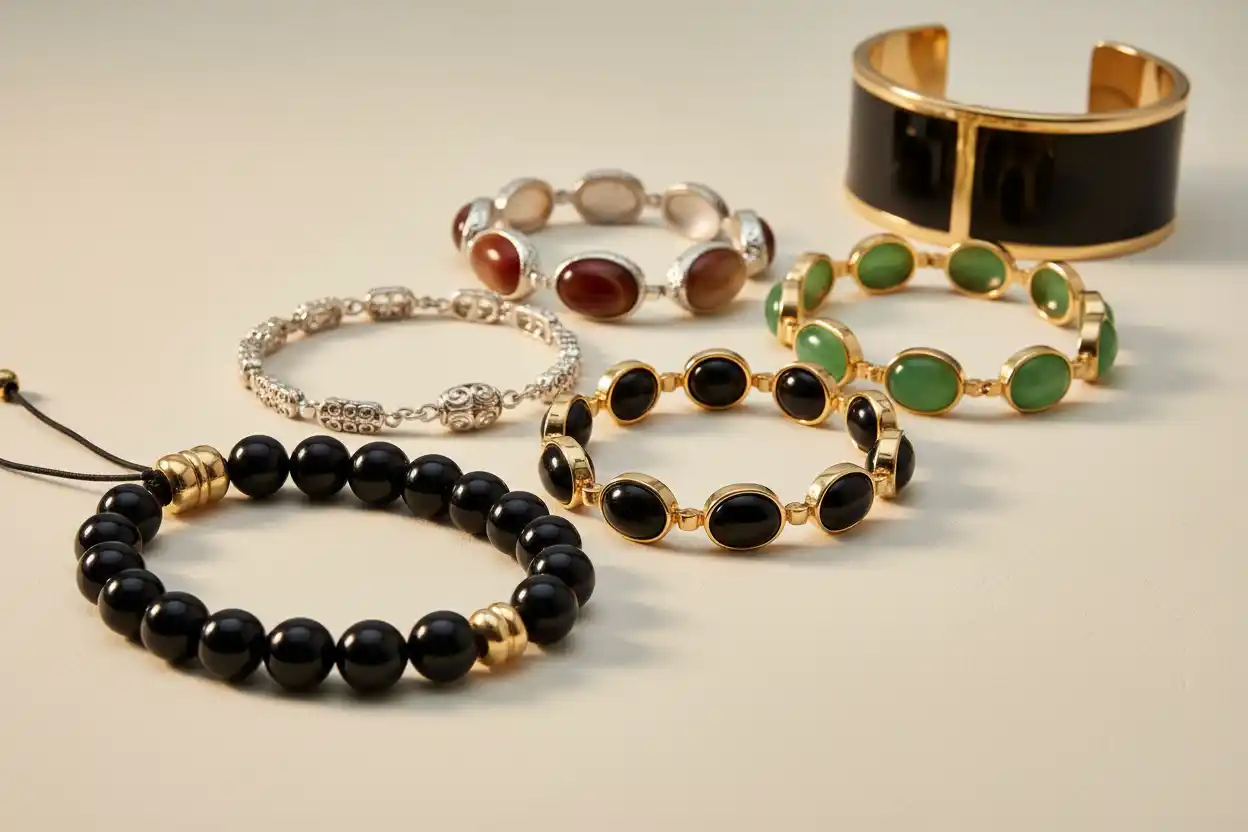
Onyx bracelets are known for smooth polish, strong visual contrast and designs that range from simple black bead strands to carved cuffs, gold-framed links and naturally banded Sardonyx. Their dark neutral appearance allows them to coordinate with both casual clothing and formal metal jewelry.
The name requires careful interpretation. Traditional Onyx is chalcedony with straight, parallel layers, commonly in contrasting light and dark colors. Much of the uniformly black material sold as black Onyx is chalcedony that has been dyed to create an even opaque surface.
Dyed black chalcedony is a durable and established jewelry material when represented accurately. It should not be presented as an exceptionally rare naturally jet-black gemstone merely because the treatment is difficult to see.
The broad Onyx gemstone guide owns geology, history and symbolism. This article focuses on bracelet construction, beads, settings, fit, treatment, buying and long-term wear.
Onyx Bracelets at a Glance
| Feature | What to evaluate |
|---|---|
| Material family | Chalcedony and Agate varieties |
| Common retail appearance | Uniform opaque black |
| Traditional Onyx pattern | Straight, parallel light and dark bands |
| Mohs hardness | Approximately 6.5–7 |
| Cleavage | None |
| Common bracelet styles | Stretch beads, knotted strands, links, stations, cuffs and bangles |
| Main material disclosure | Naturally banded, dyed black, coated or imitation |
| Main bead concern | Drill-hole chips, polish and uniformity |
| Main link concern | Bezels, hinges, articulation and clasp |
| Main fit concern | Excessive rotation or continuous tension |
| Main care concern | Dye, coatings, glue, stringing and surface scratches |
| Safest routine cleaning | Brief washing with mild soap and lukewarm water |
What Is Onyx?
Onyx belongs to the Chalcedony family, whose microscopic Quartz structure gives it good polish and practical jewelry durability.
Traditional Onyx contains straight, parallel layers. Black-and-white banding is familiar, while reddish-brown and white material belongs to Sardonyx.
Uniformly black jewelry material is often dyed chalcedony. Because natural chalcedony readily accepts treatment, producers can create consistent black beads and calibrated cabochons suitable for matching.
The Types of Onyx guide owns the broader distinction among banded Onyx, black trade Onyx, Sardonyx and color-based names.
Is Black Onyx Natural?
The underlying chalcedony is commonly natural, but the black color is frequently produced or strengthened through treatment.
This means a bracelet can contain natural gemstone material whose appearance has been altered.
The description should separate material identity from color origin. “Natural chalcedony, dyed black and sold as black Onyx” is more informative than either “fake Onyx” or “completely untreated natural black stone.”
Naturally dark chalcedony exists, but a perfectly uniform deep-black strand should not be assumed untreated.
Treatment is widely accepted because it produces stable, affordable material. Value should reflect that availability.
Main Onyx Bracelet Styles
| Bracelet style | Main advantage | Main concern |
|---|---|---|
| Stretch bead bracelet | Simple fit and low cost | Elastic deterioration |
| Knotted bead strand | Protects beads and limits loss | Cord moisture and knot wear |
| Clasped bead bracelet | More secure structure | End fittings and clasp |
| Bezel-link bracelet | Protects cabochons and controls orientation | Link articulation |
| Station bracelet | Lightweight and modern | Chain strength and flipping |
| Tennis-style bracelet | Continuous polished line | Matching and many settings |
| Bangle | Structured geometric appearance | Hinge or flexing |
| Cuff | Bold surface for carving or inlay | Correct wrist fit |
| Charm bracelet | Personalization | Charm collision |
| Macramé bracelet | Adjustable casual design | Cord wear and moisture |
| Mixed-gem bracelet | Strong color contrast | Harder neighboring stones |
| Sardonyx bracelet | Natural banded variation | Pattern matching |
Onyx Bead Bracelets
Round black beads are the most familiar bracelet format.
A good strand should show even polish, consistent dimensions and drill holes positioned near the center. Beads that vary slightly can create an intentional handmade appearance, but large accidental differences make the bracelet hang unevenly.
Inspect the surface under reflected light. Scratches, flat spots and cloudy polish become visible as the strand rotates.
Small pits may reflect the original chalcedony structure or poor finishing. They are not necessarily evidence of imitation, although they can collect residue.
The black color should remain consistent around the drill holes. Pale areas inside a chipped opening may indicate dyed material, which is acceptable when disclosed.
Stretch Onyx Bracelets
Elastic bracelets are convenient and easy to size approximately.
The elastic should pass through the beads without visible fraying or excessive stretching. A bracelet that hangs loosely before wear is already approaching replacement.
Roll the strand over the hand instead of pulling it outward into a long line. Repeated overextension weakens the elastic and places pressure on the drill holes.
Large beads create more weight and require stronger cord. Heavy twelve- or fourteen-millimeter strands may benefit from doubled elastic or a clasped construction instead.
The knot should remain protected without being forced into a sharp chipped opening.
Knotted Onyx Bracelets
Knots between beads reduce direct contact and limit loss if the cord breaks.
They are useful for large, valuable, carved or naturally banded beads. The spacing also gives the strand a more flexible drape.
Knots should remain tight and uniform. Gaps indicate stretching, while fuzzy or darkened cord suggests wear.
Silk provides a traditional appearance but absorbs moisture. Synthetic cord may offer greater resistance to perspiration and repeated use.
A knotted bracelet should be restrung when the cord becomes loose rather than waiting for complete failure.
Clasped Bead Bracelets
A clasped strand provides more controlled sizing than elastic.
The end fittings should be attached securely to the cord or wire. A decorative cap cannot compensate for a weak internal connection.
Lobster clasps suit many everyday designs. Box clasps create a cleaner formal appearance, while magnetic closures are easier to operate but can open unexpectedly under pulling force.
A safety chain can reduce loss risk on a valuable strand.
The clasp’s metal should be identified because skin contact occurs at the wrist even when most of the bracelet consists of Onyx.
Onyx Link Bracelets
Link bracelets use cabochons, tablets, carved elements or faceted black stones held in individual metal settings.
A bezel provides smooth perimeter protection and suits opaque Onyx well because light does not need to enter through the sides.
Each link should bend independently. A stiff section makes the bracelet twist and transfers pressure into neighboring joints.
Closed backs may conceal adhesive, foil or a thin slice. The seller should identify whether the element is solid chalcedony, an inlay or an assembled component.
Links must remain separated enough to prevent their metal edges from striking the Onyx during movement.
Station Bracelets
Station designs place small Onyx cabochons or beads at intervals along a chain.
Two-point connections keep flat stones oriented face-up. A single attachment allows more movement and may cause the setting to display its reverse.
The chain should be thick enough for the total station weight. Extremely fine construction can stretch even when the stones remain undamaged.
Adjustable sliders are convenient, but the mechanism should hold without creeping open.
A station bracelet provides a subtle black accent and often layers more safely than a heavy bead strand.
Onyx Cuffs and Bangles
Onyx cuffs may contain one broad cabochon, several inlays or carved geometric panels.
The metal should support the stone across its base. Thin inlay depends on adhesive and should not flex with the cuff.
An adjustable cuff should not be bent repeatedly. Frequent opening and closing weakens the metal and can loosen the Onyx.
Hinged bangles should move through the hinge rather than flex through the stone-set section.
A broad cuff must fit the wrist’s shape. A piece that pinches at the sides or rotates continuously is unlikely to become comfortable through wear.
Sardonyx Bracelets
Sardonyx contains brownish-red, orange, black or dark layers alternating with white chalcedony.
Its natural banding makes every bead or carving somewhat different.
A matched bracelet should coordinate stripe direction, contrast and pattern scale. Exact duplication is unlikely and unnecessary.
Carved Sardonyx has a long history in seals, cameos and intaglios because cutters can use contrasting layers to separate a raised image from its background.
The name should not be applied to uniformly red glass or dyed material without clarification.
Green Onyx Bracelets
Green Onyx is a trade term that can describe green chalcedony or related banded material. Some products sold under the name may instead be dyed chalcedony or green banded calcite.
The actual material should be identified before price or care is assumed.
Chalcedony-based green Onyx provides Quartz-family durability. Calcite-based trade material is considerably softer and requires more careful wear.
A listing that gives only the name green Onyx may not provide enough information for a significant purchase.
Color treatment should be disclosed because intense uniform green is commonly enhanced.
Choosing Bracelet Size
Measure the wrist with a flexible tape where the bracelet will sit.
A fitted bracelet should move slightly without rotating continuously beneath the wrist. Too much looseness increases impact against desks and doorframes.
Large beads occupy internal space, so the bracelet’s laid-flat length can overstate the wearable circumference.
A tight strand stresses elastic, cord, links and clasp connections. It may also pinch skin between beads.
An adjustable design should maintain a smooth tail that does not catch on clothing.
Bead Size and Visual Scale
Small six- or eight-millimeter Onyx beads create a restrained everyday bracelet.
Ten- to twelve-millimeter beads make a stronger visual statement and add noticeable weight. Very large beads can become uncomfortable during typing or desk work.
Wrist size does not impose one correct bead dimension. The design should balance personal style, comfort and intended layering.
Faceted beads reflect more light and appear sharper, while smooth rounds emphasize the stone’s uniform black surface.
Mixed bead sizes can create a deliberate center focus but should not change abruptly without a design reason.
Onyx Hardness and Wear
Onyx and black chalcedony generally rank around 6.5–7 on the Mohs scale.
The Gemstone Hardness Chart places the material below Topaz, Sapphire and Diamond but within a practical range for bracelet use.
Chalcedony has no cleavage and generally offers good toughness. Thin carvings, drill holes and internal fractures can still break after impact.
Harder bracelets may scratch the polish. Avoid direct stacking beside exposed Diamond girdles, Sapphire settings or rough metal edges.
A smooth metal spacer can reduce abrasion between different pieces.
Onyx vs Obsidian Bracelets
Onyx and Obsidian are both commonly black, but they are unrelated.
The direct Onyx vs Obsidian guide owns the full distinction.
Onyx is chalcedony with microcrystalline Quartz structure. Obsidian is amorphous volcanic glass and scratches more easily.
Obsidian can fracture into unusually sharp edges, while chalcedony generally provides stronger bracelet durability.
The three-way Black Tourmaline vs Obsidian vs Onyx comparison separates another commonly confused black material.
Treatment and Dye
The treated Onyx guide owns detailed dye, coating and synthetic-material boundaries.
Black dye may penetrate porous chalcedony deeply and remain stable during ordinary wear. Surface coatings are more vulnerable to scratching and polishing.
Some bracelets combine dyed stone with wax, resin or colorless coating to improve luster.
Treatment should be reflected in price and care instructions. A common dyed bead strand should not receive a premium based on claims of extraordinary natural rarity.
Avoid using household solvents or bleach to test dye because they may damage the stone, stringing and metal.
Authenticity
The Real vs Fake Onyx guide owns the full diagnostic process.
Glass and plastic can imitate black Onyx. Glass may show bubbles or mold features, while plastic feels lighter and scratches more readily.
These clues are not conclusive in every finished bracelet.
Uniform black color does not prove imitation because dyed chalcedony is common. Similarly, visible bands do not prove that a stone is untreated.
Professional identification may use microscopy, refractive index, density and spectroscopy.
Metal and Skin Sensitivity
Onyx itself rarely causes a contact reaction, but the bracelet’s metal can.
Clasps, links, solder, plating and decorative spacers may contain nickel or other irritating alloys.
The guide to gemstones and metals for sensitive skin explains why gold karat, plating and exact alloy matter.
Sterling silver may tarnish, while white gold may require rhodium replating. Stainless-steel descriptions should identify the grade when skin sensitivity is a concern.
A black cord or elastic bracelet can reduce metal contact but still needs secure construction.
Styling Onyx Bracelets
Black Onyx coordinates easily with silver, white gold, yellow gold, rose gold and leather.
A simple bead strand can be worn alone or beside a watch. A bezel-link bracelet creates a more formal appearance, while a cuff provides stronger geometric impact.
An Onyx necklace or pair of Onyx earrings can repeat the black color without requiring an identical matching set.
An Onyx ring should not rub directly against the bracelet during hand movement.
Modern spiritual traditions connect Onyx with grounding and protection. Those beliefs belong to the Onyx healing-properties guide and should not be confused with the bracelet’s physical performance.
Buying Onyx Bracelets
The dedicated guide to Where to Buy Real Onyx covers seller selection and material disclosure.
For online purchases, follow How to Buy Gemstones Online Without Getting Scammed.
Request wearable circumference, bead dimensions, total weight, stringing material, clasp alloy and treatment disclosure.
Close photographs should show drill holes, surface polish, link connections and the complete clasp.
A return period is important because bead weight and bracelet fit are difficult to judge from photographs alone.
The Crystals That Start With O and Gemstones That Start With O directories provide the wider alphabetical context.
Cleaning and Maintenance
Follow How to Clean Onyx Jewelry Safely.
Use lukewarm water, mild soap and a soft cloth or brush. Keep washing brief when the bracelet contains elastic, silk, glue, coating or unknown dye.
Avoid steam, ultrasonic equipment, bleach, acids and abrasive cleaners.
Dry around drill holes, links and clasps.
Store the bracelet flat or loosely curved. Do not hang a heavy bead strand permanently from its clasp.
Replace elastic or cord when it becomes stretched, fuzzy or discolored.
Frequently Asked Questions
1. Is black Onyx naturally black?
Some dark chalcedony occurs naturally, but uniformly black material in jewelry is commonly dyed.
2. Is dyed black Onyx genuine?
The underlying chalcedony can be natural even when its color is treated. The dye should be disclosed.
3. Is Onyx durable enough for bracelets?
Yes. Chalcedony has practical hardness and good toughness, although drill holes and thin carvings can still break.
4. What is the safest Onyx bracelet style?
A well-strung bead bracelet or low bezel-link design provides a useful balance of durability and comfort.
5. How should an Onyx bracelet fit?
It should move slightly without rotating excessively or placing continuous tension on the stringing.
6. Are stretch Onyx bracelets reliable?
They are convenient but need periodic restringing as elastic weakens through age and repeated stretching.
7. What is the difference between Onyx and Sardonyx?
Traditional Onyx commonly has black-and-white parallel bands, while Sardonyx includes reddish-brown or orange layers with white or dark bands.
8. Is green Onyx always chalcedony?
No. The trade name can also be applied to dyed material or banded calcite, so identity should be clarified.
9. Can Onyx be stacked with Diamond bracelets?
Direct contact is not ideal because Diamond and its settings can scratch the Onyx polish.
10. Can Onyx bracelets go in water?
Brief gentle cleaning is usually acceptable, but prolonged soaking can affect elastic, cord, glue, coatings and metal.
11. How often should the bracelet be restrung?
Restring it when elastic loosens, cord frays, knots separate or drill-hole damage becomes visible.
12. How can I tell glass from Onyx?
Weight, bubbles and mold features may provide clues, but professional gemological testing gives a more reliable answer.
An Onyx bracelet succeeds through construction rather than mystery. Chalcedony provides a strong polished surface, but stringing, drill holes, links and treatment disclosure determine whether the bracelet remains secure and accurately represented. A common dyed black strand can be an excellent piece of jewelry when its quality is judged honestly.