Onyx Necklaces and Pendants: Buying Guide
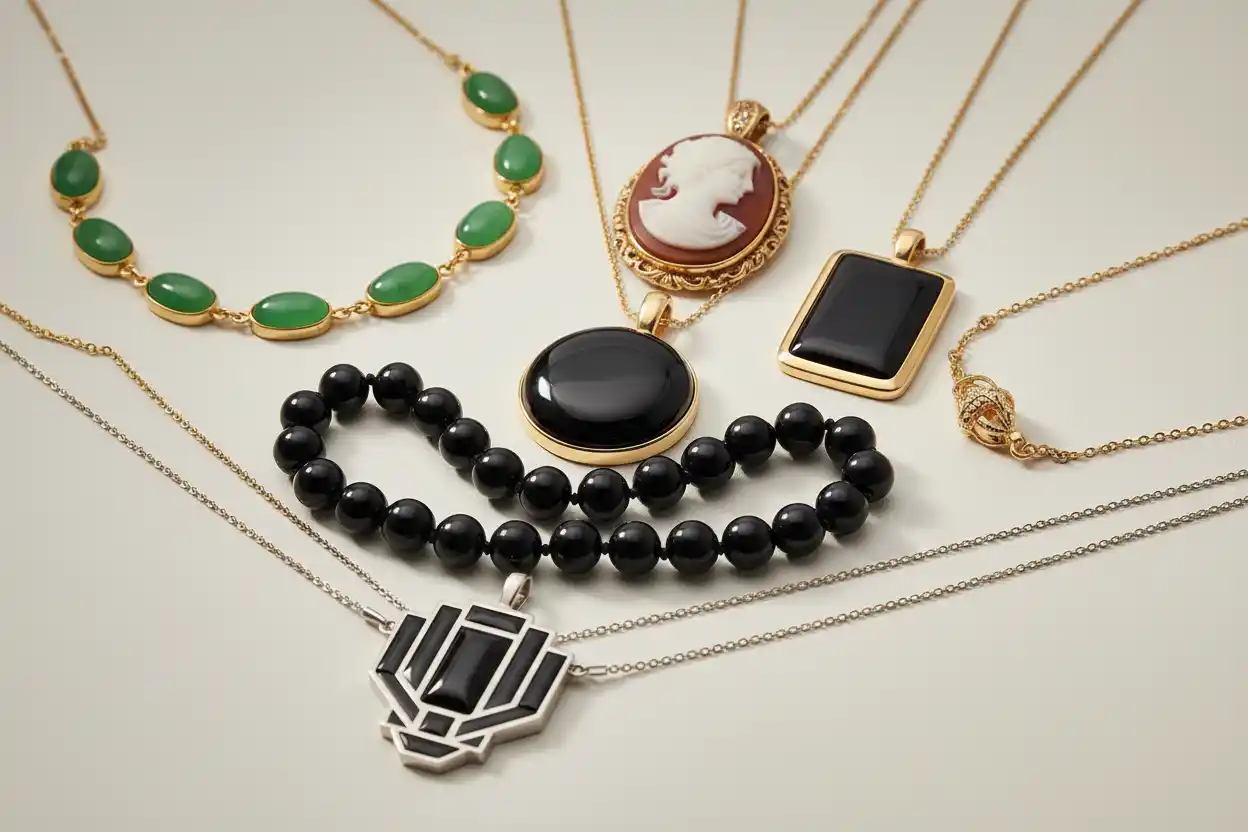
Onyx necklaces use polished black surfaces, parallel bands and carved layers to create styles ranging from minimal cabochon pendants to long bead strands, Art Deco geometry, cameos and engraved talismans. The material’s neutral color allows it to work with nearly every metal and clothing palette.
The name can describe different products. Traditional Onyx is chalcedony with straight, parallel layers. Uniformly black material is usually chalcedony that has been dyed, while products called green or decorative Onyx may occasionally be softer banded calcite rather than Quartz-family stone.
These distinctions affect value and care but do not prevent treated black chalcedony from making excellent jewelry. A well-cut stone with secure metalwork can provide far more practical value than a poorly made pendant marketed with exaggerated claims of rarity.
The broader Onyx gemstone guide owns geology, history and symbolism. This page focuses specifically on necklace formats, pendant settings, beads, chains, bails, buying and maintenance.
Onyx Necklaces at a Glance
| Feature | What to evaluate |
|---|---|
| Material family | Chalcedony |
| Traditional Onyx appearance | Straight, parallel contrasting layers |
| Common retail appearance | Uniform black, generally dyed |
| Mohs hardness | Approximately 6.5–7 |
| Most practical pendant setting | Full or substantial partial bezel |
| Common necklace styles | Solitaires, tablets, cameos, beads, stations and geometric drops |
| Main pendant concern | Bail strength, balance and thin corners |
| Main bead concern | Drill holes, stringing and total weight |
| Main disclosure concern | Dye, coatings, glue and non-chalcedony trade material |
| Main chain concern | Gauge, end fitting, clasp and pendant compatibility |
| Main comfort concern | Weight and necklace length |
| Safest routine cleaning | Mild soap, lukewarm water and a soft cloth |
Why Onyx Works Well in Necklaces
Necklaces protect Onyx more effectively than rings and bracelets because the stone receives fewer direct impacts.
Chalcedony’s hardness of approximately 6.5–7 provides practical scratch resistance, as shown in the Gemstone Hardness Chart.
The material is also opaque or translucent, so it can be mounted in closed-back settings without losing an important transparency effect. This gives designers freedom to use substantial bezels, engraved tablets and broad metal frames.
A long pendant can still strike desks, tables or seat belts. Necklace length and pendant scale should therefore be chosen together.
Main Onyx Necklace Styles
| Necklace style | Main advantage | Main concern |
|---|---|---|
| Solitaire cabochon | Simple and versatile | Bail position and balance |
| Bezel tablet | Strong geometric outline | Thin stone and closed-back construction |
| Prong-set pendant | Shows the full outline | Exposed corners |
| Cameo necklace | Uses natural color layers | Carving condition |
| Intaglio pendant | Historic engraved appearance | Thin recessed sections |
| Bead strand | Continuous polished black surface | Weight and stringing |
| Station necklace | Lightweight modern design | Chain strength and flipping |
| Lariat | Adjustable vertical form | Swinging and slider security |
| Drusy Onyx pendant | Adds crystal texture | Exposed Quartz surface |
| Sardonyx pendant | Natural banded contrast | Pattern orientation |
| Green Onyx necklace | Alternative color | Mineral-name ambiguity |
| Mixed-gem necklace | Strong black contrast | Harder neighboring stones |
Solitaire Onyx Pendants
A solitaire places one cabochon or faceted tablet at the center of the necklace.
Round and oval cabochons offer the strongest edge durability. Pears, shields, rectangles and hexagons create a more architectural appearance but require protection at points and corners.
The pendant should remain face-forward. A poorly positioned bail can cause the stone to rotate toward the chest.
Opaque black material does not need an open gallery for light. Nevertheless, a small opening in the back can help reveal whether the stone is solid, backed or glued.
A moderate pendant often provides better balance than an oversized tablet attached to a very fine chain.
Bezel-Set Onyx Pendants
A bezel is especially well suited to Onyx.
The metal surrounds the girdle, protects the edges and creates a smooth outline that catches less on fabric.
Yellow gold creates strong warm contrast. White metal produces a sharper black-and-silver appearance, while rose gold softens the transition.
The bezel should follow the stone evenly without gaps, ripples or visible adhesive.
A closed back may support a thin slice, but the seller should disclose whether the pendant contains solid chalcedony, an inlay or an assembled component.
Prong-Set Pendants
Prongs expose more of the stone’s outline and create a lighter setting.
The Onyx should rest inside a supportive basket rather than hang only between the prong tips.
Rectangles, pears and pointed geometric forms need special attention. A broad prong may conceal a chipped corner, while a narrow prong may offer insufficient protection.
Opaque stones can hide movement more easily than transparent gems. A loose Onyx may rock inside the setting without obvious light changes.
The piece should be inspected whenever a prong catches clothing or the pendant has been dropped.
Onyx Tablet Pendants
Flat tablets are common in Art Deco, signet-inspired and minimalist necklaces.
The face may be plain, engraved, inlaid or framed with metal and accent stones.
A tablet should retain enough thickness to resist flexing. Large thin rectangles can fracture if the metal frame bends.
The reverse needs complete support without concentrated pressure points.
Laser cutting and modern machining can create precise geometric forms, while hand-finished edges may show slight individual variation. The seller should not imply that every machine-cut tablet is an antique carving.
Cameo Necklaces
Onyx and Sardonyx are traditional cameo materials because their contrasting layers can be carved into a raised image and background.
A cameo pendant may depict a portrait, animal, mythological scene, flower or architectural motif.
Inspect the highest points of the carving, including noses, fingers, hair and narrow leaves. These areas chip most easily.
The frame should support the entire perimeter without pressing into delicate raised sections.
Antique cameos may carry value through craftsmanship, age, subject and provenance. Recutting or heavy polishing can reduce those qualities.
Intaglio Pendants
An intaglio is engraved below the surface.
The design may function as a seal, monogram, family emblem or decorative symbol. Dark Onyx creates strong contrast when recessed lines remain matte.
Thin tablets need a rigid backing and substantial frame.
A vintage intaglio should be inspected for softened details, replacement settings and repaired cracks.
A modern laser engraving can still be attractive but should not be marketed as hand-carved antique work.
The Gemstone Certification guide can help explain when professional identification is useful, although artistic age and authorship may require a specialist beyond a gem laboratory.
Onyx Bead Necklaces
Black Onyx bead strands range from small uniform rounds to large graduated necklaces.
A good strand should show even polish, centered drill holes and a deliberate progression of sizes.
Large beads add substantial weight. The clasp, cord and end fittings must support the complete necklace rather than merely match its appearance.
Knots between valuable beads reduce direct abrasion and limit loss if the cord breaks.
A heavy strand should be stored flat or in a broad curve instead of hanging permanently from its clasp.
Graduated Bead Strands
Graduated necklaces increase bead size toward the center.
The transition should appear smooth. Abrupt jumps make the strand look assembled from unrelated bead groups.
Each bead should maintain similar polish and black intensity. One gray, scratched or poorly drilled center can interrupt the complete design.
Large central beads may pull the necklace downward, so the chosen length should prevent the strand from striking a desk.
A well-balanced graduated necklace rests evenly rather than twisting around the neck.
Station Necklaces
Station necklaces place small Onyx cabochons or beads at intervals along a chain.
Two-point connections help flat settings remain face-up. One-point attachments allow greater movement but may show the reverse frequently.
The chain should be strong enough for the total station weight.
Spacing must prevent neighboring stones from striking one another when the necklace curves.
An adjustable slider can improve versatility, although it should hold securely without moving under the stones’ weight.
The general Crystal Necklaces guide compares station, pendant and bead formats across materials.
Lariats and Long Necklaces
A lariat creates a vertical line through a slider, loop or crossing point.
Onyx suits the style because black pendants and beads remain visually strong against many fabrics.
The slider should hold firmly. A heavy lower drop can cause an adjustable design to lengthen gradually.
Long necklaces create greater swinging motion. The lowest element should not reach a desk during seated work.
Articulated drops must move without allowing Onyx elements to collide.
Drusy Onyx Pendants
Drusy Onyx may retain a surface covered with tiny Quartz crystals.
The sparkling crystal layer creates contrast with the smooth black chalcedony beneath it.
Natural drusy surfaces can be coated or metallized to add color, so treatment should be disclosed.
The crystal surface is more difficult to clean than a polished cabochon and can catch delicate fabric.
A protective frame should support the base without crushing the exposed crystals.
Sardonyx Necklaces
Sardonyx pendants and beads display reddish-brown, orange, white and dark parallel bands.
Pattern orientation determines the design. Horizontal layers create a different visual effect from diagonal or vertical stripes.
A pendant should frame the strongest contrast rather than leaving the most distinctive band hidden beneath the bail.
Matched Sardonyx stations do not need identical patterns, but their color and stripe scale should coordinate.
The material’s own meaning and history remain on the dedicated Sardonyx page rather than being repeated fully here.
Green Onyx Necklaces
Green Onyx may refer to green chalcedony, dyed chalcedony or banded calcite sold under a traditional decorative-stone name.
These materials require different care.
A transparent or translucent green chalcedony pendant offers Quartz-family durability. Calcite-based material is much softer and should be protected from acids and scratches.
The seller should identify the mineral, treatment and whether the color is natural.
A vague green Onyx label is insufficient for an expensive necklace.
Onyx With Diamond or Other Accents
Black Onyx creates strong contrast with Diamond, Moissanite, Sapphire and colorless Zircon.
The harder stones must remain separated from the chalcedony by metal. Direct girdle contact can scratch the Onyx.
Pearl and Mother of Pearl create a softer black-and-white composition but impose more delicate cleaning requirements.
A mixed-gem necklace should follow the care requirements of its most vulnerable component.
Every accent material should be identified on the invoice rather than described only as white stones.
Choosing a Bail
The bail carries the pendant’s full weight and controls its orientation.
Its internal opening must fit both the chain and the chain’s end fitting.
An articulated bail helps a pendant settle naturally, while a fixed bail can keep a geometric tablet aligned.
The connection between bail and frame should contain enough metal to resist bending.
A heavy carving should not hang from a small glued cap or a thin open jump ring.
Choosing a Chain
Chain gauge should match pendant weight.
Cable, box, wheat, curb and rope chains can all work when appropriately sized.
A delicate chain may suit a small bezel cabochon but becomes a security risk with a broad tablet or cameo.
The clasp and jump rings should be proportionate to the chain and pendant.
The guide to gemstones and metals for sensitive skin explains why alloy, plating, nickel and solder matter independently from Onyx.
Necklace Length
Princess length works well for many solitaire pendants because it keeps the Onyx visible on the upper chest while limiting excessive movement.
Chokers sit close to perfume, cosmetics and perspiration.
Matinee and opera lengths create stronger movement and may allow a heavy pendant to strike furniture.
Actual measurement is more useful than a style name because body proportions and pendant size affect placement.
An extender should contain links strong enough for the complete piece.
Treatment and Dye Disclosure
The treated-Onyx guide owns detailed enhancement information.
Uniformly black material is commonly dyed chalcedony. Coatings may add metallic or iridescent effects, while glue and backing appear in tablets, inlays and cameos.
Treatment can remain stable and attractive, but it should be stated accurately.
High heat during repair may affect dye. Abrasive polishing can remove a surface coating.
The necklace should not receive a rarity premium merely because the black color looks unusually even.
Onyx vs Obsidian Necklaces
The Onyx vs Obsidian guide owns full identification.
Onyx is chalcedony and generally offers better scratch resistance. Obsidian is volcanic glass and can chip into very sharp edges.
Both can appear deep black and reflective in pendants.
A thin Obsidian tablet may be more vulnerable than a comparable Onyx tablet.
Material identity should be confirmed rather than inferred from color or product style.
Authenticity and Documentation
The Real vs Fake Onyx guide covers chalcedony, glass, plastic and misleading trade materials.
Uniform black color does not prove imitation because treated chalcedony is common.
A laboratory report is rarely necessary for an ordinary bead strand. Testing may become appropriate for valuable carved antiques, disputed mineral identity or expensive pieces represented as rare untreated material.
The guide to Where to Buy Real Onyx owns seller checks and material disclosure.
Price and Value
Common dyed black chalcedony is affordable.
Necklace price often depends more on metal weight, carving, bead matching, stringing, maker and historical provenance than on raw Onyx value.
A handmade cameo or signed Art Deco jewel can command a substantial price even when the stone itself is not rare.
A large bead strand may cost more because of labor, matching and weight, not because every bead represents exceptional natural black material.
Onyx is also associated with the seventh wedding anniversary. The Anniversary Gemstones by Year guide owns the complete tradition.
Buying Online
Follow How to Buy Gemstones Online Without Getting Scammed.
Request front, side and back photographs, plus video showing how the pendant hangs.
The listing should include dimensions, total weight, chain length, metal alloy, clasp type, treatment and whether the piece is solid, backed, glued or assembled.
For bead necklaces, request the bead diameter, stringing material and wearable length.
A return period is important because pendant weight and necklace position are difficult to judge from photographs.
The Black Gemstones guide provides comparison with other dark jewelry materials, while Black Crystals covers their broader symbolism.
Coordinating Onyx Jewelry
An Onyx bracelet can repeat bead size or metal details.
Onyx earrings coordinate naturally with a cabochon or cameo pendant.
An Onyx ring may serve as the larger focal piece while the necklace remains simple.
A successful set generally shares polish, metal and design language rather than using identical oversized elements.
Cleaning and Maintenance
Follow How to Clean Onyx Jewelry Safely.
Use lukewarm water, mild soap and a soft cloth or brush. Keep washing brief when dye, glue, coating, cord or antique construction is present.
Avoid steam, ultrasonic equipment, bleach, acids and abrasive cleaners.
Store bead strands flat or in a broad curve. Keep chains and clasps from rubbing against polished surfaces.
Stop wearing the necklace if the bail opens, the stone moves, a bead cord stretches or a carved element develops a chip.
Frequently Asked Questions
1. Is an Onyx necklace suitable for everyday wear?
Yes. Chalcedony offers practical hardness and toughness, provided the chain, bail and setting are secure.
2. Is a black Onyx pendant usually dyed?
Uniform black material is commonly dyed chalcedony. The treatment should be disclosed.
3. What setting is safest for Onyx?
A full or substantial partial bezel protects the perimeter and works especially well with opaque stone.
4. Are Onyx bead necklaces heavy?
Large beads can create substantial weight. Request total necklace weight before buying.
5. How should an Onyx pendant hang?
It should remain face-forward without rotating constantly or pulling the clasp toward the front.
6. Are Onyx cameos valuable?
Value depends heavily on carving quality, age, provenance, condition and setting rather than stone weight alone.
7. Is Sardonyx suitable for necklaces?
Yes. Its contrasting layers work especially well in cameos, beads and geometric pendants.
8. Is green Onyx always the same mineral as black Onyx?
No. Green Onyx may refer to chalcedony, dyed stone or softer banded calcite.
9. Can Onyx be worn with Diamonds?
Yes, provided the harder Diamond girdles cannot rub directly against the Onyx.
10. Does an Onyx necklace need certification?
Most commercial pieces do not. Testing may help with valuable carvings, antiques or disputed material claims.
11. Can an Onyx necklace get wet?
Brief gentle washing is normally acceptable, but prolonged soaking can affect dye, glue, stringing and metal.
12. How should a bead necklace be stored?
Lay it flat or in a broad curve so the complete weight does not remain suspended from the clasp and cord.
An Onyx necklace succeeds when the stone, setting and chain are proportionate. Black chalcedony can support bold scale and strong contrast, but a pendant still needs balanced suspension and a bead strand still depends on its cord. Honest treatment disclosure and substantial construction matter more than presenting a common durable material as rare.