Onyx Rings: Styles, Settings and Buying Tips
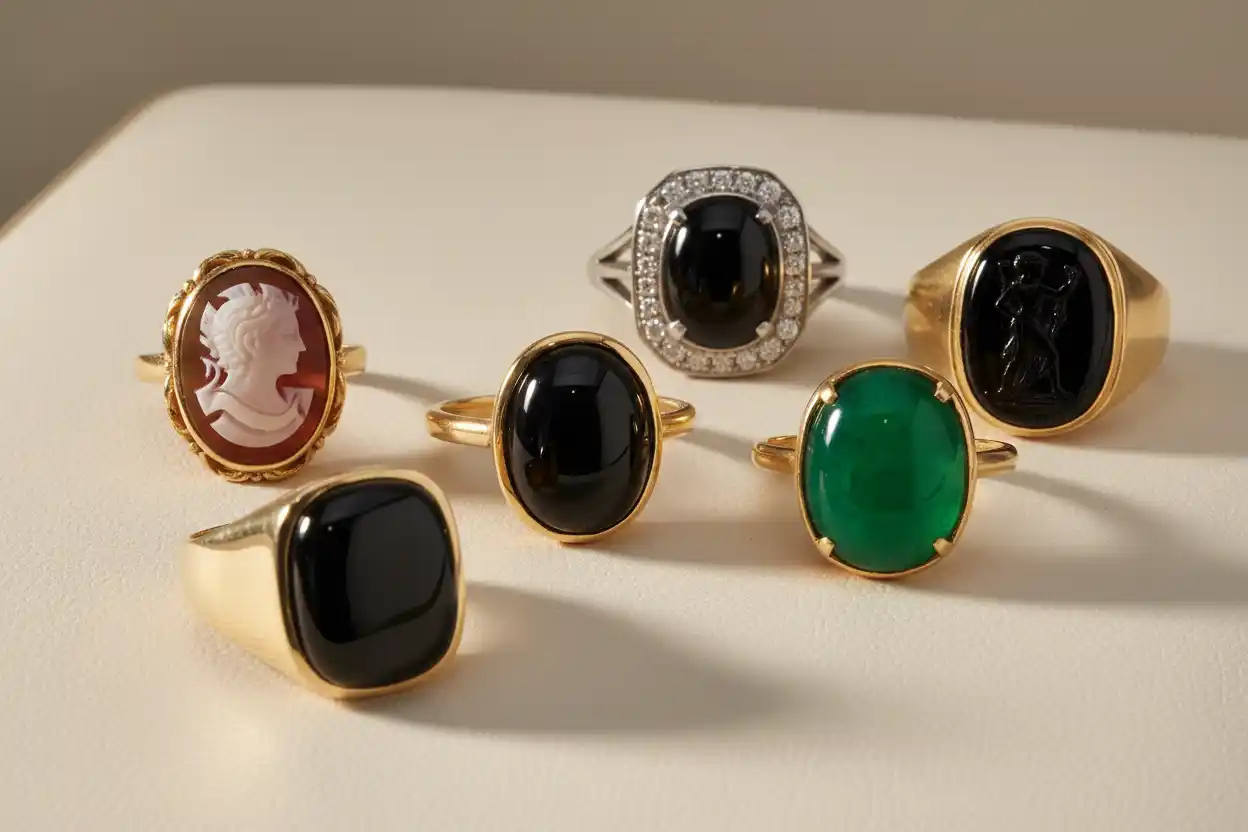
Onyx rings use deep black surfaces, parallel natural bands and carved color layers to create designs ranging from restrained signets to Art Deco halos, engraved intaglios and large cocktail pieces. The material’s opaque appearance allows the setting and metalwork to become part of the design rather than merely supporting a transparent gemstone.
The name Onyx requires careful interpretation. Traditional Onyx is chalcedony with straight, parallel bands. Most uniform jet-black material used in modern jewelry is chalcedony that has been dyed to create a consistent opaque surface.
Dyed black chalcedony can be durable, attractive and entirely suitable for a ring when the treatment is represented accurately. It should not be priced or marketed as an exceptionally rare untreated black gem simply because the finished color is even.
The broad Onyx gemstone guide owns the material’s geology, history, banding and symbolism. This page focuses on ring styles, settings, construction, fit, treatment disclosure, buying and maintenance.
Onyx Rings at a Glance
| Feature | What to evaluate |
|---|---|
| Material family | Chalcedony |
| Traditional Onyx | Straight, parallel contrasting layers |
| Common black jewelry material | Dyed black chalcedony |
| Mohs hardness | Approximately 6.5–7 |
| Toughness | Generally good |
| Most protective setting | Low full or substantial partial bezel |
| Classic ring formats | Signets, cabochons, cameos, intaglios and geometric tablets |
| Main structural concern | Thin tablets, exposed corners and weak shanks |
| Main disclosure concern | Dye, coating, glue and non-chalcedony trade material |
| Main fit concern | Rotation from broad or top-heavy settings |
| Main value factor | Craftsmanship, carving, metalwork and condition |
| Safest routine cleaning | Lukewarm water, mild soap and a soft cloth |
Is Onyx Suitable for Rings?
Onyx and black chalcedony are practical ring materials when mounted securely.
Their hardness of approximately 6.5–7 provides reasonable resistance to ordinary scratching, although Topaz, Sapphire, Diamond and other harder materials can abrade the polish. The Gemstone Hardness Chart provides the broader comparison.
Chalcedony has no cleavage and generally offers good toughness. It can still chip at thin corners, drill holes, carving details and unsupported tablet edges.
The distinction between hardness and resistance to breakage is explained in Gemstone Toughness vs Hardness.
A substantial low-set ring can tolerate frequent wear. A thin carved Onyx plate held in exposed corner prongs should be reserved for more controlled use.
Main Onyx Ring Styles
| Ring style | Main advantage | Main concern |
|---|---|---|
| Signet ring | Broad support and classic black surface | Shank strength and tablet construction |
| Bezel cabochon | Strong perimeter protection | Closed-back disclosure |
| Prong-set cabochon | Shows the complete stone outline | Exposed edges |
| Intaglio ring | Historic engraved design | Carving wear and tablet thickness |
| Cameo ring | Uses contrasting natural layers | Raised-detail damage |
| Halo ring | Strong black-and-white contrast | Hard accent stones and many prongs |
| Cocktail ring | Large visual presence | Height, leverage and rotation |
| Inlay ring | Smooth geometric surface | Adhesive and thin stone |
| Onyx band | Low-profile everyday design | Surface scratching |
| Eternity-style band | Repeating black pattern | Resizing and palm-level wear |
| Sardonyx ring | Natural banded contrast | Pattern placement |
| Green Onyx ring | Alternative translucent color | Uncertain trade identity |
Onyx Signet Rings
The signet is one of the most recognizable Onyx ring styles.
A broad metal face supports an oval, cushion, rectangular or shield-shaped stone. The Onyx may remain plain, carry a monogram or contain an engraved intaglio.
Signet construction should include enough metal beneath and around the stone to prevent flexing. A hollow face or extremely thin shoulders can bend during ordinary wear and loosen the setting.
The Onyx should sit low and remain protected by the surrounding frame. A stone projecting well above the signet face loses much of the style’s durability advantage.
Some signet stones are thin slices glued into a recessed cup. This construction is acceptable when disclosed, but it should not be confused with a deep solid cabochon.
Bezel-Set Onyx Rings
A full bezel surrounds the Onyx with metal.
Because Onyx is opaque, covering its perimeter does not restrict an important side-light effect. The bezel can therefore prioritize protection without sacrificing transparency or brilliance.
The metal should meet the stone evenly. Gaps, folded edges, visible adhesive or movement indicate poor workmanship.
A closed back may support a thin stone but can conceal glue, foil, backing or an assembled tablet. The seller should state whether the visible material is solid chalcedony through its full depth.
A low bezel is one of the strongest choices for a frequently worn Onyx ring.
Prong-Set Onyx Rings
Prong settings reveal more of the stone’s outline and create a lighter appearance.
The Onyx should rest inside a supportive basket rather than balance only between metal tips.
Rounded cabochons tolerate prongs better than rectangles, shields or pointed geometric forms. Corners should receive enough protection that a direct strike reaches metal before stone.
One broad prong may conceal an existing chip. Side and reverse photographs help reveal the actual condition.
Prong-set Onyx works best in moderate sizes and controlled-wear designs.
Onyx Intaglio Rings
An intaglio contains an image engraved below the stone’s surface.
Historically, engraved rings could function as seals by pressing a reversed image into wax or clay. Modern designs may feature monograms, heraldic devices, animals, portraits or decorative symbols.
The recessed carving should remain sharp rather than heavily worn or polished smooth.
An antique intaglio can be worth much more than the underlying Onyx because of age, authorship, subject and provenance.
Machine and laser engraving can also produce attractive modern work. The description should distinguish contemporary production from hand-carved antique craftsmanship when that difference affects price.
Onyx Cameo Rings
A cameo uses a raised image carved from one color layer above a contrasting background.
Traditional Onyx and Sardonyx are especially suitable because their flat layers allow the cutter to assign one color to the portrait and another to the field.
The highest carving points—such as noses, curls, fingers, leaves and decorative borders—are the most vulnerable.
A cameo ring should surround the carving with enough metal to reduce direct contact. Very high settings expose the raised details to repeated impact.
Repolishing can soften the design and reduce historical character, so antique pieces should be serviced conservatively.
Onyx Halo Rings
A halo surrounds black Onyx with Diamond, laboratory-grown Diamond, Moissanite, Sapphire, Zircon or Cubic Zirconia.
The light border produces strong contrast and often creates an Art Deco appearance.
Every accent material should be identified on the invoice. Colorless stones differ substantially in market value and durability even when they look similar in small sizes.
Harder accent girdles must not touch the Onyx directly. Metal should separate the stones so movement or repair cannot cause abrasion.
A halo adds many small prongs, making periodic inspection more important than in a simple bezel.
Onyx Cocktail Rings
Large black cabochons, carvings and tablets work well in statement rings.
The center should be evaluated for weight and height rather than face-up dimensions alone. A broad stone can make the ring rotate, while a high setting creates additional leverage during impact.
A wider lower shank, sizing beads or an ergonomic gallery can improve stability.
Cocktail rings are usually better suited to social occasions than unrestricted everyday wear.
A dramatic size does not make the Onyx itself rare. The value may lie primarily in gold weight, maker, carving or design.
Onyx Inlay Rings
Inlay uses thin Onyx sections fitted into metal channels or recessed areas.
The finished surface can be nearly flush, making the ring smooth and practical. Geometric black inlay is common in modern bands and Art Deco-inspired designs.
Adhesive and metal support carry much of the structural load. The ring should not flex through the inlaid section.
Open gaps, lifting edges or cloudy glue indicate deterioration.
Inlaid rings should not be soaked, steamed or cleaned ultrasonically. Water and vibration may weaken adhesives even when the chalcedony itself remains stable.
Onyx Bands
An Onyx band may use one continuous inlay, several rectangular segments or repeating bezel-set stones.
Low-profile bands reduce snagging and can be practical for regular wear.
A continuous stone strip cannot expand or contract during resizing in the same way as metal. Resizing options may therefore be extremely limited.
Segments around the palm receive more scratches than stones confined to the upper half.
A half-set band usually provides easier maintenance and resizing than a complete eternity-style design.
Sardonyx Rings
Sardonyx combines reddish-brown, orange, white, black or dark chalcedony layers.
The pattern may appear as horizontal stripes, diagonal bands or contrasting carving layers.
A well-cut ring uses the banding deliberately. The strongest stripe should not disappear beneath the bezel or sit awkwardly off-center unless the asymmetry is part of the design.
Natural variation makes every ring different. Perfectly repeated lines across multiple inexpensive rings can suggest printed, laminated or manufactured material.
The dedicated Where to Buy Real Sardonyx guide covers purchase and imitation concerns.
Green Onyx Rings
Green Onyx is an imprecise trade term.
It may describe green chalcedony, dyed chalcedony or banded calcite sold under an Onyx-related decorative name.
Chalcedony provides hardness near 6.5–7. Calcite is much softer and more vulnerable to acids, scratches and everyday ring wear.
The mineral identity should therefore be clarified before the piece is purchased.
A translucent green cabochon can be attractive, but intense uniform color may reflect dye or treatment. Disclosure matters more than whether the treatment is visually pleasing.
Black Onyx Treatment
The Treated Onyx guide owns dye, coating, resin and alteration in detail.
Uniform black chalcedony is commonly dyed or chemically darkened. The process creates predictable color and allows many stones to be matched.
Treated color is generally stable during ordinary wear, but high heat, strong chemicals and repolishing can affect it.
Surface coatings are more vulnerable than penetrating dye and may chip or wear at exposed edges.
A treated ring should receive care instructions that reflect the treatment rather than generic claims that Onyx is indestructible.
Onyx Imitations
Glass and plastic can imitate black Onyx.
Glass may show bubbles, flow structures, mold features or a different response under gemological testing. Plastic is softer and substantially lighter but can be convincing in large opaque pieces.
Banded calcite may be sold as Mexican Onyx, Afghan Onyx or decorative Onyx. It is a legitimate ornamental stone but not chalcedony Onyx.
The Real vs Fake Onyx guide owns the full identification process.
Do not use scratch, flame, acid or hot-needle tests on a finished ring.
Onyx vs Obsidian Rings
The direct Onyx vs Obsidian comparison owns the complete distinction.
Onyx is microcrystalline chalcedony. Obsidian is amorphous volcanic glass.
Onyx generally offers greater scratch resistance and is less likely to create razor-sharp chips after damage. Obsidian can show glassier reflections and different natural flow or sheen features.
Both can appear uniformly black, making unaided visual identification unreliable in some mounted rings.
Material identity should come from evidence rather than protection symbolism or product-name familiarity.
Choosing the Metal
Yellow gold creates a strong warm contrast with black Onyx.
White gold, platinum and silver produce a cooler graphic appearance. Rose gold offers a softer transition.
Metal strength and construction matter more than color alone. A broad Onyx center requires adequate shank thickness and a secure gallery.
The guide to Gemstones and Metals for Sensitive Skin explains nickel, solder, plating and alloy concerns.
The stone itself does not make a ring hypoallergenic.
Shank Width and Ring Balance
A wide Onyx top needs enough lower-shank width to remain stable.
An extremely thin shank may bend, allowing the setting to twist or the stone to loosen.
A tapered design can preserve a lighter appearance near the center while retaining more metal beneath the finger.
Top-heavy rings often rotate when the fit is loose. Sizing beads or an internal stabilizing bar may help.
Wide signets also fit more tightly than thin bands of the same nominal size, so accurate fitting matters.
Sizing and Resizing
Plain metal shanks can often be resized within reasonable limits.
Full inlay, eternity settings, carved shoulders and continuous patterns may restrict alteration.
Heat during resizing should be kept away from dyed, glued, coated or assembled Onyx.
A ring with an antique carving or delicate tablet may require stone removal before repair, increasing cost and risk.
Ask about resizing limits before purchase rather than assuming every ring can be adjusted later.
Buying Onyx Rings Online
Follow How to Buy Gemstones Online Without Getting Scammed.
Request front, side and reverse photographs, plus video showing the ring upright.
The listing should state whether the stone is dyed black chalcedony, naturally banded Onyx, Sardonyx, green chalcedony, calcite or another material.
Confirm dimensions, ring size, shank width, metal alloy, treatment, stone construction, resizing limits and return terms.
The guide to Where to Buy Real Onyx covers seller and authenticity checks.
A laboratory report is rarely necessary for an ordinary commercial ring, but the Gemstone Certification guide explains when valuable carvings or disputed material may justify testing.
Wearing and Coordinating Onyx Rings
An Onyx bracelet, Onyx necklace or pair of Onyx earrings can coordinate through metal and polish rather than identical scale.
Avoid stacking Onyx directly against exposed Diamond or Sapphire settings. The harder stones can scratch the chalcedony.
A smooth metal spacer can reduce contact.
Remove the ring before exercise, gardening, cleaning and mechanical work.
Belief-based protection and grounding traditions belong to the Onyx Healing Properties guide rather than determining physical wear.
Cleaning and Maintenance
Follow How to Clean Onyx Jewelry Safely.
Use lukewarm water, mild soap and a soft cloth or brush. Keep washing brief when the ring contains dye, glue, coatings or antique construction.
Avoid steam, ultrasonic equipment, bleach, acids and abrasive powders.
Store the ring separately from harder gemstones.
A moving stone, lifting inlay, catching prong, bent shank or damaged carving requires professional inspection before further wear.
Frequently Asked Questions
1. Is Onyx durable enough for a ring?
Yes. Chalcedony has practical hardness and good toughness, although thin corners, carvings and inlays still need protection.
2. Is black Onyx naturally black?
Natural dark chalcedony exists, but uniformly jet-black jewelry material is commonly dyed.
3. Is dyed black Onyx genuine?
The underlying chalcedony can be natural even when the color has been treated.
4. What is the safest Onyx ring setting?
A low full or substantial partial bezel provides strong perimeter protection and reduced snagging.
5. Are Onyx signet rings suitable for daily wear?
A substantial low-set signet can be worn frequently, provided the stone and shank remain secure.
6. Can Onyx rings be resized?
Many can, but continuous inlay, eternity designs, carved shoulders and delicate tablets may restrict resizing.
7. Is Sardonyx the same as black Onyx?
Sardonyx is related banded chalcedony containing reddish-brown or orange layers with white or darker bands.
8. Is green Onyx suitable for rings?
Chalcedony-based material can be suitable. Calcite sold under the same trade name is much softer and requires greater care.
9. Can Onyx be set with Diamonds?
Yes, provided metal prevents the harder Diamond girdles from rubbing directly against the Onyx.
10. Is Onyx or Obsidian better for rings?
Onyx generally offers greater scratch resistance and toughness. Obsidian requires more protection from chipping.
11. Does an antique Onyx ring need certification?
Gem testing may identify the material, but evaluating age, maker and carving quality may also require an antique-jewelry specialist.
12. How should an Onyx ring be cleaned?
Use lukewarm water, mild soap and a soft cloth. Avoid harsh chemicals, steam and ultrasonic equipment.
An Onyx ring succeeds when its architecture matches its visual weight. A broad black surface requires substantial support, whether it appears in a signet, cameo, intaglio or geometric cocktail ring. Honest dye disclosure and sound metalwork provide more lasting value than a claim that a common treated material is rare.