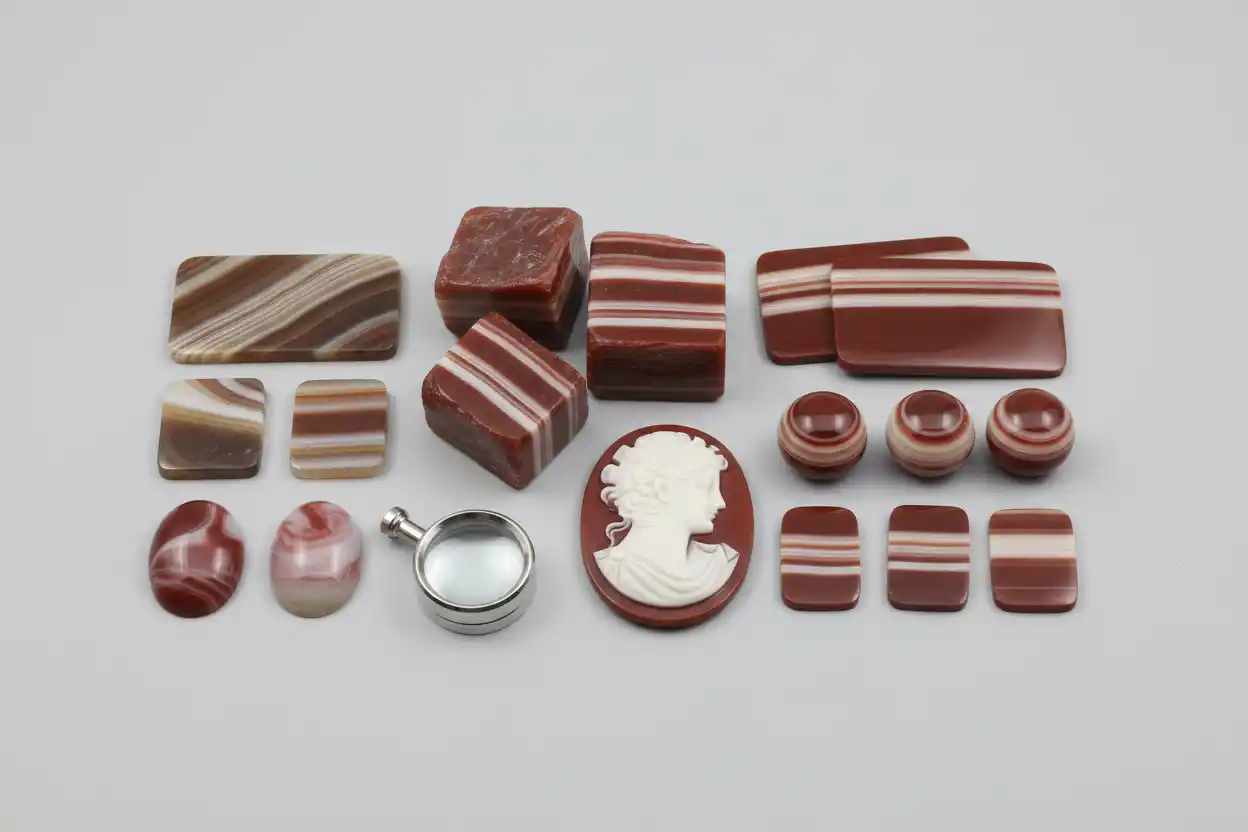
Where to Buy Real Sardonyx and Avoid Dyed or Glass Fakes
Real Sardonyx is layered chalcedony containing sard-like red, reddish-brown, orange-brown or brown bands alternating with white, cream, gray or dark Onyx layers. Its most characteristic patterns are relatively straight and parallel rather than curved like many Agates.
The contrasting layers have made Sardonyx a favored material for cameos, intaglios, seals, beads and signet stones. A carver can remove the upper light layer to expose a darker background or reverse the arrangement for a different visual effect.
However, Sardonyx has been dyed and enhanced for centuries. Dyed banded Agate, assembled slices, molded glass, resin, ceramic and shell cameos can all enter the market under incomplete descriptions.
The Sardonyx meaning and properties guide covers identity and traditional symbolism. This guide focuses on straight banding, seller selection, dye, cameos, lookalikes, construction and value.
Sardonyx Combines Sard and Onyx
Sard is brownish-red to reddish-orange chalcedony. Onyx, in its traditional gemological meaning, is chalcedony with straight, parallel layers.
Sardonyx combines those two appearances in one banded material.
The Chalcedony meaning guide explains the parent substance, while the Onyx meaning guide covers the wider Onyx market.
The types of Onyx guide distinguishes Sardonyx from Black Onyx, traditional black-and-white Onyx and commercial carbonate “onyx.”
Sardonyx is microcrystalline quartz rather than a separate mineral species. Its hardness and basic physical properties are therefore similar to other Chalcedony varieties.
Choose the Product Form Before Shopping
| Sardonyx product | Best source | Main buying concern |
|---|---|---|
| Natural rough | Chalcedony or lapidary supplier | Straight banding, dye and usable layer thickness |
| Slab | Specialist Agate dealer | Band continuity, treatment and fractures |
| Cabochon | Independent cutter | Parallel layers, polish and backing |
| Cameo | Cameo or antique-jewelry specialist | Material, carving method, repair and assembly |
| Intaglio | Gem-engraving specialist | Hand carving, depth and restoration |
| Signet stone | Jeweler familiar with carved gems | Solid stone, orientation and treatment |
| Bead strand | Established bead supplier | Dye, glass, resin and drill-hole damage |
| Tumbled stone | Reputable crystal retailer | Carnelian, generic Agate and artificial stripes |
| Carving | Skilled lapidary seller | Layer use, filler and composite construction |
| Antique jewelry | Accredited antique specialist | Replacement stones, glue and provenance |
The quality criteria for a cameo differ from those for a simple bead. Carving skill can outweigh raw-material rarity.
Where to Buy Genuine Sardonyx
Chalcedony and Agate specialists
A specialist supplier should show dry sawn faces and edges.
The layers should continue through the material rather than exist as surface paint.
Ask whether the stone was dyed before or after cutting. Chalcedony accepts dye readily, and treatment is common across the Onyx and Agate markets.
A seller should describe natural and treated colors separately rather than using “genuine” to imply untreated material.
Cameo and intaglio specialists
A carved Sardonyx piece should be identified by both material and technique.
Ask whether the design was hand-carved, machine-assisted, laser-cut or molded.
Request side and back photographs showing the natural layers and carving depth.
For antique pieces, obtain a condition report covering chipped relief, filled areas, replaced settings and later dye.
Gem and mineral shows
Shows allow comparison with Carnelian, Onyx, banded Agate, shell cameo, glass and resin.
Use a loupe to inspect color concentration, band continuity, carving marks and seams.
Natural chalcedony bands should have subtle irregularities rather than looking mechanically printed.
Do not apply solvents or scratch the stone. Dye testing should remain nondestructive and professional.
Established online sellers
The online gemstone buying guide explains seller identity, protected payment and return terms.
Request exact-item photographs under neutral light.
Dark backgrounds can make pale bands look brighter, while warm light intensifies orange and red-brown colors.
Ask for the full edge of any cameo, slab or cabochon. The edge often reveals whether bands are natural, dyed, painted or assembled.
Independent jewelers
A jeweler should state whether the stone is solid Sardonyx, dyed banded Chalcedony, a doublet or a shell cameo.
Ask to see the loose stone before setting. Closed backs can hide a seam, glue or a plain reverse.
For signet rings, confirm that the band orientation supports engraving depth without exposing weak fractures.
What Genuine Sardonyx Looks Like
Natural or treated Sardonyx commonly combines:
- Reddish brown and white
- Orange-brown and cream
- Brown-red and gray
- Rust and pale beige
- Dark brown and white
- Red-brown, black and cream
- Several transitional brown layers
Bands are generally straight, nearly parallel or gently undulating.
Their width can range from hair-thin lines to broad layers several millimeters thick.
Some stones contain translucent bands beside opaque ones. Thin layers may glow when viewed through transmitted light.
Natural band boundaries can be sharp or slightly diffuse. Perfectly identical stripes across many objects suggest manufactured material.
Sardonyx Versus Onyx
Traditional Onyx is straight-banded Chalcedony, commonly associated with black and white or gray and white layers.
Sardonyx includes sard-like red, orange-brown or reddish-brown bands.
The completed guide to buying real Onyx owns the wider Black Onyx, Calcite Onyx and commercial-name confusion.
The real-versus-fake Onyx guide provides a direct identification workflow.
A stone containing brown-red and white parallel layers fits Sardonyx more precisely than generic Onyx.
Sardonyx Versus Carnelian
Carnelian is orange-to-red Chalcedony that is usually more uniformly colored or gently zoned.
Sardonyx contains visible contrasting parallel layers.
The completed guide to buying genuine Carnelian owns heat, dye and translucent red Chalcedony quality.
A plain red-orange cabochon without contrasting layers should not receive a Sardonyx premium.
Sardonyx Versus Agate
Agate is banded Chalcedony with many pattern styles, including curved fortifications, concentric rings and irregular zones.
Sardonyx is a narrower trade variety distinguished by sard-colored and Onyx-like parallel bands.
Some commercial material is dyed banded Agate selected to resemble Sardonyx. It remains natural Chalcedony with enhanced color when disclosed.
Sardonyx Versus Black Onyx
Most uniform Black Onyx jewelry consists of dyed black Chalcedony.
Sardonyx should show contrasting layers rather than a uniformly black body.
The treated-Onyx guide explains common color enhancement and why heat during jewelry repair may affect dyed material.
A black cabochon with a thin white surface stripe may be assembled or engraved rather than natural Sardonyx.
Sardonyx Versus Banded Calcite Onyx
Green, honey, cream and orange architectural “onyx” is often Calcite or Aragonite rather than Chalcedony.
Carbonate Onyx is softer and acid-sensitive. It may have flowing translucent layers but does not share Sardonyx’s quartz-family durability.
A red-brown and white carving needs composition testing if its bands resemble both materials.
Raman spectroscopy or refractive testing separates Chalcedony from Calcite without damaging the object.
Sardonyx Versus Red Jasper
Red Jasper is usually opaque and more uniformly red, rust or brown.
It can contain white quartz veins, but those veins may be irregular rather than parallel Chalcedony layers.
Sardonyx commonly shows greater translucency along selected bands and finer microcrystalline texture.
Sardonyx Versus Obsidian
Obsidian is volcanic glass rather than Chalcedony.
The Onyx versus Obsidian guide owns the broader comparison.
Obsidian can be black, mahogany or banded, but its conchoidal glass fracture and lower hardness differ from Sardonyx.
A black-and-brown glass carving should not receive the Sardonyx name solely from color.
Sardonyx Cameos
Sardonyx is particularly suited to cameos because its contrasting layers allow a raised pale figure to stand against a darker background.
The finest carving uses the layers cleanly, with intentional transitions around hair, clothing and facial features.
Inspect the profile. Natural layers should continue through the carved relief.
A molded surface may show identical designs, rounded detail and a seam around the edge.
Hand-carved work can show subtle tool marks and individual variation without appearing crude.
Sardonyx Shell Cameos
“Sardonyx shell” is a commercial shell material used for cameos. It is not Sardonyx gemstone.
The shell naturally contains contrasting brown and cream layers that a carver can use much like banded stone.
Shell cameos are legitimate and historically important, but the seller should identify them as shell rather than Chalcedony.
Shell is lighter, softer and shows organic layered structure.
A listing that says only “Sardonyx cameo” should clarify whether it means Sardonyx stone or sardonyx shell.
Dyed Sardonyx
Sardonyx and related Agate are commonly dyed.
Artificial red, brown or black color may enter microscopic pores, band boundaries and fractures.
Well-executed treatment can penetrate deeply and may not be obvious without magnification or spectroscopy.
A dyed stone remains genuine Chalcedony. The buying issue is disclosure and whether the treatment supports an inflated natural-color claim.
The gemstone treatments guide explains dye, heat and chemical processing.
Heat and Chemical Treatment
Heating can strengthen red and orange iron-related colors in Chalcedony.
Traditional processes may also use chemical solutions to darken selected porous layers, creating stronger black-and-white or red-and-white contrast.
These methods exploit natural differences among the bands.
Treatment can be stable, although extreme heat during jewelry repair may alter some dyed colors.
Ask the seller whether the piece can safely undergo resizing, soldering or steam cleaning.
Painted and Printed Bands
Plain Chalcedony, glass, resin or ceramic can receive painted stripes.
Inspect the edge and reverse. Paint may stop abruptly, sit above the polish or bridge small scratches.
Printed patterns may repeat exactly across multiple beads.
Natural bands occupy the material’s depth and should change gradually through a curved cabochon.
The fake-crystal buyer’s guide provides broader checks for surface decoration and molded materials.
Glass and Resin Imitations
Layered or fused glass can imitate Agate and Sardonyx.
Round bubbles, flow lines, mold seams and conchoidal chips support glass.
Resin may contain pigment, mineral powder or printed layers. Casting seams and soft scratches provide additional clues.
Neither glass nor resin shows the microcrystalline quartz structure of genuine Chalcedony.
Doublets and Assembled Stones
A thin Sardonyx layer can be attached to glass, Onyx or another backing.
Two differently colored stones may also be joined to create an artificial carving layer.
Inspect the girdle for straight seams, glue bubbles and abrupt changes in texture.
An assembled cameo can remain decorative and historically interesting when described accurately.
How to Evaluate Rough and Slabs
Request dry photographs of both faces and all edges.
The bands should remain sufficiently parallel and thick for the intended carving or cabochon.
Inspect fractures crossing the layers. A crack can split a cameo during engraving.
Ask whether the rough was dyed and whether the color penetrates the entire thickness.
A large slab with thin, uneven bands may be less useful than a smaller piece with clean separation.
How to Judge Cabochons
A strong cabochon displays balanced contrasting layers with an even polish.
The cutter should orient the layers intentionally rather than leaving one thin stripe at the edge.
Inspect the back for dye, backing and filler.
The girdle should remain sound and free from deep fractures.
For signet stones, the upper layer must be thick enough to accept engraving without breaking through unintentionally.
Buying Beads
Natural strands should show related colors and band directions without perfect repetition.
Inspect drill holes for dye concentrations and a contrasting core.
Uniform black-red-white stripes arranged identically in every bead may indicate fused glass or resin.
Ask whether the strand contains Sardonyx exclusively or mixes Carnelian, Onyx and banded Agate.
Buying Sardonyx Jewelry
Chalcedony Sardonyx has Mohs hardness around 6.5 to 7 and generally good toughness.
The gemstone hardness chart and toughness-versus-hardness guide explain why existing fractures and thin carved layers still matter.
Cabochons, signet rings, pendants, brooches and earrings are practical.
Carved relief should be protected from sharp impacts, while antique settings require gentler cleaning than loose modern stones.
Locality and Provenance
Commercial Sardonyx and related banded Chalcedony have historically come from India, Brazil, Uruguay, Germany, Madagascar, the United States and other regions.
India remains strongly associated with modern Sardonyx production and carving material.
Appearance alone cannot prove country or mine. A provenance premium requires supplier records.
For antique cameos, the carving workshop, period and ownership history may contribute more value than the geological locality.
Price and Value
Common dyed Sardonyx beads and cabochons are affordable.
Value increases with:
- Strong band contrast
- Straight parallel layers
- Useful layer thickness
- Natural or disclosed stable color
- Translucency
- Fine polish
- Carving quality
- Condition
- Size
- Provenance
- Antique importance
- Solid rather than assembled construction
A small masterfully carved cameo may be worth much more than a large uncarved slab.
Likewise, natural color can add interest, but undisclosed treatment should not erase the value of strong workmanship.
The gemstone pricing guide explains how material, labor and provenance interact.
Questions to Ask the Seller
Ask whether the product is Chalcedony Sardonyx, dyed banded Agate, Black Onyx, carbonate Onyx, glass, resin or shell.
Request disclosure of dye, heat, chemical treatment, coating, backing and assembly.
For cameos, ask whether the material is stone or shell and whether the carving is hand-finished, machine-cut or molded.
Request front, back and edge photographs.
For antiques, obtain a condition and restoration report.
Finally, confirm that the return policy allows nondestructive gemological examination.
Professional Identification
Refractive index, specific gravity and microscopy can confirm Chalcedony and separate it from glass, resin, shell and carbonate Onyx.
Raman spectroscopy can distinguish quartz-family Sardonyx from Calcite and other minerals.
Microscopy may reveal dye concentrations, coatings, seams and molded surfaces.
Confirming Chalcedony does not prove natural color. Dye assessment remains a separate part of identification.
Cleaning and Storage
Clean modern sound Sardonyx with lukewarm water, mild soap and a soft cloth.
Avoid harsh solvents and high heat when dye, glue or an antique setting may be present.
Do not use ultrasonic or steam cleaning on assembled cameos, filled stones or fragile carved relief.
Store pieces away from diamonds, sapphires and other harder gemstones.
Frequently Asked Questions
1. What is Sardonyx?
Sardonyx is banded Chalcedony combining reddish-brown sard layers with white, cream, gray or dark Onyx-like bands.
2. Is Sardonyx a separate mineral species?
No. It is a commercial Chalcedony variety within the quartz family.
3. How is Sardonyx different from Onyx?
Onyx describes straight-banded Chalcedony broadly, while Sardonyx specifically includes sard-like red, orange-brown or reddish-brown layers.
4. Is Sardonyx the same as Carnelian?
No. Carnelian is generally more uniformly orange or red and lacks Sardonyx’s contrasting parallel layers.
5. Is Sardonyx commonly dyed?
Yes. Sardonyx and related banded Agate are frequently dyed or chemically darkened.
6. Is dyed Sardonyx fake?
No. It is genuine Chalcedony with treated color when disclosed accurately.
7. What is a Sardonyx cameo?
It is a carving that uses contrasting Sardonyx layers to create a raised design against a different-colored background.
8. Is sardonyx shell the same as the gemstone?
No. Sardonyx shell is organic shell material used for cameos and is not Chalcedony.
9. Can glass imitate Sardonyx?
Yes. Fused and layered glass can reproduce red, brown, white and black bands.
10. Can Sardonyx be assembled?
Yes. Thin slices or contrasting materials can be joined to create doublets or artificial carving layers.
11. Is Sardonyx suitable for everyday rings?
Sound Chalcedony Sardonyx is generally wearable, though carved relief and antique settings require protection.
12. What is the biggest warning sign in a listing?
Be cautious when a seller describes a cameo as natural Sardonyx stone but refuses to show the edge or clarify whether it is shell, glass or an assembled product.
Buy the Layers and the Workmanship Together
Sardonyx should offer real Chalcedony layers that continue through the stone. Its value may then come from natural contrast, deliberate cutting or the skill of the carver.
The black gemstones guide, red gemstones guide, white gemstones guide, S crystal directory and S gemstone directory provide wider comparisons. Choose a seller who identifies both the banded material and the technique used to shape it.
Safety note: Chalcedony contains crystalline silica. Cutting, carving, engraving, drilling or grinding can generate hazardous respirable silica dust. Use professional wet methods, effective extraction and suitable eye and respiratory protection.