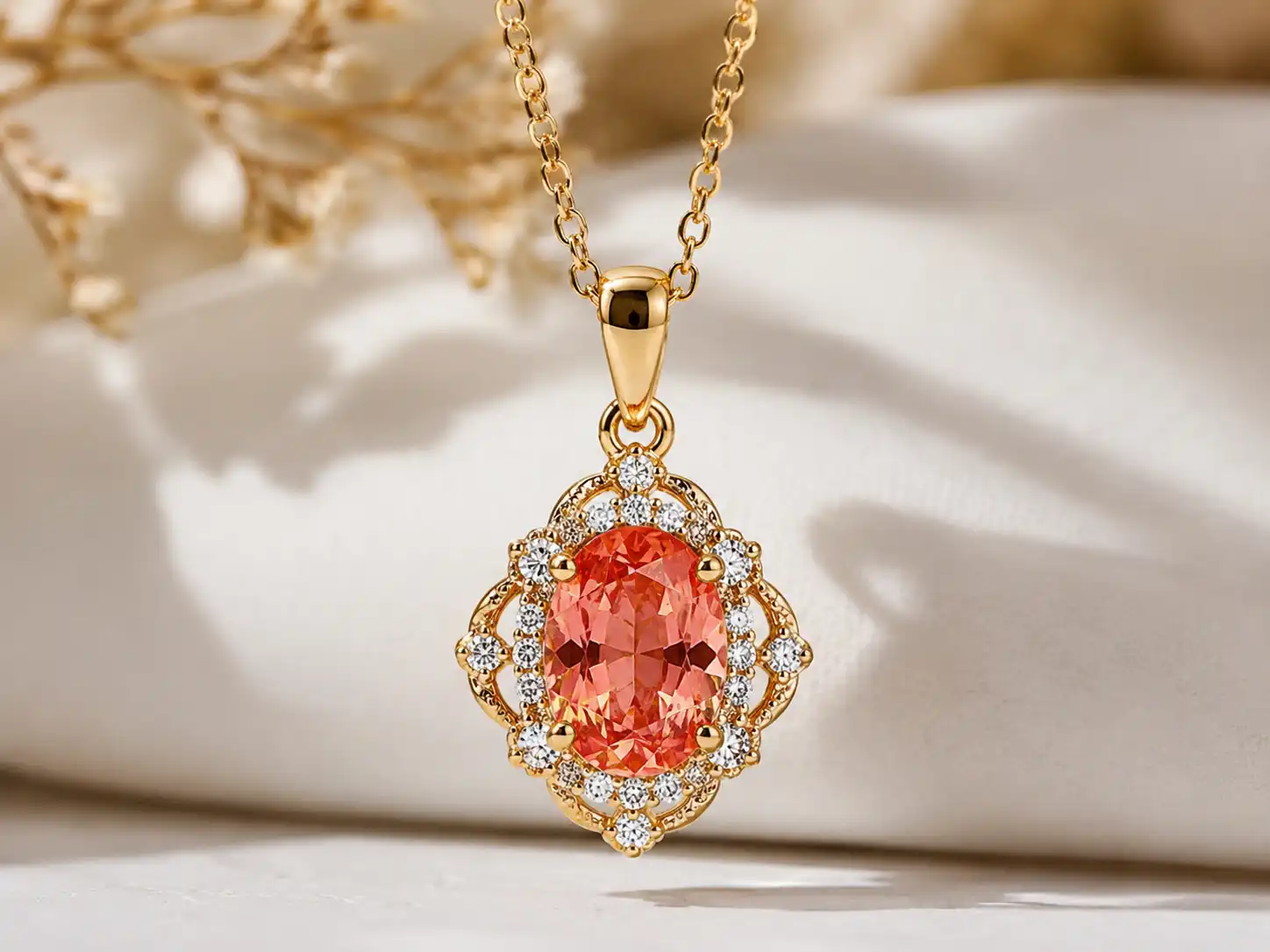
Padparadscha Sapphire Necklaces and Pendants Guide
Padparadscha Sapphire necklaces place a rare pink-orange gemstone in a protected position where color, cut and metal can be appreciated without the repeated impact experienced by rings and bracelets. A pendant also allows a larger stone to become the central focus without requiring an elaborate setting.
The necklace format introduces its own technical demands. Padparadscha can appear pinker or more orange according to illumination, viewing direction and reflected metal color. The pendant must therefore hold the stone in an orientation that presents a balanced face-up appearance.
Bail placement, setting depth and chain strength determine whether the necklace hangs forward or rotates against the chest. With an expensive center, those construction details are as important as the gemstone’s carat weight.
The broader Padparadscha Sapphire guide owns identity, formation and history. This page focuses specifically on necklace styles, pendant settings, chains, buying and maintenance.
Padparadscha Necklaces at a Glance
| Feature | What to evaluate |
|---|---|
| Gem identity | Pink-orange to orange-pink corundum |
| Mohs hardness | 9 |
| Toughness | Excellent |
| Most versatile pendant | Oval or cushion solitaire |
| Most protective setting | Full or substantial partial bezel |
| Main visual concern | Balanced pink-orange color in the hanging position |
| Main cut concern | Windowing, extinction and excess depth |
| Main treatment concern | Heat, diffusion, filling and laboratory growth |
| Main report concern | Color qualification and stability |
| Main pendant concern | Flipping and bail strength |
| Main chain concern | Gauge, clasp and bail compatibility |
| Safest cleaning | Warm soapy water; gentler care for filled or dyed stones |
Why Padparadscha Suits Necklaces
Sapphire’s hardness and toughness make it durable enough for all conventional jewelry formats.
Necklaces reduce mechanical exposure further by keeping the gemstone away from most hand-level impacts. This makes a pendant suitable for a rare unheated center, a delicate fancy cut or a stone whose replacement would be difficult.
The Gemstone Hardness Chart provides comparison with Morganite, Tourmaline, Spinel and Diamond.
A general Sapphire Necklace guide covers broad corundum construction. Padparadscha adds narrower color, stability and documentation concerns.
Long pendants can still strike desks and furniture, so greater durability does not remove the need for sensible length and balance.
Main Necklace Styles
| Necklace style | Main advantage | Main concern |
|---|---|---|
| Solitaire pendant | Gives one rare gemstone complete focus | Color and flipping |
| Bezel pendant | Strong edge protection and smooth outline | More visible metal |
| Prong pendant | Exposes the complete shape | Prong maintenance |
| Halo pendant | Adds brightness and apparent size | Hard accents and many settings |
| Three-stone pendant | Creates a symbolic or color progression | Matching and articulation |
| Station necklace | Uses several small pink-orange gems | Chain strength and orientation |
| Graduated necklace | Builds size and color toward the center | Smooth progression |
| Cluster pendant | Broad display from smaller stones | Shared settings |
| Lariat | Adjustable vertical design | Swinging and slider security |
| Convertible pendant | Can be worn as a brooch or charm | Complex findings |
| Mixed-Sapphire necklace | Creates a planned pink-orange spectrum | Accurate color naming |
| Diamond-accented line | Adds strong brilliance and contrast | Setting maintenance |
Solitaire Pendants
A solitaire provides the clearest presentation of Padparadscha color.
Oval and cushion cuts are especially common because they retain weight and distribute color effectively. Rounds provide symmetrical brilliance, while pears create an elegant vertical drop.
The gemstone should remain recognizably pink-orange in its normal hanging position. A loose gem or flat photograph may look different once the pendant is upright.
The complete loose-stone workflow belongs to the Padparadscha Sapphire Buying Guide.
A well-balanced solitaire should not rotate continuously or pull the clasp toward the front.
Bezel-Set Pendants
A bezel surrounds the Sapphire with metal.
The setting protects the girdle, reduces snagging and creates a clean visual border around the color.
Rose gold can strengthen the pink component. Yellow gold emphasizes orange, while white gold and platinum provide a more neutral comparison with the gemstone’s independent bodycolor.
The bezel should meet the stone evenly without ripples, gaps or visible adhesive.
An open or partially open back allows cleaning beneath the pavilion and confirms that the stone is not hidden behind unnecessary backing.
Prong-Set Pendants
Prongs expose more of the gemstone and create a lighter setting.
Four prongs suit many ovals, cushions and emerald cuts. Six prongs provide additional redundancy around round centers.
The stone should sit inside a supportive basket rather than remain suspended solely between the tips.
Pears require protection at the pointed end. Broad V-prongs or partial bezel coverage provide greater security.
A prong should never press directly over a surface-reaching fracture.
Halo Pendants
A halo surrounds Padparadscha with Diamond, laboratory-grown Diamond, Moissanite, white Sapphire or another colorless gem.
The border increases apparent spread and makes pastel color more visible from a distance.
Every accent material must be disclosed accurately.
Harder Diamond and Moissanite girdles should remain separated from the Sapphire by metal. Although Sapphire is highly scratch-resistant, Diamond can abrade it.
A halo introduces many small prongs and therefore requires more maintenance than a bezel solitaire.
Three-Stone Pendants
Three-stone pendants may use a larger Padparadscha center with pink, yellow or orange Sapphire sides.
The design can create a controlled progression into the mixed color. It can also symbolize a personal timeline or relationship milestone.
The side stones should be described according to their actual color categories rather than all being called Padparadscha.
A vertical arrangement creates length, while a compact horizontal design remains closer to the neckline.
Articulated stones must not strike one another during movement.
Station Necklaces
A station necklace spaces several Padparadscha Sapphires along a chain.
Two-point attachments help each setting remain face-up. A single connection allows free rotation and may display the reverse or edge frequently.
The stones should coordinate in hue direction, tone and saturation. Exact identity is not necessary, but one strongly yellow or pink station can disrupt the sequence.
The chain must be strong enough for the total setting weight.
Enough space should remain between stations to prevent collision as the necklace curves.
Graduated Necklaces
A graduated necklace increases stone size toward the center.
The progression may also strengthen slightly in saturation, although it should remain deliberate rather than accidental.
Millimeter dimensions provide more useful visual information than carat weights because deep Sapphires can retain hidden weight.
The center may receive an individual Padparadscha report while smaller side stones are described more broadly. The invoice should state the documentation scope.
A valuable graduated line requires a secure clasp and, where proportionate, a secondary safety feature.
Padparadscha Color in a Pendant
The exact color boundary belongs to Padparadscha Sapphire Color Meaning and Symbolism.
A necklace should present both pink and orange meaningfully. Strong brown, gray, yellow, purple or red modifiers weaken the characteristic lotus-like appearance.
Lighting changes the balance. Warm bulbs and yellow gold can exaggerate orange, while rose gold can strengthen pink.
View the pendant under daylight-equivalent, warm and ordinary indoor illumination.
The stone should retain its identity without depending entirely on one metal or lighting condition.
Cut Quality
Cutting must distribute the mixed color and return light across the face.
A broad central window can make the stone appear pale and show the wearer’s skin or setting through the gem.
Extinction creates dark inactive areas that remain black through movement.
Deep stones may retain carat weight without providing corresponding visual size.
Ovals and cushions should have balanced outlines, while pears require symmetrical shoulders and protected points.
A side view reveals depth and pavilion proportion more clearly than a front photograph.
Pleochroism and Orientation
Padparadscha can show different pink and orange strengths according to viewing direction.
A cutter should orient the rough so the most balanced color faces outward.
In a pendant, this orientation is especially important because the gemstone normally presents one stable face to the observer.
A stone may look attractive while loose but appear too pink or too orange when fixed vertically.
Continuous video of the finished pendant provides stronger evidence than rotating the loose gem by hand.
Clarity and Inclusions
Natural Sapphire may contain rutile silk, crystals, fingerprints, healed fractures and zoning.
Padparadscha is generally expected to remain transparent enough for its delicate color and brilliance to show clearly.
Small internal inclusions can be acceptable. Surface-reaching fractures near prongs, the girdle or a pointed end require greater concern.
Residue beneath the pavilion can make the stone appear cloudy or pale. Clean the pendant before assuming the haze lies inside the gem.
A report can help distinguish natural, synthetic and treated inclusion features.
Heat Treatment
Heat treatment is common in Sapphire.
It may improve color, clarity or both. Heated natural Padparadscha remains natural corundum but typically costs less than comparable unheated material.
The Treated Sapphire guide owns the complete treatment framework.
A heated pendant can be an excellent purchase when disclosure and price are appropriate.
The description should state treatment rather than using natural to imply untreated color.
Diffusion, Filling and Color Stability
Beryllium diffusion and related processes can create or modify orange and pink-orange color.
Fracture filling makes cracks less visible but imposes stricter cleaning and repair limits.
Some pink-orange Sapphires also contain unstable color centers, causing the orange component to change after exposure to different lighting conditions.
Laboratories may perform stability testing before using the Padparadscha name.
A pendant should be evaluated according to standardized or stable color rather than a temporary showroom state.
Natural and Laboratory-Grown Material
Laboratory-grown Sapphire has the corundum structure and hardness of natural Sapphire but forms through manufacturing.
Precisely colored pink-orange synthetic gems can make attractive necklaces at lower prices.
Their origin must be disclosed. The Lab Sapphire guide explains manufactured corundum.
The Real vs Fake Sapphire guide owns the complete authentication workflow.
A laboratory-grown stone should not carry a natural-rarity premium merely because its color resembles Padparadscha.
Choosing the Bail
The bail carries the pendant’s full weight and controls its orientation.
Its internal opening must accommodate both the chain and the chain’s end fitting. A chain may pass through while its clasp or end cap does not.
An articulated bail helps the pendant settle naturally. A fixed bail can hold a geometric cut in a consistent direction.
The connection between bail and basket must contain enough metal to resist bending.
A large halo or three-stone pendant should not hang from a thin decorative loop.
Choosing the Chain
Chain gauge should correspond with the pendant’s total weight.
Cable, box, wheat, curb and rope chains can all work when properly proportioned.
A very fine chain may suit a small solitaire but becomes a security risk with a large center, halo or multi-stone design.
The clasp and adjacent jump rings should match the chain’s strength.
The Gemstones and Metals for Sensitive Skin guide explains alloy, nickel, solder and plating concerns.
Necklace Length and Comfort
Princess length suits many Padparadscha pendants because it keeps the stone visible on the upper chest while limiting excessive movement.
Longer matinee and opera chains create more swing and may allow the pendant to strike furniture.
A heavy pendant may feel more stable on a shorter or slightly wider chain.
Actual measurements matter more than style names because body proportions and pendant size alter placement.
The piece should rest without rotating continuously or pulling the clasp toward the front.
Reports and Certification
Padparadscha’s prestige depends partly on credible color identification.
The Gemstone Certification guide explains natural or laboratory origin, treatment disclosure and geographic-origin opinions.
A major center should have a respected report when the color name contributes significantly to price.
Verify the report number and compare its dimensions and photograph with the actual stone.
Reports do not provide one universal quality grade or retail value, so visual evaluation remains necessary.
Price and Buying
Current valuation belongs to the Padparadscha Sapphire Price Guide.
Necklace price reflects color qualification, treatment, size, clarity, cut, origin evidence, stability, metal weight, chain quality and accent stones.
A smaller balanced unheated center may be worth more than a larger brownish or diffusion-treated stone.
For remote purchases, follow How to Buy Gemstones Online Without Getting Scammed.
Request video of the exact pendant hanging under several lighting conditions, not only images of the loose gem.
Coordinating Padparadscha Jewelry
A Padparadscha Sapphire bracelet can repeat the necklace’s metal and color direction.
Padparadscha Sapphire earrings coordinate naturally with a solitaire pendant, while a Padparadscha Sapphire ring may carry the strongest central stone.
The pieces need not match exactly. Consistent color family, metal and design language generally produce a more refined set.
The broader Pink Gemstones guide and Orange Gemstones guide place Padparadscha among adjacent color alternatives.
Cleaning and Maintenance
Follow How to Clean Padparadscha Sapphire Jewelry Safely.
Use warm water, mild soap and a soft brush for untreated and conventionally heated Sapphire.
Filled or dyed stones should receive gentler cleaning, commonly with a damp cloth.
Store the necklace flat or in a broad curve. Keep Diamond accents, chain ends and clasps from rubbing against the center.
Stop wearing the piece if the stone moves, the bail opens, a prong catches or the chain begins stretching.
Frequently Asked Questions
1. Is a necklace a safe way to wear Padparadscha Sapphire?
Yes. Necklaces provide a lower-impact position while Sapphire itself offers excellent durability.
2. What is the most versatile pendant style?
An oval or cushion solitaire in a bezel or secure basket works with the widest range of clothing and occasions.
3. Why does my Padparadscha look more orange in yellow gold?
Yellow metal reflects warm color into the gemstone and can strengthen its orange component.
4. Does rose gold improve Padparadscha color?
It can reinforce pink and peach tones, but the gemstone should still show an independent pink-orange identity.
5. What setting is safest?
A full or substantial partial bezel provides strong girdle protection and reduced snagging.
6. Is heat treatment common?
Yes. Heated natural Sapphire is accepted when disclosed and priced appropriately.
7. Can diffusion create Padparadscha-like color?
Yes. Advanced treatment can create or modify orange and pink-orange colors and should be detected and disclosed.
8. Can laboratory-grown Sapphire be used?
Yes. Laboratory-grown pink-orange corundum can make attractive jewelry when its manufactured origin is stated.
9. Does a Padparadscha pendant need a report?
Documentation is advisable when the color designation, natural origin or treatment status materially affects the price.
10. What chain is suitable for a large center?
Choose a chain whose gauge, clasp and jump rings are proportionate to the complete pendant weight.
11. Can the necklace be cleaned ultrasonically?
Sound untreated or heated Sapphire may tolerate it, but hand cleaning is safer when treatment and setting condition are uncertain.
12. What should I do if the pendant flips?
A jeweler should assess the bail position, center of gravity, chain thickness and setting balance.
A successful Padparadscha necklace does not rely on rarity alone. The gemstone must retain its pink-orange balance while hanging upright, the bail must hold that orientation and the chain must carry the complete setting securely. When those details align, the pendant presents the lotus-like color without asking metal or lighting to create it.