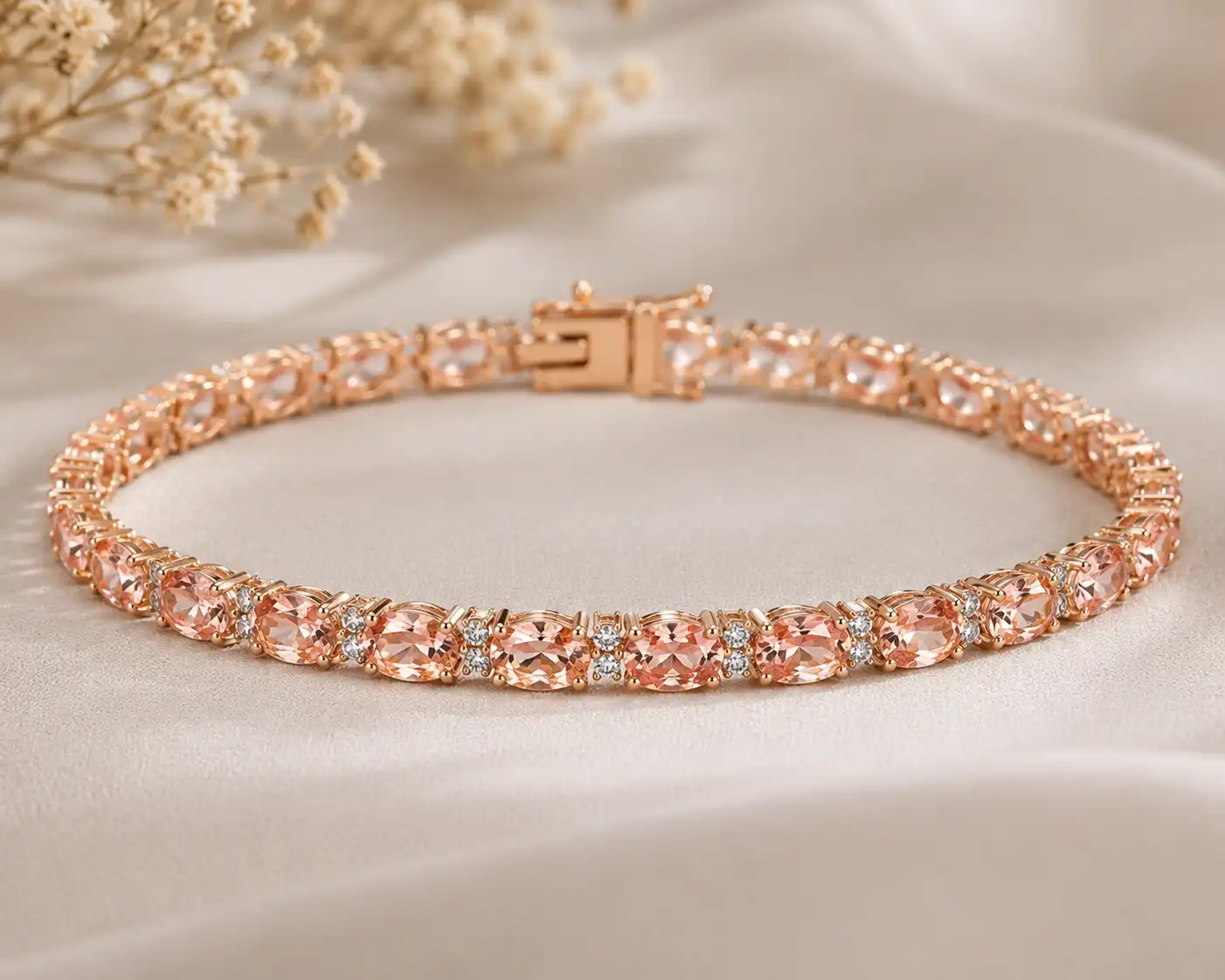
Padparadscha Sapphire Bracelets: Complete Buying Guide
Padparadscha Sapphire bracelets combine one of corundum’s rarest color descriptions with the movement and repetition of wrist jewelry. Their characteristic pink-orange to orange-pink appearance can shift subtly as the bracelet curves around the wrist and passes through daylight, indoor illumination and reflected metal color.
A bracelet creates a harder buying challenge than a solitaire ring. Several stones must coordinate in hue, tone, saturation, cut, dimensions and treatment. One strongly yellow, purple or brown stone can disturb the line even when every gem is technically a natural Sapphire.
The trade name also requires caution. Not every peach or salmon Sapphire qualifies as Padparadscha, and laboratories do not necessarily apply the description to every stone that a seller markets under the name.
The broader Padparadscha Sapphire gemstone guide owns the material’s mineralogy, sources and history. This article focuses on bracelet construction, color matching, reports, treatments, fit and long-term wear.
Padparadscha Sapphire Bracelets at a Glance
| Feature | What to evaluate |
|---|---|
| Gem identity | Pink-orange to orange-pink corundum |
| Mohs hardness | 9 |
| Toughness | Excellent |
| Cleavage | None |
| Main value factor | Qualifying and attractive pink-orange color |
| Main bracelet challenge | Matching multiple rare stones |
| Common formats | Tennis lines, bezel links, stations, bangles and mixed-gem bracelets |
| Main treatment concern | Heat, diffusion, filling, irradiation-related color and laboratory growth |
| Main color concern | Uneven pink-orange balance or unstable color |
| Main clasp concern | Positive closure and safety features |
| Main documentation concern | Whether stones meet laboratory Padparadscha criteria |
| Safest cleaning | Warm soapy water; stricter care for filled or dyed material |
What Makes a Sapphire Padparadscha?
Padparadscha is a rare Sapphire color category positioned between pink and orange.
The color is generally expected to remain within light-to-medium tones rather than becoming extremely dark. Both pink and orange should contribute meaningfully to the face-up appearance.
The dedicated Padparadscha Sapphire Color Meaning and Symbolism page owns the full color discussion.
A bracelet stone should not qualify merely because it is called peach. Strongly yellow-orange, brownish, purplish or uneven stones may fall outside laboratory criteria.
Because definitions have historically been debated, an independent report is especially important when the Padparadscha name creates a substantial price premium.
Why Padparadscha Works in Bracelets
Sapphire ranks 9 on the Gemstone Hardness Chart.
Corundum also has excellent toughness and no cleavage, making it suitable for rings, bracelets and other frequently worn jewelry.
However, a bracelet contains more potential failure points than a solitaire. Hinges, links, prongs, jump rings and clasps can fail even when the Sapphires remain undamaged.
The distinction between hardness and complete-jewelry durability is explained in Gemstone Toughness vs Hardness.
Padparadscha’s rarity adds another practical concern: replacing one matched stone can be difficult.
Main Bracelet Styles
| Bracelet style | Main advantage | Main concern |
|---|---|---|
| Tennis bracelet | Continuous pink-orange line | Matching and numerous settings |
| Bezel-link bracelet | Strong protection and smooth outline | More visible metal |
| Prong-link bracelet | Maximum stone visibility | Exposed girdles |
| Station bracelet | Uses fewer rare stones | Chain strength and station flipping |
| Graduated bracelet | Creates a central color focus | Smooth size and color progression |
| Bangle | Structured and refined appearance | Hinge, fit and stone exposure |
| Cuff | Broad design surface | Wrist fit and metal flexing |
| Charm bracelet | Personal, expandable design | Stone collision |
| Mixed Sapphire bracelet | Blends Padparadscha with pink or yellow Sapphire | Clear intentional color progression |
| Diamond-accented bracelet | Adds brightness and contrast | Harder stones and additional prongs |
| Three-stone station | Concentrates the rare color | Balance and articulation |
| Cluster bracelet | Broad color using small stones | Matching and shared settings |
Padparadscha Tennis Bracelets
A tennis bracelet creates an uninterrupted line of similarly sized gemstones.
For Padparadscha, color matching is more demanding than ordinary calibrated Sapphire. Each stone should coordinate in the balance of pink and orange, not merely look generally peach.
Tone and saturation should remain consistent around the complete wrist. One pale pink Sapphire or vivid orange Sapphire can interrupt the line.
Cut dimensions must match closely so settings articulate evenly. A stone that is deeper than its neighbors may sit too high or require a larger basket.
The clasp should engage positively and include at least one safety feature when the bracelet carries substantial value.
Bezel-Link Bracelets
Individual bezels surround each Sapphire with metal.
This construction protects the girdles, reduces snagging and separates the stones from one another.
Rose gold can strengthen the warm pink appearance, while yellow gold may emphasize orange. White gold or platinum presents the color with less warm reflection and makes yellow or brown modifiers easier to see.
A bezel should follow the stone evenly without gaps or excessive pressure.
Every link must articulate smoothly. A stiff joint can twist the bracelet and transfer force into neighboring settings.
Prong-Link Bracelets
Prong settings expose more of each Sapphire and create a lighter visual profile.
Four-prong baskets are common for oval, cushion and round stones. Shared prongs reduce visible metal but make neighboring gems dependent on the same setting components.
The stones should rest in supportive baskets rather than between prong tips alone.
Prongs must not press against surface-reaching fractures.
A valuable prong bracelet requires periodic inspection because one worn prong can result in the loss of a rare matched gem.
Station Bracelets
A station bracelet spaces several Padparadscha Sapphires along a chain.
This format uses fewer stones and can provide a more accessible entry into the category.
Two-point connections help each setting remain face-up. One-point attachments rotate freely and may display the reverse or edge for much of the day.
The chain must be proportionate to the combined station weight.
Adjustable sliders are convenient but should hold firmly rather than allowing the bracelet to expand gradually.
Graduated Bracelets
A graduated bracelet increases stone size toward the center.
The progression can also deepen slightly in saturation, although the transition should remain intentional and smooth.
A central Padparadscha may receive an individual laboratory report while smaller side stones are described more broadly as pink-orange Sapphire. The invoice should state that distinction.
Matching by carat weight alone is inadequate because deeper stones can weigh more without appearing larger.
Face-up millimeter dimensions provide the most useful visual comparison.
Bangles and Cuffs
A bangle can place one or several Padparadscha Sapphires across a rigid or hinged metal structure.
The hinge should carry movement rather than forcing the stone-set section to flex.
An open cuff should not be bent repeatedly to fit the wrist. Repeated flexing weakens metal and may loosen settings.
A broad bangle can support bezels or flush-set stones effectively.
The bracelet should pass comfortably over the hand or open securely without scraping the Sapphires against hard surfaces.
Matching Padparadscha Color
The line should be judged under neutral daylight-equivalent light, ordinary indoor illumination and warmer evening light.
Some stones appear pinker in one environment and more orange in another. That variation is expected, but the stones should shift together.
The exact balance is discussed in the Sapphire Color Meaning guide at the family level, while Padparadscha retains its narrower boundary.
Rose-gold reflection can make a pale peach Sapphire look pinker than it does loose. Compare the gems before and after setting when possible.
One optimized photograph cannot establish consistency around an entire bracelet.
Tone, Saturation and Modifiers
Padparadscha is usually valued for a delicate balance rather than extreme saturation.
Very pale stones may lose the distinctive mixed color, while dark stones can appear brown, red or overly orange.
Gray, brown, strong purple and strong yellow modifiers generally reduce the characteristic lotus-like appearance.
A line of moderately saturated stones can look more harmonious than one containing a single intensely colored center and several weak sides.
The bracelet should remain recognizably pink-orange without relying on warm showroom lighting.
Cut and Windowing
Round, oval and cushion cuts are common in bracelets.
The cut should distribute both pink and orange across the face. A broad window can make the center look pale and reveal the wearer’s skin or setting too clearly.
Extinction appears as dark areas that do not brighten through movement.
Sapphires are often cut to retain weight, which can produce deep pavilions. In a bracelet, excessive depth creates taller baskets and uneven articulation.
The full loose-stone quality process belongs to the Padparadscha Sapphire Buying Guide.
Clarity
Natural Sapphire can contain rutile silk, crystals, fingerprints, healed fractures and color zoning.
Padparadscha stones are often expected to be transparent enough for their delicate color to remain visible.
Small inclusions may support natural origin without reducing beauty. A surface-reaching fracture near a prong creates a greater durability concern.
A bracelet containing many stones does not require every gem to be flawless. It does require consistency, so one heavily included stone should not disrupt the complete line.
Heat Treatment
Heat treatment is common and accepted in the Sapphire market.
It can improve color, clarity or both. Heated natural Sapphire remains natural corundum but generally commands less than comparable unheated material at the fine end of the market.
The dedicated Treated Sapphire guide owns heat, diffusion, filling, dye and laboratory-grown material.
A bracelet containing heated stones can be excellent jewelry when treatment is disclosed and priced appropriately.
A seller should not imply that every Padparadscha is unheated merely because the color is delicate.
Diffusion and Filling
Lattice diffusion can introduce color-producing elements into Sapphire.
Color penetration may be deep or concentrated near the surface, depending on the process. Shallow treatment can be affected by recutting or significant abrasion.
Fracture filling may improve apparent clarity but creates stricter chemical and cleaning limitations.
Filled, dyed or surface-treated stones should not be valued like untreated or conventionally heated Padparadscha.
Treatment should be identified on the invoice and, where possible, on an independent laboratory report.
Color Stability
Some pink, yellow and orange Sapphires can change apparent color after exposure to ultraviolet-containing light or after being placed in darkness or intense non-UV illumination.
Laboratories may test color stability before assigning a Padparadscha description.
A bracelet whose stones respond differently can become less visually matched after changing environments.
For a high-value line, ask whether the laboratory reports addressed color stability and whether every major stone was tested under comparable conditions.
Ordinary retail observation cannot reliably replace controlled testing.
Natural and Laboratory-Grown Sapphire
Laboratory-grown Sapphire has the corundum structure and hardness of natural Sapphire but forms through manufacturing.
It can be produced in pink, orange and mixed colors.
Laboratory-grown stones may create an attractive, well-matched bracelet at a lower price, but origin must be disclosed.
The Real vs Fake Sapphire guide owns the full natural, synthetic and imitation distinction.
A bracelet containing laboratory-grown stones should not receive a natural-Padparadscha rarity premium.
Reports and Certification
The Gemstone Certification guide explains identification, treatment and geographic-origin reporting.
For a valuable bracelet, it may be impractical to obtain a full report for every tiny stone. The seller should state which stones were individually tested and how the remaining line was represented.
A major central Sapphire should have a report when its Padparadscha designation materially affects value.
Reports should be verified by number, and documented dimensions should correspond with the stone.
A report identifies gemological characteristics; it does not provide one universal retail price.
Sri Lankan, Madagascar and Other Origins
Padparadscha has a strong historical association with Sri Lanka.
Pink-orange Sapphires also occur in Madagascar, Tanzania and other corundum-producing regions.
Modern laboratories may apply the color term without restricting it exclusively to one country, depending on their policy.
Origin can influence collector interest, but color, treatment, clarity and cutting remain essential.
A Ceylon or Sri Lankan claim should be supported when it creates a significant premium.
Diamond Accents
Diamond accents create strong brilliance around Padparadscha’s softer color.
The Diamond girdles should remain separated from the Sapphires by metal. Diamond can scratch corundum during rubbing or repair.
The invoice should distinguish natural Diamond, laboratory-grown Diamond, Moissanite and other colorless accents.
A Diamond halo or border increases the number of prongs and maintenance points.
The accents should enhance the pink-orange line rather than overwhelm it.
Metal Choices
Rose gold reinforces pink and peach tones.
Yellow gold emphasizes orange and creates a warmer overall appearance.
White gold and platinum provide cooler contrast and reveal the Sapphire’s independent color more clearly.
Metal choice should also account for skin sensitivity. The Gemstones and Metals for Sensitive Skin guide explains alloy, nickel and plating concerns.
A bracelet can use mixed metal, such as white prongs with a rose-gold link structure, to balance color and contrast.
Bracelet Fit
Measure the wrist at the intended wearing position.
The bracelet should move comfortably without rotating continuously beneath the wrist. Excessive looseness increases impact, while a tight fit stresses links and the clasp.
Large settings occupy internal space, so laid-flat length may overstate the wearable circumference.
A tennis line should follow the wrist without stiff sections or twisting.
The clasp should remain easy to operate without forcing the stones against the hand.
Wearing and Coordinating
A Padparadscha Sapphire Earrings guide can help coordinate pair color and metal.
A Padparadscha Sapphire necklace can carry a larger individual stone, while a Padparadscha Sapphire ring provides a central focal point.
The bracelet does not need to match every gem exactly. Shared pink-orange direction and consistent metal usually create a more natural set.
The broader Sapphire Bracelet guide owns general corundum-bracelet construction that is not unique to Padparadscha.
Price and Value
The Padparadscha Sapphire Price Guide owns current valuation.
Bracelet price reflects color qualification, treatment, origin evidence, matching, total carat weight, cutting, metal, accent stones, reports and workmanship.
Matching several rare stones can create a premium beyond the value of the same gems sold separately.
A bracelet described as Padparadscha should not receive the premium if its stones are ordinary peach, pink or orange Sapphire without credible support.
Resale value is not guaranteed, particularly after retail margins and auction commissions.
Buying Online
Follow How to Buy Gemstones Online Without Getting Scammed.
Request continuous video of the exact bracelet under neutral, warm and ordinary indoor lighting.
Confirm the number of stones, individual and total weights, dimensions, treatment, natural or laboratory origin, report coverage, metal alloy, clasp, safety features and return terms.
The bracelet should be shown flat, curved and worn so articulation and color consistency can be assessed.
Stock images of a similar bracelet cannot establish the quality of the actual line.
Cleaning and Maintenance
Follow How to Clean Padparadscha Sapphire Jewelry Safely.
Warm soapy water is a safe routine method for untreated and conventionally heated Sapphire.
Filled or dyed stones require stricter care and may need only a damp cloth.
Remove the bracelet before exercise, gardening, heavy cleaning and mechanical work.
Inspect the clasp, safety latches, links and prongs periodically. Stop wearing the bracelet if a stone moves, a hinge stiffens or the closure changes behavior.
Frequently Asked Questions
1. What color should a Padparadscha Sapphire bracelet be?
The stones should show a balanced pink-orange to orange-pink appearance in light-to-medium tones.
2. Does every peach Sapphire qualify as Padparadscha?
No. Peach is a broad commercial color, while Padparadscha follows narrower laboratory criteria.
3. Is Padparadscha Sapphire durable enough for bracelets?
Yes. Sapphire has excellent hardness and toughness, although links, settings and clasps still require care.
4. Why is matching Padparadscha difficult?
Natural stones vary in pink-orange balance, tone, saturation, zoning, treatment and response to lighting.
5. Is heat treatment common?
Yes. Heated natural Sapphire is accepted in the trade when disclosed.
6. Are unheated stones more valuable?
Comparable unheated stones generally command a premium because they are rarer.
7. Can laboratory-grown Padparadscha-colored Sapphire be used?
Yes, provided its manufactured origin is disclosed and it is not sold with a natural-rarity premium.
8. Does every bracelet stone need a laboratory report?
Not always. Major or valuable stones should be tested, while the seller must explain the scope of documentation for smaller gems.
9. Which metal shows Padparadscha color best?
White metal shows the color most independently, while rose and yellow gold strengthen pink or orange reflections.
10. Can Padparadscha be stacked with Diamond bracelets?
It can, but repeated stone or setting contact should be avoided because Diamond can scratch Sapphire.
11. Can the bracelet be cleaned ultrasonically?
Untreated and heat-treated Sapphire may tolerate it, but hand cleaning is safer when treatment and setting condition are uncertain.
12. What should I do if one stone looks different after purchase?
Compare the bracelet under several lighting environments and consult the seller or a laboratory if color stability or misrepresentation is suspected.
A Padparadscha Sapphire bracelet succeeds through consistency rather than repetition alone. Each stone must contribute to the same pink-orange conversation, while the links and clasp must protect a line that may be difficult to replace. The strongest piece combines credible color identification with precise matching and substantial construction.