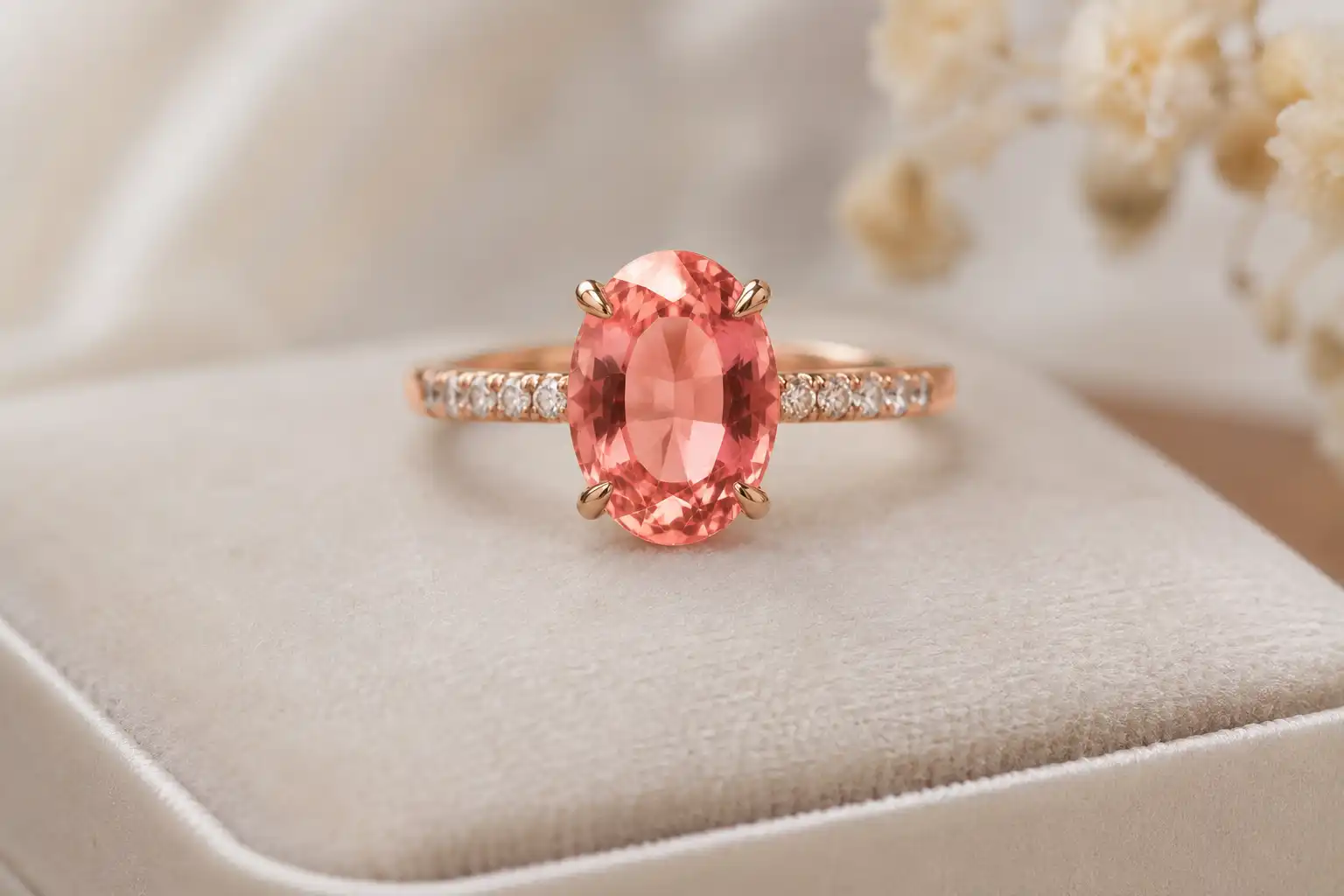
Padparadscha Sapphire Rings: Styles and Buying Tips
Padparadscha Sapphire rings combine corundum’s exceptional jewelry durability with one of the gem trade’s narrowest and most debated color descriptions. The center should show a recognizable balance of pink and orange rather than appearing merely peach, pink, yellow-orange or brownish.
This color can respond noticeably to illumination and metal reflection. Rose gold often strengthens the pink component, yellow gold adds warmth, and white metal presents the bodycolor more independently. A beautiful ring should remain recognizably pink-orange without depending entirely on one setting or showroom lamp.
Padparadscha is suitable for frequent ring wear because Sapphire ranks 9 on the Mohs scale, has excellent toughness and lacks cleavage. Nevertheless, prongs can loosen, exposed corners can chip and harder Diamond accents can abrade corundum if their girdles make direct contact.
The broader Padparadscha Sapphire guide owns the material’s formation, properties, sources and symbolism. This article focuses specifically on ring styles, settings, fit, treatment disclosure and practical buying decisions.
Padparadscha Sapphire Rings at a Glance
| Feature | What to evaluate |
|---|---|
| Gem identity | Pink-orange to orange-pink corundum |
| Mohs hardness | 9 |
| Toughness | Excellent |
| Cleavage | None |
| Main quality factor | Attractive, qualifying pink-orange color |
| Most protective setting | Low full or substantial partial bezel |
| Most familiar cuts | Oval, cushion, round, pear and radiant |
| Main color concern | Strong yellow, brown, gray, purple or red modifiers |
| Main treatment concern | Heat, diffusion, filling and laboratory growth |
| Main report concern | Color designation, treatment and color stability |
| Main ring concern | Setting height, prongs, rotation and band compatibility |
| Safest routine cleaning | Warm soapy water; gentler care for filled or dyed stones |
Is Padparadscha Suitable for Rings?
Padparadscha has the same species-level durability as other Sapphires.
Its hardness provides strong resistance to ordinary scratching, as shown in the Gemstone Hardness Chart. Corundum also has excellent toughness and no directional cleavage.
These properties make Padparadscha more practical for rings than Morganite, Moonstone, Opal or many Tourmalines. However, hardness does not protect the shank, prongs or gallery from bending.
The difference between surface hardness and breakage resistance is explained in Gemstone Toughness vs Hardness.
A low, securely mounted stone can tolerate frequent wear. A high pear or thin emerald cut still requires sensible removal before heavy work.
What Color Should the Ring Show?
Padparadscha should combine pink and orange in a meaningful face-up balance.
A stone may lean slightly toward orangy pink or pinkish orange, but neither component should disappear. Strong yellow, brown, gray, purple or red can move the color outside the preferred category.
The complete boundary belongs to Padparadscha Sapphire Color Meaning and Symbolism.
View the ring in neutral daylight-equivalent illumination, ordinary indoor light and warm evening light. The color may shift, yet it should retain a coherent mixed identity.
A seller’s use of peach, lotus, salmon or sunset is descriptive rather than proof that the gem meets laboratory Padparadscha criteria.
Main Padparadscha Ring Styles
| Ring style | Main advantage | Main concern |
|---|---|---|
| Solitaire | Keeps full attention on color and cut | Setting height and orientation |
| Full bezel | Maximum practical edge protection | More visible metal |
| Partial bezel | Balances visibility and security | Exposed sides |
| Halo | Adds contrast and apparent size | Numerous accents and prongs |
| Three-stone | Creates symbolism and color progression | Side-stone compatibility |
| Cathedral | Raises the center elegantly | Additional height |
| Low basket | Practical for frequent wear | Wedding-band clearance |
| Vintage-inspired | Supports engraving and milgrain | Maintenance of small details |
| East-west setting | Gives an oval or emerald cut a modern profile | Band fit |
| Cluster ring | Uses smaller stones for broader color | Matching and shared prongs |
| Cocktail ring | Allows large dramatic color | Rotation and impact |
| Signet-style ring | Provides low protected construction | Closed-back inspection |
Solitaire Rings
A solitaire offers the clearest view of Padparadscha color.
Oval and cushion cuts dominate because they use natural Sapphire rough efficiently and distribute mixed color well. Rounds provide symmetrical brilliance, while radiant and emerald cuts create a more geometric appearance.
The center should remain lively from the wearer’s normal viewpoint. A stone photographed at one carefully selected angle may reveal a broad window or dark extinction once mounted.
The complete loose-stone assessment belongs to the Padparadscha Sapphire Buying Guide.
A solitaire ring should contain enough metal beneath the center to prevent the basket from twisting after impact.
Bezel-Set Rings
A full bezel surrounds the Sapphire with metal.
This is one of the strongest general settings for active wear because the rim protects the girdle and reduces snagging. A low bezel also minimizes leverage when the ring contacts a hard surface.
The metal should meet the stone evenly without gaps, ripples or excessive coverage. An uneven bezel may place concentrated pressure on the gem or conceal an existing chip.
A partial bezel leaves selected sides visible but provides less protection.
White metal shows the pink-orange bodycolor most independently, while rose and yellow gold intentionally modify its presentation.
Prong-Set Rings
Prongs expose more of the stone and produce a lighter visual outline.
Four-prong settings are common for cushions, ovals and emerald cuts. Six prongs add redundancy around rounds, while pears need protection at the pointed tip.
The Sapphire should rest in a supportive basket rather than remain suspended only between prong tips.
One prong must not press directly over a surface-reaching fracture. Likewise, Diamond accents should remain separated from the center by metal rather than touching its girdle.
Prong rings need periodic inspection because one weakened component can lead to loss even when the Sapphire itself remains undamaged.
Halo Rings
A halo surrounds the Padparadscha center with Diamond, laboratory-grown Diamond, Moissanite, white Sapphire, pink Sapphire or another accent.
White accents increase apparent size and make pastel color more visible from a distance. Pink or orange side stones can create a stronger color gradient.
Every accent material should be identified accurately. Small white gems can look similar while differing substantially in price and optical behavior.
Diamond and Moissanite are harder than Sapphire. Their girdles should not rub directly against the center.
A halo also adds numerous small prongs, making it more maintenance-intensive than a solitaire bezel.
Three-Stone Rings
Three-stone rings can use a Padparadscha center with Diamond sides, matching pink-orange Sapphires or deliberately contrasting fancy colors.
Diamond trapezoids, half-moons and pears provide a bright neutral frame. Pink and yellow Sapphires can create a controlled transition into the center’s mixed color.
The side stones should be described according to their actual identities. Ordinary pink or orange Sapphire should not be called Padparadscha merely because it accompanies a qualifying center.
The three settings need enough separation to prevent girdle contact.
A low, integrated gallery usually performs better than three independently high baskets.
Vintage-Inspired Rings
Padparadscha works naturally with milgrain, engraving, floral halos and geometric Art Deco motifs.
Delicate pink-orange color can soften an architectural platinum or white-gold setting, while rose gold creates a warmer antique-inspired appearance.
Small decorative beads and engraved edges collect residue more readily than a smooth modern bezel.
Vintage-style does not necessarily mean antique. A newly manufactured ring should not be represented as historical merely because it uses old design language.
Genuine period jewelry requires additional evaluation of maker, repairs, replaced stones and metal condition.
East-West and Modern Settings
An east-west setting turns an oval, emerald or marquise cut horizontally across the finger.
The orientation can make a moderate stone appear wider and more contemporary. It may also reduce height compared with a conventional vertical basket.
The design needs sufficient side protection, particularly around the ends of an elongated center.
An east-west setting can complicate wedding-band fit if the gallery extends across the ring’s shoulders.
Side and profile photographs should show the actual clearance rather than only the attractive face-up outline.
Cocktail and Statement Rings
Larger Padparadscha-colored stones create distinctive cocktail rings.
The buyer should separate physical size from qualifying color. A large brownish peach Sapphire may cost less than a smaller balanced Padparadscha despite offering more visible area.
Large centers create leverage and may rotate around the finger. A wider lower shank, sizing beads or an internal stabilizing bar can improve comfort.
Statement rings should remain low enough to avoid constant impact.
A high price should be supported by credible color and treatment documentation rather than size or an elaborate trade description alone.
Padparadscha Engagement Rings
Padparadscha is durable enough for bridal jewelry and offers an alternative to traditional blue Sapphire or Diamond.
The broader Sapphire Engagement Ring guide owns the complete bridal workflow, while Pink Gemstones for Engagement Rings compares pink and peach alternatives.
For a Padparadscha center, prioritize credible laboratory identification, stable color, secure construction and realistic replacement planning.
An exact natural color may be difficult to reproduce if the original stone is lost.
The meaning of the ring comes from the commitment attached to it; the lotus-like color does not guarantee relationship outcomes.
Choosing the Cut
Oval and cushion cuts commonly present the most balanced combination of color, brilliance and rough retention.
Rounds can provide strong sparkle but generally remove more material. Pears create an elongated appearance, while radiants combine brilliant faceting with rectangular or square outlines.
Emerald cuts make color zoning, windows and clarity easier to see.
The cut should distribute pink and orange across the face rather than isolate them into unrelated patches.
Carat weight can hide in a deep pavilion. Compare face-up millimeter dimensions as well as weight.
Windowing and Extinction
A window is a pale or transparent-looking central area through which the wearer’s finger or setting can be seen too clearly.
Extinction consists of dark regions that remain inactive as the ring moves.
Both weaken the presentation of a delicate pastel stone. A stone may retain more carat weight through deep cutting while appearing smaller and darker than a better-proportioned alternative.
Examine the ring through normal hand movement, not only beneath intense display lighting.
The best cut does not need to be perfectly symmetrical if it distributes the rare color attractively, but obvious dead areas should not be ignored.
Clarity
Natural Padparadscha may contain rutile silk, crystals, fingerprints, healed fractures and color zoning.
Small inclusions can support natural origin without reducing beauty. Eye-clean appearance is desirable, particularly because pale color makes internal features easier to see than in dark blue Sapphire.
A surface-reaching fracture near a prong, corner or girdle requires closer attention.
An unusually clean stone is not automatically synthetic, but natural origin and treatment should still be established independently.
Clarity should be judged face-up first, then under magnification for structural risks.
Heat Treatment
Heat treatment is common in the Sapphire market.
It may improve color, clarity or both. Heated natural Padparadscha remains natural corundum, but comparable unheated material generally receives a premium.
The complete treatment boundary belongs to Treated Sapphire.
A heated ring can provide excellent beauty and durability at a more accessible price. The treatment should be disclosed clearly on the invoice and laboratory report.
Terms such as natural Sapphire do not automatically mean unheated.
Diffusion, Filling and Laboratory Growth
Beryllium diffusion and other processes can create or modify pink-orange color.
Depending on the method, color may penetrate deeply or remain concentrated nearer the surface. Recutting can affect shallow treatment.
Fracture filling improves apparent clarity but creates stricter repair and cleaning limits.
Laboratory-grown Sapphire has the same fundamental corundum structure and hardness as natural material but forms through manufacturing.
The Real vs Fake Sapphire guide owns the complete natural, laboratory-grown and imitation distinction.
Color Stability
Certain pink, orange and yellow Sapphires contain color centers that respond to ultraviolet-rich light and other illumination conditions.
The stone may become temporarily more orange or lose part of its orange component under controlled fading.
Laboratories can apply color-stability testing when evaluating the Padparadscha designation.
A ring purchased beneath ultraviolet-rich retail lighting may look somewhat different in an ordinary home environment.
For an important stone, request a report whose conclusions address color stability rather than relying on the seller’s visual description alone.
Choosing the Metal
Rose gold strengthens pink and peach reflections. Yellow gold emphasizes warmth and orange, while platinum and white gold create greater color contrast.
No metal is universally best. The correct choice depends on whether the wearer wants the ring to amplify warmth or show the Sapphire more neutrally.
The stone should still possess an independent pink-orange appearance before setting.
Metal durability and alloy matter as much as color. The guide to Gemstones and Metals for Sensitive Skin explains nickel, plating and direct skin-contact concerns.
Ring Fit and Balance
A broad or high center needs a secure fit.
A loose ring rotates and strikes surfaces more frequently. An overly tight ring causes discomfort and may complicate removal during swelling.
Wide bands fit differently from narrow bands at the same nominal size. Halo and three-stone designs may require extra clearance between fingers.
Sizing beads can stabilize a top-heavy ring without reducing the visible shank width.
The lower shank should contain enough metal to resist bending through ordinary wear.
Wedding-Band Compatibility
A straight wedding band sits flush only when the engagement-ring gallery leaves enough clearance.
Low baskets and broad halos can create a gap. A contoured, notched or open band may fit more closely.
The bands should not force Diamond girdles or rough metal edges against the Padparadscha center.
Try the intended combination before purchase when possible.
A matching metal color is optional; construction compatibility matters more than creating a perfectly identical set.
Reports and Documentation
Padparadscha’s color premium makes independent documentation particularly important.
The Gemstone Certification guide explains natural or laboratory origin, detectable treatment, color description and geographic-origin opinions.
Verify the report number and compare the documented weight and dimensions with the ring’s center.
A report does not provide one universal quality grade or appraisal. The buyer must still assess cut, visible color, durability and price.
For unmounted high-value stones, obtain the report before setting whenever possible.
Price and Buying
Current valuation belongs to the Padparadscha Sapphire Price Guide.
Color qualification, treatment, size, clarity, cut, origin evidence and stability drive gemstone value. Metal weight, accent stones, designer and workmanship determine the finished ring price.
A small balanced unheated Sapphire can be worth more than a larger diffusion-treated or brownish stone.
For remote purchases, follow How to Buy Gemstones Online Without Getting Scammed.
Request continuous video under neutral and ordinary indoor lighting, plus side views showing the entire setting.
Coordinating Padparadscha Jewelry
A Padparadscha Sapphire bracelet can repeat the metal or general color direction.
Padparadscha Sapphire earrings provide a balanced pair, while a Padparadscha Sapphire necklace can present another focal stone.
The general Sapphire Rings guide covers styles that apply across the corundum family.
A coordinated set does not require identical color. Slight variation usually looks more natural than forcing every gem to match one photograph.
Padparadscha also connects naturally with the September Birthstone guide and the broader Orange Gemstones list.
Cleaning and Maintenance
Follow How to Clean Padparadscha Sapphire Jewelry Safely.
Warm water, mild soap and a soft brush suit untreated and conventionally heated Sapphire.
Filled, dyed or uncertain material requires more conservative care.
Remove the ring before heavy cleaning, mechanical work, gardening and activities that can bend the setting.
Store it separately from Diamond jewelry. Although Sapphire is hard, Diamond can scratch it.
Stop wearing the ring if the center moves, a prong catches, the shank bends or an accent stone becomes loose.
Frequently Asked Questions
1. Is Padparadscha Sapphire durable enough for daily rings?
Yes. Sapphire has excellent hardness and toughness, although the setting still requires maintenance and protection from hard impacts.
2. What color should a Padparadscha ring be?
It should display a meaningful balance of pink and orange rather than simply appearing pink, peach, yellow-orange or brown.
3. What setting is safest?
A low full bezel generally provides the strongest practical perimeter protection and reduced snagging.
4. Is Padparadscha suitable for engagement rings?
Yes. It is durable enough for bridal wear when properly set and documented.
5. Is heat treatment common?
Yes. Heated natural Sapphire is widely accepted when disclosed.
6. Are unheated stones more valuable?
Comparable unheated examples usually command a premium because they are rarer.
7. Can laboratory-grown Padparadscha-colored Sapphire be used in rings?
Yes, provided its manufactured origin is disclosed and reflected in the price.
8. Why does the ring look pinker in rose gold?
Rose gold reflects pink and copper tones into the gemstone, modifying its apparent face-up color.
9. Can a peach Sapphire be sold as Padparadscha?
Only when it meets the relevant color and treatment criteria. Peach is a broader commercial description.
10. Does the ring need a laboratory report?
A report is strongly advisable when the Padparadscha designation, treatment status or natural origin materially affects price.
11. Can Padparadscha rings be resized?
Many can, but complex halos, engraving and heat-sensitive treatments may complicate the process.
12. How should the ring be cleaned?
Use warm soapy water and a soft brush for untreated or heated Sapphire. Filled or dyed material requires gentler care.
A Padparadscha ring should be selected for the color it actually displays, not for how effectively a setting or lamp can manufacture warmth around it. Once a credible pink-orange center is paired with strong architecture and realistic maintenance, the ring combines genuine rarity with the durability expected from Sapphire.