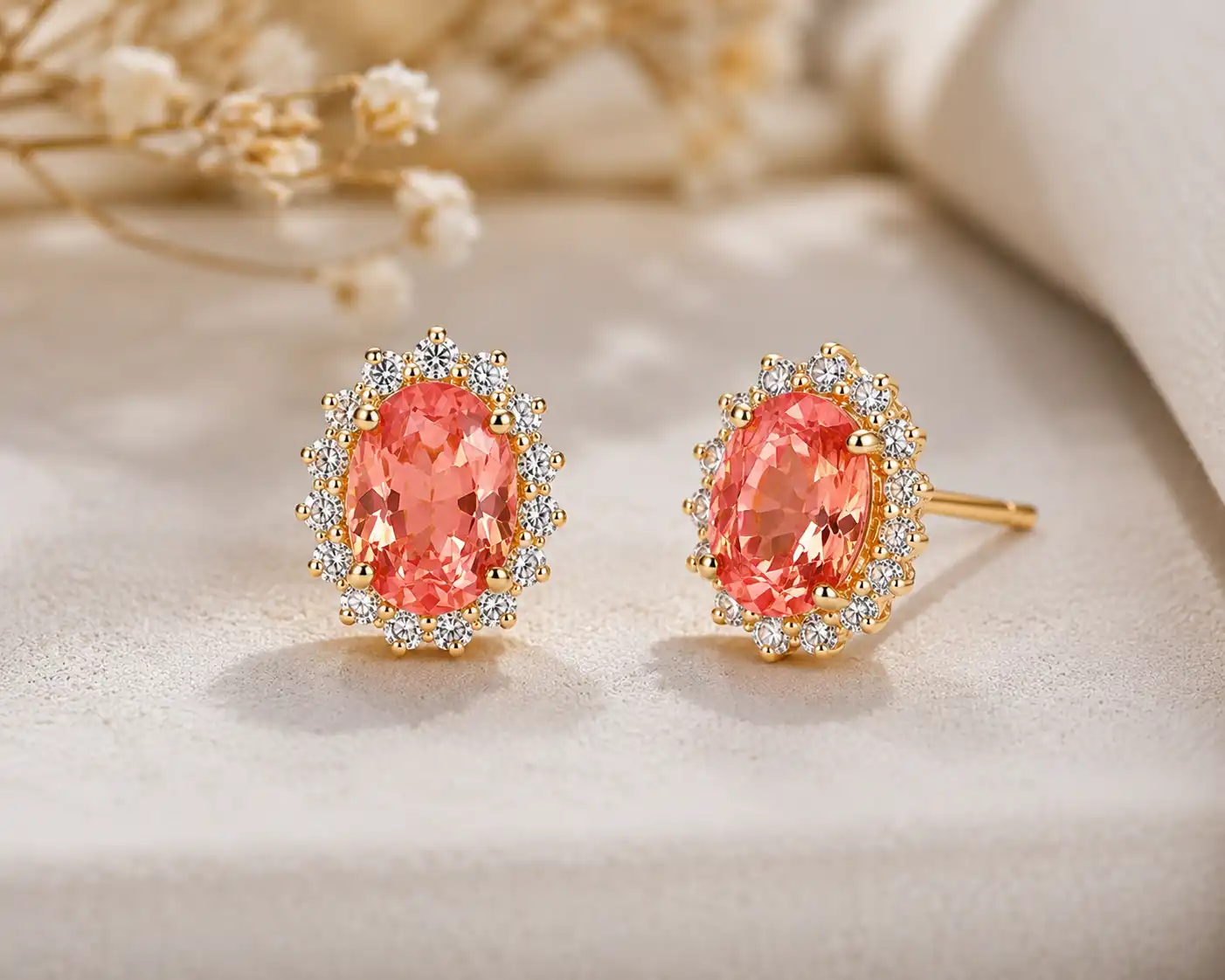
Padparadscha Sapphire Earrings: Complete Style Guide
Padparadscha Sapphire earrings place one of corundum’s rarest color descriptions in a jewelry format that combines visibility with relatively low impact exposure. Their defining pink-orange to orange-pink color can look softly peach in one light, warmer at sunset and slightly pinker beside rose gold.
Earrings are particularly suitable for fine Padparadscha because Sapphire has excellent durability, while the position avoids much of the desk, tool and doorframe contact faced by rings and bracelets. Even so, a successful pair depends on more than hardness. The two stones must coordinate in color balance, tone, saturation, cut, dimensions and directional appearance.
The trade name also deserves scrutiny. Not every peach or salmon Sapphire qualifies as Padparadscha, and a matched pair may carry a substantial premium when both stones meet respected laboratory criteria.
The broader Padparadscha Sapphire guide owns the gem’s identity, formation, sources and historical context. This article focuses specifically on earring styles, pair matching, settings, backs, treatment disclosure and care.
Padparadscha Sapphire Earrings at a Glance
| Feature | What to evaluate |
|---|---|
| Gem identity | Pink-orange to orange-pink corundum |
| Mohs hardness | 9 |
| Toughness | Excellent |
| Cleavage | None |
| Most versatile format | Oval, round or cushion stud |
| Most protective setting | Full or substantial partial bezel |
| Main pair-quality concern | Coordinated pink-orange balance |
| Main cut concern | Windowing, extinction and mismatched dimensions |
| Main treatment concern | Heat, diffusion, filling and laboratory growth |
| Main report concern | Whether both stones qualify as Padparadscha |
| Main comfort concern | Weight per earring and post placement |
| Safest cleaning | Warm soapy water; damp cloth for filled or dyed material |
Why Padparadscha Suits Earrings
Sapphire ranks among the strongest conventional jewelry gemstones.
Its hardness provides excellent scratch resistance, while its lack of cleavage and generally strong toughness reduce the risk of directional splitting. The Gemstone Hardness Chart provides useful comparison with Diamond, Spinel, Tourmaline and Morganite.
Earrings add another layer of protection because they rarely strike hard surfaces during ordinary wear. This allows delicate colors, elongated cuts and valuable matched stones to be worn with less risk than hand-level jewelry.
A broader Sapphire Earrings guide covers general blue and fancy Sapphire styles. Padparadscha adds a narrower color-matching and disclosure challenge that requires its own assessment.
What Color Should the Pair Be?
Padparadscha should show a meaningful blend of pink and orange.
One component may dominate slightly, but neither should disappear. A pair marketed under the name should not consist of one ordinary pink Sapphire and one distinctly orange Sapphire merely because their average appearance seems peach.
The exact color boundary belongs to Padparadscha Sapphire Color Meaning and Symbolism.
View both earrings together under neutral daylight-equivalent light, warm indoor light and ordinary room illumination. Their colors may shift, but they should shift in a coordinated way.
Strong yellow, brown, purple or gray modifiers can weaken the characteristic lotus-like appearance.
Matching Two Rare Stones
Matching Padparadscha is more difficult than matching ordinary calibrated Sapphire.
The pair must coordinate in hue direction, tone and saturation. A pale orangy-pink stone can look noticeably different beside a stronger pinkish-orange partner even when their dimensions match.
Clarity should also appear balanced. One stone should not look transparent and lively while the other appears cloudy or heavily included.
Cutting creates another variable. If one oval has greater depth, a wider window or stronger extinction, the pair may return light differently.
Exact natural duplication is not required. The goal is visual partnership rather than laboratory-level identity.
Main Earring Styles
| Earring style | Main advantage | Main concern |
|---|---|---|
| Solitaire stud | Keeps attention on the rare color | Pair matching and post position |
| Bezel stud | Smooth, protective and practical | More visible metal |
| Prong stud | Exposes more of the gemstone | Prong maintenance |
| Halo stud | Creates contrast and visual spread | Numerous accent settings |
| Three-stone earring | Allows a planned color progression | Matching and combined weight |
| Short drop | Adds movement without excessive length | Connector security |
| Long dangle | Shows color through a wider range of angles | Weight and snagging |
| Leverback earring | Secure closure for valuable stones | Hinge condition |
| Huggie charm | Compact modern style | Charm collision |
| Cluster earring | Broad color using smaller gems | Shared settings |
| Jacket earring | Adjustable day-to-evening design | Component compatibility |
| Asymmetrical pair | Contemporary and individual | Intentional balance |
Solitaire Stud Earrings
Solitaire studs are the most direct presentation of Padparadscha color.
Ovals and cushions are especially common because they use natural corundum rough efficiently. Rounds provide symmetrical brilliance, while emerald and radiant cuts create a more architectural appearance.
The post should sit close to the setting’s center of gravity. If it is attached too high, the stone may tilt downward instead of facing forward.
Broad support backs help larger studs remain upright. Tiny friction backs may technically hold the post but allow the gemstone to lean.
A valuable pair should use secure backs proportionate to the stones rather than the least visible option available.
Bezel-Set Studs
A bezel surrounds each Sapphire with metal.
The setting provides smooth edge protection and reduces snagging on hair or fabric. It also creates a clearly defined metal border around the pink-orange center.
Rose gold can make the stones look pinker and warmer. Yellow gold often emphasizes orange, while white gold or platinum shows the bodycolor with less reflected warmth.
The bezel should follow the stone evenly without ripples, gaps or excessive metal covering one side.
Open or partly open backs allow inspection and cleaning beneath the stones.
Prong-Set Studs
Prong settings expose more of the gemstones and produce a lighter visual outline.
Four prongs are common for ovals, cushions and emerald cuts. Six prongs add redundancy around rounds, although they create more visible metal.
The stones should rest in supportive baskets rather than remain suspended solely between prong tips.
Each prong should be smooth and evenly tightened. A prong that catches hair may already be lifted or worn.
Prongs must not press directly over surface-reaching fractures.
Halo Earrings
A halo surrounds Padparadscha with Diamond, laboratory-grown Diamond, Moissanite, white Sapphire, Zircon or Cubic Zirconia.
The bright border increases apparent size and can make a delicate pastel center easier to see from a distance.
Every accent material should be identified accurately. Similar-looking white stones differ in brilliance, value and maintenance.
Diamond and Moissanite are harder than Sapphire. Metal must separate their girdles from the Padparadscha centers so rubbing cannot cause abrasion.
A halo also introduces numerous small prongs, increasing inspection requirements.
Drop Earrings
Short drops offer movement without creating the weight of a long formal dangle.
Pear, oval and cushion Padparadscha stones work particularly well. A gemstone may reveal slightly different pink and orange proportions as the earring moves through the light.
The connector should hold each stone face-forward instead of allowing uncontrolled rotation.
A drop’s upper section may contain Diamond, pink Sapphire or orange Sapphire, but the color progression should appear deliberate.
Leverbacks and locking posts provide stronger loss protection than open hooks.
Long Dangles
Long dangles can combine several Padparadscha Sapphires or use one larger stone beneath a chain of accents.
The design should be evaluated by weight per earring rather than total carat weight alone. Substantial metal, halos and multiple stones can create uncomfortable leverage.
Articulated sections must move without allowing stones to strike one another.
The lowest element should clear the shoulder during ordinary head movement.
Long earrings should be removed before changing tight clothing, brushing long hair or using headphones that press against the settings.
Three-Stone and Graduated Earrings
A three-stone earring may use equal Padparadscha gems or a deliberate progression from pale pink-orange to stronger color.
The sequence should remain visually consistent between the left and right earring.
A larger lower stone generally creates the most stable composition, but total weight and connector strength must be considered.
Some earrings use Padparadscha as the center between pink and yellow or orange Sapphires. This can be attractive when the seller identifies each color category accurately rather than calling every stone Padparadscha.
Earring Jackets
A jacket sits behind or around a central stud.
The wearer may use a Padparadscha solitaire alone for daytime and add a Diamond or Sapphire jacket for a larger evening appearance.
The post length must accommodate both components without leaving the earring insecure.
The jacket opening should center around the stud and avoid rubbing against the Sapphire’s girdle.
Because components may be sold separately, verify metal color, post gauge and back compatibility before purchase.
Choosing the Cut
Oval and cushion cuts dominate the market because they preserve weight and distribute color effectively.
Round brilliants provide balanced sparkle but may carry a cutting premium because more rough is removed. Pears create elegant drops, while emerald cuts emphasize clarity and broad flashes.
The cut should distribute pink and orange across the face. A broad central window can make a stone appear pale and allow the setting or skin behind it to show too clearly.
Extinction creates dark areas that remain inactive as the earrings move.
A matched pair should have closely coordinated visible dimensions, not merely equal carat weights.
Pleochroism and Orientation
Sapphire can show different color strengths along different crystal directions.
One Padparadscha may appear pinker from one direction and more orange from another. Skilled cutting uses orientation to preserve the most attractive face-up balance.
A mismatched pair can result when the stones are cut along different directions. They may look coordinated in one photograph but shift differently during wear.
Continuous video of both earrings in the upright position helps reveal this issue.
Pleochroism can add life to the pair, but it should not make one earring look categorically different from the other.
Clarity and Inclusions
Natural Padparadscha may contain rutile silk, crystals, fingerprints, healed fractures and color zoning.
Small inclusions can support natural origin and may be acceptable when they do not reduce transparency or threaten durability.
One stone should not be visibly cleaner than the other unless the difference is difficult to notice face-up.
Surface-reaching fractures near prongs deserve greater concern than small internal crystals away from the girdle.
A laboratory report can help separate natural inclusions from synthetic growth features and treatment residues.
Heat Treatment
Heat treatment is common in the Sapphire market.
It may improve color, clarity or both. Heated natural Padparadscha remains natural corundum, but comparable unheated stones generally command a premium.
The Treated Sapphire guide owns the full treatment boundary.
A matched heated pair can make excellent earrings when the treatment is disclosed and reflected in price.
The seller should not imply that a delicate color automatically proves the stones are unheated.
Diffusion, Filling and Dye
Diffusion can create or modify orange, pink and related colors within Sapphire.
Fracture filling makes cracks less visible, while dye may enter cavities or fractures in lower-quality material.
These treatments occupy different value and care categories from conventional heating.
Filled or dyed earrings should be cleaned with a damp cloth rather than aggressive equipment.
A high-value Padparadscha pair should have documentation capable of addressing detectable treatment.
Color Stability
Some pink, yellow and orange Sapphires can change apparent color after exposure to ultraviolet-rich light or controlled illumination.
Consequently, a gemstone may appear more orange under one condition and return toward pink after another.
Laboratories can perform color-stability testing before applying a Padparadscha description.
For a valuable pair, both stones should behave compatibly. Two gems that respond differently could become visibly mismatched outside the original selling environment.
Ask whether the reports address stability rather than relying on one showroom observation.
Natural and Laboratory-Grown Stones
Laboratory-grown Sapphire has the corundum structure and hardness of natural Sapphire but forms through manufacturing.
Pink-orange laboratory-grown stones can make attractive, precisely matched earrings at a lower price.
Their origin must be disclosed clearly. The Lab Sapphire guide explains manufactured corundum in greater detail.
The Real vs Fake Sapphire guide owns natural, synthetic and imitation identification.
Laboratory-grown stones should not receive a natural Padparadscha rarity premium.
Reports and Documentation
Padparadscha’s debated color boundary makes documentation particularly valuable.
The Gemstone Certification guide explains identification, treatment and origin reports.
Ideally, both important stones should be tested. A report for only one earring does not establish that the second stone has the same identity or treatment.
The documented dimensions and weights should correspond with the actual pair.
A report does not provide a universal quality grade or retail valuation, but it can substantiate the attributes that justify a premium.
Metal and Skin Comfort
Rose gold reinforces the pair’s pink and peach aspects. Yellow gold adds warmth, while white metal gives clearer contrast.
The Gemstones and Metals for Sensitive Skin guide explains why posts, backs, solder, plating and alloy matter independently from the stones.
Friction backs suit light studs. Screw or locking backs provide greater security for valuable centers.
Leverbacks work well for drops and dangles because the closure surrounds the piercing.
Weight should remain comfortable enough for the intended wearing duration.
Price and Buying
Current valuation belongs to the Padparadscha Sapphire Price Guide.
Pair price reflects color qualification, matching difficulty, treatment, size, clarity, cut, reports, metal and accent stones.
Two well-matched smaller gems may command a premium over two individually attractive but poorly coordinated stones.
The complete loose-gem workflow belongs to the Padparadscha Sapphire Buying Guide.
For remote purchases, follow How to Buy Gemstones Online Without Getting Scammed.
Coordinating Padparadscha Jewelry
A Padparadscha Sapphire bracelet can repeat the pair’s metal and general pink-orange direction.
A Padparadscha Sapphire necklace may use a larger central gem, while a Padparadscha Sapphire ring creates a stronger focal point.
The pieces do not need identical tone. A coordinated set usually looks more natural when the color family and design language match without forcing exact duplication.
The broader Orange Gemstones guide and Pink Gemstones guide place the color within adjacent gem families.
Cleaning and Storage
Follow How to Clean Padparadscha Sapphire Jewelry Safely.
Warm water, mild soap and a soft brush are suitable for untreated and conventionally heated Sapphire.
Filled, dyed or uncertain stones require more conservative care.
Apply perfume, cosmetics and hairspray before inserting the earrings.
Store each earring separately so its post, back or accent stones cannot scratch the other.
Stop wearing the pair when a stone moves, a prong catches, the post bends or the closure no longer engages securely.
Frequently Asked Questions
1. What color should Padparadscha Sapphire earrings be?
They should show a balanced pink-orange to orange-pink appearance rather than simply pale peach, pink or pure orange.
2. Do the two stones need identical color?
No, but hue balance, tone and saturation should be close enough that the pair looks intentional.
3. What is the safest setting?
A low full or substantial partial bezel provides strong perimeter protection and reduced snagging.
4. Are Padparadscha Sapphires durable enough for daily earrings?
Yes. Sapphire is very durable, although posts, backs, prongs and accent settings still need maintenance.
5. Is heat treatment common?
Yes. Heated natural Sapphire is widely accepted when disclosed.
6. Are unheated earrings more valuable?
Comparable unheated stones generally command a premium because matching two untreated examples is especially difficult.
7. Can laboratory-grown stones be Padparadscha-colored?
Yes. Laboratory-grown pink-orange Sapphire exists and must be identified as manufactured.
8. Does each earring need a laboratory report?
Important high-value stones should ideally be tested individually. The seller should disclose the scope of all documentation.
9. Why do the earrings look different indoors?
Lighting, pleochroism, metal reflection and color stability can change their apparent pink-orange balance.
10. Which metal shows the color best?
White metal shows the color most independently, while rose and yellow gold strengthen pink or orange reflections.
11. Can Padparadscha earrings be cleaned ultrasonically?
Sound untreated or heated Sapphire may tolerate it, but hand cleaning is safer when treatment and setting condition are uncertain.
12. What should I do if one stone becomes loose?
Stop wearing the pair and have the setting inspected before the gem is lost or damaged.
Padparadscha earrings succeed when the stones move through light as a pair. Their exact colors do not need to be duplicated, but their pink-orange balance, brightness and cut must remain coordinated. Secure backs and credible documentation complete a design whose greatest luxury lies in matching rarity with wearability.