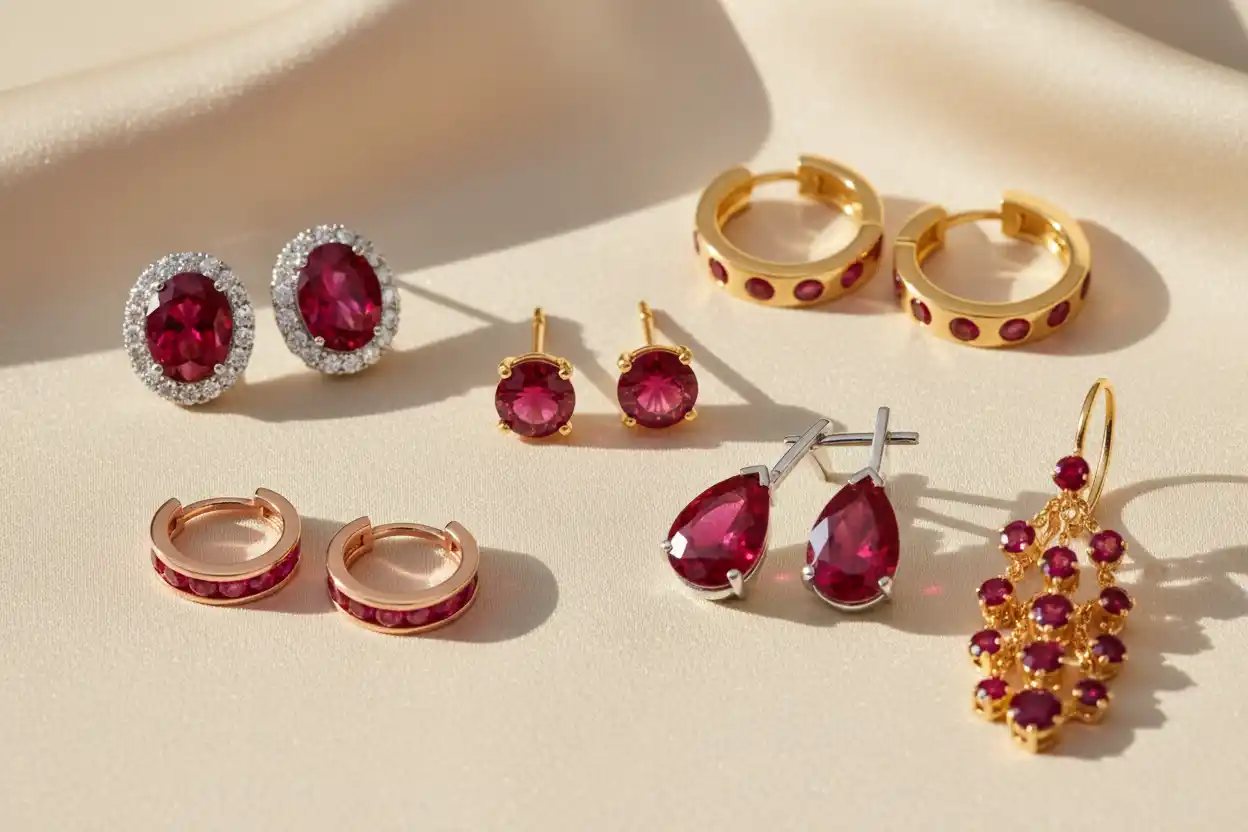
Ruby Earrings: Styles, Quality, Settings and Buying Guide
Ruby earrings combine saturated red color with the durability of corundum. Studs, hoops, drops and chandelier designs can use vivid transparent gems, opaque cabochons, star rubies or laboratory-grown stones, creating options across a wide range of budgets.
Earrings are particularly suitable for ruby because they receive less impact than rings and bracelets. This allows more exposed settings, delicate cuts and substantial stones without subjecting them to continual contact with hard surfaces.
The main quality challenges are matching the pair, preventing dark extinction, selecting comfortable weight and identifying treatment. Two individually attractive rubies do not necessarily form a good pair if their colors, dimensions, cut or transparency differ visibly.
Ruby’s mineral identity, formation and symbolism are explained in the ruby meaning guide. Loose-stone quality belongs in the ruby buying guide, while cost factors remain in the ruby price guide.
Ruby Earring Styles at a Glance
| Style | Appearance | Best use | Main concern |
|---|---|---|---|
| Solitaire studs | One ruby on each ear | Everyday and classic jewelry | Pair matching and secure backs |
| Bezel studs | Smooth metal-framed rubies | Frequent wear and minimal snagging | Closed settings can deepen color |
| Halo studs | Ruby centers with bright accents | Formal and gift jewelry | Small accent prongs need inspection |
| Cluster earrings | Groups of small rubies | Strong red presence at moderate cost | Residue and shared-prong wear |
| Huggies | Compact stone-set hoops | Daily and layered-ear styling | Hinge and latch quality |
| Hoop earrings | Rubies arranged around a curve | Strong movement and color | Weight and exposed settings |
| Drop earrings | One principal stone below the lobe | Showing ovals, pears and cushions | Equal length and comfortable weight |
| Dangle earrings | Multiple articulated components | Evening and occasion wear | Twisting and snagging |
| Chandelier earrings | Wide multi-level design | Formal statement jewelry | Weight distribution |
| Star ruby earrings | Domed cabochons with asterism | Distinctive collector jewelry | Matching two stars |
| Ear climbers | Graduated stones along the lobe | Modern compact styling | Backing pressure and rotation |
| Earring jackets | Decorative back element around a stud | Convertible styling | Front-and-back alignment |
Why Ruby Works Well in Earrings
Ruby ranks 9 on the Mohs scale and has no perfect cleavage.
That combination makes it resistant to surface wear and structural splitting during ordinary earring use.
The ears also keep the stones away from most hard surfaces. Large rubies, delicate drops and star cabochons can therefore be worn more safely than in exposed rings.
Movement benefits red gems. As the wearer turns the head, changing angles can reduce dark areas and produce brighter red flashes.
Earrings also allow a buyer to divide total gemstone weight between two stones, although matched natural pairs can carry a premium because two suitable gems must be found.
Ruby Stud Earrings
Studs provide the simplest and most versatile style.
Round mixed cuts are common because they return light evenly and are easy to match. Ovals and cushions provide greater visible color for their width.
The basket should sit close enough to the ear to avoid drooping but not so tightly that cleaning becomes impossible.
Four prongs expose more of each ruby. Six prongs add redundancy and create a traditional outline.
Large studs need broad backs or supportive discs to prevent the stones from tilting forward.
The pair should sit at the same angle on the ears. Uneven posts or baskets can make one earring appear lower even when the rubies match.
Bezel-Set Ruby Studs
A bezel surrounds the ruby’s edge with metal.
This setting reduces snagging, protects girdles and works well beneath scarves, helmets and over-ear headphones.
A full bezel can darken a deep ruby. Open-backed construction and a thin rim help preserve brightness.
Partial bezels show more stone while protecting selected sides.
The metal edge should be even and smooth. Gaps or visible movement indicate poor setting work.
Bezel studs are especially practical for children, active wearers and people who prefer low-profile jewelry.
Ruby Halo Earrings
A halo surrounds each ruby with diamonds, white sapphires or another bright accent.
The border increases the visual footprint and strengthens red-white contrast.
Matching remains complex because the two ruby centers and both halos must align.
The center stones should sit at equal heights, and the accent spacing should remain consistent.
Small shared prongs need periodic inspection.
Open galleries make the earrings easier to clean from behind, which prevents pale residue from reducing the ruby’s brightness.
Ruby Cluster Earrings
Cluster earrings use several small rubies in each design.
Floral, starburst and geometric arrangements create broad color without requiring two large stones.
The rubies should match within each cluster and between the two earrings.
A deliberate center-to-edge color graduation can work, but random dark or pale stones look poorly sorted.
Shared prongs reduce metal but can loosen more than one gemstone when worn.
Clusters trap cosmetics and hair products, making accessible backs particularly useful.
Ruby Huggie Earrings
Huggies are small hinged hoops that sit close to the lobe.
Rubies may be prong-set, channel-set or pavé-set across the front.
Channel settings create a smooth surface, while prongs admit more side light.
The hinge should move cleanly without wobbling. The post should click positively into the latch.
Internal diameter determines comfort. A hoop that appears small externally can still be too tight for a thick lobe or higher piercing.
Because huggies sit close to skin, they collect residue more quickly than open drops.
Ruby Hoop Earrings
Ruby hoops can place stones across the front half or in an inside-out arrangement.
Inside-out hoops set rubies on the outer front and inner back so the gems remain visible from the front.
This design increases the number of settings and total weight.
Each ruby should sit level along the curve. Tilted stones interrupt the line and may catch clothing.
Large hoops create leverage at the piercing and should remain lighter than their appearance suggests.
A locking hinge or substantial latch is preferable to a thin wire closure for stone-set hoops.
Ruby Drop Earrings
Drop earrings suspend one principal ruby below each lobe.
Pear, oval, cushion and elongated cuts work particularly well.
A fixed drop creates controlled movement, while an articulated link allows the stone to swing and catch additional light.
The two earrings should hang at equal lengths. Compare every jump ring, connector and bail.
Pointed cuts require protective settings. Pears should have V-prongs or end bezels.
Open-backed drops preserve brightness, but very dark rubies may appear livelier with carefully designed reflective metal behind them.
Dangle and Chandelier Earrings
Dangles use several moving elements.
Chandeliers expand into wider, multi-level designs that can combine rubies with diamonds, spinel, pearls or plain metal.
Every joint should move freely without excessive sideways play.
Weight distribution is crucial. A broad upper element or supportive back can reduce pressure from a heavy lower section.
Ruby is relatively dense, so a multi-stone pair may weigh more than photographs suggest.
Statement earrings should be tested for several minutes before a long event.
Star Ruby Earrings
Star ruby shows asterism created by aligned inclusions.
Matching a pair requires similar bodycolor, dome shape, star sharpness, centering and movement.
The stars may appear soft in diffused light and become clearer under a focused source.
A perfect sharp star does not automatically prove natural origin. Synthetic star corundum and diffusion-related effects exist.
Domed stones work best in bezels or substantial prongs that protect the perimeter.
Lead-glass filling has also been encountered in star rubies, making treatment disclosure important.
Earring Jackets
An earring jacket sits behind the lobe and surrounds or extends below a stud.
A ruby solitaire can be paired with a diamond halo jacket, pearl drop or ruby cluster.
This creates both simple and formal options from one pair of studs.
Post length must accommodate the ear and jacket without leaving excessive looseness.
The jacket should align symmetrically around the front ruby.
A pale or small center may become visually overwhelmed by a large bright jacket.
Ear Climbers
Ear climbers follow the curve of the lobe.
Small graduated rubies create a continuous rising line of red.
The design depends on correct backing pressure. Too little allows rotation; too much causes discomfort.
Low bezels or well-finished shared prongs reduce hair snagging.
A climber must suit the wearer’s ear shape rather than relying on one universal angle.
Matching Ruby Pairs
Pair matching affects color, value and visual balance.
Compare hue, tone, saturation, transparency, cut, dimensions and fluorescence-related appearance under the same lighting.
One ruby should not look significantly more purple, orange, dark or included than the other.
Exact chemical composition and geographic origin do not need to match unless the jewelry is marketed that way.
Millimeter dimensions are more useful than equal carat weight alone because cut depth changes face-up size.
A high-quality pair can be more difficult to assemble than one larger single stone, particularly in natural untreated material.
Choosing Ruby Color
Fine ruby commonly shows vivid red to slightly purplish red.
The pair should remain visibly red in ordinary light.
Dark stones may appear elegant but should not look black across most of the surface.
Pinkish-red earrings can create a lighter look and may be more affordable.
Orangish-red or brownish-red rubies suit warm-metal designs but fall outside the most highly prized color range.
The types of ruby guide explains star, color and locality-associated varieties.
Clarity
Ruby commonly contains inclusions.
Small crystals, silk and healed fissures can be acceptable when brightness remains strong.
Large surface-reaching fractures, cavities and obvious glass filling reduce durability and value.
Matching clarity is important. One transparent ruby beside one cloudy stone appears unbalanced.
Natural ruby can be eye-clean, especially in small sizes, so clarity alone does not establish laboratory growth.
The real-versus-fake ruby guide explains natural, synthetic and simulated material.
Cut Quality
Cut determines how much red light each stone returns.
Deep rubies can retain weight while appearing dark. Shallow stones can show windows.
Round and cushion cuts often create strong brilliance. Ovals and pears offer larger-looking colored areas.
Both earrings should have matching table proportions, outline and pavilion depth.
Bow-tie extinction can occur in elongated cuts. It should not dominate the center.
A well-cut matched pair is more important visually than identical numerical carat weight.
Millimeter Size and Carat Weight
Carat refers to weight.
A listing may quote total carat weight for both earrings combined. Confirm whether the number represents the pair or each stone.
Ruby’s density means it can face up smaller than some other gems of equal weight.
The carat-versus-millimeter chart helps compare dimensions.
For drop earrings, request both gemstone dimensions and total earring length.
Photographs without a scale can make studs and drops appear substantially larger than they are.
Weight and Comfort
Small and medium ruby studs are usually comfortable.
Large clusters, thick gold settings and chandelier designs can become heavy.
Broad friction backs, locking backs and supportive discs help stabilize large studs.
Drops place weight below the lobe and may feel comfortable initially but tiring after several hours.
Ask for total gram weight when buying substantial earrings.
Comfort is a quality factor, especially for jewelry intended for events lasting many hours.
Earring Backs
Friction backs are common and convenient.
Screw backs provide additional security but take longer to use and can be overtightened.
Locking backs create a positive mechanical hold and suit valuable studs.
Leverbacks protect the wire end and work well for drops.
Latch backs are common on hoops and huggies.
Silicone stoppers can secure light hooks but eventually harden or loosen.
No back compensates for a bent post or damaged hinge.
Choosing the Metal
Yellow gold makes ruby appear warmer.
Rose gold works well with pinkish and purplish-red stones.
White gold and platinum create strong contrast and emphasize vivid red.
Metal sensitivity should be considered because some white-gold alloys contain nickel.
Sterling silver is accessible but may tarnish and offers less structural strength in very fine prongs.
The post material matters because it remains in direct contact with the piercing.
Natural Ruby and Lab Ruby Earrings
Lab-grown ruby earrings can provide vivid matched pairs at a lower cost.
Their hardness and basic wear performance are equivalent to natural corundum.
Natural ruby carries geological rarity and may display more individual internal character.
The lab ruby buying guide explains manufactured-stone selection, while the lab ruby price guide provides value context.
A pair should be sold under clear origin disclosure. Lab ruby should not be represented simply as natural ruby, and red glass should not be called lab ruby.
Treatments and Filling
Heat treatment is common and can improve natural ruby’s color or clarity.
Extensive glass filling creates additional care concerns. Filler can be damaged by heat, acid and jewelry repair.
Diffusion and coating may also affect selected material.
For a complete treatment breakdown, see How to Spot Treated or Synthetic Ruby and Gemstone Treatments Explained.
A valuable pair should have consistent treatment status. One heated ruby and one heavily filled stone do not form an equivalent match even when the color appears similar.
Ruby Versus Spinel and Garnet
Red spinel can resemble ruby closely.
Garnet also occurs in several red shades but has different optical properties and hardness.
The distinction matters because natural spinel and garnet are legitimate gemstones, not inherently fake products.
The ruby-versus-spinel guide explains their historical and gemological differences.
The three-way ruby, garnet and spinel comparison helps identify mixed or mislabeled red-stone earrings.
Birthstone and Gift Meaning
Ruby is July’s traditional birthstone.
Studs are practical gifts because they require no ring or wrist sizing.
The July birthstone guide explains ruby’s calendar history, while July birthstone jewelry compares gift formats.
Ruby’s traditional meanings include vitality, devotion, courage and protection.
The symbolism should not be treated as a medical effect or as a promise that the jewelry controls a relationship.
Coordinating Ruby Earrings
A ruby bracelet creates a visible color repeat at the wrist.
A ruby necklace can coordinate with drops or studs, while a ruby ring creates a stronger matched set.
For bridal jewelry, ruby earrings can accompany a ruby engagement ring without using an identical setting style.
Matching metal often creates more cohesion than forcing every ruby to share precisely the same shade.
Buying Ruby Earrings
Confirm whether the rubies are natural, laboratory-grown, heated, diffusion-treated, filled or simulated.
Compare the pair in neutral and warm light.
Request individual dimensions, total carat weight, total earring weight, metal fineness and backing type.
Inspect prongs, posts, hinges and symmetry.
For a significant natural pair, an independent report can confirm identity and treatment. The gemstone certification guide explains laboratory choices, and How to Read a Gem Lab Report helps interpret the wording.
For remote purchases, follow How to Buy Gemstones Online and test comfort and matching during the return period.
Cleaning and Storage
Untreated and conventionally heat-treated ruby can usually be cleaned with warm water, mild soap and a soft brush.
Glass-filled, dyed or uncertain material requires more cautious care.
Use How to Clean Ruby Jewelry for the complete procedure.
Store each earring separately or attach the pair to a padded card.
Keep the rubies away from diamond jewelry and protect posts, pointed drops and delicate chandelier links from bending.
Frequently Asked Questions
1. Is ruby suitable for everyday earrings?
Yes. Ruby is highly resistant to scratching, and earrings receive relatively little impact.
2. Which ruby earring style is most secure?
Low bezel-set studs provide excellent girdle protection and reduced snagging.
3. How should a matched ruby pair look?
The stones should have compatible color, dimensions, cut, transparency and overall brightness.
4. Are natural ruby earrings always included?
Natural rubies commonly contain inclusions, but small stones can also be eye-clean.
5. Is lab ruby suitable for earrings?
Yes. Lab ruby is corundum and offers excellent durability, strong color and easier pair matching.
6. Is heated ruby acceptable in earrings?
Yes. Heat treatment is common and generally stable when disclosed accurately.
7. Why are some ruby earrings extremely inexpensive?
They may contain opaque low-grade ruby, laboratory-grown material, glass-filled composites or red simulants.
8. Can star ruby earrings be matched perfectly?
Close matching is possible, but natural stars may differ slightly in centering, sharpness and bodycolor.
9. Which metal makes ruby look redder?
White metals create strong contrast, while yellow gold emphasizes warmth. The result depends on the ruby’s undertone.
10. Can ruby earrings be cleaned ultrasonically?
Sound untreated or heated stones may be suitable, but filled, fractured or uncertain material should not be cleaned ultrasonically.
11. Do ruby earrings need laboratory reports?
Reports are most useful for large, high-value natural stones or when treatment and origin affect the price materially.
12. What do ruby earrings symbolize?
They are associated traditionally with vitality, courage, devotion and July birthstone identity, but they do not guarantee health or relationship outcomes.
Ruby earrings succeed through pair quality rather than one impressive stone viewed in isolation. Compatible color, equal face-up dimensions, secure backs and treatment consistency create the visual balance a pair requires. Because the ears protect ruby from much of the impact faced by rings and bracelets, earrings are among the most practical ways to wear fine, star or laboratory-grown ruby.
Ruby is indexed in Crystals That Start With R and Gemstones That Start With R.