
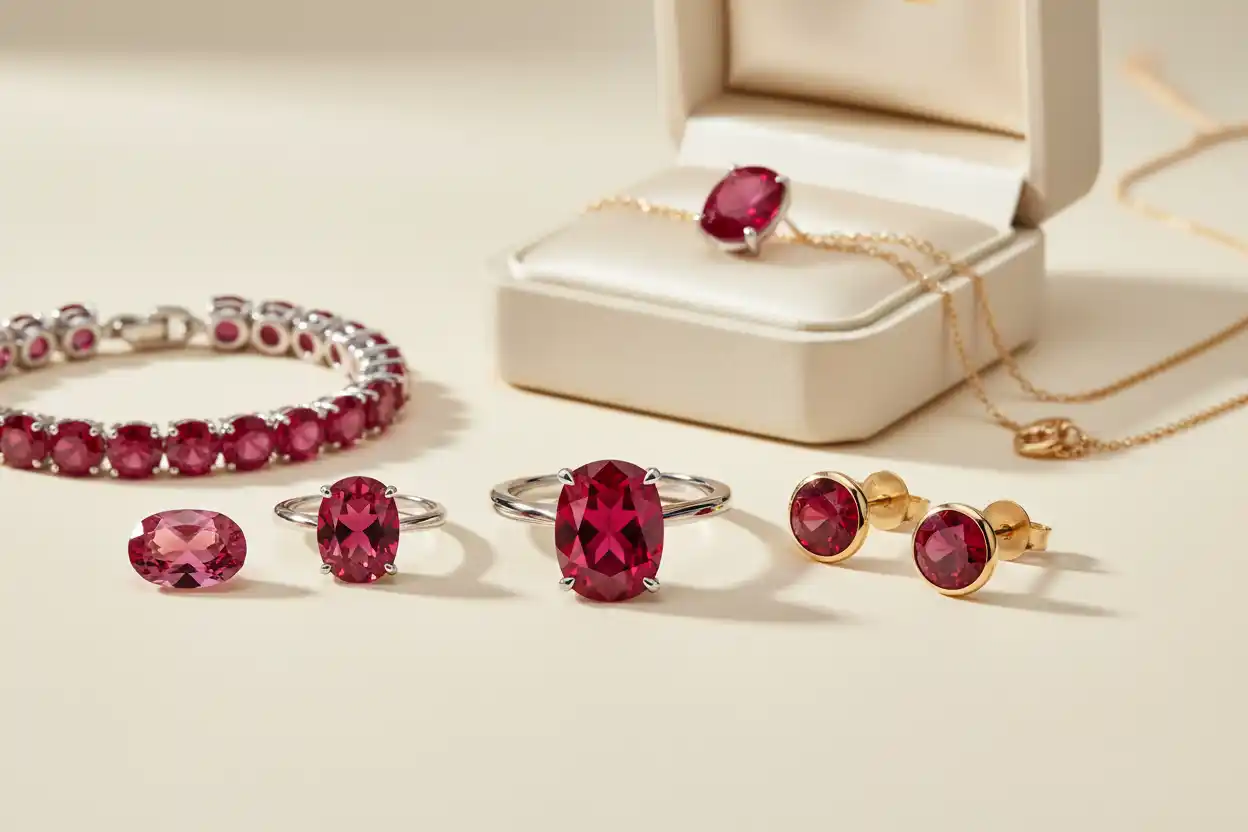

Ruby jewelry can mark a July birthday with a small bezel-set pendant, classic stud earrings, an heirloom-style ring, a tennis bracelet, or a laboratory-grown stone chosen for size and color. The best gift is not necessarily the largest ruby. Treatment, color, construction, documentation, comfort, and the recipient’s routine determine whether the piece delivers lasting value.
The main July birthstone guide explains ruby’s month association, history, color, and symbolism. The full birthstones-by-month guide places it within the calendar. This page concentrates on gift decisions: natural versus laboratory-grown ruby, quality, treatments, jewelry forms, metals, settings, sizing, budgets, and seller evidence.
Begin With the Gift Situation
A July birthday gift for a child, partner, parent, friend, or collector should not follow one template.
| Gift situation | Practical approach |
|---|---|
| First birthstone gift | Small pendant or studs in durable metal |
| Milestone birthday | Better-color natural ruby or documented lab-grown stone |
| Romantic gift | Ring, pendant or bracelet with personal engraving |
| New baby or young child | Keepsake pendant for later wear rather than a small loose accessory |
| Collector | Untreated, origin-documented, star, trapiche or unusual ruby |
| Daily wearer | Low protective setting and sound stone |
| Occasional formal wearer | Larger drop earrings, cocktail ring or statement necklace |
| Limited budget | Smaller natural ruby, heated ruby or lab-grown ruby with honest disclosure |
| Heirloom goal | Repairable construction, durable metal and independent documentation |
| Recipient with sensitivities | Carefully disclosed posts, chain, clasp and alloy |
The recipient’s current jewelry provides the best evidence. Note metal color, typical stone size, ring profile, chain length, earring type, and whether they prefer vintage or modern design.
Natural Ruby, Laboratory-Grown Ruby or an Imitation?
Natural ruby forms geologically and may be untreated or enhanced. Laboratory-grown ruby is manufactured but has substantially the same corundum structure and composition.
An imitation merely resembles ruby. Red glass, garnet, spinel, cubic zirconia, doublets, and other products can imitate color without being ruby.
The broader ruby guide explains natural material. The lab-ruby guide covers manufacturing methods, properties, disclosure, and symbolism.
Neither natural nor laboratory-grown origin should be concealed. The gift receipt, invoice, and product description should state which material was purchased.
When Natural Ruby Makes Sense
Natural ruby suits a gift where geological rarity, provenance, collectability, or heirloom value matters.
Fine natural ruby can become expensive quickly as color, size, transparency, favorable origin, and limited treatment align. A smaller natural stone with attractive red color often gives a better result than a large dark ruby chosen primarily for carat weight.
Natural inclusions are expected. They can support identity and origin analysis, although surface-reaching fractures may affect durability.
The ruby buying guide explains how to evaluate color, clarity, cut, carat weight, origin, treatment, and reports.
When Laboratory-Grown Ruby Makes Sense
Laboratory-grown ruby can offer stronger visible color, larger size, and cleaner appearance within a controlled budget.
It may be especially suitable for:
- A large statement ring
- Matching earrings
- A tennis bracelet requiring many similar stones
- A gift where appearance matters more than natural rarity
- A travel ring
- A replacement for a lost or damaged natural ruby
- A recipient who explicitly prefers manufactured gems
The lab-ruby buying guide covers growth method, quality, disclosure, setting, and seller questions. The lab-ruby price guide explains why laboratory-grown ruby should not be priced as though it had natural geological rarity.
A seller should use “laboratory-grown,” “laboratory-created,” or an equally clear description rather than hiding origin behind terms such as cultured, genuine, simulated, or eco ruby.
Ruby Treatments Affect the Gift
Most natural ruby has been heated. Conventional heat treatment is widely accepted when disclosed and can improve color and appearance.
Other treatments require closer attention:
- Lead-glass fracture filling
- Cavity filling
- Lattice diffusion
- Dyeing
- Surface coating
- Composite construction
- Flux-assisted healing with residue
- Repairs concealed by the setting
The dedicated treated-ruby guide explains how treatments affect value, durability, cleaning, repair, and laboratory reports.
A conventionally heated ruby can make an excellent gift. A heavily glass-filled ruby occupies a different product category and should be priced, described, and cared for accordingly.
Choosing Ruby Color
Color is the strongest visual quality factor. Fine ruby generally appears vivid red to slightly purplish red.
Avoid choosing solely from a saturated product photograph. Ask for video under daylight-equivalent and indoor lighting. A stone that looks bright red beneath one lamp may appear brownish, purplish, or very dark in ordinary use.
Consider the recipient’s taste:
- Pure or slightly purplish red looks classic.
- Orangy red can appear warmer beside yellow or rose gold.
- Dark red suits understated or masculine designs.
- Pinkish red may suit someone who prefers softer color, although pale material can approach the pink-sapphire boundary.
- Star ruby offers a cabochon with a moving optical effect rather than faceted brilliance.
The Types of Ruby guide covers color, source, star, trapiche, natural, treated, and laboratory-grown categories.
Cut and Carat Weight
Ruby rough is valuable, so cutters often preserve weight. Some stones have deep pavilions, asymmetrical outlines, off-center culets, or mixed-cut patterns.
These compromises may be reasonable when they preserve exceptional color. However, a gift should still look balanced in its setting and return light across much of the face.
Millimeter dimensions often communicate visible size more clearly than carat weight. A deep stone can carry considerable hidden weight without appearing large from above.
The ruby price guide explains why prices can rise sharply with size when color and quality remain high.
Ruby Rings
A ruby ring works for birthdays, anniversaries, graduations, and romantic milestones.
Ruby’s hardness and toughness make it suitable for regular wear, but the setting must protect corners and support the stone evenly. Bezel, halo, six-prong, cathedral, cluster, three-stone, signet, and vintage-inspired designs can all work.
Request the exact ring size. Wide bands fit differently from narrow bands, and eternity-style construction may limit resizing.
A ruby engagement ring requires additional attention to long-term setting maintenance, wedding-band contact, treatment stability, and independent documentation.
Ruby Earrings
Ruby earrings are among the easiest surprise gifts because no ring size is required.
Studs provide the most practical daily-wear option. Halo studs increase visual spread, while drops and hoops create more movement.
Check that the pair matches in:
- Hue
- Saturation
- Tone
- Cut
- Apparent diameter
- Transparency
- Fluorescence response
- Treatment
- Setting height
Laboratory-grown ruby can be particularly effective for a strongly matched pair because consistent color and clarity are easier to obtain.
Ruby Necklaces and Pendants
A ruby necklace suits recipients who do not wear rings or whose size is unknown.
A small solitaire pendant can be worn routinely, while a cluster, heart, floral, cross, initial, locket, or geometric setting adds a more specific message.
Confirm the chain length, gauge, clasp, pendant measurements, total weight, and whether the bail can pass over the chain’s end fitting.
A substantial natural ruby should not hang from an unusually thin chain simply because the delicate look photographs well.
Ruby Bracelets
A ruby bracelet can use tennis-style links, bezels, charms, beads, cabochons, or mixed stones.
Bracelets face repeated impact, so every setting and connector matters. A high-value piece benefits from a box clasp, figure-eight safety, or secondary chain.
Many matched stones are required for a tennis bracelet. Laboratory-grown ruby or smaller heated natural rubies can achieve a consistent design without the extreme cost of a fully matched suite of fine untreated stones.
Metals for Ruby
Yellow gold produces a warm traditional contrast and works especially well with orangy or deep red stones. White gold and platinum emphasize cooler red or purplish-red color, while rose gold can soften the combination.
Sterling silver can suit modest gifts, although the quality of prongs, plating, and solder should match the intended wear.
The guide to gemstones and metals for sensitive skin explains why nickel content, rhodium plating, gold fineness, titanium, platinum, posts, clasps, and solder require separate disclosure.
Settings and Accent Stones
A bezel protects the perimeter and creates a low profile. Prongs allow more light but require inspection. Halos increase visual size and can protect the center from lateral impact.
Diamonds are the most familiar accent, although white sapphire, spinel, zircon, moissanite, or colorless laboratory-grown gems can create different price and appearance combinations.
Hard accent-stone girdles should not contact ruby directly in a poorly designed cluster. Ruby is durable, but repeated pressure between neighboring stones can damage edges or settings.
For glass-filled ruby, the jeweler must know the treatment before tightening prongs, polishing, soldering, or cleaning.
Gift Budget Without Misleading Shortcuts
Ruby price varies so widely that a universal “good ruby price” is not useful.
At a limited budget, buyers can prioritize:
- A smaller natural heated ruby
- Better color with modest inclusions
- A simple setting
- Laboratory-grown ruby
- A cluster of small calibrated stones
- A ruby accent beside another center gem
- A cabochon rather than a transparent faceted stone
At a higher budget, value may concentrate in strong color, larger size, limited treatment, origin documentation, exceptional star quality, or an important period design.
Do not assume that an expensive retail setting proves the ruby is natural, untreated, or accurately graded.
Laboratory Reports and Appraisals
The guide to gemstone certification laboratories explains the role of independent reports.
A colored-stone identification report can address:
- Natural or laboratory-grown origin
- Ruby or another material
- Detectable treatment
- Weight and measurements
- Color and cutting style
- Geographic-origin opinion when requested and scientifically supportable
An appraisal addresses value and insurance replacement. It is not a substitute for gemological identification.
Match the report number, photograph, dimensions, weight, shape, and inclusions with the exact piece.
Recognizing Misrepresentation
The real-versus-fake ruby guide covers identification in depth.
Warning signs include:
- Unusually large flawless ruby at a low price
- “Certified” without naming the laboratory
- Natural used as though it meant untreated
- Glass filling omitted from the listing
- Laboratory-grown ruby described only as genuine
- Origin claims based solely on color
- Heavy photo saturation
- Return terms that prohibit independent inspection
- A report that does not match the jewelry
- Seller refusal to explain treatment
Do not use scratch, flame, acid, or destructive home tests.
Buying Online
Follow the safeguards in How to Buy Gemstones Online Without Getting Scammed.
Request a written invoice describing:
| Item | Required detail |
|---|---|
| Ruby origin | Natural or laboratory-grown |
| Treatment | Heat, filling, diffusion, dye, coating or other process |
| Stone data | Weight, dimensions, shape and number of stones |
| Color presentation | Neutral-light photographs and video |
| Metal | Alloy, fineness, hallmark and plating |
| Construction | Prongs, bezel, glue, backing and repairs |
| Sizing | Current ring or bracelet size and alteration limits |
| Documentation | Laboratory report and appraisal details |
| Condition | Chips, abrasions, fractures and previous repair |
| Returns | Inspection period and refund conditions |
Keep screenshots of the listing and all seller messages until the return period has passed.
Engraving and Personalization
Engraving can include a birthday, initials, a short phrase, coordinates, or a family date. Confirm that the selected location will remain intact if the ring is resized.
For a pendant, engraving the back of a metal setting preserves the ruby and allows future refinishing.
Birth-month flowers, constellations, zodiac symbols, or family stones can add meaning, but they should not make the design structurally crowded or difficult to repair.
July Birthstone Gifts for Different Ages
For a young child, a keepsake pendant stored for later use may be safer than a small wearable object. Avoid loose charms and fragile chains.
For a teenager, small studs, a simple pendant, or an adjustable bracelet can provide practical wear.
For an adult milestone birthday, consider better color, a larger stone, custom engraving, or an independent report.
For an older heirloom recipient, prioritize easy clasps, comfortable weight, readable documentation, and repairable construction.
Care and Long-Term Service
Follow How to Clean Ruby Jewelry Safely rather than applying one cleaning method to every treated stone.
Warm soapy water is generally safe. Untreated and conventionally heated rubies are durable, but lead-glass-filled, cavity-filled, dyed, glued, or heavily fractured pieces need much gentler handling.
Have frequently worn rings and bracelets inspected for loose prongs, worn links, damaged clasps, and stone movement. Tell the jeweler about all known treatments before repair.
Store ruby separately because it can scratch many other gems. Diamonds can scratch ruby.
Frequently Asked Questions
1. What is the best July birthstone jewelry gift?
Stud earrings and pendants are safest when sizing is unknown. A ring or bracelet can be more personal when accurate measurements and the recipient’s wear habits are known.
2. Is laboratory-grown ruby appropriate for a birthstone gift?
Yes, when it is clearly disclosed. It offers ruby’s corundum properties and red color without natural geological rarity.
3. Is natural ruby always more valuable than lab-grown ruby?
Comparable natural ruby generally carries greater rarity value, but quality, treatment, size, documentation, setting, and condition still affect the finished jewelry.
4. Are heat-treated rubies suitable as gifts?
Yes. Conventional heat treatment is widely accepted. The seller should disclose it, and the price should reflect treatment status.
5. Should I avoid glass-filled ruby?
Not necessarily when it is fully disclosed and priced as heavily treated material. However, it requires greater care and is not equivalent in durability or value to untreated or conventionally heated ruby.
6. Which metal looks best with ruby?
Yellow gold gives a warm traditional appearance, white metals create crisp contrast, and rose gold softens the red. The recipient’s existing jewelry is the best guide.
7. Is ruby durable enough for an everyday ring?
Sound untreated or conventionally heated ruby is highly suitable. Poorly set, heavily fractured, or glass-filled material requires more caution.
8. What size ruby should I buy?
Choose face-up dimensions and color before chasing carat weight. A smaller bright ruby can look better than a deeper, darker stone with hidden weight.
9. Does a ruby gift need a laboratory report?
A report is advisable when natural origin, treatment, geographic source, or high value materially affects the purchase decision.
10. Can ruby jewelry be resized?
Many metal rings can be resized, but treatment and setting construction affect the repair method. The jeweler must know whether the ruby is filled, diffused, glued, or otherwise enhanced.
11. What is a practical ruby gift for someone who rarely wears jewelry?
A small pendant, restrained studs, or a compact charm provides birthstone meaning without requiring frequent formal use.
12. What documents should accompany ruby jewelry?
Keep the itemized invoice, treatment disclosure, laboratory report, appraisal, metal details, care instructions, sizing record, warranty, and return terms.
A successful July birthstone gift aligns three things: the recipient’s style, the ruby’s true identity, and the construction supporting it. Natural heated ruby, exceptional untreated material, and laboratory-grown ruby can each be appropriate when their differences are made clear. Honest disclosure, balanced color, secure settings, accurate sizing, and useful documentation make the gift more meaningful than an inflated carat weight or an unsupported prestige label.
Ruby and July birthstone symbolism reflects cultural and personal tradition. Wearing ruby does not scientifically guarantee love, courage, protection, vitality, prosperity, healing, or any other physical or emotional outcome.