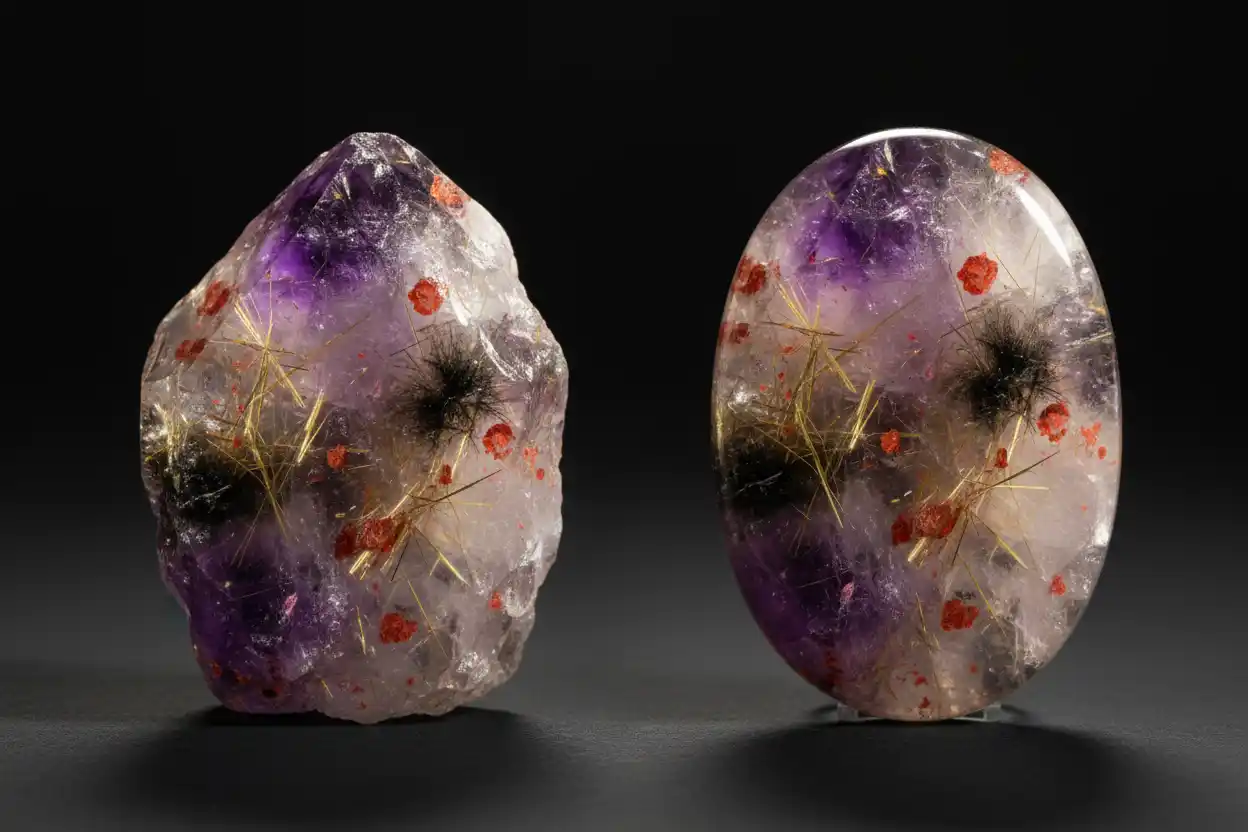
Super Seven: Meaning, Properties & Symbolism
Super Seven is a commercial name for inclusion-rich quartz traditionally associated with material from Brazil, especially the state of Espírito Santo. Sellers claim that it combines clear quartz, amethyst, smoky quartz, cacoxenite, goethite, lepidocrocite, and rutile within one specimen.
The name does not represent an approved mineral species, and three of the alleged “seven minerals” are color varieties of the same quartz host. Furthermore, many pieces sold under the label have never been analytically shown to contain every claimed inclusion.
Super Seven at a Glance
| Property | Super Seven |
|---|---|
| Composition | Quartz, SiO₂, with variable iron-oxide, phosphate, rutile, and other inclusions |
| Group or type | Included quartz sold under a metaphysical trade name |
| Color | Colorless, purple, grey, smoky brown, red, orange, yellow, gold, black, or mixed |
| Crystal system or texture | Trigonal quartz with zoned color and variable inclusions |
| Habit | Prismatic quartz crystals, points, clusters, massive rough, polished stones |
| Luster | Vitreous, with metallic, earthy, or silky internal reflections |
| Transparency | Transparent to opaque, commonly translucent |
| Mohs hardness | 7 for the quartz host |
| Cleavage | None in quartz |
| Tenacity | Brittle |
| Common uses | Mineral specimens, points, cabochons, beads, pendants, carvings, meditation objects |
| Primary care concern | Unsupported inclusion claims, fractures, coatings, dye, heat treatment, composites, and silica dust |
What Is Super Seven?
Super Seven is not one mineral and does not have one fixed chemical formula. It is a trade description applied to visually complex quartz containing color zones and inclusions.
The original marketing concept claims seven components:
- Clear Quartz
- Amethyst
- Smoky Quartz
- Cacoxenite
- Goethite
- Lepidocrocite
- Rutile
The first three are all quartz. Their colors and transparency differ, but each has the same basic SiO₂ composition and trigonal crystal structure.
The remaining four are claimed inclusion minerals. Even when several are present, a seller cannot confirm all of them reliably with unaided vision.
The material is also called Melody’s Stone or Sacred Seven in metaphysical commerce. These names do not establish mineral identity, locality, authenticity, or therapeutic properties.
Super Seven belongs within the trade-name and included-quartz boundary of types of gemstones. It also appears in the crystals that start with S and gemstones that start with S directories.
Are There Really Seven Minerals?
A genuine quartz crystal can contain several minerals, but the number seven should not be assumed from the commercial name.
Clear Quartz, amethyst, and Smoky Quartz can occur as zones within one crystal. Purple color develops through iron-related color centers, while smoky color generally involves irradiation-related centers associated with aluminum.
The claimed non-quartz components require separate identification. Cacoxenite, goethite, rutile, hematite, and related iron phases can look similar when they occur as microscopic needles, blades, flakes, or earthy clouds.
Red inclusions advertised as lepidocrocite are especially uncertain. Many inclusions sold under that name have not received Raman or X-ray confirmation and may instead be hematite or goethite.
A stone containing only amethyst, smoky zones, hematite, and rutile can still be an attractive natural included quartz. It simply should not be described as analytically proven seven-mineral material.
The Quartz Components
Clear Quartz refers to colorless transparent quartz. In Super Seven, it forms the host or clear windows between colored and included zones.
Amethyst is purple quartz colored mainly by iron-related defects and natural irradiation. Purple areas may occur near the termination, along phantoms, or within irregular growth sectors.
Smoky Quartz ranges from pale grey to deep brown or nearly black. In one crystal, smoky areas may grade into colorless or purple zones.
Because all three are quartz varieties, they do not form separate crystal systems inside the stone. Instead, color centers change through different growth regions of the same host.
The types of Clear Quartz guide covers quartz variety naming more broadly, while Super Seven remains focused on mixed color zoning and claimed inclusions.
The Claimed Inclusion Minerals
Cacoxenite is an iron-aluminum phosphate that can form golden-yellow, brown, or orange radiating needles and fibrous aggregates. It may occur with iron ores and phosphates, but a golden inclusion in quartz is not automatically cacoxenite.
Goethite is an iron oxyhydroxide that can form brown, yellow, orange, black, or reddish needles and blades. The dedicated goethite guide covers its independent mineral properties.
Rutile is titanium dioxide. Golden, red-brown, or black needles can occur in quartz, as explained on the rutile page.
Lepidocrocite is another iron oxyhydroxide. Although frequently listed as a Super Seven component, its presence should be confirmed analytically because morphology and red color alone are inadequate.
Hematite is not always included in the canonical seven-item list, yet it is common in red included quartz and may be mistaken for lepidocrocite or goethite.
The inclusion assemblage can also contain mica, chlorite, clay, feldspar, fluid inclusions, iron staining, and other minerals not mentioned in the Super Seven marketing formula.
How Super Seven Quartz Forms
Quartz grows from silica-rich hydrothermal fluids in fractures, cavities, and veins.
Changes in fluid chemistry, temperature, pressure, oxidation conditions, and trace-element supply create different color zones and inclusion generations.
An early quartz crystal may receive a coating of iron minerals before later quartz encloses it. That process creates a phantom marking an earlier stage of growth.
Rutile needles can grow before or alongside the quartz and become trapped as the host expands.
Amethyst and smoky coloration may develop in different sectors according to iron, aluminum, irradiation, and growth conditions.
Repeated fracturing can introduce later iron oxides. Consequently, some red or brown material occurs in healed cracks rather than as primary inclusions.
A visually complex specimen may therefore record several geological events without containing every mineral named in the trade description.
Brazilian Origin and Locality Claims
Super Seven is traditionally associated with included quartz from Espírito Santo, Brazil. Many sellers repeat this origin as part of the material’s commercial identity.
Brazil does produce abundant amethyst, smoky quartz, rutile-bearing quartz, iron-included quartz, and phantom crystals. However, the exact mine or district is often missing from retail documentation.
The claim that the “only Super Seven mine is permanently closed” is widely repeated but rarely supported by verifiable mine records. Buyers should not accept a scarcity premium based only on that statement.
Some stones sold as Super Seven come from Minas Gerais or other Brazilian quartz regions. Others may originate outside Brazil altogether.
A country or state label is not proof that the specimen contains the claimed seven components. Provenance and mineral analysis answer different questions and should not be confused.
Super Seven Versus Garden Quartz
Garden Quartz—also called Lodolite—contains scenic inclusions such as chlorite, iron oxides, clay, feldspar, and fluid-filled cavities.
Its value usually comes from landscape-like internal scenes rather than a claim about seven specific components.
Super Seven tends to emphasize amethyst, smoky zoning, red or gold inclusions, and metaphysical branding. Garden Quartz can be colorless, green, brown, red, or multicolored without amethyst.
The same included specimen might receive either name in the marketplace. A precise mineral description remains more useful than choosing the most valuable-sounding trade term.
Super Seven Versus Rutilated Quartz
Rutilated Quartz requires visible rutile needles inside quartz. The needles may be gold, coppery, red-brown, silver, or black.
A Super Seven specimen can contain rutile, but rutile is only one claimed component. Purple, smoky, red, yellow, and phantom zones usually contribute to the broader appearance.
When the main visual feature is an organized network of rutile needles, Rutilated Quartz provides the clearer commercial description.
When the specimen contains several color zones and varied inclusions, Super Seven may describe its trade identity, provided the seller does not claim untested mineral content.
Super Seven Versus Fire Quartz
Fire Quartz is a broad trade term for quartz with red, orange, or brown iron-oxide inclusions and coatings.
Super Seven often includes similar iron-rich patterns. However, it additionally implies amethyst, smoky quartz, rutile, and several specific included minerals.
A red included quartz should not be upgraded to Super Seven pricing merely because it has a purple patch or one golden needle.
Microscopic and spectroscopic testing can identify major phases, but proving every claimed component in a heterogeneous stone may require analysis of several different regions.
How to Identify Super Seven
The first task is confirming the host is natural quartz. Standard quartz properties include hardness 7, specific gravity near 2.65, no cleavage, and refractive indices around 1.544–1.553.
Natural crystals may show prismatic faces, horizontal striations, growth zoning, fluid inclusions, healed fractures, mineral crystals, and irregular color distribution.
Under magnification, claimed inclusions should appear structurally integrated with the quartz. Surface glitter, painted color, and resin-filled cavities require separate evaluation.
The next task is distinguishing color varieties. Purple zones may support amethyst, while smoky-grey areas may indicate Smoky Quartz, but treatment can produce or alter both colors.
Finally, the inclusion minerals require analysis. Raman spectroscopy is particularly useful for distinguishing hematite, goethite, rutile, cacoxenite, mica, and other small crystals.
One tested inclusion does not prove the identity of every similar-looking particle elsewhere in the stone.
The broader how to identify crystals framework is particularly relevant because Super Seven combines mineral identification, treatment testing, and trade-name evaluation.
Treatments, Coatings, and Color Enhancement
Natural quartz can be irradiated to create or intensify smoky color. Iron-bearing quartz can also be irradiated and heated to alter purple, yellow, or green color centers.
Artificially treated quartz may remain genuine quartz, but the treatment should be disclosed.
Dye can be introduced into fractures. Red, purple, black, or yellow color concentrated along cracks provides a warning sign.
Aura coatings deposit metallic films on the surface, producing iridescent blue, rainbow, pink, or gold effects. These coatings are not part of the natural seven-component concept.
Clear resin may fill fractures or stabilize crumbly inclusion-rich areas. Resin can also bind quartz fragments into reconstructed points or spheres.
Artificially assembled crystals can combine natural quartz, glue, metallic particles, and colored resin. Seams, bubbles, abrupt boundaries, and repeated inclusion patterns may expose construction.
The dedicated treated Clear Quartz guide owns detailed quartz-treatment intent, while real vs fake Clear Quartz covers glass and resin imitation.
Synthetic and Manufactured Material
Hydrothermal synthetic quartz is widely produced for electronics and gemstone applications. Synthetic amethyst, colorless quartz, and smoky-colored material can all exist.
A laboratory-grown quartz crystal does not become Super Seven merely because particles are added or color zones are created artificially.
Glass can imitate transparent purple, smoky, and colorless zones. Metallic glitter or red particles may be added to support the seven-mineral story.
Resin composites can contain crushed amethyst, quartz chips, iron powder, and pigments. They should be described as reconstructed material.
Some stones are genuine natural quartz but incorrectly marketed. Misnaming is more common than a sophisticated laboratory-grown seven-phase imitation.
A seller should state whether the item is a natural crystal, polished natural quartz, treated quartz, reconstructed composite, glass, or synthetic quartz.
Cutting and Polishing Behavior
Super Seven rough is cut to display inclusions, phantoms, and color zoning rather than to maximize conventional brilliance.
Cabochons, freeforms, beads, towers, spheres, and polished points are common. Transparent sections may also be faceted.
A cutter should examine the rough under transmitted light before sawing. Purple and smoky areas that look strong at the surface may be thin layers that disappear during cutting.
Fractures often contain the most vivid iron color. Removing them improves durability but can eliminate the pattern that gave the rough its commercial appeal.
Dense inclusions may undercut or tear out at the surface. Polishing compound can collect in pits and appear as white residue.
A natural crystal with a good termination and documented origin may retain more value as a specimen than after being cut into a generic tower.
Durability and Jewelry Suitability
The quartz host has hardness 7 and no cleavage, making stable Super Seven suitable for pendants, earrings, beads, and protected rings.
Internal fractures are the main practical weakness. Heavily phantom-filled, crackle-treated, resin-filled, or inclusion-rich stones can chip more readily than clean quartz.
A full bezel protects cabochon edges. Tall crystal points and exposed freeforms are more vulnerable to impact.
Beads may rub against one another and gradually abrade polished surfaces. Drill holes can also intersect natural fractures.
The treatment status should be known before resizing or repairing jewelry. Heat can damage resin, coatings, glue, and some color treatments.
Super Seven Value and July 2026 Asking Prices
Super Seven is priced as a trade-name quartz rather than a scientifically standardized seven-mineral material.
As of July 2026, small rough crystals, tumbled stones, and simple points commonly carry asking prices around $8–$40.
Cabochons frequently appear around $15–$45, while polished towers and better inclusion-rich points commonly range from $30–$150.
Large spheres, display crystals, strong amethyst-smoky phantoms, and visually dramatic Brazilian pieces may ask approximately $150–$500 or more.
Some sellers request substantially higher prices based on rarity, metaphysical claims, or an alleged closed mine. Those premiums need supporting provenance, size, aesthetics, condition, and preferably analytical evidence.
The presence of seven named minerals is not visually proven by a high price. A well-documented quartz containing three confirmed inclusions may be more credible than an expensive stone accompanied only by a printed metaphysical card.
Detailed seller and authenticity guidance belongs on the dedicated where to buy Super Seven page.
Buying Super Seven
Ask whether “Super Seven” describes a trade appearance or a laboratory-confirmed mineral assemblage.
A seller claiming all seven components should explain how they were identified. Visual inspection, supplier tradition, or a chart matching colors to minerals is not laboratory evidence.
Request transmitted-light and reflected-light photographs. Transmitted light shows amethyst, smoky zoning, phantoms, and internal fractures; reflected light reveals metallic and fibrous inclusions.
Inspect every polished item for resin, glue, coatings, dye concentrations, bubbles, and reconstructed seams.
Ask for locality details beyond “Brazil.” Espírito Santo, a mine district, supplier records, and earlier collection labels improve provenance.
A return policy should allow independent gemological examination. The how to buy gemstones online guide provides the wider transaction framework.
Cleaning and Storage
Clean stable untreated Super Seven with lukewarm water, mild soap, and a soft brush or cloth. Rinse briefly and dry it thoroughly.
Avoid prolonged soaking when the material contains fractures, iron minerals, glue, resin, coatings, or uncertain treatment.
Do not use steam or ultrasonic cleaning on heavily fractured stones. Vibration can expand hidden cracks.
Strong sunlight and heat may fade amethyst zones over time. Store valuable purple material away from a bright window.
Keep polished stones separate from harder gems. Natural crystals should be supported by their base rather than handled repeatedly by the termination.
Super Seven Meaning and Symbolism
Super Seven’s symbolism comes almost entirely from modern metaphysical marketing. The commercial name was built around the idea that seven materials combine their separate meanings in one stone.
Contemporary practitioners commonly associate it with integration, cooperation, insight, transformation, personal development, and bringing several priorities into one coherent direction.
Its changing purple, smoky, clear, red, and gold zones can serve as a visual metaphor for complexity. A person may use the stone as a reminder that identity can contain different qualities without requiring them to become identical.
The number seven carries religious, cultural, mathematical, and symbolic significance in many traditions. However, those traditions do not establish that every Super Seven specimen contains seven minerals or has measurable spiritual effects.
Claims that the stone never needs cleansing, activates every energy center, develops psychic powers, or treats illness are not supported by scientific evidence.
Super Seven can still hold personal meaning as an included quartz specimen, keepsake, meditation object, or symbol of integrating several experiences.
Frequently Asked Questions
1. Is Super Seven an official mineral?
No. It is a commercial trade name for inclusion-rich quartz.
2. What are the claimed seven components?
Clear Quartz, Amethyst, Smoky Quartz, Cacoxenite, Goethite, Lepidocrocite, and Rutile.
3. Are Clear Quartz, Amethyst, and Smoky Quartz separate minerals?
No. They are color or transparency varieties of the same mineral, quartz.
4. Does every Super Seven stone contain all seven components?
No. Many stones have never been tested, and some contain only several quartz zones and iron inclusions.
5. Is red material inside Super Seven always lepidocrocite?
No. Red inclusions may be hematite, goethite, mica, or another iron-rich mineral.
6. Where does authentic Super Seven come from?
The trade name is traditionally associated with Espírito Santo, Brazil, although precise mine documentation is often limited.
7. Is the original Super Seven mine closed?
The claim is widely repeated but should not be accepted without verifiable mine and provenance records.
8. How does Super Seven differ from Garden Quartz?
Garden Quartz emphasizes scenic inclusions, while Super Seven claims a specific seven-component combination and commonly includes amethyst or smoky zones.
9. Is Super Seven the same as Rutilated Quartz?
No. Rutilated Quartz is defined by visible rutile needles, whereas Super Seven implies several color zones and inclusion minerals.
10. Can Super Seven be treated?
Yes. Quartz may be irradiated, heated, dyed, coated, filled, or reconstructed.
11. Can a laboratory prove all seven minerals are present?
Potentially, but several inclusions and regions may require separate Raman, chemical, or diffraction analyses.
12. What makes Super Seven valuable?
Natural quartz identity, attractive zoning, visible inclusions, crystal form, condition, locality, cutting, and honest disclosure matter more than the number seven.
Super Seven becomes more interesting—not less—when the marketing formula is set aside. Each specimen can then be evaluated as a genuine geological record whose inclusions should be identified from evidence rather than from a predetermined list.
Super Seven has a quartz host. Cutting, drilling, grinding, or dry-polishing can create respirable crystalline silica dust capable of causing serious lung disease. Use wet methods, effective local exhaust ventilation, sealed eye protection, suitable respiratory protection, and controlled cleanup during lapidary work.