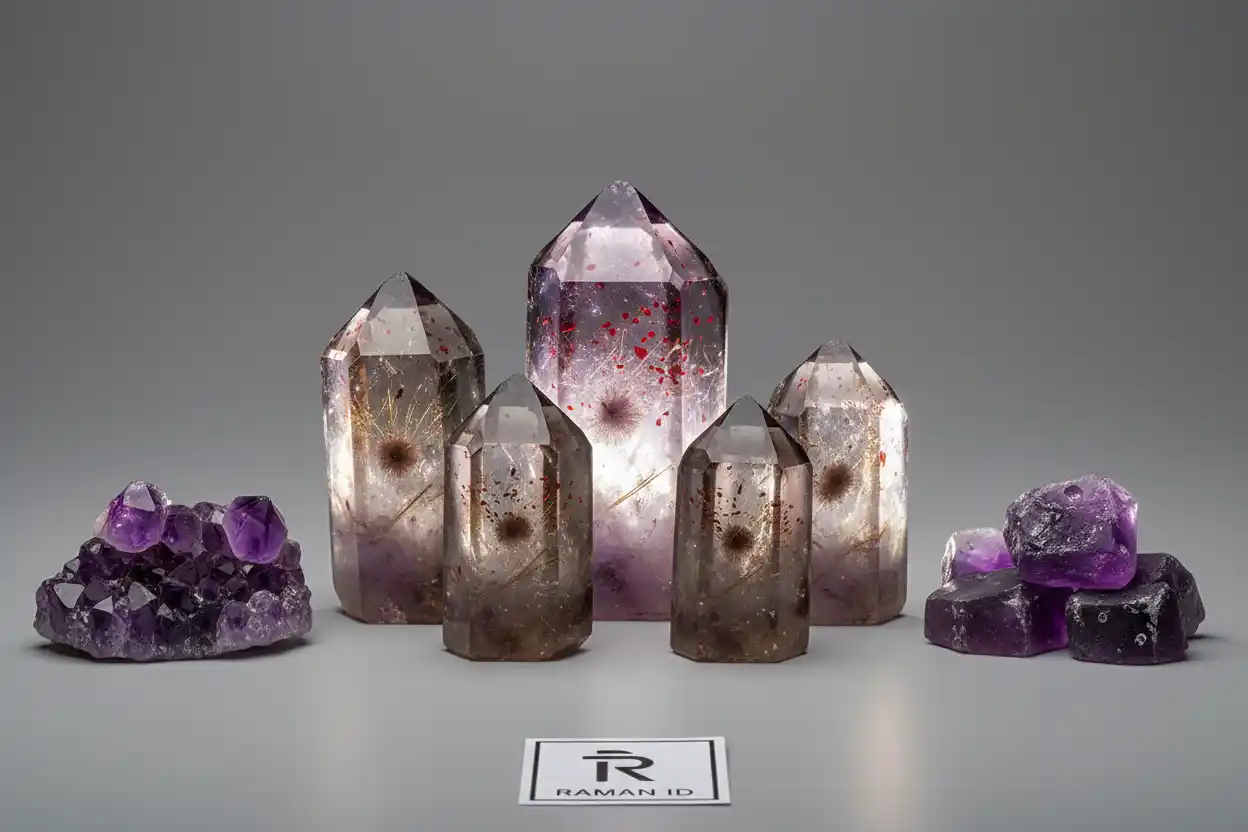
Where to Buy Real Super Seven Quartz and Avoid Trade-Name Fakes
Super Seven is a commercial name applied to included Quartz, commonly combining colorless Quartz, Amethyst and Smoky Quartz zoning with visible iron-rich or titanium-bearing mineral inclusions.
The material is also marketed as Melody Stone or Sacred Seven. Sellers often claim that every genuine piece combines seven named components: clear Quartz, Amethyst, Smoky Quartz, Rutile, Goethite, Lepidocrocite and Cacoxenite.
That seven-part formula should not be accepted without evidence. Clear Quartz, Amethyst and Smoky Quartz are color varieties of the same mineral species, Quartz. Furthermore, red, brown and golden inclusions cannot be identified reliably through color alone.
Many stones sold as Super Seven are natural, attractive included Amethyst or Smoky Quartz. The buying problem is not necessarily that the Quartz is fake. Instead, sellers may claim unsupported inclusion species, exclusive Brazilian provenance, mine exhaustion or the presence of all seven components in every bead.
The Super Seven meaning and properties guide covers the trade name and traditional symbolism. This buying guide focuses on evidence, inclusion identification, sellers, treatments, composites and realistic value.
Super Seven Is a Trade Name, Not a Mineral Species
The host is Quartz, SiO2.
The Quartz family guide explains the parent species. Clear Quartz, Amethyst and Smoky Quartz represent colorless, purple and smoky-brown varieties of that same mineral.
A single crystal can show colorless, purple and smoky zones. Counting those zones as three of seven named “minerals” is therefore a commercial convention rather than a mineral-species count.
The remaining claimed components are separate minerals. Their presence must be demonstrated individually.
One natural specimen may contain Hematite and Goethite but no Rutile. Another may contain Rutile and unidentified iron oxide. A third may consist mostly of zoned Amethyst with no analytically confirmed rare inclusions.
No buyer should assume that the product name guarantees seven components.
The Commonly Advertised Seven Components
| Advertised component | What it actually represents | Buying caution |
|---|---|---|
| Clear Quartz | Colorless Quartz | Same mineral species as Amethyst and Smoky Quartz |
| Amethyst | Purple Quartz | Natural or treated color must be considered |
| Smoky Quartz | Gray-to-brown Quartz | Natural or irradiated color may be difficult to separate |
| Rutile | Titanium dioxide inclusions | Golden or red needles need analytical confirmation |
| Goethite | Iron oxyhydroxide inclusions | Can resemble other iron-rich needles or sprays |
| Lepidocrocite | Iron oxyhydroxide | Frequently claimed from red plates without testing |
| Cacoxenite | Iron-aluminum phosphate | Rare inclusion claim requiring strong evidence |
A seller may use this traditional commercial list, but the listing should separate the marketing formula from the components actually identified in the individual stone.
Choose the Product Form Before Shopping
| Super Seven product | Best source | Main buying concern |
|---|---|---|
| Natural crystal point | Included-Quartz or mineral dealer | Provenance, treatment and actual inclusions |
| Zoned Amethyst point | Quartz specialist | Natural color, repairs and exaggerated trade naming |
| Included rough | Lapidary supplier | Inclusion distribution and usable yield |
| Cabochon | Independent cutter | Inclusion depth, backing and filler |
| Bead strand | Established supplier | Mixed Quartz, dye and unsupported seven-mineral claims |
| Sphere | Included-Quartz specialist | Composite construction and hidden seams |
| Tower | Seller with exact-item video | Carved point, resin and inserted material |
| Pendant | Independent jeweler | Backing, glue and surface-reaching fractures |
| Laboratory-documented piece | Collector-gem dealer | Scope of testing and specimen matching |
| Source-specific specimen | Provenance-focused mineral dealer | Espírito Santo documentation and original labels |
A certificate referring only to a product line is not evidence for every bead in a strand.
Where to Buy Defensible Super Seven
Included-Quartz specialists
A specialist dealer should describe the visible features before naming every inclusion.
Request a breakdown such as:
“Natural zoned Amethyst and Smoky Quartz with red Hematite-like plates and brown iron-oxide sprays.”
That description is more credible than a copied statement claiming seven minerals without testing.
Ask which inclusions were identified analytically and which were inferred visually.
Mineral dealers
Mineral dealers are preferable for natural points and locality specimens.
Request the exact Brazilian state, mine or district, along with the collection history.
The seller should show all crystal faces, the termination and base. A polished or repaired specimen may conceal important growth and condition evidence.
Ask whether the crystal was acid-cleaned, irradiated, heated, coated or stabilized.
Gem and mineral shows
Shows allow direct comparison with ordinary included Amethyst, Phantom Quartz, Garden Quartz and Rutilated Quartz.
Use a loupe to trace inclusions through several depths.
Different minerals may have distinct habits: plates, needles, sprays, radiating clusters or coatings along growth planes.
Do not assign species from color alone. A golden needle is not automatically Rutile, and a brown fan is not automatically Cacoxenite.
Established online stores
The online gemstone buying guide explains payment protection, seller identity and returns.
Request a continuous neutral-light rotation and high-resolution inclusion close-ups.
Ask for ordinary reflected-light images as well as backlit views. Backlighting can exaggerate inclusion density and transparency.
The pictured stone should be the exact item that will ship.
If a seller claims laboratory certification, request the report number, testing laboratory and photographs matching the tested object.
What Defensible Super Seven Looks Like
There is no single required appearance.
Natural material may combine:
- Colorless Quartz
- Purple Amethyst zoning
- Gray or brown Smoky Quartz
- Red or black Hematite plates
- Yellow-brown Goethite sprays
- Golden or copper needles
- Phantom growth outlines
- Iron staining
- Internal veils and fractures
- Several unidentified inclusion phases
Some pieces are transparent and lightly included. Others are cloudy, dark and densely mineralized.
A natural crystal may show several inclusion types without containing the exact traditional seven.
Likewise, one piece may look visually simple while laboratory testing reveals more than one iron mineral.
The strongest buying standard is accurate description rather than a required visual checklist.
Quartz Color Zoning
A single crystal can transition from clear to smoky, purple or nearly colorless.
The colors may form bands, phantoms, sector zoning or irregular clouds.
Amethyst color relates to iron-associated color centers in Quartz, while smoky color involves different radiation-related defects.
A crystal displaying both colors is still one Quartz host.
The seller should not charge separately for “three minerals” when the stone contains three Quartz color varieties.
Color zoning can remain valuable because of its beauty and growth history, but it should be described accurately.
Rutile Claims
Rutile is titanium dioxide and commonly forms golden, copper, red-brown, silver or dark needles.
Rutilated Quartz is a separate, more specific buying category when Rutile clearly dominates the inclusions.
The completed guide to buying real Rutilated Quartz covers inserted wires, glass and composite spheres.
Not every golden needle in Super Seven is Rutile. Goethite, Actinolite and other minerals can produce similar appearances.
A Rutile premium needs morphology or Raman confirmation.
Goethite Claims
Goethite is an iron oxyhydroxide that can form yellow-brown, reddish-brown or dark needle-like, fibrous and radiating inclusions.
Goethite is well documented in Quartz and Amethyst.
However, Hematite, Lepidocrocite and other iron minerals may appear similar when inclusions are small.
Sellers should use cautious descriptions such as “brown iron-oxide or oxyhydroxide inclusions” when analysis is absent.
Hematite Inclusions
Hematite commonly forms red, black, metallic or platy inclusions in Quartz.
The completed guide to buying real Hematite owns the separate market for solid Hematite specimens and jewelry.
Within Super Seven, Hematite may appear as red flakes, black plates, rosettes or included dust.
Red plates frequently receive more exotic labels in retail listings. Raman spectroscopy provides a more reliable identity than color or metaphysical tradition.
Cacoxenite Claims
Cacoxenite is a hydrated iron-aluminum phosphate mineral.
It can form golden-brown radiating fibers in suitable geological environments.
However, a seller should not identify every yellow-brown fan inside Amethyst as Cacoxenite.
Goethite and other iron-bearing minerals can form similar sprays, while reflected light through Quartz changes apparent color.
An expensive Cacoxenite-in-Quartz claim requires direct analysis of the inclusion.
The dedicated Cacoxenite page explains the actual mineral without proving its presence in every Super Seven stone.
Lepidocrocite Claims
Lepidocrocite is an iron oxyhydroxide that can appear red-brown and platy.
Within the Super Seven market, red plates are commonly assigned this name without analytical testing.
Hematite, Goethite and mica can create similar red or orange inclusions.
A report identifying the Quartz host is not enough. The inclusion itself must be measured.
When the seller cannot provide evidence, “red platy iron-mineral inclusions” is more accurate.
Super Seven Versus Phantom Quartz
Phantom Quartz preserves the outline of an earlier Quartz growth stage.
The completed guide to buying real Phantom Quartz owns growth-outline identification and inserted-layer concerns.
Many Super Seven pieces show phantoms because iron minerals or color zones collected on earlier crystal faces.
A phantom does not prove the traditional seven components. It describes the inclusion geometry, not the mineral count.
Super Seven Versus Garden Quartz
Garden Quartz contains scenic mineral inclusions, clouds and plumes.
The completed guide to buying genuine Garden Quartz covers Lodolite terminology, inserted material and inclusion scenes.
A Super Seven piece may also qualify as Garden Quartz when its inclusions form a landscape-like pattern.
The names overlap in appearance, but Super Seven carries a specific seven-component marketing story that requires stronger evidence.
Super Seven Versus Ordinary Included Amethyst
Ordinary Amethyst can contain Hematite, Goethite, Rutile, clay minerals, fluid inclusions and growth phantoms.
That material may look nearly identical to products sold as Super Seven.
The real-versus-fake Amethyst guide owns glass, synthetic Quartz and basic Amethyst identity.
The treated-Amethyst guide covers heat, irradiation, coating and synthetic material.
A seller should not multiply the price simply by applying the Super Seven name to included Amethyst without source or inclusion evidence.
Super Seven Versus Auralite-Type Trade Material
Auralite and similar numbered trade names are applied to Canadian Amethyst or other included Quartz products with claims of numerous mineral components.
These names represent separate commercial stories and source claims.
They should not be treated as synonyms automatically.
A Canadian Amethyst specimen should not be relabeled Brazilian Super Seven because both contain red mineral inclusions.
Likewise, a Super Seven seller should not borrow a larger component count from another trade name to create a rarity premium.
Glass Imitations
Glass can contain metallic flakes, fibers, color zones and bubbles that imitate included Quartz.
Warning signs include:
- Mold seams
- Flow lines
- Numerous round bubbles
- Repeated inclusion patterns
- Metallic glitter without crystal faces
- Factory-identical beads
- No natural crystal or rough evidence
- Abrupt color layers
Natural Quartz can contain rounded fluid inclusions, so bubbles alone are not conclusive.
The real-versus-fake Clear Quartz guide provides the broader separation workflow.
Dyed and Fracture-Colored Quartz
Clear or pale Quartz can be fractured and dyed purple, red, brown or gold.
Artificial color may concentrate along cracks, drill holes and surface-reaching channels.
A dyed object can display several colors and appear richly included under backlighting.
Natural Quartz color zoning usually relates to crystal growth rather than a random surface-connected crack network.
Ask for treatment disclosure and magnified views.
Irradiated and Heated Quartz
Irradiation can create or deepen smoky and Amethyst color centers.
Heat can alter purple Amethyst toward yellow, brown or colorless appearances.
A multi-zoned treated crystal can remain natural Quartz but should not receive an untreated source-specific premium.
Determining treatment may require spectroscopy and may remain difficult in some stones.
Known history should therefore be disclosed even when the exact color origin cannot be proven conclusively.
Coatings and Aura Treatments
Metallic coatings can create blue, gold, pink, purple or rainbow surfaces.
Dense included Quartz may look especially dramatic after coating because its fractures and mineral plates reflect the artificial film.
Inspect chipped edges, the base and protected recesses for abrupt surface color.
A coated natural crystal remains Quartz but is not untreated Super Seven.
The gemstone treatments guide explains coating, irradiation, filling and dye.
Inserted Inclusions
Quartz, glass or resin can be drilled and filled with metal fibers, mineral powder or colored fragments.
A polished plug, cylindrical channel or inclusions ending against one opening suggests insertion.
Natural inclusions may reach the surface, but they should not all terminate at one artificial access point.
Microscopy can reveal glue, tool marks and foreign filler.
Resin and Composite Products
Clear resin can suspend Amethyst chips, Hematite powder, metallic fibers and pigment.
Casting seams, soft scratches, bubbles and repeated internal designs support polymer manufacture.
Large spheres may consist of several joined sections, including natural Quartz, synthetic Quartz, glass and resin.
A product can contain real minerals without being one naturally grown Super Seven crystal.
Glued Crystal Clusters
Separate Amethyst and Quartz points can be attached to matrix or one another.
Inspect each base for glossy adhesive, bubbles and mismatched sockets.
A repaired original cluster differs from a fully fabricated arrangement.
Both require disclosure because the market value of an intact natural cluster differs from an assembled display piece.
How to Evaluate a Natural Point
Start with the Quartz crystal form.
Inspect the prism faces, termination, base and any repairs. Determine which surfaces are natural and which are polished.
Next, trace each inclusion type through several angles.
Ask whether the seller can distinguish confirmed inclusions from visual guesses.
Finally, evaluate color zoning, fractures and source documentation independently from the Super Seven name.
How to Evaluate Rough and Slabs
Request dry reflected-light and transmitted-light photographs.
Backlighting shows inclusion density, while reflected light represents ordinary appearance.
Assess whether purple, smoky and inclusion-rich zones continue through the rough.
Inspect fractures surrounding dense iron-mineral clusters.
Ask whether sample stones from the parcel have been analyzed and whether the report applies to the whole parcel or one selected specimen.
How to Judge Cabochons and Faceted Stones
A strong cabochon should show depth, varied mineral habits and an even polish.
The cutter may orient a phantom or included spray deliberately across the crown.
Inspect the back for foil, resin and color-enhancing support.
Faceted stones can create multiple reflections that make inclusions appear more numerous.
A shallow stone may window, while a deep cut can hide dark areas and add unnecessary weight.
Buying Beads
Bead strands represent one of the highest-risk Super Seven products because every bead can come from different rough.
A certificate for one sample cannot prove seven components in the complete strand.
Natural beads should vary in color zoning and inclusion pattern.
Perfectly identical red and gold inclusions suggest glass or resin.
Inspect drill holes for dye, filler and a contrasting core.
Ask whether the seller sorted the beads visually or tested individual samples.
Buying Spheres and Towers
Request a complete rotation.
Large spheres need special scrutiny for seams and composite construction.
Most towers are carved rather than naturally terminated.
Inspect the tip and base for repairs, resin and inserted inclusions.
A dramatic inclusion-rich display face should not determine the value of an otherwise plain object.
Buying Super Seven Jewelry
The Quartz host has Mohs hardness 7, but fractures and inclusions affect practical toughness.
The gemstone hardness chart and gemstone toughness-versus-hardness guide explain this distinction.
Pendants and earrings are safer than exposed rings when the stone contains large surface-reaching inclusions.
Ask to inspect the loose stone before purchasing a closed-back setting.
Adhesive, foil or dark backing can strengthen the apparent inclusion contrast.
Brazilian Provenance
The original commercial Super Seven story is associated with included Quartz and Amethyst from Espírito Santo, Brazil.
However, a Brazilian origin alone does not establish the traditional seven components.
Likewise, similar included Quartz occurs in other Brazilian states and other countries.
Request the mine, district, exporter or old collection label when source affects price.
Statements that one deposit is exhausted or that every remaining piece is old stock require documentary evidence.
Price and Value
Super Seven has no scientific or standardized grading system.
Value should depend on:
- Natural Quartz identity
- Attractive color zoning
- Host transparency
- Inclusion variety
- Inclusion aesthetics
- Confirmed inclusion species
- Crystal form
- Size
- Structural condition
- Cutting quality
- Treatment disclosure
- Brazilian provenance
- Solid construction
- Laboratory documentation
A small analytically documented crystal can be more valuable than a large bead strand carrying only a copied seven-mineral claim.
The product name alone should not create a premium.
Questions to Ask the Seller
Ask which components were actually identified in the specific stone.
Request the testing method and laboratory report for rare-inclusion claims.
Ask whether clear, smoky and purple zones are being counted as three Quartz varieties rather than three mineral species.
Request Brazilian locality records.
Confirm heat, irradiation, dye, coating, resin, inserted material, glue and composite construction.
For beads, ask how many were tested. For spheres, request a complete circumference video.
For natural points, request every face, termination and base.
Finally, confirm a return policy that permits independent testing.
Professional Identification
Standard gemological testing confirms the Quartz host.
Microscopy can document natural growth zoning, inclusion habits, synthetic features, dye, resin and assembly seams.
Raman spectroscopy can identify Rutile, Hematite, Goethite, Cacoxenite and many other potential inclusions when they are accessible to the laser.
Several inclusions must often be tested because one measurement cannot prove every visually different component.
Infrared spectroscopy may assist with natural-versus-synthetic Quartz and certain treatments.
A report identifying natural Quartz does not prove the seven-component marketing formula.
Cleaning and Storage
Clean sound untreated material with lukewarm water, mild soap and a soft cloth.
Avoid ultrasonic or steam cleaning when the stone contains extensive fractures, filler, glue or coating.
Do not use abrasive cleaners on aura-treated specimens.
Store natural points so their terminations cannot strike one another.
Frequently Asked Questions
1. Is Super Seven a mineral species?
No. It is a commercial name for included and color-zoned Quartz.
2. What are the traditional seven components?
The common list includes clear Quartz, Amethyst, Smoky Quartz, Rutile, Goethite, Lepidocrocite and Cacoxenite.
3. Are clear Quartz, Amethyst and Smoky Quartz separate minerals?
No. They are color varieties of the same mineral species, Quartz.
4. Does every genuine piece contain seven components?
No. The trade name does not guarantee that all advertised minerals occur in every specimen.
5. Can inclusions be identified by color?
Not reliably. Hematite, Goethite, Rutile, mica and other minerals can overlap visually.
6. Is Super Seven the same as Phantom Quartz?
No. Phantom describes an earlier crystal-growth outline, while Super Seven is a trade name based on claimed components.
7. Is Super Seven the same as Garden Quartz?
No. Garden Quartz emphasizes scenic inclusions, although one stone can be marketed under both names.
8. Can ordinary included Amethyst be sold as Super Seven?
Yes. The seller should provide source and inclusion evidence before charging a significant trade-name premium.
9. Can Super Seven be treated?
Yes. Quartz may be irradiated, heated, dyed, coated, fracture-filled or assembled.
10. Can glass or resin imitate Super Seven?
Yes. Manufactured materials can contain glitter, fibers, fragments and several colored zones.
11. Do Super Seven beads need laboratory reports?
Individual inexpensive beads usually do not, but a copied certificate for one sample cannot prove every bead contains seven components.
12. What is the biggest warning sign in a listing?
Be cautious when a seller guarantees all seven minerals from photographs alone and refuses to provide inclusion testing or Brazilian provenance.
Buy the Identified Quartz, Not the Number Seven
Super Seven can be beautiful natural included Amethyst and Smoky Quartz without containing a fixed seven-mineral recipe. A credible seller separates what can be seen, what has been tested and what remains a traditional trade claim.
The S crystal directory, S gemstone directory and how to identify crystals guide provide broader classification and testing context.
Safety note: Super Seven products should not be ingested or placed in drinking water. Included Quartz may contain iron oxides, titanium minerals, phosphates or other phases. Cutting and grinding require wet methods, effective silica-dust extraction and suitable respiratory and eye protection.