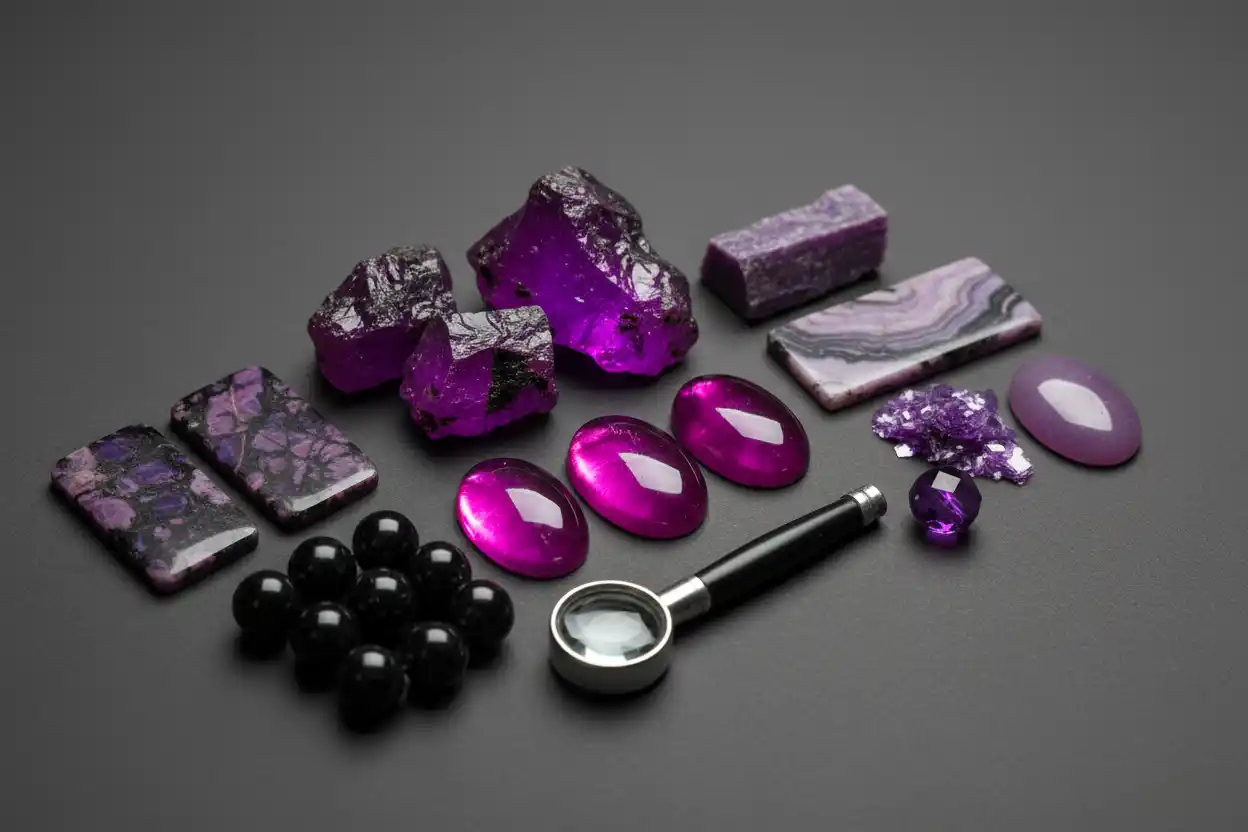
Where to Buy Real Sugilite and Avoid Dyed Purple Fakes
Real Sugilite is a complex lithium-bearing silicate mineral best known in the gem trade for purple, violet, reddish-purple, magenta and lavender material from the Kalahari manganese field of South Africa.
Jewelry-quality Sugilite is commonly a fine-grained aggregate rather than one transparent single crystal. Some material consists predominantly of manganese-bearing Sugilite, while other commercial material contains substantial Chalcedony mixed with and colored by Sugilite.
This compositional variation explains why Sugilite can range from opaque purple rock with black manganese-rich matrix to translucent, intensely colored material sometimes marketed as gel Sugilite.
The market also contains dyed Serpentine, dyed quartzite, Charoite, Lepidolite, Rhodonite, purple glass, resin and reconstructed material. Therefore, color alone is one of the least reliable buying tests.
The Sugilite meaning and properties guide covers mineral identity and traditional symbolism. This guide focuses on source, composition, seller evidence, treatments, imitations and practical value.
Sugilite Is a Complex Ring Silicate
Sugilite belongs to a group of complex cyclosilicate minerals related structurally to milarite and osumilite-group materials.
Its idealized chemistry includes potassium, sodium, lithium, iron, manganese, aluminum and silicon. Natural substitutions make the exact composition variable.
Purple gem material from the Wessels Mine contains manganese-bearing Sugilite, commonly with other minerals.
The attractive color relates primarily to manganese within the material. However, color depth does not reveal how much of a polished stone consists of Sugilite rather than Chalcedony, manganese oxides or other associated phases.
Consequently, a laboratory may need several tests across different zones to characterize a large cabochon or carving accurately.
Wessels Mine Sugilite
The best-known gem-quality purple Sugilite comes from the Wessels Mine near Hotazel and Kuruman in South Africa’s Kalahari manganese field.
The material occurs within a large stratiform manganese orebody rather than a conventional gemstone pegmatite.
Gem-quality material can include:
- Predominantly Sugilite-rich aggregate
- Sugilite mixed with Chalcedony
- Black manganese oxide minerals
- Brown or gray host material
- Veins and patches of associated minerals
- Translucent purple silica-rich zones
- Opaque purple manganese-rich rock
A Wessels Mine premium requires source records. Purple color and black matrix cannot establish the mine by themselves.
The Japanese type locality produced the mineral first described as Sugilite, but its appearance differs greatly from the famous massive purple South African gem material.
Choose the Product Form Before Shopping
| Sugilite product | Best source | Main buying concern |
|---|---|---|
| Natural rough | South African mineral or lapidary specialist | Provenance, Sugilite content and black matrix |
| Slab | Specialist lapidary dealer | Color distribution, resin and usable yield |
| Opaque cabochon | Independent cutter | Purple saturation, matrix and backing |
| Translucent or gel cabochon | Collector-gem dealer | Material identity, filler and rarity premium |
| Bead strand | Established supplier | Dyed Serpentine, glass and reconstructed material |
| Sphere | Experienced carving retailer | Total color coverage, resin and assembly |
| Carving | Skilled lapidary seller | Mixed mineral zones and composite construction |
| Transparent crystal | Fine-mineral dealer | Exact species, locality and laboratory report |
| Jewelry | Jeweler familiar with Sugilite | Backing, glue and exact-stone disclosure |
| Historic specimen | Provenance-focused dealer | Original mine labels and collection history |
Common opaque material and translucent gem-quality Sugilite should not be graded through one pricing system.
Where to Buy Genuine Sugilite
Specialist South African mineral dealers
A dealer with a traceable South African supply chain offers the strongest provenance.
Ask whether the material came from the Wessels Mine, another Kalahari manganese occurrence or an older collection.
Request original parcel labels, invoices or photographs of the unprocessed rough.
A seller should distinguish confirmed Wessels provenance from the broader phrase “African Sugilite.”
Fine-mineral dealers
Single crystals and scientifically important specimens require stronger identification than ordinary massive purple material.
Request the locality, crystal habit, analytical method and associated minerals.
X-ray diffraction, Raman spectroscopy and chemical analysis may be necessary for rare transparent crystals.
A visually purple crystal is not automatically Sugilite.
Lapidary suppliers
Request dry photographs of the rough, several sawn faces and sample polished stones.
Water, oil and wax can deepen the purple color and reduce the visibility of fractures.
Ask how much black or brown matrix appears inside the block rather than only at its surface.
A large piece may contain one narrow vivid-purple vein surrounded by lower-value host rock.
Gem and mineral shows
Shows allow comparison with Charoite, Lepidolite, Rhodonite, Amethyst, dyed Serpentine and purple glass.
Use a loupe to inspect grain texture, dye concentrations, black matrix, filler and coatings.
Do not scratch or apply solvents to the seller’s stone.
A purple aggregate with fibrous structure may be dyed Serpentine, while genuine Sugilite commonly has a dense fine-grained or silica-rich aggregate texture.
Established online stores
The online gemstone buying guide explains seller identity, payment protection and returns.
Request exact-item photographs under daylight-equivalent and warm indoor light. Sugilite can appear more bluish purple under one source and more reddish purple under another.
Ask whether saturation, contrast or black levels were adjusted.
For premium translucent material, request transmitted-light photographs and a continuous video.
What Genuine Sugilite Looks Like
Natural gem material may be:
- Violet
- Bluish purple
- Reddish purple
- Magenta-purple
- Lavender
- Pinkish purple
- Dark grape purple
- Purple with black matrix
- Purple with gray or brown host rock
- Translucent purple with cloudy internal areas
Opaque material may have mottled, veined or patchy color.
Fine translucent Sugilite can resemble richly colored purple Chalcedony. This visual similarity reflects the fact that some commercial material contains both phases.
Black areas commonly consist of manganese-rich minerals rather than painted matrix.
White or gray zones may contain Chalcedony or other host material.
A completely uniform neon-purple object is possible in selected high-grade material but warrants careful testing when it is large or inexpensive.
Predominantly Sugilite Versus Sugilite-in-Chalcedony
Laboratory research has identified two important commercial material types.
One contains predominantly manganese-bearing Sugilite with lesser impurity minerals.
The other consists of Chalcedony mixed with and colored by Sugilite.
Both can be sold legitimately as Sugilite gem material, but the distinction affects transparency, hardness, polish and laboratory readings.
Chalcedony-rich material may be more translucent and harder than Sugilite-dominant aggregate.
A seller should avoid presenting every translucent purple stone as chemically pure Sugilite.
“Gel Sugilite”
Gel Sugilite is an informal trade name commonly applied to translucent or semitransparent material with strong purple color.
The term is not a separate mineral species or standardized grade.
It may describe:
- Sugilite-rich translucent aggregate
- Chalcedony containing Sugilite
- Purple silica-rich material from the manganese deposit
- Selected low-matrix cabochons
- Highly polished material photographed in transmitted light
Because the term carries a large premium, request a laboratory report for expensive examples.
A report should characterize the material rather than repeat the gel trade name without analysis.
Sugilite Versus Charoite
Charoite is a purple silicate-rich rock from Russia known for swirling, fibrous and feathered patterns.
Sugilite more commonly has granular, massive, veined or Chalcedony-like texture.
The completed guide to buying real Charoite owns Russian provenance, fibrous structure, resin and imitation concerns.
A purple stone with dramatic flowing lilac fibers is more characteristic of Charoite than Sugilite.
Nevertheless, polished low-pattern material may require Raman spectroscopy or X-ray diffraction.
Sugilite Versus Lepidolite
Lepidolite is a lithium-rich mica that commonly appears lilac, lavender, pinkish purple or gray-purple.
The completed guide to buying genuine Lepidolite covers mica sparkle, resin and lithium-mineral associations.
Lepidolite normally shows platy cleavage, mica glitter or layered texture.
Sugilite is generally denser-looking and lacks widespread mica flakes.
Large purple mica-rich carvings should not receive a Sugilite description simply because both materials contain lithium.
Sugilite Versus Rhodonite
Rhodonite is a manganese-rich silicate commonly found as pink or red material with black manganese oxide veins.
The completed guide to buying real Rhodonite owns black-matrix quality, filling and transparent-gem rarity.
Deep purplish Rhodonite can overlap with reddish-purple Sugilite.
Sugilite generally leans more violet, while Rhodonite often shows stronger rose or red components.
Color remains insufficient for expensive material, particularly when black manganese matrix appears in both.
Sugilite Versus Amethyst
Amethyst is purple Quartz, usually transparent to translucent and often showing hexagonal crystal form.
Sugilite is generally an opaque-to-translucent aggregate.
A faceted transparent purple stone is more likely Amethyst or another transparent gem than ordinary Sugilite, although rare transparent Sugilite crystals exist.
Quartz refractive properties and crystal structure separate the materials readily.
Do not purchase a large flawless faceted Sugilite without a laboratory report.
Sugilite Versus Purple Fluorite
Purple Fluorite is calcium fluoride with Mohs hardness 4 and perfect octahedral cleavage.
Sugilite-bearing aggregate has different mineral structure and generally lacks Fluorite’s transparent cubic zoning.
The completed guide to buying Purple Fluorite owns violet-color treatment, glass and Amethyst confusion.
Opaque carvings can still overlap visually, so spectroscopy may be necessary.
Sugilite Versus Jade and Dyed Jadeite
Jade refers properly to Jadeite or Nephrite.
Sugilite has occasionally been used alongside Jade in jewelry, while purple Jadeite or dyed material can resemble translucent Sugilite.
The real-versus-fake Jade guide explains the two true Jade species and common substitutes.
The treated-Jade guide covers dye and polymer impregnation.
A seller should not describe Sugilite as purple Jade or identify a purple aggregate as Sugilite from toughness alone.
Dyed Serpentine Imitation
Serpentine is one of the most important natural-stone imitations.
Its fine aggregate texture can accept dye and resemble opaque Sugilite after treatment.
Purple dye may concentrate in fractures, fibrous boundaries and pores.
Under magnification, Serpentine can reveal fibrous or scaly texture inconsistent with Sugilite-bearing aggregate.
A chipped edge may show a green, yellow-green, gray or pale core.
Professional spectroscopy is safer than destructive testing because both materials can occur in complex aggregates.
Dyed Quartzite and Chalcedony
White or pale quartzite and Chalcedony can be dyed purple.
The resulting material may be hard, translucent and convincing, particularly when black matrix is painted or added.
Artificial color commonly concentrates in fractures, pores and grain boundaries.
Natural Chalcedony-rich Sugilite can also show purple color within silica, so the laboratory must identify both mineral composition and color origin.
Glass and Ceramic Imitations
Purple glass can imitate translucent cabochons, beads and carvings.
Round bubbles, flow lines, mold seams and conchoidal chips support glass.
Ceramic may reproduce black-and-purple patterns through glaze or printing.
A chip can reveal a uniform fired body beneath the surface decoration.
Bubble-free glass remains possible, so an expensive transparent piece should receive gemological testing.
Resin and Reconstructed Material
Purple resin can contain black pigment, mineral powder and natural Sugilite fragments.
Casting seams, soft scratches, numerous bubbles and repeated patterns support polymer manufacture.
Fragments and powder may also be pressed or molded with binder.
A reconstructed product can contain real Sugilite without being one natural solid stone.
The seller should disclose the percentage of natural material and the type of binder.
Dye, Wax and Surface Coating
Pale material can be dyed purple, while wax and oil may deepen natural color temporarily.
Clear coatings can improve surface gloss or conceal porosity.
Inspect drill holes, high points and chipped edges for color differences, peeling or residue.
A treated natural stone should not receive an untreated premium.
The gemstone treatments guide explains dye, coating, filling and impregnation.
Resin Filling and Stabilization
Fractures and low-grade matrix can be filled with clear or purple polymer.
Filler can improve polish, reduce visible cracks and strengthen carvings.
Under magnification, resin may contain bubbles or show a different luster.
Black filler can imitate manganese matrix, while purple filler can conceal pale host rock.
Limited filling and extensive reconstruction require different descriptions.
How to Evaluate Rough and Slabs
Request dry photographs of the natural surface, several cut faces and the complete edges.
Assess how much material is vivid purple versus black manganese matrix, gray host rock and pale silica.
Look for color that continues through the rough.
Inspect fractures and weak boundaries. Large multi-mineral pieces can split or polish unevenly.
Ask whether representative cabochons required stabilization.
How to Judge Cabochons
Fine cabochons should offer attractive purple saturation, balanced matrix and an even polish.
Some buyers prefer uniform purple, while others value black veining and contrasting patterns.
Translucency should be assessed under transmitted light without confusing a thin cut for exceptional material.
Inspect the girdle for open fractures and the back for backing, dye and filler.
A smaller natural high-color cabochon may be more valuable than a large matrix-heavy composite.
Buying Beads and Bracelets
Natural strands should show variation in purple tone, matrix and translucency.
Inspect drill holes for dye, resin and a contrasting core.
Perfectly identical bright-purple beads with printed black lines suggest glass or reconstructed material.
Ask whether the strand contains solid Sugilite, Chalcedony-rich Sugilite or mixed purple stones.
Because bead edges can rub against one another, resin-rich and fractured material may show wear over time.
Buying Spheres, Towers and Carvings
Request a complete rotation.
One display side may contain vivid purple while the reverse is mostly black or gray matrix.
A sphere should not have a straight equatorial assembly seam.
Most towers are carved rather than naturally crystallized.
Carvings should avoid thin projections crossing fractures or softer associated phases.
Buying Sugilite Jewelry
Sugilite-rich aggregate is suitable for pendants, earrings and protected cabochon rings when structurally sound.
Durability varies because Chalcedony-rich material can behave differently from Sugilite-dominant aggregate.
The gemstone hardness chart, gemstone cleavage guide and gemstone toughness-versus-hardness guide explain why one hardness number cannot describe every mixed stone.
A bezel protects edges more effectively than narrow prongs.
Avoid impact, harsh chemicals and high heat, particularly when resin or wax is present.
Locality and Provenance
The Wessels Mine remains the classic source of gem-quality purple Sugilite.
Other Sugilite occurrences are known, but most do not produce the same commercial purple aggregate.
A seller should retain original labels and mine records because provenance adds substantial value.
Statements such as “old mine,” “mine closed,” “last stock” or “museum grade” require documentary support.
The rarest gemstones guide provides wider context without turning every Sugilite object into a rare facetable gem.
Price and Value
Sugilite value depends on:
- Purple saturation
- Color balance
- Translucency
- Sugilite-rich versus matrix-heavy composition
- Black-matrix aesthetics
- Structural condition
- Size
- Cutting quality
- Treatment disclosure
- Solid construction
- Wessels provenance
- Laboratory documentation
Highly translucent vivid material generally commands the highest price.
However, an opaque cabochon with excellent natural color and documented provenance can be more valuable than a translucent dyed imitation.
Undefined “gel,” “royal” and “AAA” labels should not replace measurable description.
Questions to Ask the Seller
Ask whether the material is Sugilite-rich aggregate, Chalcedony mixed with Sugilite or another purple stone.
Request Wessels Mine or broader South African provenance and supporting records.
Confirm dye, wax, oil, coating, resin, filling, backing and reconstruction.
For premium translucent stones, request a laboratory report.
Ask for front, back, edge and transmitted-light photographs.
For beads, request drill-hole close-ups. For spheres and carvings, obtain a complete rotation.
Finally, confirm a return policy that allows independent gemological testing.
Professional Identification
Raman spectroscopy and X-ray diffraction can identify Sugilite and associated minerals.
Chemical analysis helps distinguish manganese-bearing Sugilite from visually similar silicates.
Microscopy can reveal dye, Serpentine texture, resin, coating and assembly seams.
Refractive-index and specific-gravity measurements may vary because commercial material is polycrystalline and polymineralic.
Several test points are often necessary across a cabochon or carving.
Confirming Sugilite does not automatically establish Wessels provenance, which remains a documentary question.
Cleaning and Storage
Use lukewarm water, mild soap and a soft cloth on sound untreated material.
Avoid ultrasonic and steam cleaning, particularly when the stone contains fractures, resin, dye or wax.
Do not use acids, bleach or household solvents.
Store Sugilite separately from harder gems and remove rings before impact-prone work.
Frequently Asked Questions
1. Is Sugilite a mineral species?
Yes. Sugilite is a complex lithium-bearing silicate mineral, although commercial gem material commonly contains several associated minerals.
2. Where does the best purple Sugilite come from?
The Wessels Mine in South Africa’s Kalahari manganese field is the classic source of gem-quality purple material.
3. Is all commercial Sugilite pure Sugilite?
No. Some material is Sugilite-rich, while other gem material contains substantial Chalcedony mixed with Sugilite.
4. What is gel Sugilite?
It is an informal trade term for translucent, strongly colored material rather than a separate mineral species or standardized grade.
5. Is Sugilite the same as Charoite?
No. Charoite is a purple Russian silicate-rich rock with distinctive swirling, fibrous patterns.
6. Is Sugilite the same as Lepidolite?
No. Lepidolite is a lithium-rich mica with platy cleavage and mica sparkle.
7. Can dyed Serpentine imitate Sugilite?
Yes. Purple-dyed Serpentine can resemble opaque Sugilite and may require spectroscopy for reliable separation.
8. Can Sugilite be dyed?
Yes. Pale material and natural-stone imitations can receive purple dye.
9. Can Sugilite contain resin?
Yes. Fractures may be filled, and low-grade fragments can be reconstructed with polymer.
10. Is transparent Sugilite common?
No. Transparent or highly translucent material is much rarer than opaque aggregate.
11. Is Sugilite suitable for everyday rings?
Protected cabochons can be worn carefully, but mixed composition, fractures and treatments make exposed daily settings risky.
12. What is the biggest warning sign in a listing?
Be cautious when inexpensive neon-purple objects have identical black patterns and no Wessels provenance, edge photographs or treatment disclosure.
Buy the Purple Aggregate with Evidence Behind It
Sugilite’s value rests on mineral composition, color, transparency and documented South African provenance. A purple appearance alone cannot establish any of those factors.
The purple crystals guide, purple gemstones guide, S crystal directory, S gemstone directory and visual gemstone guide provide wider comparisons.
Safety note: Sugilite-bearing rock may contain several manganese-rich minerals and other associated phases. Do not ingest the stone or inhale cutting dust. Lapidary work requires wet methods, effective extraction and suitable respiratory and eye protection.