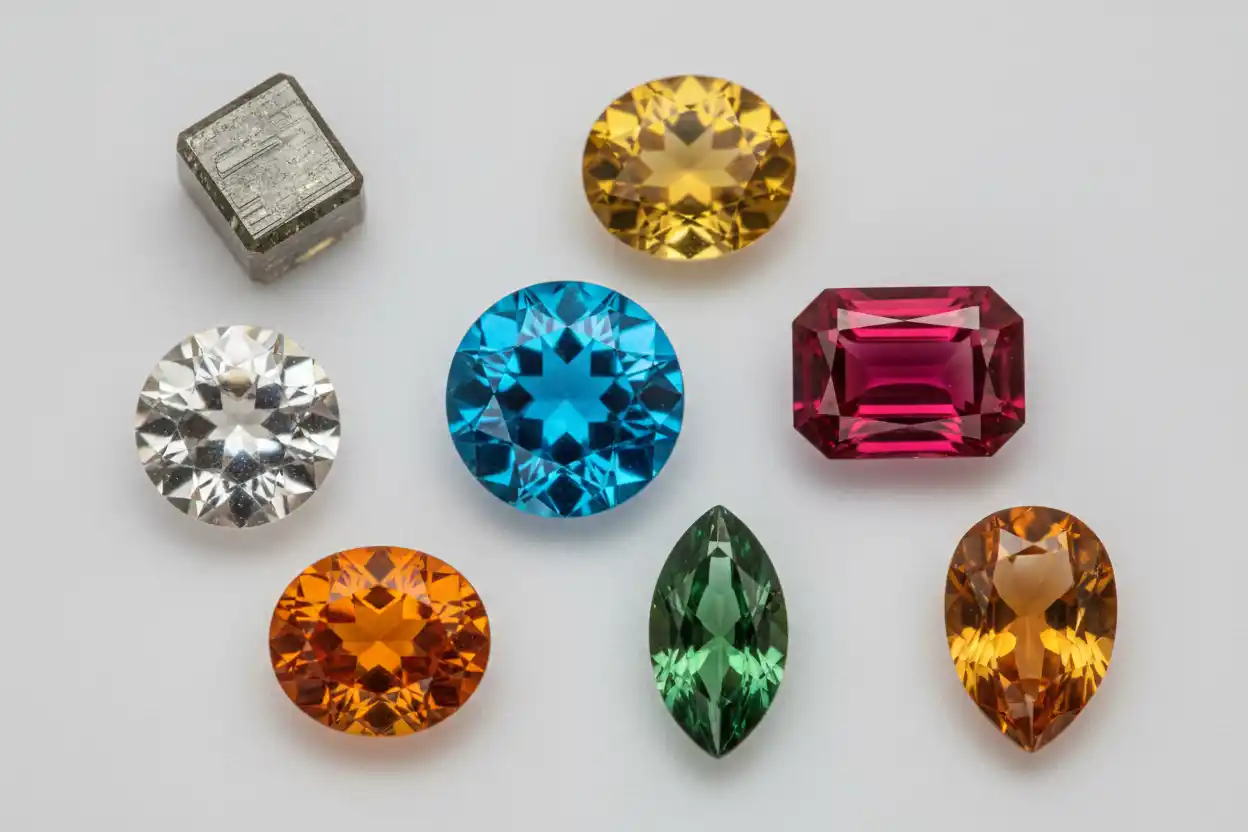
Types of Zircon: Colors and Varieties Explained
Zircon is a natural zirconium silicate gemstone with unusually high brilliance, dispersion and double refraction. Its types can be classified by color, structural condition, optical effect and historical trade name, but none should be confused with laboratory-made cubic zirconia.
This article owns the broad classification intent, while the zircon meaning guide covers the gem’s symbolism and historical associations in greater depth.
Zircon at a Glance
| Property | Zircon |
|---|---|
| Mineral group | Nesosilicate |
| Chemical composition | ZrSiO₄ |
| Crystal system | Tetragonal |
| Typical colors | Colorless, blue, yellow, orange, red, reddish-brown, brown, green, pink and violet |
| Crystal habit | Tetragonal prisms and dipyramids; rounded grains in alluvial deposits |
| Luster | Vitreous to adamantine |
| Transparency | Transparent to opaque |
| Refractive index | Approximately 1.810–1.984, depending on structural condition |
| Birefringence | Approximately 0.000–0.059, from low to high zircon |
| Specific gravity | Approximately 3.90–4.73 |
| Mohs hardness | Approximately 6–7.5 |
| Cleavage | Indistinct |
| Tenacity | Brittle; toughness generally fair to good |
| Common cuts | Rounds, ovals, cushions, brilliant cuts, mixed cuts and occasional cabochons |
| Main care concern | Facet edges can abrade, and some heat-treated colors can change after prolonged bright-light exposure |
Zircon Is Not Cubic Zirconia
Zircon is a naturally occurring mineral with the chemical formula ZrSiO₄. By contrast, cubic zirconia is a manufactured zirconium-oxide material produced in laboratories.
The two contain zirconium, but their crystal structures, chemistry, density, optical behavior and origins are different. Cubic zirconia is not a synthetic version of zircon because a true synthetic counterpart must reproduce the natural mineral’s essential composition and structure.
The types of cubic zirconia guide therefore covers a separate manufactured-gem category. This page focuses only on natural zircon and its recognized color, structural and optical forms.
How Zircon Types Are Classified
Zircon classification operates on two overlapping levels. The jewelry market divides stones by color and trade name, while gemologists also distinguish high, intermediate and low zircon according to radiation-related structural damage.
A blue zircon and a red zircon can both be structurally high zircon. Meanwhile, a green stone may belong to the low or intermediate structural category because natural radiation has disrupted its crystal lattice over geological time.
Therefore, color names and structural types should not be treated as competing systems. They describe different properties.
Zircon Color Varieties
Blue Zircon
Blue zircon is the most familiar commercial color and ranges from pale icy blue to greenish blue, turquoise-blue and vivid medium blue. Strongly saturated stones can show excellent brilliance and rainbow-colored fire.
Nearly all blue zircon begins as brown or reddish-brown rough and receives controlled heat treatment. Reducing conditions commonly produce blue to greenish-blue colors, although the exact response depends on composition and structural condition.
Blue is a color variety, not a separate zircon species. The stone remains natural zircon after heating, but the treatment should be disclosed.
Cambodia is particularly associated with commercial blue zircon, especially material from Ratanakiri. Myanmar, Vietnam and other sources also produce heat-treatable rough.
Colorless or White Zircon
Colorless zircon has historically served as a diamond imitation because of its high luster, dispersion and brilliance. However, strong double refraction and lower hardness distinguish it from diamond.
Natural colorless zircon occurs, but much commercial material has been heated from brown rough. The best stones appear bright and transparent without gray, brown or smoky modifiers.
White zircon is a trade color description rather than a separate variety. It should not be confused with white cubic zirconia.
Matara Zircon
Matara zircon is a traditional name for colorless zircon associated with the Matara region of Sri Lanka. Historical spellings include Matura.
The name is locality-linked and has sometimes been applied loosely to colorless zircon regardless of origin. Modern sellers should specify whether Matara describes documented provenance or merely a colorless appearance.
Yellow Zircon
Yellow zircon ranges from pale straw and lemon to rich golden yellow. Natural and heat-treated examples both occur.
Bright yellow stones are sometimes sold as canary zircon. Canary is an informal color description rather than a mineralogical variety.
Dark, muddy or strongly brownish-yellow stones generally receive lower prices than vivid golden material with good transparency.
Golden Zircon
Golden zircon displays a warm, saturated yellow to yellowish-orange appearance. Fine examples combine deep color with strong brilliance and can resemble golden sapphire, chrysoberyl or topaz.
The name golden zircon is descriptive. It does not indicate a particular mine, structural type or treatment condition.
Jargoon or Jargon Zircon
Jargoon, also spelled jargon, is a historical name for pale yellow, smoky or nearly colorless zircon. Usage has varied across periods and sources, so the term has no precise modern color boundary.
A seller should accompany it with an ordinary color description rather than expecting buyers to understand an archaic trade word.
Orange Zircon
Orange zircon ranges from yellowish orange to reddish orange. Some material receives heat treatment, while other stones retain natural color.
Fine orange zircon can show excellent fire, but overly dark brown modifiers may reduce face-up brightness. Tanzania and East Africa are associated with several distinctive orange deposits.
Mashewa Zircon
Mashewa zircon refers to orange to reddish-orange material associated with Tanzania’s Mashewa area. The name identifies locality rather than a separate mineral species.
Origin should be documented when the locality is used to justify a premium. Similar orange colors can occur in zircon from other regions.
Red Zircon
Red zircon is among the rarer and more collectible colors. It ranges from orangy red and brick red to deep reddish brown.
Bright red stones with good transparency are scarce, especially in larger sizes. Some historical descriptions overlap with the word hyacinth, although that term has not always been used consistently.
Hyacinth or Jacinth Zircon
Hyacinth and jacinth are historical names commonly applied to yellowish-red, orange-red, reddish-brown or garnet-red zircon. Ancient and medieval texts sometimes used the word for other similarly colored gems, so historical references do not always identify zircon conclusively.
In modern trade, hyacinth should be treated as a traditional color term rather than a formal variety. A precise description such as orangy-red zircon is clearer.
Brown Zircon
Brown is one of zircon’s common natural colors and includes honey-brown, cinnamon, reddish-brown and dark chocolate-brown stones. Much Cambodian and Southeast Asian rough is brown before heat treatment.
Transparent warm-brown stones can be attractive in their natural state. Chocolate zircon and cinnamon zircon are promotional color descriptions, not standardized varieties.
Green Zircon
Green zircon is uncommon in the jewelry market and especially interesting to collectors. Colors range from yellowish green and olive to deep forest green.
Many green zircons have experienced substantial radiation-related structural damage and may belong to the low or intermediate categories. Their refractive index, hardness, density and brilliance can therefore differ from ordinary high zircon.
Not every green zircon is metamict to the same degree. Laboratory measurement is needed to determine structural condition.
Pink and Purple Zircon
Pink, rose, lilac and purple zircon occur but remain much less common than blue, yellow or brown material. Some colors are natural, while heat treatment can modify certain stones.
Because saturation is often light and supply is limited, fine transparent examples appeal primarily to collectors. Pink zircon should not be confused with pink cubic zirconia or synthetic pink sapphire.
Black Zircon
Black zircon is uncommon as a transparent gem and may owe its appearance to dense inclusions, extreme structural damage or an opaque body color. Some commercial products labeled black zircon may be treated, coated or misidentified.
A laboratory report is prudent when a black stone is sold as rare natural zircon at a significant price.
Structural Types of Zircon
High Zircon
High zircon, also called normal zircon, retains a well-ordered crystal structure with relatively little radiation damage. It shows zircon’s expected high refractive index, density, hardness, birefringence and brilliance.
Virtually all zircon used in conventional transparent jewelry belongs to this structural category or has been restored toward it through heating.
Strong facet doubling is commonly visible in high zircon because of pronounced double refraction. This feature can help separate zircon from singly refractive cubic zirconia, spinel and diamond.
Intermediate Zircon
Intermediate zircon has experienced partial structural disruption from radioactive trace elements incorporated during growth. Its refractive index, density, hardness and birefringence fall between those of high and low material.
The stone may appear slightly hazy or less brilliant than high zircon. Heat can partially repair the structure, depending on the nature and extent of damage.
Low or Metamict Zircon
Low zircon has undergone extensive lattice damage over geological time. Uranium and thorium occur as trace substitutions in the crystal, and their radioactive decay gradually disrupts the surrounding structure.
Severely metamict zircon can become cloudy, less dense, softer and optically close to singly refractive. Green stones are commonly associated with this condition, although color alone is not conclusive.
The word metamict describes structural breakdown, not a treatment and not a separate chemical species. Heating may restore part of the crystal order and change the gem’s physical and optical properties.
Optical and Phenomenal Types
Cat’s-Eye Zircon
Rare zircon contains long, parallel inclusions that create chatoyancy when the stone is cut as a cabochon. Correct orientation produces a moving line across the dome.
Cat’s-eye zircon is usually collected as a curiosity rather than traded as a major commercial phenomenal gem. The strength, sharpness and centering of the eye determine its appeal.
Color-Change Zircon
A small number of zircons show different colors under daylight and incandescent illumination. Reported shifts can involve green, brown, gray, yellow or reddish tones.
The effect results from selective light absorption and should not be confused with ordinary pleochroism or unstable heat-treated color.
Photochromic Zircon
Rare zircon can change temporarily after ultraviolet or strong light exposure and then return toward its original appearance. This photochromic response is unusual and generally requires controlled observation.
Sellers should not apply the term to any stone that simply appears different in photographs or under warmer lighting.
Pleochroic Zircon
Some zircon shows different color intensity when viewed from different directions. Blue stones may display greenish or differently saturated directions, while other colors can also show directional variation.
Cutters orient the rough to obtain the most attractive face-up color and minimize distracting secondary hues.
Historical and Locality Trade Names
Ratanakiri Zircon
Ratanakiri zircon refers to stones associated with Cambodia’s Ratanakiri Province. The region is especially known for brown rough that can be heated to blue or colorless material.
The name is geographic rather than mineralogical. It should not be used as proof of treatment status because both untreated brown and heated colors can originate there.
Starlite Zircon
Starlite is a historical trade name associated with heat-treated blue zircon. It is not widely standardized in the modern market and does not indicate a star effect.
Because the word can create confusion with asterism or branded products, blue zircon is usually the clearer description.
Siam Zircon
Siam zircon is an older geographic trade name associated with material traded through Thailand. It may not prove that the crystal formed within modern Thailand because regional gem markets handle stones from neighboring countries.
Canary and Chocolate Zircon
Canary zircon describes bright yellow material, while chocolate zircon describes brown stones. Both are retail color names with no fixed mineralogical or geographic definition.
Formation and Geological Importance
Zircon crystallizes as an accessory mineral in many igneous rocks, especially granites, syenites, pegmatites and volcanic rocks. It also survives metamorphism and can recrystallize or grow new zones during geological events.
Because zircon resists chemical weathering and abrasion, crystals can remain intact after the surrounding rock breaks down. Rivers then concentrate the dense grains in alluvial gem deposits beside sapphire, spinel, garnet and other resistant minerals.
Zircon readily incorporates trace uranium but strongly rejects lead when it first crystallizes. As uranium decays to lead at measurable rates, geologists can use uranium-lead dating to calculate crystal ages.
Some detrital zircon grains from Western Australia are approximately 4.4 billion years old. Those microscopic grains are scientifically important rather than gem quality, but they demonstrate the mineral’s exceptional durability.
The broad types of gemstones guide places zircon among natural crystalline gem minerals rather than synthetic diamond substitutes.
Important Zircon Sources
Cambodia is a leading source of commercial brown rough used to produce blue and colorless zircon. Ratanakiri is particularly associated with this trade.
Sri Lanka has supplied colorless, yellow, brown, green and reddish zircon from alluvial gem gravels for centuries. The Matara name originates from this tradition.
Myanmar, Thailand and Vietnam also produce gem zircon. Vietnamese material includes reddish-brown stones that respond to controlled heating, while Myanmar supplies a range of natural and treated colors.
Tanzania produces orange, reddish-orange and brown material, including stones associated with the Mashewa area. Madagascar, Mozambique and Nigeria yield additional colors.
Australia contains abundant geological zircon and some gem material, although much production serves industrial zirconium markets rather than the jewelry trade.
Inclusions and Internal Features
Most faceted zircon appears eye-clean, but untreated stones can have a smoky, cloudy or hazy appearance. Radiation damage, minute particles, fractures and internal strain can all reduce transparency.
Microscopic features may include healed fractures, needles, tubes, growth zones, small crystals and fluid inclusions. Long parallel inclusions can create cat’s-eye material.
High zircon commonly shows pronounced doubling of opposite facet edges when viewed through the crown. This is an optical property rather than an inclusion, but it is one of the gem’s most useful identifying features.
Low zircon may show a less orderly internal appearance and reduced optical activity because radiation damage has disrupted the crystal lattice.
Identifying Zircon and Its Lookalikes
Zircon’s high refractive index, strong dispersion, substantial density and double refraction separate it from many gems. A trained observer can often see doubled pavilion facets with a loupe in high zircon.
The stone is significantly denser than quartz, beryl and topaz. Its refractive index is also higher, although low metamict zircon may give reduced readings.
Colorless zircon can resemble diamond, but diamond is singly refractive, much harder and has different thermal properties. Abraded zircon facet edges also contrast with the generally sharper junctions of a well-preserved diamond.
Cubic zirconia is singly refractive, typically heavier for the same dimensions and usually free from natural inclusions. It also has a different refractive index and crystal structure.
Synthetic spinel and glass can imitate blue, yellow or colorless zircon. Refractive index, birefringence, spectrum, density and magnification usually separate them.
The crystal identification guide explains why appearance alone is insufficient. Confusion with manufactured diamond substitutes is addressed further in moissanite versus cubic zirconia.
Treatments, Synthetic Material and Imitations
Heat Treatment
Heating is the dominant zircon treatment. Brown rough can be heated under reducing conditions to produce blue, while oxidizing conditions may create colorless, yellow or other lighter results.
Nearly all vivid blue zircon and much colorless zircon in the commercial market should be assumed heated unless a reliable laboratory concludes otherwise.
Heat can also repair part of the radiation-damaged crystal structure. Consequently, treatment may change not only color but also refractive index, density, birefringence and transparency.
The results are often stable during normal wear, but some heat-treated stones can return partly toward light brown after prolonged exposure to bright light.
Fracture Filling
Transparent zircon can theoretically be filled with resin or another substance to reduce the visibility of surface-reaching fractures. The treatment is rare compared with heating.
Filled material requires conservative care because heat and solvents may affect the filler.
Coatings and Misrepresentation
Surface coatings can alter the apparent color of many gems, including zircon, although coating is not a standard zircon treatment. Color concentrated at facet junctions, scratches or damaged areas can suggest a surface layer.
More commonly, sellers misrepresent cubic zirconia, synthetic spinel, glass or another transparent stone as natural zircon.
The complete terminology for heat, filling and coating remains with the gemstone treatments guide.
Synthetic Zircon
Laboratory-grown zircon has scientific uses, but it is not a significant commercial jewelry product. Most jewelry advertised as synthetic zircon is actually cubic zirconia or another imitation.
The lab-grown versus natural gemstone guide explains the formal distinction between a synthetic counterpart and a simulant.
Cutting and Polishing Behavior
Zircon’s high refractive index and dispersion make brilliant-style cuts especially effective. Rounds, ovals and cushions can show intense flashes of spectral color when the angles are well proportioned.
A historical modification called the zircon cut adds eight extra facets around the lower pavilion. The design can increase light activity, although it is now uncommon because it requires additional labor.
Step and mixed cuts are also used, particularly when the rough has an elongated form or a darker body color. Poor proportions can create a transparent window in the center and weaken the stone’s brilliance.
Strong birefringence requires thoughtful orientation. Excessive visible doubling may make small facets appear fuzzy, while good orientation balances sharpness, fire and color.
Zircon is brittle, so cutters must avoid excessive pressure and sudden temperature changes. Facet edges can chip during setting, and repolishing should be entrusted to a lapidary familiar with the material.
Durability and Jewelry Suitability
Zircon ranges from about 6 to 7.5 on the Mohs scale, depending partly on structural condition. The gemstone hardness chart helps place that range below sapphire and spinel but above many ornamental gems.
Its toughness is generally fair to good, yet the stone is brittle and facet junctions abrade more readily than its brilliant appearance suggests. High zircon is normally more durable than heavily metamict low zircon.
Earrings and pendants are excellent uses because they receive limited impact. Zircon necklaces and zircon earrings can showcase the stone’s fire with relatively low risk.
Rings require more care. A protective setting and sensible wear habits are important, as explained in the zircon ring guide.
Zircon can also appear in bracelets, but exposed facet edges may rub against desks, metal components or neighboring stones.
Zircon Prices in 2026
Commercial zircon remains relatively affordable compared with sapphire, ruby and diamond. Pale, small or included stones may retail for approximately $15–$50 per carat.
Current commercial blue zircon around one to two carats commonly falls near $15–$50 per carat. Better two- to five-carat blue stones often range from about $35–$180 per carat, while larger, well-cut blue gems can reach roughly $70–$350 per carat.
Colorless zircon commonly sells around $15–$80 per carat, depending on size, cut and transparency. It should remain substantially less expensive than diamond despite its strong fire.
Yellow, orange, brown and other fancy colors may range from approximately $15 to $250 per carat in ordinary sizes. Fine large stones, saturated orange-red material and collector-quality colors can approach or exceed $400 per carat.
Rare transparent green and bright red zircon can command higher specialist prices, particularly when the structural condition, color and treatment history are documented. Exceptional collector stones may exceed broad commercial ranges.
The complete valuation intent belongs to the zircon price guide. The separate cubic zirconia price guide should not be used as a comparison for natural zircon because the supply structures are fundamentally different.
Buying Guidance
Confirm that the seller means natural zircon rather than cubic zirconia. Product descriptions that abbreviate the material only as “zirconia,” “CZ zircon” or “created zircon” require clarification.
Assume bright blue zircon is heated unless a credible laboratory states otherwise. Heat treatment is accepted, but it should be disclosed and reflected in the description.
Check a faceted stone for chipped or worn facet junctions, especially around the girdle. Abrasion can reduce sparkle and may indicate that the gem requires repolishing.
View the stone under neutral and warm lighting. Blue zircon may reveal greenish pleochroism, while some treated colors can shift after prolonged strong illumination.
Because zircon is dense, compare millimeter dimensions as well as carat weight. A five-carat zircon will generally look smaller than a five-carat diamond or quartz gem.
Fine green, red, cat’s-eye, unusually large or reportedly unheated stones deserve laboratory verification. The zircon buying guide retains the full seller, report and valuation workflow.
When comparing against manufactured alternatives, use a separate cubic zirconia buying guide rather than treating the two materials as grades of the same gem.
Cleaning, Heat, Sunlight and Storage
Clean zircon with lukewarm water, mild soap and a soft brush. Rinse carefully and dry with a lint-free cloth.
Ultrasonic and steam cleaners are not recommended because zircon can be brittle and may contain fractures. The detailed procedure appears in the zircon jewelry cleaning guide.
Avoid high heat, sudden temperature changes and direct contact with a jeweler’s torch. Heat can alter color and place stress on included or fracture-filled stones.
Most zircon remains stable during normal wear. Nevertheless, some heat-treated blue or colorless stones can partially revert toward brown after prolonged exposure to strong light, so avoid leaving jewelry for weeks in a bright display window.
Store zircon separately from sapphire, ruby, diamond and other harder gems. A padded compartment prevents facet edges from rubbing against neighboring jewelry.
Meaning and Symbolism
Historical zircon lore is complicated because the gem was often confused with topaz, diamond, hyacinth and other stones. Modern traditions associate different colors with wisdom, prosperity, protection, rest or personal confidence.
These are cultural and personal interpretations rather than scientifically demonstrated properties. The separate zircon color meaning guide preserves that belief-based intent without confusing it with gemological color classification.
Zircon is one of the stones included in modern December birthstone lists, alongside turquoise and tanzanite.
Frequently Asked Questions
1. What is the difference between zircon and cubic zirconia?
Zircon is the natural mineral ZrSiO₄. Cubic zirconia is manufactured zirconium oxide with a cubic crystal structure and is not a variety or synthetic counterpart of zircon.
2. Is blue zircon naturally blue?
Naturally blue material is very rare. Nearly all vivid blue zircon in the jewelry market has been heated from brown or reddish-brown rough.
3. What are high, intermediate and low zircon?
They are structural categories based on how much natural radiation damage has disrupted the crystal lattice. High zircon retains normal properties, while low metamict zircon has undergone extensive damage.
4. What is hyacinth zircon?
Hyacinth or jacinth is a historical name for yellowish-red, orange-red or reddish-brown zircon. The term has also referred to other gems in older texts, so modern color descriptions are clearer.
5. What is Matara zircon?
Matara zircon is a traditional name for colorless zircon associated with the Matara region of Sri Lanka. The name has sometimes been applied loosely to colorless stones from other places.
6. Does Starlite zircon show a star?
No. Starlite is an older trade name for blue heat-treated zircon and does not indicate asterism.
7. Why is green zircon rare?
Transparent green gem material is scarce, and many green stones have radiation-damaged intermediate or low structures. Their unusual color and structural condition attract collectors.
8. Why do zircon facets look doubled?
Zircon is strongly doubly refractive. Light splits into two rays inside the stone, allowing doubled images of pavilion facet edges to appear through the crown.
9. Does cat’s-eye zircon exist?
Yes, but it is rare. Long parallel inclusions can create a moving eye when the stone is oriented and cut as a cabochon.
10. Can blue zircon fade in sunlight?
Some heat-treated stones can partially revert toward light brown after prolonged exposure to bright light. Ordinary wear is usually not a problem, but long-term display in intense light should be avoided.
11. Is zircon unsafe because it contains uranium or thorium?
Zircon can contain trace radioactive elements that gradually affect its crystal structure. Finished jewelry stones are not generally considered hazardous during ordinary handling, and the trace content is primarily relevant to gemology and geochronology.
12. Can zircon be worn every day?
It can be worn regularly with care, especially in earrings and pendants. Rings require a protective setting because zircon is brittle and its facet edges can abrade or chip.
Zircon’s color names are only one part of its classification. Its structural condition, treatment history and optical behavior provide equally important information, especially when evaluating green, blue, colorless or unusually valuable stones.
Zircon is listed in both Crystals That Start With Z and Gemstones That Start With Z.