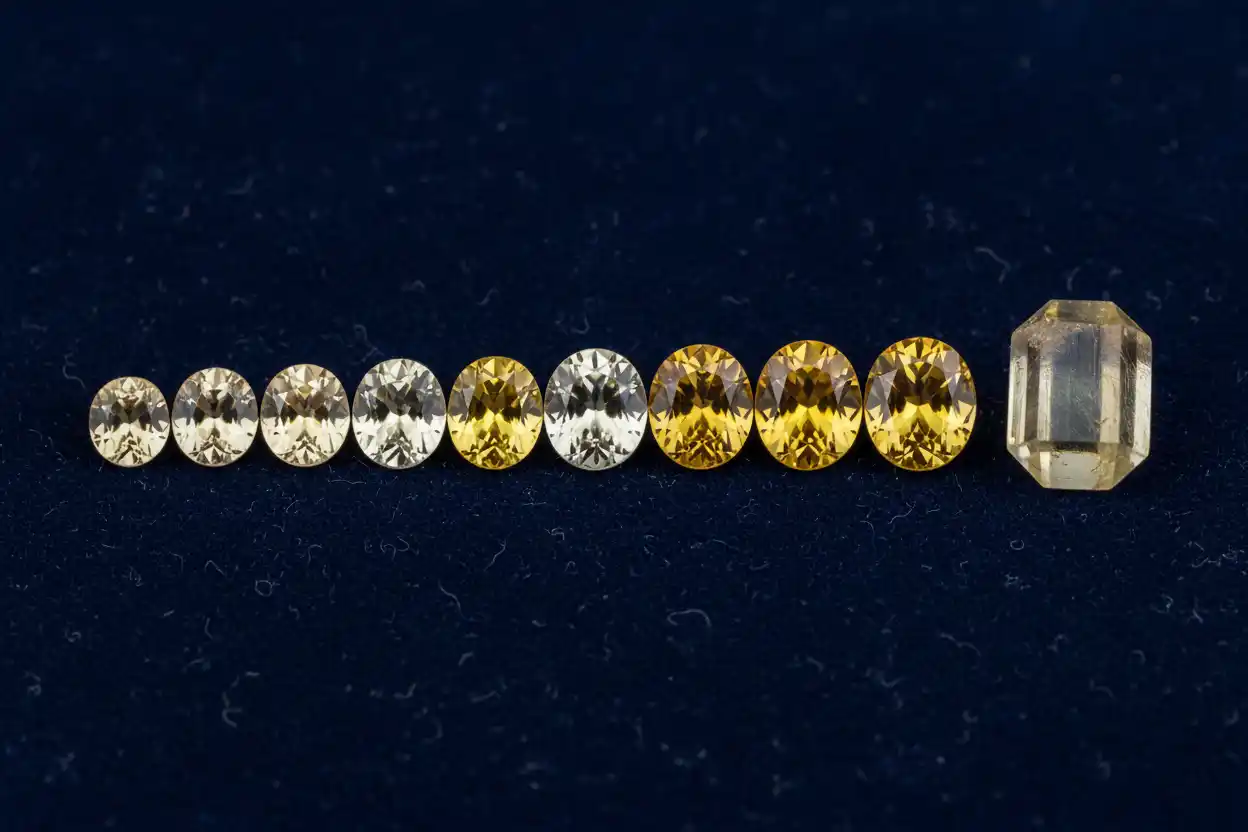
Yellow Sapphire: Meaning, Properties & Symbolism
Yellow sapphire is yellow-to-orangy-yellow corundum, the same mineral species as blue sapphire and ruby. Fine stones combine vivid saturation, high transparency, durable hardness and a cut that returns light without large dark or transparent areas.
Its color may be natural, enhanced by heat, created or modified through beryllium diffusion, or produced in a laboratory-grown crystal. Consequently, color alone cannot establish origin, treatment or value.
Yellow Sapphire at a Glance
| Property | Yellow Sapphire |
|---|---|
| Mineral species | Corundum |
| Chemical formula | Al₂O₃ |
| Mineral class | Oxide |
| Typical colors | Pale straw, lemon, canary, golden yellow, greenish yellow and orangy yellow |
| Major color causes | Ferric iron, iron-associated trapped-hole centers, heat-related color centers and treatment-related beryllium diffusion |
| Crystal system | Trigonal |
| Common habit | Barrel-shaped, bipyramidal, tabular, prismatic or waterworn alluvial crystals |
| Luster | Vitreous to subadamantine |
| Transparency | Transparent to opaque |
| Refractive indices | Approximately 1.762–1.770 |
| Birefringence | Approximately 0.008–0.010 |
| Optical character | Uniaxial negative |
| Specific gravity | Approximately 3.95–4.10 |
| Mohs hardness | 9 |
| Cleavage | None, although parting can occur |
| Tenacity | Brittle with excellent practical jewelry durability |
| Common cuts | Oval, cushion, round, pear, emerald, radiant and cabochon |
| Main buying concern | Heat, beryllium diffusion, synthetic origin, unstable color and exaggerated Pukhraj claims |
What Is Yellow Sapphire?
Yellow sapphire is yellow gem-quality corundum.
Corundum consists principally of aluminum and oxygen. Pure corundum is colorless, while trace elements and structural defects produce different colors.
A red chromium-rich corundum gem is classified as ruby. Corundum in other colors is classified as sapphire.
Therefore, yellow sapphire is not a mineral species separate from blue, pink, green or white sapphire. Its identity rests on corundum chemistry combined with a dominant yellow body color.
The parent sapphire guide owns family-level mineralogy, while Types of Sapphire explains the broader range of corundum colors and varieties.
This page focuses specifically on yellow color origin, treatment, identification, value and practical wear.
What Makes Sapphire Yellow?
Yellow sapphire color is more complicated than a simple statement that the stone contains iron.
Ferric iron, written chemically as Fe³⁺, can absorb portions of visible light and contribute yellow coloration.
A second important mechanism involves a positively charged trapped-hole center associated with ferric iron. This structural condition can produce a stronger yellow than iron alone.
Natural stones can contain either mechanism or a combination of both.
Heating colorless or weakly yellow sapphire may create stronger yellow color by changing the charge state and structural environment around iron.
Beryllium diffusion can also create or modify yellow and orange coloration at high temperatures.
Because several natural and treatment-related mechanisms can generate a similar face-up appearance, a laboratory must examine spectroscopy, trace chemistry, inclusions and growth features together.
Yellow Sapphire Color Range
Pale Straw Sapphire
Pale straw stones have weak saturation and may show gray, brown or green undertones.
They are normally more affordable than vivid yellow material.
A pale stone can still be attractive when it has excellent transparency, precise cutting and strong brightness.
Lemon Yellow Sapphire
Lemon-yellow sapphire has a relatively clean, slightly cool yellow.
Some stones show a faint green modifier, particularly under daylight-equivalent lighting.
A pronounced green component may reduce broad market demand, although collectors can value unusual natural colors.
Canary Yellow Sapphire
Canary is a commercial description for bright, saturated yellow.
It is not a laboratory-defined sapphire variety or universally standardized color grade.
Sellers may use the term for natural, heated, diffused or synthetic stones, so treatment disclosure remains essential.
Golden Yellow Sapphire
Golden material has a warmer yellow, sometimes with slight orange or brown modification.
Fine stones remain bright rather than overly dark.
Warm yellow can look richer under incandescent light and lighter under daylight.
Orangy-Yellow Sapphire
Orangy-yellow stones approach the boundary between yellow sapphire and orange sapphire.
When pink and orange combine within a narrow accepted range, a stone may enter padparadscha discussions. However, ordinary orangy-yellow sapphire should not be marketed as padparadscha sapphire without expert laboratory support.
Greenish-Yellow Sapphire
Greenish-yellow sapphire may occur naturally or through treatment.
Some buyers prefer pure yellow, while others value chartreuse or golden-green tones for their individuality.
Color description should record both the dominant yellow and its modifier rather than hiding green under a premium trade name.
Natural Yellow Sapphire
Natural yellow sapphire develops its color during geological formation or through natural radiation and structural processes after crystallization.
Untreated stones may show subtle color zoning, mineral inclusions, healed fractures and natural growth structures.
Some untreated yellow sapphires are light-stable. Others contain unstable color centers that can fade under strong light or heat.
Natural does not therefore mean that every color is permanently stable.
A laboratory may expose a stone to controlled light or perform spectroscopic testing when stability is a concern.
Untreated yellow sapphire receives a premium when the color is vivid, stable, attractive and supported by a respected report.
However, an unattractive untreated stone is not automatically more valuable than a beautiful, properly disclosed heat-treated gem.
Heat-Treated Yellow Sapphire
Heating is the most common sapphire enhancement.
Colorless or weakly yellow corundum containing suitable iron-related features can develop a stronger yellow during heat treatment.
Heating may also improve apparent clarity by altering rutile silk and healing certain fractures.
The resulting stone remains natural sapphire because the original corundum formed geologically.
A report may describe the stone as natural corundum with indications of heating.
Heat treatment is widely accepted, but it affects rarity and price. An unheated premium should not be paid without independent confirmation.
Some low-temperature and high-temperature processes are difficult to identify from visual inspection alone.
The complete treatment framework remains with How to Spot Treated or Synthetic Sapphire.
Beryllium-Diffused Yellow Sapphire
Beryllium diffusion is a high-temperature treatment that allows beryllium to enter the corundum lattice.
It can create or strengthen yellow, orange and related colors.
Unlike older shallow surface diffusion, beryllium can penetrate deeply enough that ordinary recutting may not remove the color.
A diffused stone is still natural corundum, but its color was created or substantially modified through treatment.
Beryllium-diffused yellow sapphire generally sells for less than a comparable naturally colored or conventionally heated stone.
Detection may require advanced trace-element analysis. A standard jeweler’s loupe cannot establish whether beryllium entered the crystal.
For valuable yellow sapphire, the report should address treatment rather than merely state that the material is natural sapphire.
Color Stability
Some yellow sapphires contain color centers that fade after exposure to visible light, ultraviolet radiation or heat.
A stone may look more saturated after storage in darkness and become paler after display.
Other yellow sapphires remain stable under ordinary conditions because their color derives mainly from ferric iron or stable treatment-created structures.
The buyer cannot reliably predict stability from hue, origin or price alone.
A laboratory may use controlled fading tests and spectroscopy to assess the color mechanism.
Retail photographs should represent the stable appearance rather than a temporary color produced through dark storage or recent irradiation.
A seller offering an expensive yellow sapphire should disclose known stability concerns.
Yellow Sapphire Versus Pukhraj
Pukhraj is a traditional South Asian name for yellow sapphire, particularly in Vedic astrology and related cultural practices.
The complete cultural, historical and buyer-intent discussion belongs to Pukhraj Yellow Sapphire in Vedic Tradition.
Gemologically, a Pukhraj sold as yellow sapphire should still be natural corundum.
The cultural name does not establish species, origin, treatment or quality.
Citrine, yellow topaz, yellow glass and synthetic sapphire are sometimes offered as low-cost substitutes. A substitute may be sold honestly when clearly disclosed, but it should not be represented as natural yellow sapphire.
Astrological claims should remain culturally framed and should not replace laboratory identification or medical, legal or financial advice.
How Yellow Sapphire Forms
Corundum forms in geological environments rich in aluminum but relatively poor in silica.
If abundant silica were present, aluminum would tend to enter feldspar, mica or other aluminosilicate minerals rather than form corundum.
Yellow sapphire occurs in metamorphic marble, gneiss, schist and other aluminum-rich rocks.
It can also form in basalt-related igneous environments and be carried toward the surface by volcanic activity.
Weathering releases resistant corundum crystals from the host rock.
Streams then transport and round them into alluvial gravels, where their high density allows concentration alongside zircon, spinel and garnet.
Iron availability and structural conditions during growth influence whether the sapphire becomes yellow, blue, green or nearly colorless.
Important Yellow Sapphire Sources
Sri Lanka
Sri Lanka is the best-known source of fine yellow sapphire.
Alluvial gravels yield pale lemon, golden, orangy-yellow and occasionally large transparent crystals.
Sri Lankan material can be untreated, heat treated or diffused after mining. Origin does not establish treatment.
The traditional term Ceylon sapphire refers to Sri Lankan origin, not one guaranteed color or quality grade.
Madagascar
Madagascar produces yellow sapphire from metamorphic and basalt-related deposits.
Fine natural stones can show vivid yellow and high transparency.
Madagascar has also supplied material used in scientific studies of natural, heated and beryllium-diffused yellow color.
Tanzania
Tanzania produces yellow, green, blue and multicolored sapphire from several deposits.
Songea material may be heat treated or beryllium diffused to improve yellow and orange colors.
Thailand and Cambodia
Thai and Cambodian deposits produce dark, iron-rich sapphire that can include yellow, green and brown colors.
Local heat-treatment industries have historically processed sapphire from several countries, so treatment location and geological origin may differ.
Australia
Australia produces yellow and greenish-yellow sapphire alongside its better-known dark blue material.
Some stones have strong iron content and deeper tones.
Montana
Montana deposits yield pale yellow, golden, greenish and bicolored sapphire.
American cutting can add a craftsmanship premium, but geological origin should be supported by documentation.
Additional Sources
Myanmar, Kenya, Nigeria and several other corundum-producing regions supply yellow sapphire in smaller quantities.
Inclusions and Internal Features
Natural yellow sapphire may contain rutile needles, zircon crystals, apatite, mica, spinel and other minerals.
Rutile silk can create a soft haze or, when aligned densely, a star effect in cabochon-cut material.
Healed fractures often form fingerprint-like networks.
Angular growth zoning can reveal changes in chemistry during crystal formation.
Heat may dissolve rutile, modify inclusions and create discoid stress fractures around mineral crystals.
Beryllium diffusion involves very high temperatures and can produce altered inclusions, recrystallized surfaces and unusual color distribution.
Synthetic sapphire may show curved growth lines, gas bubbles, flux residue or laboratory-specific growth structures.
No single inclusion proves origin or treatment in every stone, so laboratories combine several observations.
Yellow Star Sapphire
Yellow star sapphire contains aligned inclusions that reflect light as asterism.
Most stones show a six-rayed star.
The cabochon must be oriented so the rays cross near the center.
A sharp, complete and mobile star commands more than a diffuse off-center effect.
Yellow star sapphire is less common in the commercial market than blue or black star material.
Synthetic star sapphire also exists and can display extremely regular rays.
Diffusion can be used to create star effects near the surface, making laboratory identification important for expensive pieces.
Yellow Sapphire Versus Citrine
Citrine is yellow quartz with hardness 7 and specific gravity near 2.65.
Yellow sapphire has hardness 9 and specific gravity near 4.00.
Sapphire is normally more brilliant, denser and substantially more scratch-resistant.
Citrine is more abundant and generally much less expensive.
Heat-treated amethyst sold as citrine remains quartz and should not be represented as sapphire.
The complete distinction appears in Citrine vs Yellow Sapphire.
Yellow Sapphire Versus Yellow Topaz
Yellow topaz has hardness 8 and perfect basal cleavage.
Sapphire has no true cleavage and offers better everyday durability.
Topaz is generally available in larger sizes at lower prices.
Yellow topaz can have a softer, more glass-like brilliance, while sapphire has a higher refractive index.
The stones require gemological testing because color and cut can overlap closely.
Yellow Sapphire Versus Yellow Diamond
Yellow diamond has much greater brilliance, dispersion and hardness.
Its color comes largely from nitrogen-related defects rather than iron-related sapphire mechanisms.
Diamond is singly refractive, while sapphire is doubly refractive.
Fine fancy-yellow diamonds usually cost substantially more than comparable yellow sapphires.
Yellow sapphire offers rich color and daily durability without the pricing structure of a fancy-color diamond.
Yellow Sapphire Versus Yellow Glass
Yellow glass can imitate a clean sapphire at low cost.
Rounded bubbles, flow lines, surface scratches and low density can reveal glass.
Some glass is exceptionally clean, so the absence of bubbles does not prove sapphire.
A thermal tester designed only for diamond may not identify colored glass correctly.
Refractive index and spectroscopy provide dependable separation.
Identifying Real Yellow Sapphire
A gemologist expects corundum refractive indices near 1.762–1.770 and specific gravity near 4.0.
Double refraction is low but measurable.
Sapphire remains inert to ordinary acid and ranks 9 on the Mohs scale.
Scratch testing should never be performed on finished jewelry.
Microscopic inclusions help evaluate natural versus synthetic origin and provide evidence of heating.
Ultraviolet-visible, infrared and Raman spectroscopy examine color centers, inclusions and mineral identity.
Trace-element analysis can detect beryllium diffusion and support geographic-origin opinions.
The consumer-level checklist remains with Real vs Fake Sapphire and How to Identify Crystals.
Synthetic Yellow Sapphire
Laboratory-grown yellow sapphire has the same essential Al₂O₃ composition and corundum structure as natural sapphire.
Flame-fusion growth produces affordable clean crystals and may leave curved growth lines or gas bubbles.
Flux and hydrothermal methods can create more natural-looking inclusions.
Czochralski and related techniques produce large high-purity synthetic corundum for technical and gem use.
Synthetic yellow sapphire can be beautiful and durable, but it should be disclosed and priced separately.
The broad distinction appears in Lab Sapphire: Meaning, Properties & Symbolism and Lab-Grown vs Natural Gemstones.
Cutting and Optical Performance
Yellow sapphire is cut into ovals, cushions, rounds, pears, emerald cuts and fantasy shapes.
Color is the dominant value factor, so cutters orient rough to maximize saturation while avoiding excessive brown or green.
A shallow pavilion creates a window through the center.
An overly deep cut hides weight below the girdle and makes the stone appear smaller than its carat weight suggests.
Dark extinction areas reduce brightness.
Cutters may retain extra weight because sapphire rough is valuable, but buyers should prioritize face-up appearance and dimensions.
Vivid yellow can tolerate a brilliant cut, while richly saturated orangy-yellow material may benefit from step or mixed cuts that preserve color.
Hardness, Toughness and Jewelry Suitability
Yellow sapphire measures 9 on the gemstone hardness chart.
It resists everyday scratching better than nearly every colored gemstone.
Corundum has no true cleavage, although parting and fractures can occur.
The distinction between scratch resistance and breakage resistance appears in Gemstone Toughness vs Hardness.
Sapphire remains brittle and can chip at exposed corners or thin girdles.
Its overall durability makes it suitable for rings, bracelets, earrings and pendants.
Yellow Sapphire Jewelry
A sapphire ring can support daily wear when the setting protects corners and the stone has no major surface-reaching fractures.
Yellow sapphire is also used in sapphire engagement rings because it combines bright color with exceptional hardness.
Sapphire necklaces and sapphire earrings allow larger stones with lower impact risk.
Sapphire bracelets require secure settings because repeated contact can loosen stones.
Yellow gold can intensify a warm yellow body color, while white metals make green or brown modifiers more visible.
Yellow Sapphire Prices in 2026
Yellow sapphire prices vary dramatically with treatment, color, clarity, cut and size.
Small commercial heated or diffused stones commonly begin around $100–$300 per carat.
Better heat-treated natural sapphires with attractive yellow color commonly range from approximately $300–$1,000 per carat.
Current specialist listings show approximately one-carat heated stones around $800 per carat, while lower-priced lattice-diffused material can appear near $190 per carat.
Fine vivid stones of several carats can range from approximately $1,000–$2,500 per carat.
Large vivid Sri Lankan stones currently appear in specialist inventories above $2,500 per carat.
Unheated yellow sapphire can command a premium when the color is stable, vivid and laboratory documented.
Pale, included, poorly cut or unstable stones may sell far below these ranges.
The complete sapphire-family value framework remains with the Sapphire Price Guide.
What Determines Value?
Color is the leading factor.
The strongest broad demand favors vivid yellow to orangy-yellow without excessive gray, brown or green.
Color stability matters because a temporarily saturated stone may fade after purchase.
Natural versus synthetic origin creates a major price distinction.
Treatment also matters. Unheated generally receives the highest premium, followed by conventionally heated material, while beryllium-diffused stones sell for less when other qualities are comparable.
Clarity should be judged alongside color. Minor natural inclusions are acceptable, but large fractures reduce beauty and durability.
Cut controls brightness, windowing and face-up size.
Carat weight increases value per carat when color and quality remain strong.
Laboratory documentation adds confidence, particularly for unheated status, diffusion testing and origin claims.
Buying Guidance
Use the full Sapphire Buying Guide for seller, report and quality checks.
Request a report from a respected independent laboratory for any meaningful purchase.
The report should identify natural or laboratory-grown origin and address heat or lattice diffusion.
Ask whether color stability was evaluated.
View the sapphire under daylight-equivalent and warm indoor light.
Check for a green, brown or gray modifier that retail photography may hide.
Compare face-up dimensions, not carat weight alone.
Inspect the center for windowing and the edges for chips.
Do not accept a generic Pukhraj certificate that lacks recognized gemological testing.
Astrological suitability and gemological quality are separate considerations.
Cleaning and Storage
Clean yellow sapphire with warm water, mild soap and a soft brush.
The complete procedure appears in How to Clean Sapphire Jewelry.
Untreated and heat-treated sapphires without serious fractures can often tolerate ultrasonic cleaning.
Warm soapy water remains the safer default when treatment or filling is uncertain.
Avoid ultrasonic and steam cleaners for fracture-filled, coated or heavily included stones.
Keep the gem away from strong heat during jewelry repair.
Store sapphire separately because it can scratch most other gemstones.
Limit unnecessary intense ultraviolet exposure when a yellow stone’s color stability has not been confirmed.
Meaning and Symbolism
Yellow sapphire has long-standing cultural importance in South Asia, especially within Vedic and Jyotish traditions.
It is commonly associated there with Jupiter, learning, prosperity, marriage, generosity and wise judgment.
Those beliefs vary by tradition and practitioner and should not be presented as universal outcomes.
Modern crystal symbolism also connects yellow sapphire with confidence, intellectual focus, optimism and responsible leadership.
Its durability encourages interpretations involving commitments intended to remain steady through pressure.
These meanings are cultural, spiritual or personal rather than scientifically demonstrated effects.
The broader comparison of sapphire colors remains with Sapphire Color Meaning and Symbolism.
Yellow sapphire also appears among yellow crystals and yellow gemstones.
Frequently Asked Questions
1. Is yellow sapphire a real sapphire?
Yes. It is yellow corundum, the same mineral species as blue and pink sapphire.
2. What makes sapphire yellow?
Ferric iron, iron-associated trapped-hole centers and treatment-related structural changes can create yellow color.
3. Is all yellow sapphire heat treated?
No. Untreated natural stones exist, but heating is common and should be addressed by a laboratory report.
4. What is beryllium-diffused yellow sapphire?
It is natural corundum whose color was created or modified by introducing beryllium at very high temperature.
5. Can yellow sapphire fade?
Some yellow color centers are unstable and can fade under light or heat. Other stones remain stable.
6. Is Pukhraj the same as yellow sapphire?
Pukhraj traditionally refers to yellow sapphire, but the name alone does not prove that a stone is natural corundum.
7. How can yellow sapphire be distinguished from citrine?
Sapphire is denser, harder and has different optical properties. Laboratory testing provides a dependable identification.
8. Is laboratory-grown yellow sapphire durable?
Yes. Synthetic corundum has essentially the same hardness and structure as natural sapphire, but it has a different origin and value.
9. Is yellow sapphire suitable for an engagement ring?
Yes. Hardness 9 and excellent practical durability make it suitable for regular ring wear.
10. Can yellow sapphire go in an ultrasonic cleaner?
Untreated or heat-only stones without significant fractures often can, but warm soapy water is safer when treatment is uncertain.
11. How much is yellow sapphire worth?
Commercial treated stones may begin near $100–$300 per carat, while vivid, large or unheated stones can reach $1,000–$2,500 per carat or more.
12. Does yellow sapphire have scientifically proven healing properties?
No. Cultural and personal symbolism can be meaningful, but scientific evidence does not establish healing or guaranteed astrological effects.
Yellow sapphire rewards precise disclosure. A vivid stone may be naturally colored, heated, beryllium diffused or laboratory grown, and each category can produce an attractive gem. Its lasting value depends on identifying which process created the color and pricing it accordingly.
Yellow sapphire appears in Crystals That Start With Y and Gemstones That Start With Y.