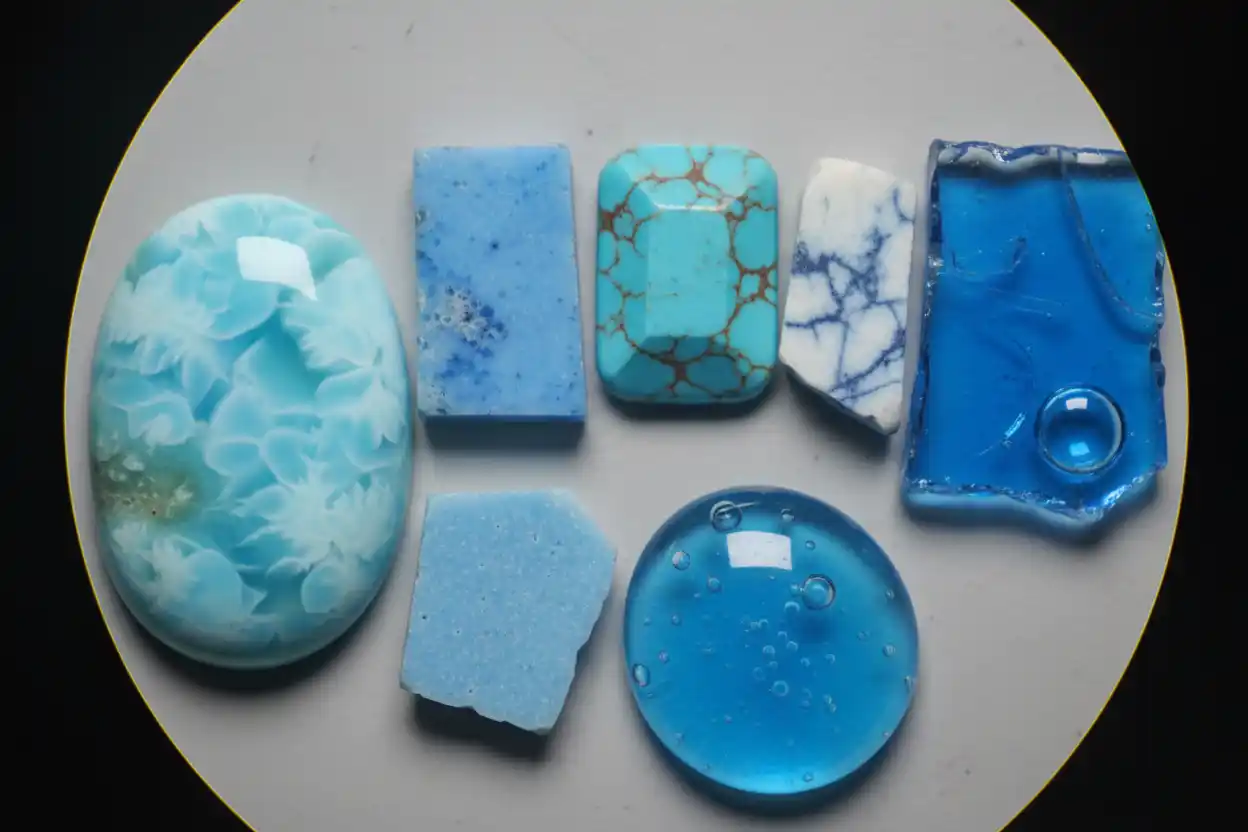
Real vs Fake Larimar: Pectolite Identification and Imitations
Real Larimar is the accepted trade name for blue pectolite associated with the Dominican Republic. It is typically opaque to translucent and displays pale sky blue, turquoise blue, green-blue, or deeper blue separated by white fibrous, cloud-like, feathery, or radial structures.
Imitations include ceramic, resin, glass, dyed howlite, magnesite, quartzite, calcite, and other blue stones. Turquoise, hemimorphite, smithsonite, and blue chalcedony can also resemble selected Larimar colors without being deliberately manufactured.
Genuine Larimar may additionally be dyed, filled, coated, stabilized, or assembled. Therefore, material identity, color origin, and construction must be evaluated independently.
This page owns the direct authenticity workflow. The completed treated Larimar guide retains enhancement processes, altered color, fillers, and disclosure.
Genuine Larimar vs Common Imitations
| Feature | Genuine Larimar | Ceramic imitation | Dyed howlite or magnesite | Glass | Resin or composite |
|---|---|---|---|---|---|
| Material | Blue pectolite aggregate | Manufactured ceramic | Different porous mineral | Manufactured glass | Polymer or bonded fragments |
| Typical pattern | Fibrous, cloudy, feathered, radial, or spheroidal blue-and-white structure | Painted or manufactured cloud patterns | Dark veins or porous dye concentration | Flow lines, bubbles, or uniform body | Poured swirls, mold lines, or fragment boundaries |
| Refractive index | Aggregate readings commonly around 1.59–1.63 | Usually lower or otherwise different | Mineral-dependent | Glass-dependent | Polymer-dependent |
| Specific gravity | Variable, commonly around 2.6–2.9 | Often lower | Mineral-dependent | Variable | Commonly lower |
| Hardness | Roughly 4.5–6 depending on compactness and structure | Variable | Commonly softer | Often around 5–6 | Commonly softer |
| Texture | Finely fibrous aggregate | Granular or homogeneous manufactured body | Chalky, porous, or veined | Amorphous glass texture | Cast or reconstructed |
| Natural inclusions | Calcite veinlets, hematite patterns, copper minerals, natrolite, or matrix | Gas bubbles and artificial color concentrations may occur | Dye in pores and veins | Bubbles and curved flow may occur | Casting bubbles and fillers |
| Best confirmation | Microscopy, spot RI, density, Raman, or XRD | Standard gem testing | Mineral identification | Optical testing | Microscopy and spectroscopy |
Color and pattern remain screening clues rather than proof. A sophisticated imitation can reproduce pale blue, white clouds, and polished translucency.
What Is Genuine Larimar?
The completed Larimar meaning guide owns geology, symbolism, use, and general properties.
Larimar is a blue variety of pectolite, a sodium calcium silicate hydroxide. Pectolite crystallizes in the triclinic system, although gem-quality Larimar usually appears as a compact fibrous aggregate rather than as isolated transparent crystals.
The material occurs in veins and cavities within altered volcanic rocks in the Dominican Republic. It is not volcanic glass and did not cool as a blue lava.
Hydrothermal fluids deposited pectolite within the host rock. Fine fibers and spheroidal aggregates create the patterns visible in polished cabochons.
The Larimar trade identity is tied to Dominican blue pectolite. A visually similar blue mineral from another country should be identified by its actual mineral and origin rather than borrowing the name automatically.
Larimar Color
Larimar ranges from nearly white through pale blue, sky blue, turquoise blue, greenish blue, and deeper blue.
Fine blue is associated with trace copper-related absorption. Copper is present only in small quantities rather than as a major structural component.
White areas commonly consist of calcite or pale pectolite structures. Brown, red, black, or gray inclusions may reflect hematite, copper minerals, altered host rock, or other associated material.
A dark saturated blue can attract a premium, but color should remain natural-looking and integrated with the fibrous structure.
Uniform neon blue, painted-looking patches, or identical color in every bead deserves closer examination.
The planned blue gemstones guide places Larimar among other blue materials without replacing mineral identification.
Natural Fibrous Patterns
Larimar commonly displays fibrous spheroids that intersect as rounded clouds, feathers, fans, or branching white structures.
Some cabochons resemble sunlight moving through shallow seawater. Others show dense white pectolite or calcite between blue areas.
The pattern should possess depth. Fine lines may continue below the polished surface and change when the stone is rotated.
Manufactured swirls often look painted, poured, or perfectly smooth. Natural fibers may have subtle texture, uneven edges, and multiple overlapping scales.
However, a low-pattern natural Larimar can appear comparatively uniform. Absence of dramatic white webbing does not automatically prove imitation.
White Calcite Veins
White calcite veinlets commonly separate fibrous pectolite areas.
The calcite may appear opaque, cloudy, or slightly translucent. It can be thin and delicate or occupy a substantial part of a cabochon.
Too much calcite generally reduces the amount of blue and may lower commercial value. It does not make the piece fake.
Imitations may paint white streaks over a blue base or suspend white pigment in resin. Examine whether the white material continues through edges and drill holes.
Do not use acid to test suspected calcite. Pectolite and associated minerals can be damaged, while the result adds little to a safe identification.
Red-Plume and Dark Inclusions
Some Larimar contains fern-like or dendritic reddish patterns associated with hematite.
Copper sulfide minerals such as chalcocite may occur as dark inclusions. Natrolite and host-rock material can also appear.
These inclusions create legitimate natural variety but do not authenticate every stone. Pigment, glitter, and mineral fragments can be embedded in resin or ceramic.
Magnification should reveal how the inclusion relates to the surrounding fibrous growth rather than simply confirming that a red or black mark exists.
Larimar Versus Turquoise
Turquoise is a hydrated copper aluminum phosphate, whereas Larimar is pectolite.
Turquoise commonly forms nodules, vein fillings, and crusts. Its matrix may be brown, black, or gray, while Larimar more often displays white fibrous clouds.
Larimar is usually softer and has a different refractive index and density.
The completed Larimar versus turquoise guide owns the full comparison. The planned real-versus-fake turquoise guide retains turquoise imitation and treatment details.
A retailer’s phrase Caribbean turquoise does not turn Larimar into turquoise.
Dyed Howlite and Magnesite
Howlite is white and porous with gray or black web-like veins.
After dyeing, it can resemble turquoise or low-pattern Larimar. Dye tends to concentrate in veins, pores, drill holes, and surface-reaching fractures.
Magnesite can be dyed similarly and may show a chalky or granular texture.
Larimar’s white areas tend to be fibrous or cloud-like rather than dark spiderweb lines. Nevertheless, dyed host minerals vary, making optical or Raman testing more reliable.
Ceramic Larimar Imitations
Ceramic can reproduce Larimar’s opaque blue-and-white appearance effectively.
One documented imitation contained whitish gas bubbles and dark-blue color concentrations. Its refractive index and density were substantially lower than genuine pectolite.
Ceramic patterns may appear painted or suspended in a comparatively uniform manufactured body. Chips can reveal a differently colored interior.
A ceramic cabochon may still feel cool and stone-like, defeating touch tests.
Microscopy, spot refractive index, and hydrostatic density usually provide stronger evidence than appearance alone.
Glass Imitations
Glass may be transparent, translucent, or opaque and can incorporate white swirls.
Round bubbles, curved flow lines, mold seams, and homogeneous blue areas suggest manufacture.
High-quality glass can lack obvious bubbles. Conversely, natural pectolite may contain cavities or pale rounded structures that an inexperienced observer could misread.
Glass does not possess Larimar’s fibrous pectolite aggregate. Raman spectroscopy or refractive measurements resolve difficult cases.
Resin and Plastic
Resin can be poured into blue-and-white swirls, mixed with stone powder, or cast around genuine Larimar fragments.
Common clues include mold seams, repeated patterns, casting bubbles, low weight, soft surface scratches, and transparent polymer between fragments.
Some composites contain enough natural material to be marketed ambiguously as stabilized Larimar. The invoice should state whether the item is solid stone, filled stone, reconstructed material, or resin composite.
A hot needle should never be used. It damages the object and can release fumes.
Dyed Calcite and Other Blue Stones
Calcite can be dyed pale blue and cut into cabochons. Its softness and cleavage differ from pectolite, but destructive tests are unnecessary.
Blue chalcedony and quartzite have different grain textures and lower refractive-index ranges.
Smithsonite can appear blue-green, waxy, and translucent. Hemimorphite may show pale blue botryoidal or fibrous forms.
These stones are genuine natural materials. They become Larimar imitations only when sold under the wrong identity.
Is Synthetic Larimar Common?
True laboratory-grown pectolite matching natural Larimar is not a standard mainstream jewelry product.
Listings using synthetic Larimar often refer to resin, ceramic, glass, reconstructed stone, or another blue material.
The accurate label should name the actual substance. Laboratory-created language should not be used merely to make plastic or ceramic sound equivalent to pectolite.
The laboratory-grown-versus-natural gemstone guide explains the distinction between synthetic counterparts and visual simulants.
Dyed and Stabilized Larimar
Although fine Larimar has natural blue color, lower-grade material may be dyed or coated.
Dye can accumulate in cracks, fibrous boundaries, pits, and drill holes. Surface coating may wear from edges and reveal a paler body.
Resin stabilization can fill fractures, strengthen weak areas, and improve polish. Transparent bubbles or areas of different luster may reveal filler.
The completed treatment guide owns the detection and care details. The general gemstone treatments guide explains how stabilization differs from reconstruction.
Hardness and Durability
Larimar’s fibrous aggregate can show better toughness than a single pectolite crystal, but it remains comparatively soft.
Values can vary from roughly 4.5 to 6 according to compactness, associated minerals, and test location.
It scratches more readily than quartz, topaz, sapphire, and diamond.
The gemstone hardness chart provides scratch-resistance context. The toughness-versus-hardness guide explains why fibrous structure can resist some fractures while thin edges and included zones remain vulnerable.
Scratch testing a finished cabochon is destructive and cannot prove Dominican origin.
Refractive Index
Genuine Larimar commonly gives aggregate refractive-index readings around 1.59–1.63.
The precise result varies because the material is polycrystalline and can include calcite, natrolite, hematite, or copper minerals.
Ceramic, glass, howlite, magnesite, quartz, and resin typically produce different readings.
A flat polished area is preferable. Curved cabochons may provide only spot readings.
Specific Gravity
Larimar density varies with purity and inclusions.
Published specimens have ranged roughly from 2.62 to 2.90, with typical fine blue material near 2.8.
Calcite, natrolite, copper minerals, matrix, filler, and porosity can shift the result.
Resin and ceramic imitations may be substantially lighter, although fillers can be added to imitate stone-like heft.
Mounted jewelry cannot be weighed hydrostatically with useful accuracy.
Ultraviolet Light
Blue and green pectolite can show zoned fluorescence, with reactions differing between blue areas, pale fibers, and associated minerals.
Imitations may fluoresce because of ceramic pigments, resin, glue, or dyes.
No one ultraviolet color proves Larimar.
UV is most useful for locating inconsistent filler or manufactured material when combined with microscopy and physical measurements.
Heat and Color Stability
Larimar should not be heated for identification.
High heat can whiten the material, create small fractures, reduce transparency, and weaken the stone.
Ordinary brief light exposure does not provide a useful authenticity test. Prolonged intense sunlight can heat jewelry unnecessarily and may affect dyes or fillers.
Do not attempt to prove genuineness by leaving a stone in the sun to see whether it fades.
Magnification
A 10× loupe can reveal fibrous texture, calcite boundaries, hematite patterns, gas bubbles, dye concentration, coating wear, resin, and mold seams.
Inspect the edge and back of a cabochon. Determine whether the pattern continues beneath the surface.
Drill holes are particularly informative because they expose internal material and often collect dye or resin.
A convincing natural pattern should change organically through the depth rather than remaining a flat painted design.
Raman and X-Ray Identification
Raman spectroscopy can identify pectolite, calcite, quartz, howlite, smithsonite, and many imitations.
X-ray diffraction confirms crystalline pectolite in fine-grained material.
Chemical analysis can identify the sodium-calcium-silicate composition and trace copper associated with blue color.
The gemstone certification guide explains when formal testing is worthwhile. The guide to reading a gem laboratory report helps distinguish identification from unsupported locality or value claims.
Provenance and Dominican Origin
Larimar’s accepted trade identity depends on Dominican origin.
A seller should provide a credible supply history rather than relying on Caribbean blue, Atlantis stone, or volcanic gemstone language.
Visual appearance cannot prove a specific mine or dealer chain.
For an expensive carving or exceptional deep-blue piece, an independent laboratory can confirm pectolite. Exact geographic origin may still rely on documentation and traceability.
A Safe Home Inspection Sequence
Begin with neutral daylight. Compare color and pattern from the front, back, and edges.
Use a loupe to look for fibrous spheroids, white mineral boundaries, dark inclusions, bubbles, dye, and resin.
Check whether several beads repeat exactly. Sequential natural pieces may relate, but identical manufactured swirls are suspicious.
Compare the seller’s disclosure with the object’s construction. Natural pectolite, treated pectolite, reconstructed material, and ceramic require different descriptions.
Do not scratch, apply acid, use a hot needle, expose the stone to flame, or test fading through prolonged sunlight.
Buying Genuine Larimar
The completed Larimar buying guide owns color, pattern, cutting, seller, and provenance criteria.
Detailed values remain within the Larimar price guide.
Request exact-item photographs and videos. Ask whether the stone is solid natural Larimar, dyed, filled, stabilized, coated, or composite.
For online transactions, follow how to buy gemstones online and retain a meaningful inspection period.
Larimar Jewelry and Care
A Larimar ring needs a protective setting and selective wear.
A Larimar necklace or Larimar earrings generally faces less impact than a Larimar bracelet.
Use the completed Larimar jewelry cleaning guide rather than steam, ultrasonic vibration, harsh chemicals, or high heat.
Belief-based care belongs in how to cleanse and charge Larimar and should use physically gentle methods.
Frequently Asked Questions
1. What is genuine Larimar?
Genuine Larimar is blue pectolite associated with deposits in the Dominican Republic.
2. Is Larimar a volcanic glass?
No. It is a fibrous pectolite aggregate deposited hydrothermally within altered volcanic host rocks.
3. Does all real Larimar have white patterns?
No. White fibrous and calcite structures are common, but some genuine pieces are relatively uniform.
4. What commonly imitates Larimar?
Ceramic, resin, glass, dyed howlite, magnesite, calcite, quartzite, and other blue stones are common alternatives.
5. Is turquoise the same as Larimar?
No. Turquoise is a copper aluminum phosphate, while Larimar is blue pectolite.
6. Are dark spots proof that Larimar is real?
No. Genuine pieces may contain hematite, copper minerals, or matrix, but dark particles can also be embedded in imitations.
7. Can Larimar be dyed?
Yes. Pale or low-quality material may be dyed or coated, and treatments should be disclosed.
8. Does synthetic Larimar exist?
True synthetic pectolite is not common in ordinary jewelry. Products labeled synthetic Larimar are often ceramic, resin, glass, or composites.
9. Can I use an acid test?
No. Acid damages pectolite and calcite and is unsuitable for finished jewelry.
10. Does real Larimar fade in sunlight?
Sunlight is not a reliable authenticity test. Avoid prolonged intense exposure because heat and undisclosed treatments may affect the piece.
11. Which measurements identify Larimar?
Aggregate refractive index around 1.59–1.63 and density commonly around 2.6–2.9 support pectolite when combined with microscopy.
12. When should Larimar be professionally tested?
Testing is useful for expensive deep-blue pieces, major carvings, disputed Dominican provenance, or suspected ceramic and composite material.
Genuine Larimar has a recognizable fibrous pectolite structure, but its color and pattern vary too much for one visual rule. A strong conclusion combines depth of pattern, aggregate texture, refractive index, density, and accurate Dominican provenance. Ceramic and resin can imitate the ocean-like appearance; they cannot reproduce the complete mineral evidence.
Larimar is indexed in Crystals That Start With L and Gemstones That Start With L.