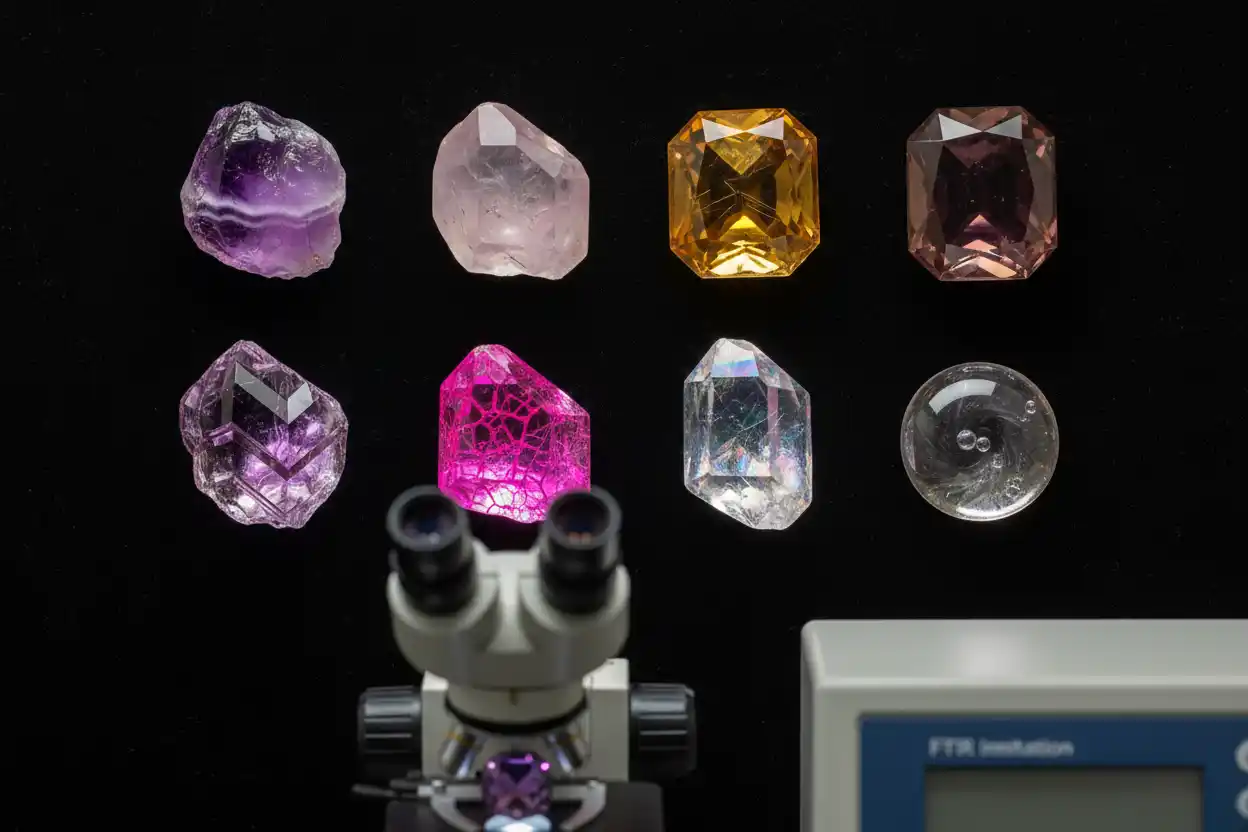
How to Spot Treated or Synthetic Amethyst
Amethyst is purple crystalline quartz. Its color arises from iron-related defects and natural radiation acting within the quartz structure.
Most commercial Amethyst is sold with natural purple color, but treatment can lighten overly dark material, remove brownish components, intensify or create purple through irradiation, convert Amethyst into Citrine or Prasiolite, add dye, coat the surface, or fill fractures.
Hydrothermal synthetic Amethyst is also commercially available. Because natural and synthetic Amethyst share quartz’s composition, crystal structure, hardness, density, and refractive index, ordinary home tests cannot establish geological origin.
The correct identification process separates treatment from synthesis. A heated natural Amethyst remains natural quartz. A hydrothermal synthetic Amethyst is laboratory-grown quartz. Dyed glass or purple resin is an imitation with a different material identity.
Amethyst treatment categories at a glance
| Product category | What changed | Common evidence | Correct description |
|---|---|---|---|
| Natural-color Amethyst | Natural quartz with purple color centers | Natural zoning, inclusions, quartz properties | Natural Amethyst |
| Heat-lightened Amethyst | Dark or brownish Amethyst heated | Reduced darkness, changed inclusions, altered zoning | Heat-treated Amethyst |
| Heat-converted Citrine | Amethyst heated until purple becomes yellow or orange | Yellow-orange color, altered iron inclusions | Heat-treated Citrine |
| Heat-converted Prasiolite | Certain Amethyst heated to green | Pale green quartz | Heat-treated Prasiolite |
| Irradiated Amethyst | Suitable quartz irradiated to create or strengthen purple | Treatment-related color centers, difficult visual detection | Irradiated quartz |
| Dyed Amethyst | Pale quartz or fractured material colored purple | Dye in cracks, drill holes, pores, and grain boundaries | Dyed quartz |
| Coated Amethyst | Purple or iridescent surface film | Edge wear, peeling, surface-only color | Coated quartz |
| Fracture-filled Amethyst | Cracks filled with resin, glass, oil, or polymer | Flash effects, bubbles, luster differences | Filled Amethyst |
| Hydrothermal synthetic Amethyst | Laboratory-grown quartz | Seed-related growth, synthetic inclusions, FTIR evidence | Synthetic Amethyst |
| Reconstructed Amethyst | Fragments or powder in a binder | Resin between grains, molded body, bubbles | Composite containing Amethyst |
| Glass or resin imitation | Artificial material made to resemble purple quartz | Bubbles, flow, seams, polymer or glass spectrum | Amethyst imitation |
What natural Amethyst is
Amethyst is purple quartz with the composition SiO₂, trigonal crystal structure, Mohs hardness 7, and specific gravity near 2.65.
The species-level context appears in Quartz: Types, Properties & Meaning, while the material’s geology, inclusions, and traditional use appear in Amethyst: Meaning, Healing Properties & Uses.
Natural Amethyst commonly forms in volcanic cavities, hydrothermal veins, pegmatites, geodes, and sedimentary environments. Its purple color can be weak, intense, evenly distributed, or strongly zoned.
The wider variety structure—including pale, deep, Chevron, Brandberg, geode, and other market material—belongs to Types of Amethyst.
Natural zoning
Natural Amethyst frequently shows color concentrated in particular growth sectors.
When a faceted stone is viewed face down over a white background, the purple may appear in angular, triangular, straight, or sector-related zones rather than one perfectly uniform body.
Crystals may show stronger purple near their terminations, within alternating growth bands, or along rhombohedral faces.
Natural zoning can be uneven enough to look artificial. Conversely, synthetic hydrothermal Amethyst can also show controlled zoning.
The pattern provides context but cannot prove natural origin by itself.
Heat treatment to lighten dark Amethyst
Overly dark Amethyst may look nearly black, hide inclusions, and return little light.
Controlled heating can lighten the purple, reduce brownish color, or improve face-up appearance. The stone remains natural quartz because the treatment modifies existing color centers rather than replacing the material.
Heat may also alter inclusions. Yellowish goethite can dehydrate and transform toward red-brown hematite, while some fluid inclusions can expand or fracture.
A heat-treated stone does not always contain visible damaged inclusions. Detection may be difficult when the material is clean or the treatment temperature was moderate.
Conversion to Citrine
Heating suitable Amethyst can change purple quartz into yellow, golden, orange, or reddish-orange quartz sold as Citrine.
Much commercial Citrine originates this way because natural-color Citrine is comparatively uncommon.
The finished material remains quartz, but its yellow-orange color was treatment produced.
The broad purchasing distinction belongs to Real vs. Fake Citrine, while detailed Citrine enhancement belongs to How to Spot Treated or Synthetic Citrine.
The natural and commercial Citrine profiles appear in Citrine: Meaning, Healing Properties & Uses and Citrine Buying Guide.
A geode with white bases and burnt-orange crystal tips is commonly heated Amethyst, but appearance alone is not universal proof.
Conversion to Prasiolite
Certain Amethyst from suitable sources can become pale green after heating. Irradiation followed by heat may also produce green quartz in some material.
The result is properly called Prasiolite. The trade phrase green Amethyst is widely used but can confuse buyers because the stone is no longer purple.
The complete green-quartz profile appears in Prasiolite (Green Amethyst): Meaning, Healing Properties & Uses, while purchase factors belong to the Prasiolite Buying Guide.
Not every Amethyst becomes attractive green quartz. Many specimens turn yellow, brown, colorless, or develop undesirable tones after heating.
Heat can remove color completely
Sufficient heat can bleach Amethyst or shift it toward pale yellow, brown, green, or nearly colorless quartz.
The exact result depends on iron configuration, natural radiation history, locality, temperature, atmosphere, and duration.
Jewelry repair heat can therefore change a stone unintentionally. Amethyst should be removed or carefully protected before soldering nearby.
Abrupt temperature change can also fracture quartz, especially when it contains liquid inclusions or internal stress.
Artificial irradiation
Suitable iron-bearing quartz can be irradiated to create or strengthen purple color.
Natural Amethyst also owes part of its color to natural geological radiation. Therefore, artificial and natural irradiation can produce overlapping color-center behavior.
Some artificially irradiated quartz requires subsequent heat to stabilize or modify its color. Other treatment sequences can create Citrine, Prasiolite, smoky quartz, or bicolored material.
Visual separation may be impossible. The color can be even, zoned, pale, or intense in both natural and treated stones.
Laboratories rely on spectroscopy, growth evidence, inclusion scenes, and known treatment behavior, but some natural-versus-artificial color histories cannot be proved conclusively.
Artificially created Ametrine zoning
Purple and yellow zones can be produced in natural or synthetic quartz through combinations of irradiation and heat.
Ametrine also occurs naturally, most famously from Bolivia.
Because treatment can reproduce adjacent Amethyst and Citrine colors, a sharp purple-yellow boundary does not prove natural bicoloration.
The broader bicolored material appears in Ametrine: Meaning, Healing Properties & Uses.
In some cases, laboratories may be unable to distinguish natural geological heating and irradiation from equivalent human treatment with complete certainty.
Dyeing pale Amethyst or quartz
Low-color Amethyst, clear quartz, crackled quartz, Chalcedony, and quartzite can be dyed purple.
Dye often concentrates along surface-reaching fractures, induced crack networks, drill holes, pits, and grain boundaries.
A dyed crackle-quartz bead may show intense purple lines crossing an otherwise colorless body. Natural Amethyst color is more likely to occupy crystallographic sectors rather than only open fissures.
Stable dye may not rub off or bleed in water. A negative home test proves little.
The general non-destructive workflow appears in How to Spot Dyed Crystals.
Coated Amethyst
Clear quartz, pale Amethyst, synthetic quartz, or glass can receive a purple, metallic, iridescent, or transparent coating.
Possible clues include stronger color on the pavilion, scratches through the film, peeling, worn facet junctions, colorless chips, or coating protected beneath prongs.
Some coatings are only nanometers thick and cannot be recognized through casual magnification. X-ray fluorescence, Raman spectroscopy, surface analysis, and careful immersion may be required.
A coated natural quartz core remains quartz, but its purple or rainbow appearance is treatment-created.
Aura coatings
Metallic coatings containing titanium, gold, bismuth, chromium, or related materials can create purple, blue, pink, green, or rainbow surfaces.
These products are often marketed as aura Amethyst or treated aura quartz.
The crystal beneath the coating may be natural Amethyst, clear quartz, synthetic quartz, or another material.
The iridescence comes from thin-film interference rather than natural Amethyst color zoning. Abrasion and repolishing can remove the coating.
Fracture filling
Open cracks can be filled with resin, oil, wax, polymer, or glass-like substances to reduce visibility and improve stability.
Under magnification, a filled fracture may display blue, orange, purple, or yellow flash effects. Round bubbles, flow lines, smooth filler surfaces, or differences in luster can appear.
Color may also be added to the filler, strengthening purple along the fracture.
Fracture-filled Amethyst is less common than filled Emerald or Ruby, but it is sufficiently possible that care recommendations should account for it.
Steam, high heat, strong solvents, and ultrasonic cleaning can damage filler or worsen the underlying crack.
Hydrothermal synthetic Amethyst
Synthetic Amethyst is grown commercially through hydrothermal methods that reproduce quartz crystallization in hot pressurized solutions.
The resulting crystal has quartz’s composition, hardness, density, refractive index, birefringence, and basic spectrum.
Consequently, a scratch test, refractometer, specific gravity, or Diamond tester cannot separate natural and synthetic Amethyst.
Synthetic material can be large, clean, evenly colored, or deliberately zoned. Its low cost can make it attractive for jewelry when disclosed accurately.
The problem arises when it is represented as naturally mined material or given a false locality.
The broader origin terminology appears in Lab-Grown vs Natural Gemstones.
Seed plates and synthetic growth
Hydrothermal quartz grows on a seed plate inside an autoclave.
Rough synthetic crystals may preserve a visible seed boundary. After faceting, the seed may be removed or hidden near the girdle.
Growth bands can relate to the seed orientation and controlled temperature gradient. Some synthetic material shows unusual nail-head spicules, breadcrumb-like particles, or other hydrothermal inclusions.
Modern crystals may be extremely clean and lack easy textbook clues. Microscopy should therefore be combined with infrared spectroscopy.
Brazil-law twinning
Natural Amethyst often shows Brazil-law twinning, which can be revealed through polarized-light methods or immersion.
Historically, its presence was considered strong evidence of natural origin because many synthetic crystals lacked the same polysynthetic pattern.
However, twinning is not a perfect universal test. Some natural Amethyst displays little obvious twinning, and synthetic production can create more complex structures than early material.
Brazil-law twinning remains useful when clearly observed, but an inconclusive result should lead to FTIR rather than an unsupported origin claim.
Natural inclusions
Natural Amethyst may contain liquid and gas inclusions, negative crystals, needles, hematite, goethite, mica, rutile, Lepidocrocite-related particles, quartz growth features, and healed fractures.
The presence of natural-looking inclusions can support geological origin, but no one feature is required.
Synthetic Amethyst can contain fluid inclusions, seed-related structures, growth features, and manufacturing remnants that resemble natural imperfections.
The inclusion scene must be interpreted within its crystallographic orientation and spectroscopic context.
FTIR separation
High-resolution FTIR is one of the strongest tools for separating natural and hydrothermal synthetic Amethyst.
Research has focused on hydrogen-related absorption bands in the 3000–3700 cm⁻¹ region. A feature near 3595 cm⁻¹, including its width and intensity, can provide useful natural-versus-synthetic evidence when measured at sufficiently high spectral resolution.
Standard low-resolution measurements may miss subtle bands or produce ambiguous results. Laboratories therefore use validated protocols rather than one simplified peak rule.
FTIR also detects resin, oil, wax, and some coating or filler components.
Glass and synthetic Spinel imitations
Purple glass can resemble Amethyst in faceted stones, beads, carvings, and geodes.
Possible clues include round bubbles, curved flow lines, conchoidal chips, mold seams, and lower hardness. Bubble-free glass remains possible.
Purple synthetic Spinel may also be used as an imitation. It is singly refractive and has different refractive index, density, and spectrum.
The complete broad identification workflow appears in Real vs Fake Amethyst, while the amorphous-material distinction belongs to Glass vs. Crystal.
Reconstructed Amethyst
Amethyst fragments, quartz powder, glass, pigment, and resin can be bonded into beads, carvings, decorative points, and simulated geode clusters.
A reconstructed object may contain genuine Amethyst but lacks the continuous natural structure of one crystal or rock.
Magnification may reveal fragments separated by transparent binder, bubbles, repeated grain size, artificial matrix, or a molded surface.
The correct description should use composite, bonded, reconstructed, or reconstituted material.
Natural purple lookalikes
Fluorite, Charoite, purple Sapphire, Spinel, Scapolite, Iolite, Sugilite, Lepidolite, and glass can overlap Amethyst visually.
The direct purple-mineral comparisons in Fluorite vs Amethyst and Amethyst vs Charoite own their separate identification workflows.
A stone should first be confirmed as quartz before its treatment or growth origin is evaluated.
Color fading and stability
Some Amethyst fades after prolonged exposure to intense sunlight or heat. Stability varies by locality and color-center structure.
A stable stone may tolerate ordinary indoor wear for decades, while another can lighten under strong display lighting, hot windows, or repeated thermal exposure.
Artificially irradiated or treated colors can also vary in stability.
Store Amethyst away from prolonged intense sunlight and avoid high heat during cleaning or repair.
Laboratory reports
A laboratory report becomes valuable for large clean stones, exceptional natural-origin claims, high-value carvings, unusual zoning, synthetic concerns, or documented locality premiums.
The report may confirm natural or laboratory-grown quartz and identify detectable filling, coating, dye, or other treatment.
A standard report may not always prove whether purple color resulted from natural or artificial irradiation.
The completed Gemstone Certification Labs Compared explains report services. Use How to Read a Gem Lab Report to match the document to the exact stone.
The Amethyst Buying Guide owns quality and seller evaluation, while the Amethyst Price Guide places ordinary, fine, synthetic, treated, and collector material in market context.
Before purchasing online, follow How to Buy Gemstones Online Without Getting Scammed.
Care for treated and synthetic Amethyst
Warm water, mild soap, and a soft brush provide the safest general cleaning method.
Steam should be avoided because heat and sudden temperature changes can fracture quartz or change color.
Ultrasonic cleaning may be acceptable for sound untreated or synthetic Amethyst, but it should not be used when dye, filler, coating, or significant fractures are present.
Avoid bleach, acids, alkalis, household solvents, and high heat. Repolishing can remove coatings and expose filled fractures.
The complete care workflow appears in How to Clean Amethyst Jewelry Safely. Nonwater traditional methods appear in How to Cleanse and Charge Amethyst Safely.
Frequently Asked Questions
1. Is most Amethyst treated?
Much commercial Amethyst has natural purple color, although heat, irradiation, dye, coating, filling, and synthetic growth occur.
2. Why is dark Amethyst heated?
Heating can lighten overly dark material and reduce unwanted brown components.
3. Is heated Amethyst still Amethyst?
It remains natural quartz if the stone stays purple. If it changes to yellow or green, the finished variety is usually sold as Citrine or Prasiolite.
4. Is most Citrine heated Amethyst?
A large proportion of commercial Citrine is produced by heating Amethyst or other iron-bearing quartz.
5. Can irradiation create Amethyst?
Yes. Suitable iron-bearing quartz can develop or strengthen purple color after irradiation.
6. Can laboratories always detect artificial irradiation?
No. Natural and artificial radiation can produce overlapping color centers, making some cases difficult or impossible to separate conclusively.
7. Is synthetic Amethyst real quartz?
Yes. Hydrothermal synthetic Amethyst is crystalline quartz grown in a laboratory, but it is not naturally mined.
8. Can a scratch test separate natural and synthetic Amethyst?
No. Both have quartz hardness 7 and essentially the same standard physical properties.
9. What is the best test for synthetic Amethyst?
Microscopy and high-resolution FTIR provide the strongest practical natural-versus-synthetic evidence.
10. Can Amethyst be dyed?
Yes. Pale quartz, crackled quartz, beads, and lower-quality Amethyst can receive purple dye.
11. Can Amethyst fade in sunlight?
Some material can fade after prolonged intense light or heat exposure.
12. When should Amethyst receive a laboratory report?
Testing is useful for large clean gems, valuable natural-origin claims, unusual crystals, suspected hydrothermal synthesis, and coated or filled material.
Conclusion
Amethyst treatment covers several different processes. Heat can lighten dark purple or convert the stone into Citrine or Prasiolite. Irradiation can create or intensify color, while dye, coatings, and filler modify the surface or fractures.
Hydrothermal synthetic Amethyst is a separate category. It has genuine quartz composition and properties, so standard gemological measurements cannot establish geological origin.
The most dependable workflow confirms quartz first, examines color distribution and inclusions, checks for surface or fracture treatments, and uses high-resolution FTIR when natural-versus-synthetic origin matters.
A purple color, perfect clarity, or natural-looking crystal shape is not enough to answer all four questions.