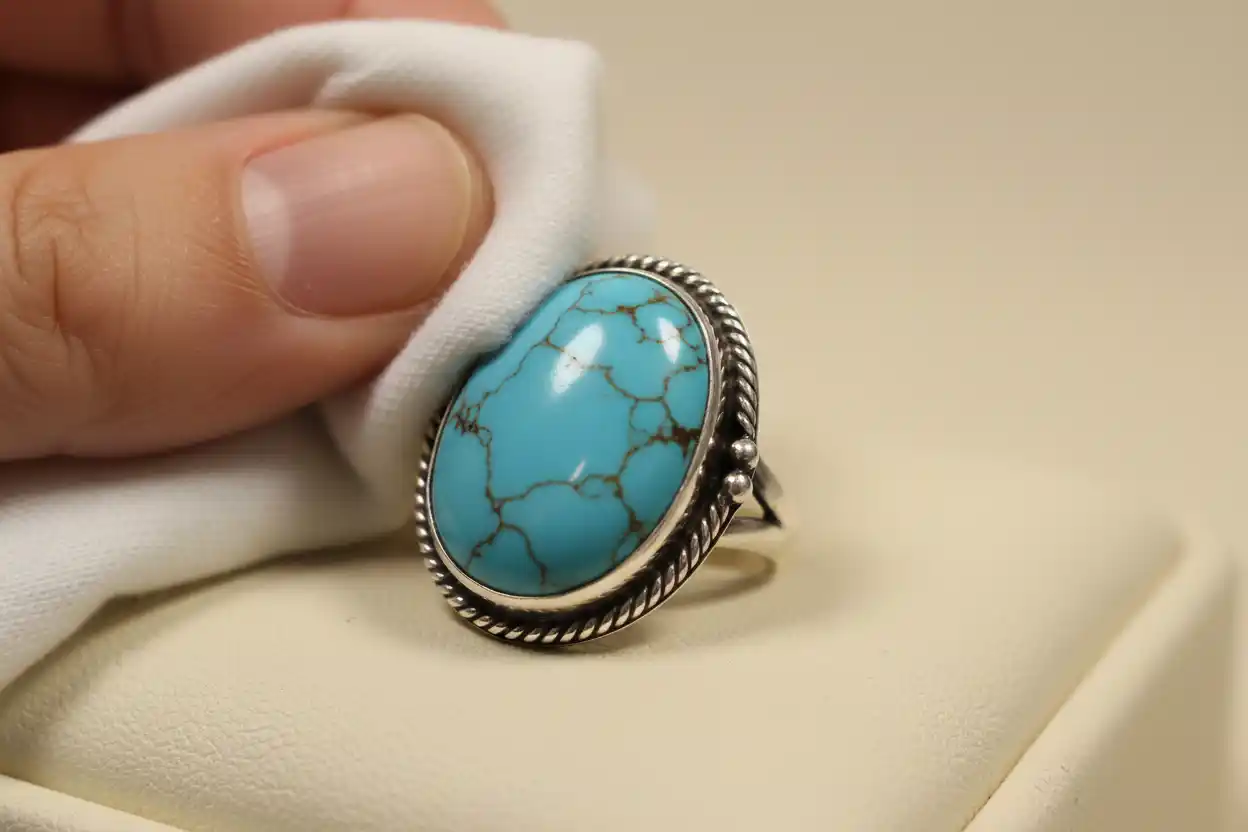
How to Clean Turquoise Jewelry Safely
Turquoise jewelry should be cleaned briefly with warm water, mild liquid soap, and a soft cloth or very soft brush. It should never be soaked or placed in an ultrasonic or steam cleaner.
Turquoise is porous, relatively soft, and frequently stabilized, waxed, impregnated, dyed, backed, glued, or assembled. Heat, solvents, acids, cosmetics, skin oils, perspiration, abrasive products, and prolonged moisture may discolor the stone or damage its treatment.
Why Turquoise Needs Minimal Cleaning
Turquoise is a hydrated copper aluminum phosphate mineral that commonly forms as opaque nodules, seams, crusts, and vein material.
Its mineralogy, color, mining history, matrix patterns, and symbolic associations belong to the broader Turquoise guide.
Turquoise usually ranges from blue and greenish blue to blue green or green. Brown, black, tan, or gray matrix may come from the host rock in which the Turquoise formed.
The gemstone generally ranks 5 to 6 on the Mohs scale. Its toughness ranges from fair to good, but porosity and treatment create more important cleaning limits than hardness alone.
| Property | Cleaning implication |
|---|---|
| Material | Hydrated copper aluminum phosphate |
| Typical colors | Blue, greenish blue, blue green, or green |
| Mohs hardness | Approximately 5 to 6 |
| Toughness | Fair to good |
| Surface character | Often porous |
| Safest routine cleaning | Brief warm-soapy-water wiping |
| Ultrasonic cleaning | Never recommended |
| Steam cleaning | Never recommended |
| Main risks | Oils, cosmetics, acids, solvents, heat, dye, impregnation, glue, and abrasion |
The gemstone hardness chart explains why Quartz-bearing dust and many jewelry stones can scratch Turquoise.
Its porosity, treatment, and setting construction are not captured by a hardness number. The broader distinction appears in Gemstone Toughness vs Hardness.
Turquoise Can Absorb Oils and Chemicals
Untreated Turquoise can be porous enough to absorb skin oil, perspiration, lotion, perfume, and dirt.
Over time, these substances may darken the stone, shift its color toward green, create patchiness, or dull its surface.
The change may be permanent because contamination can enter beneath the polished surface.
Consequently, preventive care is more effective than aggressive cleaning. Put Turquoise on after cosmetics have dried and wipe it gently after wear.
Do not apply oil to deepen the blue. Household oils attract dirt, alter appearance, and complicate future identification or treatment assessment.
Treatment Is Extremely Common
Lower-quality or porous Turquoise is frequently treated to improve durability, color, and polish.
Stabilization or impregnation introduces polymer, resin, plastic, wax, or related substances into the pores.
Dye may be used to strengthen blue or green color, while backing material can reinforce a thin cabochon. Some pieces combine dye and impregnation.
The Zachery process is another recognized enhancement used to improve color or polish without conventional polymer impregnation.
The full treatment-identification workflow belongs to How to Spot Treated or Synthetic Turquoise and Gemstone Treatments Explained.
Treatment does not automatically make Turquoise undesirable, but it must be disclosed and protected from heat, solvents, acids, and abrasive polishing.
Inspect the Jewel Before Cleaning
Examine the stone beneath bright, indirect light.
Look for cracks, chalky patches, peeling color, cloudy glue, lifted backing, gaps around bezels, damaged drill holes, missing inlay, frayed string, and loose metal components.
Matrix lines are not automatically fractures. However, a line that catches against cloth, changes under gentle pressure, or reaches a chipped edge may indicate damage.
Check flat-backed cabochons for visible glue seams. Many Turquoise stones are backed or attached with adhesive.
Do not wet a cracked, lifting, antique, or visibly unstable piece.
Test for Unstable Dye
Dampen a white cotton swab or corner of a white cloth with clean water.
Touch an inconspicuous area briefly, preferably near the back, drill hole, or bezel edge.
Stop if blue or green color transfers. Use dry wiping only and arrange professional assessment for valuable jewelry.
Do not test dye with acetone, alcohol, bleach, acid, or heat. These substances may remove treatment or damage the jewel.
The complete material-authentication workflow belongs to Real vs. Fake Turquoise.
Prepare a Gentle Cleaning Solution
Fill a small bowl with warm—not hot—water and add only a few drops of mild liquid soap.
Use a soft lint-free cloth, soft makeup brush, or exceptionally soft toothbrush.
Place a folded towel beneath the work area. The padding protects a cabochon or inlay if the jewelry slips.
Do not clean directly over an uncovered sink.
Avoid ammonia, bleach, alcohol, acetone, vinegar, lemon juice, silver dip, abrasive particles, and concentrated degreasers.
Clean Turquoise Briefly
Dampen the cloth or brush with the mild solution and remove excess water.
Wipe the stone gently, paying attention to bezel edges, drill holes, carving recesses, and areas that contact the skin.
Do not scrub the matrix or try to remove brown and black lines. They may be part of the natural host rock.
Avoid saturating backing seams, glue, knots, elastic, or inlay.
Use a second cloth dampened with plain water to remove soap. Blot the jewel immediately.
Do Not Soak Turquoise
Extended immersion may allow water to enter pores, backing seams, drill holes, fractures, adhesive, stringing, wax, or resin.
A stabilized stone may tolerate brief contact, but treatment type is often unknown to the owner.
Soaking also creates no meaningful cleaning advantage. Surface grime can be removed with controlled damp wiping.
The broader environmental discussion belongs to Which Crystals Can and Can’t Go in Water, but finished Turquoise jewelry should receive the stricter construction-based method.
Never Use an Ultrasonic Cleaner
Turquoise should never enter an ultrasonic cleaner.
Vibration, heat, and cleaning solution can damage a porous surface, enlarge fractures, loosen backing, disturb inlay, release glued cabochons, or alter treatment.
The broader equipment restrictions appear in Which Gemstones Can Go in an Ultrasonic Cleaner?.
A machine formulated for Diamond or Sapphire is unsuitable for Turquoise.
Never Steam Clean Turquoise
Steam exposes Turquoise to concentrated heat, pressure, and rapid moisture change.
High heat may discolor the gemstone, damage its surface, soften adhesive, or alter wax, resin, polymer, and dye.
Steam may also affect silver solder, inlay, antique repairs, and companion materials.
Warm damp-cloth cleaning is sufficient for routine care.
Avoid Acids and Solvents
Turquoise can be attacked by acids and is vulnerable to ordinary solvents.
Keep it away from vinegar, lemon juice, hydrochloric acid, descaling products, bathroom cleaner, metal dips, acetone, alcohol, and paint solvent.
These substances may etch the mineral, discolor it, dissolve treatment, soften glue, or expose pores.
Do not clean a silver setting by immersing the entire Turquoise jewel in chemical dip.
Cleaning Tarnished Silver Around Turquoise
Turquoise is often mounted in sterling silver, particularly in Southwestern, Native American, Tibetan, Central Asian, and vintage jewelry traditions.
Use a silver-polishing cloth only on exposed metal, taking care not to rub the stone.
Work slowly near bezel edges. Metal-polishing compounds can lodge in porous Turquoise and create dark residue.
Do not use baking soda paste, aluminum-foil baths, liquid silver dip, or abrasive metal polish on the complete jewel.
Severe tarnish beside valuable or antique Turquoise should be handled by a jeweler or conservator.
Cleaning a Turquoise Ring
A Turquoise ring receives frequent contact with soap, sanitizer, lotion, perspiration, water, and hard surfaces.
Wipe the cabochon after wear and clean around the bezel with minimal moisture.
Remove the ring before washing hands, showering, swimming, cooking, exercising, gardening, cleaning, and applying skincare products.
Turquoise rings are better suited to thoughtful wear than constant exposure.
Cleaning Turquoise Earrings
Turquoise earrings usually face less impact but collect cosmetics, hairspray, and skin oils.
Clean the posts, hooks, backs, clips, and hinges separately from the stone.
Keep alcohol-based disinfectant on compatible metal fittings and away from Turquoise, dye, wax, resin, glue, and backing.
Dry drill holes and caps completely before storage.
Cleaning a Turquoise Necklace
A Turquoise necklace may contain beads, slabs, nuggets, carvings, knots, wire, metal spacers, and adhesive.
Lay the necklace flat and wipe each stone individually rather than immersing the strand.
Wet thread and cord can stretch, weaken, or transfer dirt into drill holes.
Apply perfume, sunscreen, and lotion before putting on the necklace and allow them to dry fully.
Cleaning a Turquoise Bracelet
A Turquoise bracelet experiences repeated wrist impact and contact with desks, clothing, cosmetics, and perspiration.
Inspect every cabochon, bead, bezel, link, knot, elastic section, hinge, and clasp.
Wipe the bracelet rather than soaking it. Dry the piece flat.
Remove it before desk work, exercise, household cleaning, bathing, and swimming.
Natural Matrix Versus Damage
Natural Turquoise may contain brown, black, tan, gray, or golden host-rock matrix.
Aesthetic preferences vary. Some buyers favor clean blue stones, while others seek spiderweb, matrix-rich, or locality-characteristic patterns.
Matrix should not be scrubbed away. It forms part of the stone or its host material.
The broader quality and variety distinctions belong to Types of Turquoise.
A newly widening crack, lifting section, or powdery edge is damage rather than decorative matrix and requires professional attention.
Turquoise Versus Amazonite and Larimar
Turquoise may be confused with Amazonite, Larimar, dyed Howlite, dyed Magnesite, Chrysocolla, glass, ceramic, and reconstructed materials.
The direct feldspar comparison belongs to Amazonite vs Turquoise.
The comparison with blue pectolite belongs to Larimar vs Turquoise.
Cleaning response should never be used as an identity test. Acids, scratches, heat, and solvents can damage all of these materials.
Buying, Price, and Documentation
The Turquoise buying guide covers color, texture, matrix, porosity, treatment, backing, origin claims, construction, and seller disclosure.
Market factors belong to the Turquoise price guide.
Value can vary widely between superficially similar stones because treatment, density, origin, color, texture, matrix, size, craftsmanship, and provenance differ.
Laboratory testing may identify Turquoise and detect certain impregnation, dye, polymer, wax, or other treatments.
Turquoise is one of December’s recognized birthstones, covered in the December birthstone guide.
Physical Cleaning Versus Cleansing
Physical cleaning removes cosmetics, perspiration, oil, dust, and setting residue.
Traditional symbolic practices belong to How to Cleanse and Charge Turquoise.
Any traditional practice should still avoid saltwater soaking, acids, burial in abrasive material, smoke residue, prolonged moisture, and direct heat.
Frequently Asked Questions
1. What is the safest way to clean Turquoise?
Use a soft cloth or very soft brush dampened with warm water and a small amount of mild soap, then dry it immediately.
2. Can Turquoise get wet?
Brief controlled damp cleaning is acceptable, but Turquoise jewelry should not be soaked.
3. Can Turquoise go in an ultrasonic cleaner?
No. Ultrasound can damage porous material, treatments, glue, backing, inlay, fractures, and settings.
4. Can Turquoise be steam cleaned?
No. Steam can discolor the stone and damage treated surfaces, glue, wax, resin, and dye.
5. Is Turquoise commonly stabilized?
Yes. Porous material is often impregnated with polymer, resin, plastic, or wax to improve durability and color.
6. Can Turquoise be dyed?
Yes. Dye is sometimes used alone or together with stabilization.
7. Can vinegar clean Turquoise?
No. Turquoise is acid sensitive, and vinegar may damage the mineral and its treatments.
8. Can rubbing alcohol clean Turquoise?
No. Alcohol can affect dye, wax, resin, polymer, glue, coatings, and the porous surface.
9. Can toothpaste polish Turquoise?
No. Toothpaste is abrasive and may scratch or dull the stone.
10. Why is Turquoise turning green or dark?
Skin oil, perspiration, cosmetics, dirt, treatment deterioration, or chemical exposure may have entered the porous material.
11. How often should Turquoise jewelry be cleaned?
Wipe it after every wear and use damp cleaning only when visible residue remains.
12. When should Turquoise receive professional care?
Professional care is appropriate for antique jewelry, unstable dye, lifting backing, cracked stones, damaged inlay, deep discoloration, or severe silver tarnish.
Conclusion
Turquoise preserves its color best when contamination is prevented rather than removed later. A lightly dampened cloth and mild soap clean the surface without driving moisture or chemicals into its pores. When blue color darkens, transfers, or becomes patchy, stop cleaning—the issue is likely absorption or treatment stability rather than ordinary surface dirt.