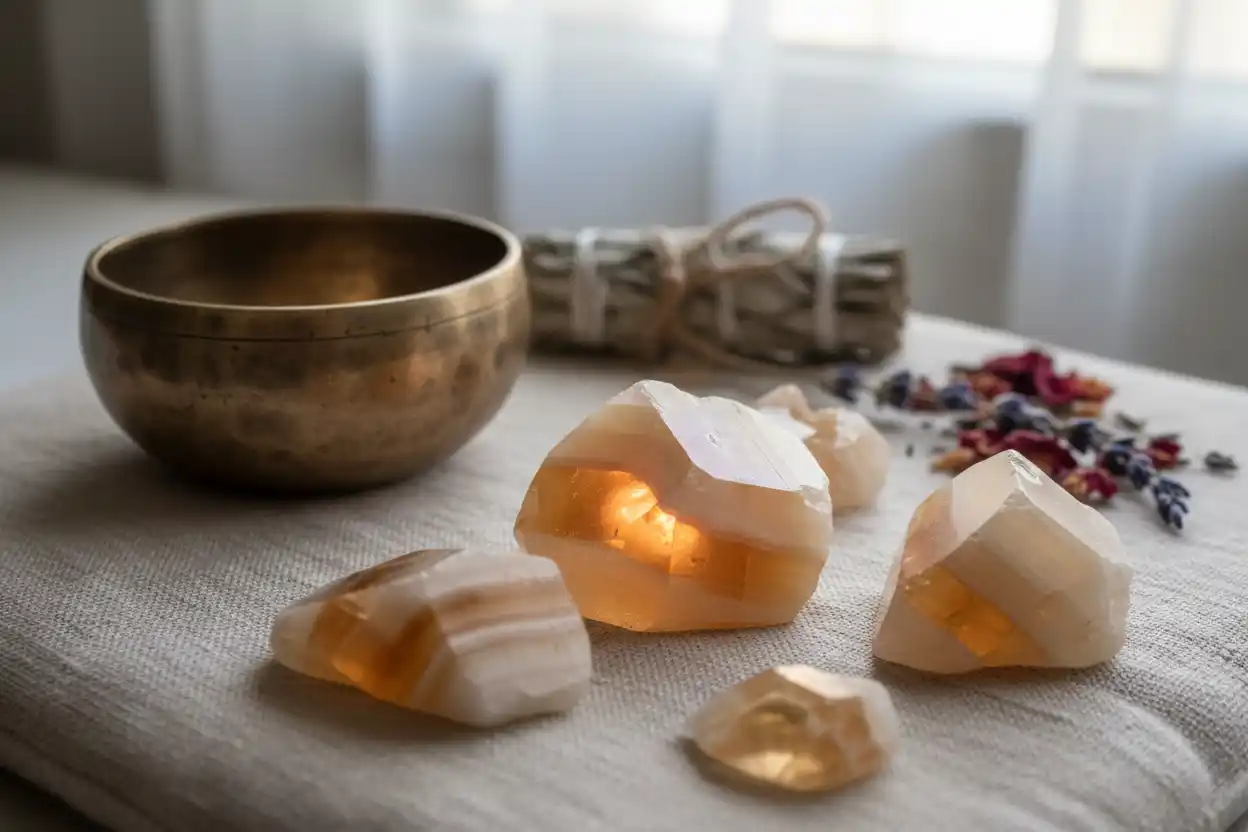
How to Cleanse and Charge Calcite
The safest ways to cleanse and charge Calcite are sound, intention, visualization, breath, indirect indoor moonlight, and a gentle dry-cloth or soft-brush ritual. These methods avoid the acids, water soaking, salt, abrasion, pressure, and hard surfaces that can damage its soft, brittle crystals.
Calcite should not be cleansed with vinegar, lemon juice, saltwater, prolonged running water, steam, ultrasonic equipment, or direct contact with harder crystals. Its Mohs hardness of 3 and perfect rhombohedral cleavage make it easy to scratch, chip, or split.
What Cleansing and Charging Mean
Cleansing is a spiritual or personal ritual intended to mark a transition, release previous associations, or prepare an object for meditation.
Charging generally means dedicating the stone to a purpose, routine, memory, or personal value.
These practices do not change Calcite’s chemical composition, crystal structure, health effects, or measurable physical energy.
The mineral’s geology, optical properties, colors, localities, and symbolism belong to the broader Calcite guide.
Color-related symbolism belongs separately to Calcite Color Meaning, while this page remains focused on safe ritual handling.
Why Calcite Needs Low-Contact Methods
Calcite is calcium carbonate and defines hardness 3 on the Mohs scale.
It has perfect rhombohedral cleavage, meaning it can split repeatedly along smooth structural planes.
| Property | Ritual implication |
|---|---|
| Composition | Calcium carbonate |
| Crystal system | Trigonal |
| Mohs hardness | 3 |
| Tenacity | Brittle |
| Cleavage | Perfect rhombohedral cleavage |
| Common forms | Rhombohedra, scalenohedra, tabular crystals, stalactites, masses, and cave formations |
| Safest ritual methods | Sound, intention, visualization, breath, and protected moonlight |
| Water exposure | Avoid soaking |
| Acid exposure | Never use |
| Main risks | Scratches, cleavage, chips, acid etching, salt, matrix damage, dye, and coatings |
The gemstone hardness chart explains why fingernails are usually too soft to scratch Calcite but coins, steel, glass, ceramic, Quartz, and many gemstones can.
Hardness is only one part of durability. Calcite’s brittleness and cleavage are addressed in Gemstone Toughness vs Hardness and Gemstone Cleavage Explained.
Double Refraction Is Not Damage
Transparent optical Calcite can display strong double refraction.
When placed over printed text, a clear cleavage piece may show two images because light divides into two rays inside the crystal.
This effect is a physical optical property, not trapped energy, a crack, or a sign that the stone needs cleansing.
Cloudy areas, internal reflections, cleavage lines, and color zoning may also be natural.
Do not polish or scrape the stone in an attempt to remove optical doubling.
Inspect the Calcite Before Beginning
Examine the specimen beneath soft, indirect light.
Look for chipped corners, fresh cleavage surfaces, open cracks, powdery areas, unstable matrix, cloudy glue, peeling coatings, and color transfer.
Calcite occurs in fragile crystal clusters, polished objects, palm stones, carvings, optical cleavage pieces, and rough masses.
A smooth carving may tolerate careful cloth handling, while a cluster with sharp scalenohedral points should remain on a padded tray.
Do not press on a cleavage line or squeeze a cluster to test its strength.
Separate Physical Dirt from Spiritual Cleansing
A symbolic ritual does not remove dust, fingerprints, soil, or cosmetic residue.
For a smooth stable specimen, use a clean dry microfiber cloth with minimal pressure.
A soft makeup brush or fine artist’s brush may remove loose dust from a cluster. Brush outward without forcing bristles between crystals.
Do not use commercial jewelry cleaner, alcohol, sanitizer, vinegar, abrasive paste, steam, or ultrasound.
Water may leave deposits, affect dye, enter cleavage cracks, or damage matrix and repairs. For valuable specimens, professional conservation is safer than household washing.
Method 1: Cleanse Calcite with Sound
Place the Calcite on a thick folded cloth.
Ring a chime, bell, tuning fork, or singing bowl nearby.
You may also hum, chant, clap softly, or play calm music.
Do not place Calcite inside a metal singing bowl or directly against a hard vibrating surface. Its edges can scratch or split.
Several gentle tones are sufficient. Loudness and physical vibration are unnecessary.
Method 2: Use Intention
Leave the Calcite resting on its padded support.
Choose one clear purpose for the object. It might remind you to simplify a problem, review information carefully, create a calmer workspace, or begin a new routine.
State the intention silently or aloud.
This method is suitable for every Calcite color and form because it requires no moisture or abrasive contact.
The ritual can be brief while still feeling deliberate.
Method 3: Use Visualization
Place the stone where it cannot roll or fall.
Imagine earlier associations fading while the Calcite becomes connected with a chosen value or action.
Some practitioners match the visualization to the stone’s color. Others use white or neutral light.
The imagery remains symbolic and does not imply that Calcite produces measurable healing energy.
Continue for several slow breaths or a few minutes.
Method 4: Use Breath Carefully
Keep the Calcite on a padded surface.
Take several slow breaths and exhale gently toward the space above it once or twice.
Avoid forceful blowing and visible condensation.
Do not blow directly into a fragile cluster because loose particles or small crystals may shift.
State the intention after the breath ritual.
Method 5: Use Indirect Moonlight Indoors
Place Calcite indoors near a window on a soft cloth, lined tray, or stable display stand.
An hour, an evening, or overnight indoor placement may be used.
Do not place it outside. Dew, rain, temperature changes, grit, animals, and hard surfaces create unnecessary risk.
The moon phase affects personal symbolism rather than Calcite’s chemistry.
The wider environmental framework appears in Which Crystals Can and Can’t Go in the Sun.
Method 6: Use a Written Intention
Write a concise statement and place it beside the stone.
A practical statement might focus on making one clear decision, completing a small task, or creating a more organized environment.
Keep pens, clips, staples, and metal objects away from the Calcite.
For a transparent piece, the written words may appear doubled through the crystal. That optical effect can become part of the ritual without requiring direct contact.
Method 7: Use a Mindful Dry-Cloth Ritual
Place a polished Calcite on a padded work surface.
Wipe it once or twice with a very soft microfiber cloth.
Use minimal pressure and stop if the cloth catches against a cleavage edge, fracture, or chip.
As you work, focus on the intention associated with the object.
Do not use this method on delicate clusters, sharp points, rough matrix, or powdery surfaces.
Method 8: Arrange Calcite Near a Symbolic Object
Place Calcite near a photograph, journal, unlit candle, dry flower, textile, or another meaningful item.
Use separate soft supports.
Do not place harder crystals directly on top of Calcite. Quartz, Amethyst, Citrine, Garnet, Tourmaline, and many other stones can scratch it.
Direct contact is not required for symbolic charging.
Never Use Vinegar or Lemon Juice
Calcite reacts readily with acids.
Vinegar, lemon juice, acidic sprays, metal dips, descaling products, and bathroom cleaners can etch, pit, dull, or dissolve its surface.
Fizzing is a standard indication of carbonate reaction, not energetic cleansing.
Do not conduct an acid test on a valued crystal, polished object, carving, or jewelry component.
The related calcium-carbonate polymorph is discussed in How to Cleanse and Charge Aragonite.
Avoid Prolonged Water Exposure
Calcite is only sparingly soluble in neutral water, but soaking still creates practical risks.
Water can enter cleavage cracks, mobilize dirt, leave deposits, damage glue, affect dye or coatings, weaken matrix, and create handling hazards.
Repeated wetting and drying may also worsen a fragile specimen’s condition.
When Calcite becomes wet accidentally, blot it gently and allow it to dry naturally at room temperature.
The broader water-safety framework belongs to Which Crystals Can and Can’t Go in Water.
Do Not Use Salt or Saltwater
Salt grains can scratch Calcite and become trapped inside cleavage openings, clusters, drill holes, and carvings.
Saltwater adds prolonged moisture and can leave deposits after evaporation.
Do not bury Calcite in Himalayan salt, sea salt, table salt, or cleansing granules.
When salt is symbolically meaningful, place it in a separate bowl while the stone remains on a lined dish nearby.
Do Not Bury Calcite in Soil
Soil contains Quartz grains, mineral debris, moisture, organic acids, fertilizers, and microorganisms.
These materials can scratch, stain, or lodge within Calcite.
Outdoor burial also exposes the stone to pressure, rain, impact, and loss.
A nature-based alternative places Calcite near a potted plant without contact with soil or water.
Avoid Steam, Ultrasonic Cleaning, and Heat
Ultrasonic vibration can enlarge fractures, split crystals along cleavage, and loosen repairs.
Steam adds concentrated heat, pressure, and sudden moisture change.
Neither process is required for physical or symbolic care.
The wider machine-safety discussion belongs to Which Gemstones Can Go in an Ultrasonic Cleaner?.
Keep Calcite away from candles, hot ash, radiators, heated bowls, and abrupt temperature changes.
Blue Calcite
Blue Calcite commonly appears pale blue, cloudy, translucent, and massive.
Its color may come from inclusions, structural effects, or trace components, depending on the material.
Use sound, intention, visualization, and protected moonlight. Avoid water soaking because polished blue material may contain fractures, wax, dye, or repaired areas.
The tracker’s Where to Buy Real Blue Calcite guide owns authenticity and purchasing considerations.
Green and Honey Calcite
Green Calcite can range from pale mint to deeper green and may be confused with Fluorite, Aragonite, or dyed material.
Honey Calcite covers warm golden, amber-like, or brownish-yellow material.
Both retain Calcite’s softness, perfect cleavage, and acid sensitivity.
The same dry ritual methods apply regardless of color.
Purchase-specific guidance belongs to Where to Buy Real Green Calcite and Where to Buy Real Honey Calcite.
Orange, Red, and Yellow Calcite
Orange Calcite, Red Calcite, and Yellow Calcite may contain iron oxides, inclusions, color zoning, or commercial treatments.
Vivid color does not make the mineral more water resistant or less acid sensitive.
Avoid prolonged sunlight when dye or coating is suspected.
Sound and intention provide reliable methods without testing color stability.
Mangano, Cobaltoan, White, and Zebra Calcite
Mangano Calcite commonly appears pale pink because manganese substitutes within the structure.
Cobaltocalcite may show stronger pink-to-magenta color associated with cobalt.
White Calcite emphasizes pale or colorless material, while Zebra Calcite contains contrasting bands and may include additional minerals.
Each variety may have distinct inclusions and matrix, but all remain soft carbonates.
The full family structure belongs to Types of Calcite.
Buying and Treatment Context
The Where to Buy Real Calcite guide covers cleavage, color, transparency, repairs, dye, coatings, imitations, and specimen condition.
Calcite may be dyed, coated, glued, reconstructed, stabilized, or combined with other minerals.
The broad enhancement framework belongs to Gemstone Treatments Explained.
Do not use acids, scratches, fire, or destructive tests to assess authenticity.
Safety During Ritual Use
Do not lick Calcite, grind it, intentionally generate dust, burn it, or place it directly in drinking water.
Ordinary intact handling is different from ingestion or inhaling mineral dust.
Wash your hands after handling powdery, dyed, treated, or matrix-rich specimens.
The broader distinction between safe display and unsafe destructive use appears in the Toxic Crystals safety list.
Frequently Asked Questions
1. What is the safest way to cleanse Calcite?
Use sound, intention, visualization, breath, a gentle dry cloth, or indirect indoor moonlight.
2. Can Calcite be cleansed in water?
Soaking is not recommended. Water may enter cleavage cracks, affect treatments, leave deposits, or damage matrix and glue.
3. Can Calcite be left in moonlight overnight?
Yes, when kept indoors on a stable padded surface.
4. Can Calcite be charged in sunlight?
Indirect indoor light is safer, especially when dye, coatings, or matrix minerals may be present.
5. Can vinegar clean or cleanse Calcite?
No. Vinegar reacts with calcium carbonate and can etch or dissolve the stone.
6. Can Calcite be cleansed with salt?
Direct salt contact is not recommended because grains can scratch the soft surface and lodge in cleavage openings.
7. Can Calcite be cleansed with smoke?
A brief cool-smoke ritual is possible, but sound or visualization avoids soot, heat, and residue.
8. Can Calcite touch Clear Quartz?
Use a cloth barrier. Quartz is much harder and can scratch Calcite.
9. Why does clear Calcite make text look doubled?
Strong double refraction divides light into two rays, producing two visible images.
10. Are all Calcite colors cleansed the same way?
Yes. Color and inclusions vary, but the mineral remains soft, brittle, perfectly cleavable, and acid sensitive.
11. How often should Calcite be cleansed?
Use a schedule that fits your personal practice while minimizing unnecessary handling.
12. Does cleansing change Calcite scientifically?
No established evidence shows that cleansing changes its chemistry, health effects, or measurable physical energy.
Conclusion
Calcite’s color range may be broad, but every variety shares the same practical vulnerabilities: softness, brittle tenacity, perfect cleavage, and acid sensitivity. Sound, intention, visualization, and protected moonlight preserve those surfaces without introducing water, salt, or abrasion. A safe ritual should deepen the object’s personal meaning without creating a fresh chip, cloudy deposit, or etched patch.
Crystal cleansing and charging are spiritual or personal practices, not scientifically established methods for changing health, energy, or the physical properties of Calcite.