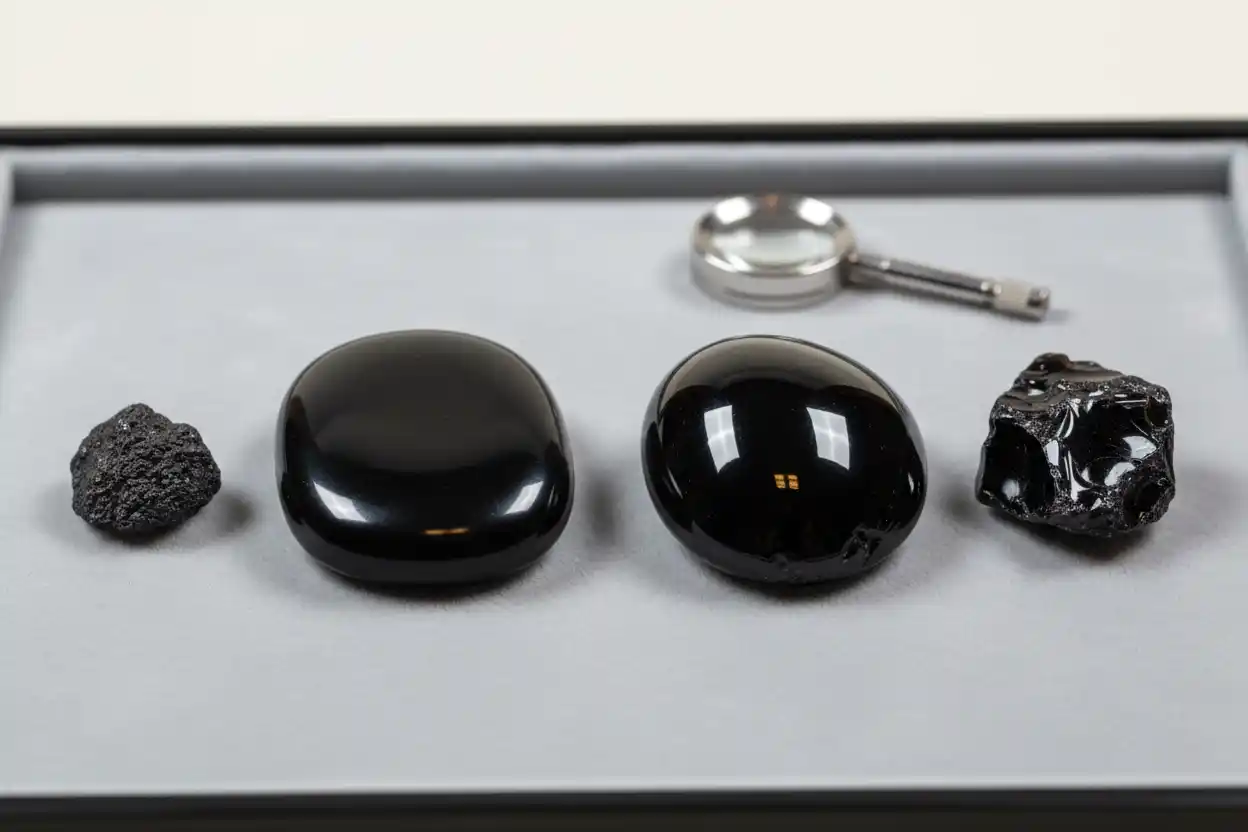
Onyx vs Obsidian: Differences and Identification
Onyx and Obsidian can both appear smooth, polished and uniformly black, making them easy to confuse in beads, cabochons, carvings and inexpensive jewelry. Their similarity is based mainly on color.
Onyx is chalcedony, a microcrystalline form of Quartz. Traditional Onyx contains straight, parallel layers, although most uniform black material in modern jewelry is chalcedony that has been dyed.
Obsidian is natural volcanic glass. It forms when silica-rich lava cools without developing an extensive crystal structure and commonly breaks with a smooth conchoidal fracture capable of producing exceptionally sharp edges.
These structural differences affect hardness, fracture, treatments, jewelry durability and identification. The broad Onyx guide and Obsidian guide own their complete profiles. This article focuses strictly on separating them.
Onyx vs Obsidian at a Glance
| Property | Onyx | Obsidian |
|---|---|---|
| Material identity | Parallel-banded chalcedony | Natural volcanic glass |
| General composition | SiO₂-rich microcrystalline Quartz | Silica-rich volcanic glass with variable oxides |
| Internal structure | Microcrystalline | Amorphous, sometimes with microlites |
| Traditional appearance | Straight, parallel contrasting bands | Black, brown or gray glass with flow, bubbles or sheen |
| Common uniform-black product | Usually dyed chalcedony | Commonly naturally dark, though glass imitations occur |
| Mohs hardness | Approximately 6.5–7 | Commonly around 5–5.5 |
| Cleavage | None | None |
| Fracture | Conchoidal to uneven | Strongly conchoidal |
| Edge after fracture | Sharp | Potentially razor sharp |
| Typical luster | Waxy to vitreous | Strongly vitreous |
| Transparency | Translucent at thin edges to opaque | Transparent at thin edges to opaque |
| Typical jewelry durability | Good | More vulnerable to scratches and chips |
| Main treatment concern | Dye and coating | Manufactured glass, coatings and misleading color names |
| Main identification clue | Chalcedony properties and possible parallel banding | Glass structure and volcanic flow features |
The Fundamental Difference
Onyx is crystalline at a microscopic scale.
Its tiny intergrown Quartz grains form a dense chalcedony structure. Even when the grains cannot be seen individually, they give the material Quartz-family hardness and behavior.
Obsidian has no extensive repeating crystal lattice. It is a glassy igneous rock produced when lava cools too quickly for substantial crystal growth.
This difference cannot always be seen in a polished black bead, but it controls many measurable properties.
Onyx is therefore not a type of volcanic glass, and Obsidian is not a form of Quartz.
Traditional Onyx Banding
Traditional Onyx contains flat, parallel layers.
Black-and-white banding is familiar, while reddish-brown and white layers belong to Sardonyx.
The bands developed through repeated chalcedony deposition under changing chemical conditions.
A polished black stone without visible bands may still be sold as black Onyx, but it is commonly dyed chalcedony rather than a naturally uniform example of classical banded material.
The Types of Onyx guide owns the complete terminology and variety framework.
Obsidian Flow and Internal Features
Obsidian may appear uniform, but many specimens contain flow bands, bubbles, mineral grains, microlites or devitrified areas.
These structures record movement and cooling within lava.
Snowflake Obsidian contains pale spherulitic crystal growth. Mahogany Obsidian has reddish-brown and black areas, while Golden Obsidian and Silver-Sheen Obsidian show internal optical effects.
Rainbow Obsidian can reveal several colors under directional light.
These features do not occur in typical black Onyx.
Crystal Structure
Onyx consists of microscopic crystalline silica.
Its grains are extremely small, but each Quartz component maintains an ordered atomic structure.
Obsidian is amorphous. Its atoms became fixed before they could organize into a long-range repeating lattice.
The difference is why Obsidian is technically a natural glass rather than a mineral species.
Retailers may call both stones crystals in broad metaphysical language, but the term is technically inaccurate for Obsidian.
Hardness
Onyx generally ranks around 6.5–7 on the Mohs scale.
Obsidian commonly ranks around 5–5.5, although composition and testing conditions can produce some variation.
Onyx therefore resists scratches more effectively.
The Gemstone Hardness Chart provides comparison with other jewelry stones.
Do not use a scratch test to separate finished pieces. Scratching causes permanent damage, and coatings, dirt or testing angle can create misleading results.
Toughness and Fracture
Neither material has cleavage.
Onyx generally offers good toughness because its microscopic Quartz grains form a dense interlocking mass.
Obsidian is brittle and fractures conchoidally. A hard impact can create curved chips with edges sharper than their appearance suggests.
The Gemstone Toughness vs Hardness guide explains why scratch resistance and breakage behavior must be assessed separately.
A damaged Obsidian item should be handled more cautiously because a small chip can create a cutting hazard.
Luster
Polished Obsidian often has a stronger glassy reflection.
Onyx usually shows a waxy-to-vitreous polish that can still become highly reflective, especially after excellent finishing.
Luster can provide a clue but is not conclusive. Dyed chalcedony with a high polish may look glassy, while scratched Obsidian may appear dull.
Surface coatings can also alter either appearance.
Lighting and photography frequently exaggerate or suppress the difference.
Transparency at Thin Edges
Both materials may look opaque in ordinary thicknesses.
A thin Onyx edge may transmit gray, brown or pale light. Dyed black chalcedony may show uneven penetration around chips or drill holes.
Black Obsidian often transmits smoky brown, gray or greenish light at thin edges.
This observation can support identification but does not prove it. Manufactured glass can reproduce the same effect, while very thick specimens remain opaque.
Density
Onyx generally falls near ordinary chalcedony density, around the mid-2.6 range.
Obsidian commonly has lower and more variable density, often in the low-to-mid 2 range depending on composition and bubbles.
A precisely measured loose sample may therefore provide useful information.
The difference is difficult to judge by hand, particularly when stones have different dimensions.
Metal settings, drill holes and internal cavities make casual weight comparison unreliable.
Hydrostatic specific-gravity testing is more useful than simply deciding which stone feels heavier.
Refractive Properties
Onyx shares the refractive behavior of chalcedony, generally around the low 1.53–1.54 range.
Obsidian usually has a lower glass-like refractive index, commonly around the upper 1.4 range, though composition affects the exact result.
A refractometer can help separate loose polished material when an accessible surface is available.
Cabochons and curved beads may produce only a spot reading and require proper technique.
Professional testing is safer and more reliable than destructive home methods.
Black Onyx Is Commonly Dyed
Uniformly black Onyx in jewelry is frequently dyed chalcedony.
The treatment may penetrate deeply and remain stable through ordinary use. It allows manufacturers to create matching beads, cabochons and calibrated pieces.
The Treated Onyx guide owns dye, coating and resin details.
Dyed chalcedony remains structurally Onyx-related material, but its black color should not be represented as naturally rare.
Pale areas around chips or drill holes may reveal incomplete dye penetration, although absence of those signs does not prove untreated color.
Is Black Obsidian Treated?
Ordinary black Obsidian often has natural dark color.
However, manufactured glass, slag, resin and coated material may be sold as Obsidian. Bright transparent blue, green and neon-colored “Obsidian” products deserve particular scrutiny.
Natural sheen and rainbow effects arise from internal structures. A surface film, metallic paint or iridescent coating belongs to another category.
The Types of Obsidian guide explains natural black, mahogany, snowflake, sheen and rainbow varieties.
The guide to Where to Buy Real Obsidian owns seller and imitation checks.
Natural Rough Appearance
Rough Onyx usually resembles dense chalcedony. It may show bands, waxy surfaces and conchoidal fracture without the intensely glassy appearance of fresh Obsidian.
Rough Obsidian often has a glassy black, brown or gray surface and smooth shell-like fracture scars.
Fresh edges may be extremely sharp.
Weathered Obsidian can develop pale crusts, hydration layers or devitrified patches, making the distinction less obvious.
A broken fragment without context should not be identified solely from one photograph.
Onyx vs Snowflake Obsidian
Snowflake Obsidian contains pale rounded or radiating spherulites within dark volcanic glass.
The spots are areas where crystal growth developed inside the glass during devitrification.
Banded Onyx produces layers rather than snowflake-like spherulites.
A black-and-white spotted stone therefore favors Snowflake Obsidian, while straight parallel white lines favor Onyx.
Printed or manufactured glass can imitate either pattern, so structure and properties still matter.
Onyx vs Mahogany Obsidian
Mahogany Obsidian shows irregular reddish-brown and black patches or flows.
Sardonyx shows more orderly layers of reddish-brown, white, orange or black chalcedony.
The two can share a similar color palette but differ in pattern geometry and internal structure.
Mahogany Obsidian generally has glassier luster and lower hardness. Sardonyx offers chalcedony durability and may show flat parallel bands.
Onyx vs Sheen Obsidian
Golden and silver-sheen Obsidian display directional internal reflection.
The sheen moves as the stone or light changes angle.
Black Onyx does not normally show the same broad internal gold or silver optical effect. A metallic-looking Onyx may have a surface coating or reflective backing.
The effect should be inspected through movement. A stationary surface film differs from internal directional sheen.
Onyx vs Black Tourmaline
The tracker’s Black Tourmaline vs Obsidian vs Onyx guide owns the three-way comparison.
Black Tourmaline is a crystalline borosilicate mineral, commonly Schorl. It often shows lengthwise striations and prismatic crystal form.
Onyx is chalcedony, while Obsidian is glass.
Their shared protection symbolism does not indicate a geological relationship.
Jewelry Durability
Onyx is generally the stronger choice for rings, bracelets, thin geometric earrings and frequently handled beads.
Obsidian can still make successful pendants, earrings, cabochons and carvings when protected from hard impact.
A bezel helps both materials but is especially useful for Obsidian.
Onyx can be stacked cautiously with smooth metal. Obsidian should not rub against harder gems or rough settings.
A chipped Onyx may be unattractive, while a chipped Obsidian can also become physically sharp.
Beads and Bracelets
Black Onyx beads are widely available and often dyed for consistent matching.
Obsidian beads may display stronger glassy reflection, flow structures or slight color variation.
Drill-hole chips should be examined in both. Obsidian openings can create sharp edges that cut elastic or cord.
The Onyx Bracelets guide owns Onyx-specific stringing and fit.
The material should be identified before a price premium is assigned for natural black color or volcanic origin.
Rings and Pendants
An Onyx ring can use signet, cameo, intaglio, bezel and inlay construction.
Obsidian rings should remain lower and more protected because of their lower hardness and brittle glassy fracture.
Pendants are safer for both. A large Onyx tablet can be supported in a broad metal frame, while a polished Obsidian cabochon should avoid thin exposed points.
The setting should match the material rather than assuming every black stone has equal durability.
Historical Uses
Onyx and Sardonyx were important carving materials for seals, cameos and intaglios.
Obsidian was shaped into cutting tools, projectile points, blades, mirrors and ritual objects. Its archaeological sources can often be matched through trace-element chemistry.
Their histories reflect different physical strengths. Onyx offered layered carving contrast, while Obsidian offered exceptional fracture sharpness.
One stone should not be substituted for the other in a historical description merely because both appear black.
Price and Value
Common dyed black Onyx is affordable.
Its finished-jewelry value often comes from metal, carving, maker, age and craftsmanship rather than material rarity.
Ordinary Obsidian is also widely available and inexpensive. Fire, rainbow and exceptional sheen material may receive higher prices for optical quality and skilled cutting.
A generic black bead should not command a large premium merely because it is described as protective, volcanic or ancient.
Documented antique carvings and archaeological objects belong to specialized markets with provenance and legal considerations.
Safe At-Home Observations
Begin with pattern and luster.
Straight parallel bands favor Onyx. Flow structures, snowflakes, mahogany patches or moving internal sheen favor Obsidian.
Inspect a thin edge under safe diffused backlighting. Note color transmission without assuming it is conclusive.
Use magnification to look for bubbles, dye concentrations, coatings, grain texture and fracture form.
Do not chip the item intentionally. Breaking Obsidian creates dangerous edges and permanently damages the object.
Professional Identification
A gemologist may use refractive index, density, microscopy, spectroscopy and structural observations.
Onyx and Obsidian occupy sufficiently different ranges that standard testing usually separates them.
The Real vs Fake Onyx guide addresses dyed chalcedony, glass and plastic.
The Where to Buy Real Black Obsidian guide covers natural volcanic glass and commercial imitation risks.
A laboratory report is rarely economical for inexpensive beads, but testing can resolve valuable carvings, disputed antiques and unusual optical material.
Cleaning and Care
Onyx should follow How to Clean Onyx Jewelry Safely.
Use mild soap, lukewarm water and a soft cloth or brush. Keep washing brief when dye, glue or coatings are present.
Obsidian should also be cleaned gently with mild soap and a soft cloth. Abrasive powders can scratch its glassy surface.
Avoid thermal shock, steam and ultrasonic equipment for either when treatment, assembly or fractures are uncertain.
Store the materials separately from harder gemstones and inspect Obsidian immediately after impact.
Frequently Asked Questions
1. Are Onyx and Obsidian the same stone?
No. Onyx is microcrystalline chalcedony, while Obsidian is natural volcanic glass.
2. Which is harder?
Onyx is harder at approximately 6.5–7. Obsidian commonly ranks around 5–5.5.
3. Which stone is more durable?
Onyx generally offers better scratch resistance and toughness for jewelry. Obsidian chips more readily.
4. Is black Onyx naturally black?
Some dark chalcedony exists, but uniform commercial black Onyx is commonly dyed.
5. Is black Obsidian naturally black?
Ordinary black Obsidian usually has natural dark color, although manufactured glass imitations are common.
6. Which stone has bands?
Traditional Onyx has straight parallel bands. Obsidian may show flow lines, sheen, snowflakes or irregular color patches.
7. Which stone breaks into sharper edges?
Obsidian can fracture into exceptionally sharp glass edges.
8. Is Snowflake Obsidian a type of Onyx?
No. It is volcanic glass containing pale spherulitic crystal growth.
9. Can Onyx and Obsidian both be used in rings?
Yes, but Onyx generally tolerates ring wear better. Obsidian needs a low protective setting.
10. Can a scratch test separate them?
It might damage both and is unnecessary. Professional optical and density testing is safer.
11. Which stone is more valuable?
Ordinary examples of both are affordable. Value depends more on optical effects, carving, provenance, workmanship and setting.
12. How should I clean them?
Use mild soap, lukewarm water and a soft cloth. Avoid abrasives, thermal shock and harsh chemicals.
Onyx and Obsidian share a color but not a structure or geological history. Microscopic Quartz gives Onyx its practical hardness and carving tradition, while volcanic glass gives Obsidian its flowing textures and extraordinarily sharp fracture. Pattern offers the first clue; gemological testing provides the reliable distinction.