Real vs Fake Clear Quartz: Rock Crystal Identification Guide
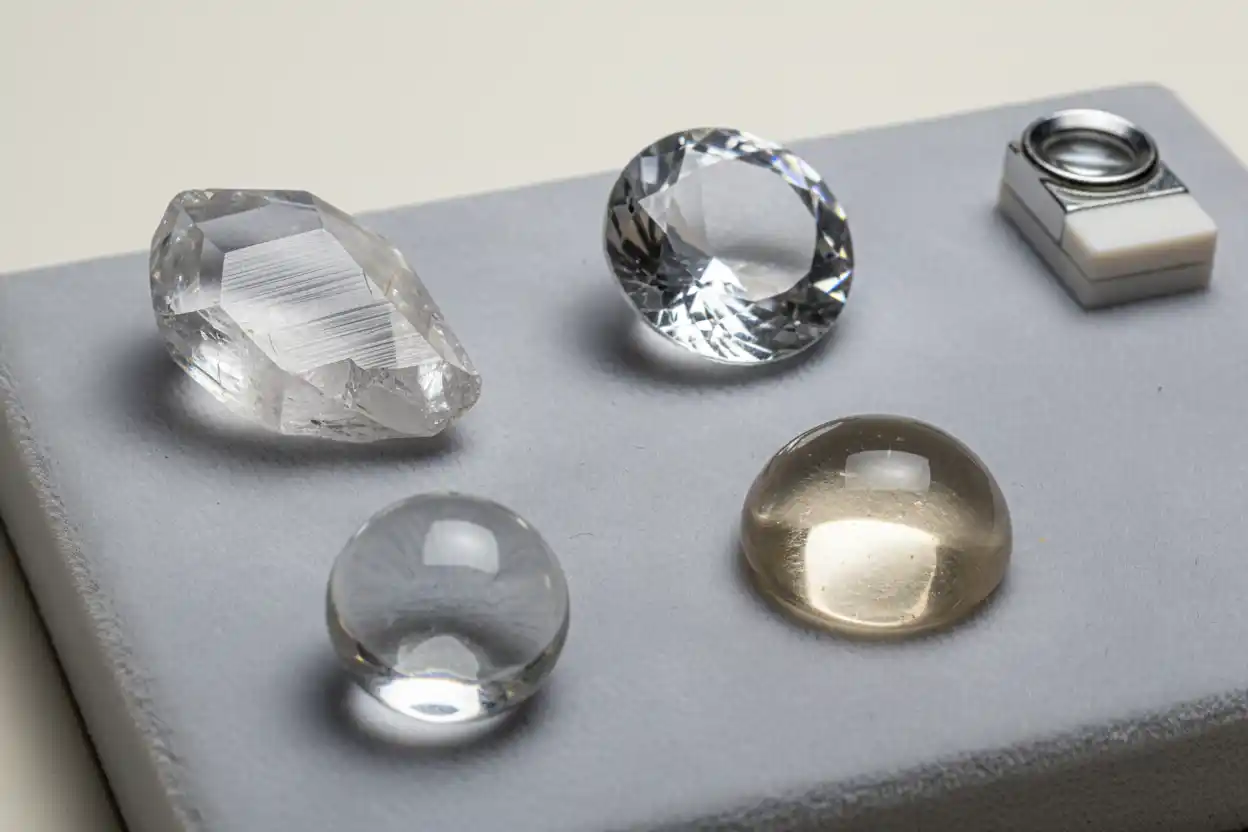
Real clear quartz, also called rock crystal, is naturally formed transparent or translucent crystalline silicon dioxide. It may appear as a complete six-sided crystal, broken rough, polished sphere, carved object, cabochon or faceted gem.
The main imitations are ordinary glass, lead-containing decorative glass, acrylic and transparent resin. Hydrothermal synthetic quartz creates a more difficult distinction because it has essentially the same composition, hardness, density and optical properties as natural quartz.
A perfectly clear object is not automatically fake. Natural rock crystal can grow in exceptionally transparent material with few visible inclusions. Conversely, bubbles do not always prove glass because natural quartz can contain fluid inclusions with gas bubbles.
The correct conclusion comes from the type of bubble, crystal growth, optical behavior, twinning, inclusions and measured properties. This page owns the direct authenticity workflow. The treated-clear-quartz guide retains synthetic growth, irradiation, coating, filling and artificial-fracture boundaries.
Natural Clear Quartz vs Common Imitations
| Feature | Natural clear quartz | Hydrothermal synthetic quartz | Glass imitation | Resin or acrylic |
|---|---|---|---|---|
| Material | Naturally formed crystalline SiO₂ | Laboratory-grown crystalline SiO₂ | Amorphous manufactured glass | Manufactured polymer |
| Mohs hardness | 7 | 7 | Commonly around 5–6 | Much softer |
| Refractive index | Approximately 1.544–1.553 | Same quartz range | Variable, often near but not identical | Variable |
| Birefringence | About 0.009 | Same quartz behavior | None in ordinary glass | None |
| Specific gravity | About 2.65–2.66 | About 2.65–2.66 | Variable | Usually lower |
| Crystal habit | Six-sided prisms and terminations may occur | Controlled crystal growth from a seed | Molded, cast or broken shapes | Molded or cast |
| Inclusions | Fluid inclusions, mineral crystals, fingerprints, veils and growth features | Seed-related structures and hydrothermal growth features | Round bubbles and curved flow lines | Casting bubbles, seams and suspended debris |
| Twinning | Natural twinning may be present | Often absent or growth-method dependent | None | None |
| Best separation | Microscopy, birefringence, twinning and spectroscopy | Advanced natural-versus-synthetic testing | Optical and microscopic tests | Density, microscopy and material analysis |
The absence of inclusions cannot resolve natural versus synthetic origin. Both categories can be highly transparent.
What Is Genuine Clear Quartz?
Clear quartz is the colorless transparent variety of macrocrystalline quartz.
The term rock crystal is an established alias for clear natural quartz. It should not be confused with the retail use of crystal for cut glass, chandeliers or decorative lead glass.
Quartz crystallizes in the trigonal system and often develops a six-sided prismatic appearance terminated by rhombohedral faces. Its hardness, chemical resistance and abundance make it useful in jewelry, carving, optics and industry.
The types-of-clear-quartz guide explains crystal points, optical material, included varieties and commercial forms without treating every clear object as one quality grade.
Natural Quartz Crystal Habit
A complete natural quartz crystal commonly develops six prism faces around its length.
The termination usually consists of several sloping faces rather than one flat molded point. Growth striations may cross the prism faces horizontally.
Natural crystals can be distorted, tapered, flattened or intergrown. Damage during mining may remove tips or faces.
A perfect geometric retail tower is usually cut and polished, even when the material itself is natural quartz. Manufactured shape does not make the stone synthetic.
The raw-versus-polished crystal guide explains the difference between natural growth form and lapidary shaping.
Natural Inclusions
Natural rock crystal may contain liquid-filled cavities, negative crystals, mineral grains, needles, fingerprints, veils, fractures and growth zoning.
A two-phase fluid inclusion contains liquid and a small gas bubble within a cavity enclosed by the growing crystal. The bubble may move as the stone rotates or as temperature changes.
These inclusions differ from ordinary manufacturing bubbles suspended in glass, although the distinction may require magnification and experience.
A clean natural quartz crystal can contain few or no inclusions visible at 10× magnification. Arkansas and other sources have produced large, exceptionally clear rock crystal suitable for optical work and carving.
Bubbles in Quartz Versus Glass
The popular claim that real quartz never contains bubbles is incorrect.
Quartz can contain microscopic or visible fluid inclusions with gas bubbles. These cavities may have angular negative-crystal outlines, irregular boundaries or associations with healed fractures.
Glass bubbles more often appear as isolated smooth spheres, rounded cavities or elongated bubbles following curved flow. They may occur in a homogeneous body without mineral growth structures.
One perfectly round feature is not enough for a conclusion. Inspect its boundary, depth, surrounding flow and relationship with other inclusions.
Double Refraction
Quartz is doubly refractive, whereas ordinary glass is isotropic and singly refractive.
When light passes through quartz in most directions, it separates into two rays. The birefringence is weak, so obvious doubled facet lines may not be visible without appropriate orientation and instruments.
A polariscope can show that a transparent quartz object is anisotropic. Glass normally remains dark through rotation unless internal strain creates an anomalous response.
This test can separate many glass imitations but cannot distinguish natural quartz from hydrothermal synthetic quartz.
The Line-Doubling Test
Some home guides suggest drawing a line on paper and looking through the crystal for doubling.
The result depends on orientation, curvature, thickness and optical quality. Weak quartz birefringence may not create an obvious second line.
A faceted surface, spherical carving or internal fracture can distort the image.
Failure to see doubling does not prove glass. A proper polariscope or refractometer provides more reliable evidence.
Natural Twinning
Quartz can contain Dauphiné, Brazil-law and other twinning relationships.
Brazil-law twinning is particularly useful in distinguishing some natural quartz from hydrothermal synthetic material when viewed with polarized light or specialized methods.
The pattern may appear as intersecting, triangular or irregular domains.
Not every natural clear quartz shows an observable pattern. Synthetic producers can also use twinned seed material, making the distinction more complex.
Twinning is therefore strong evidence only when interpreted by an experienced gemologist.
Hydrothermal Synthetic Quartz
Synthetic quartz is grown commercially in sealed high-pressure vessels.
Silica nutrient dissolves in hot alkaline solution and recrystallizes on a seed plate in a cooler part of the vessel. The method produces large, controlled crystals used extensively in electronics and optics.
Gem-quality synthetic rock crystal can be colorless and exceptionally clean. It has real quartz hardness, density, birefringence and refractive index.
The material is not glass. It should be called hydrothermal synthetic quartz or laboratory-grown quartz.
Natural-versus-synthetic separation may rely on seed boundaries, growth zoning, inclusions, twinning, infrared absorption and trace-element chemistry.
Seed Plates and Growth Boundaries
Hydrothermal synthetic quartz commonly grows from a seed plate.
In some objects, a straight internal boundary or thin central plate remains visible. Parallel growth structures may extend away from it.
Cutters can orient the material to hide or remove much of this evidence. A polished object may not contain the original central seed.
Natural quartz can also contain straight fractures and growth planes, so a single line is not conclusive.
Glass Imitations
Glass is the most common clear-quartz imitation in spheres, points, beads and carvings.
Round bubbles, curved flow lines, molded seams and a uniform amorphous interior are useful clues.
A glass point may have perfectly smooth faces without natural striations. Its tip and base can show mold marks or machine symmetry.
High-quality optical glass may contain few bubbles and can be difficult to judge by eye. Lead-containing decorative crystal glass may feel unusually heavy.
The glass-versus-crystal guide owns the complete terminology and material comparison.
“Smelt Quartz” and “Reconstituted Quartz”
Smelt quartz is usually a misleading name for glass manufactured from silica-rich ingredients.
Melting natural quartz destroys its original crystal structure. The cooled product becomes amorphous glass unless it is recrystallized through another controlled process.
Reconstituted quartz may describe quartz particles bonded with resin, fused silica, glass or another composite. The term should not be treated as a synonym for one solid natural crystal.
A seller should identify whether the object is natural quartz, synthetic crystalline quartz, fused silica glass or a resin-bound composite.
Resin and Acrylic Imitations
Transparent resin can be molded into towers, spheres, skulls and so-called crystal points.
It often feels lighter and warmer than quartz, although temperature is subjective.
Casting bubbles, mold seams, surface scratches and suspended glitter may appear under magnification. Some products contain dried flowers, metal flakes or quartz chips.
A hot-needle or flame test should not be used. It damages the object and can release hazardous fumes.
Fused Silica
Fused silica is manufactured by melting or chemically producing high-purity silica.
Although its chemistry may be predominantly SiO₂, it is amorphous glass rather than crystalline quartz.
It lacks quartz’s crystal lattice, birefringence and natural growth features.
The distinction matters in optical and scientific equipment even when the product is casually called quartz glass.
Lead Crystal Glass
Traditional crystal glass may contain lead oxide or alternative heavy-metal oxides to increase brilliance and weight.
The word crystal in this context describes a glass category, not natural quartz crystallography.
Lead crystal can appear more dispersive than rock crystal and may produce strong spectral flashes when faceted.
Its density and isotropic optical behavior separate it from quartz.
Herkimer “Diamond”
Herkimer diamond is naturally double-terminated quartz associated with Herkimer County, New York, and related commercial material.
It is not diamond. The name refers to its bright clarity and naturally faceted appearance.
Genuine Herkimer County provenance adds locality interest, while double-terminated quartz from other regions should be described accurately.
The where-to-buy-Herkimer-diamond guide owns locality, imitation and seller boundaries.
Clear Quartz Versus Selenite
Clear selenite can resemble elongated transparent quartz.
Selenite is gypsum with a Mohs hardness of about 2 and strong cleavage. Quartz is much harder and lacks cleavage.
The completed clear-quartz-versus-selenite guide owns the direct comparison.
Do not scratch the crystals deliberately. Habit, cleavage, optical behavior and professional testing are safer.
Included Clear Quartz Varieties
Garden quartz contains scenic mineral inclusions and growth features.
Phantom quartz records earlier crystal-growth outlines within later quartz.
Rutilated quartz contains rutile needles, while tourmalinated quartz contains tourmaline crystals.
Druzy quartz consists of many small crystals coating a surface.
These inclusions can help support natural identity, but glass and resin products can embed genuine minerals deliberately. The host material still requires identification.
Rainbows and Internal Fractures
Rainbow flashes inside clear quartz commonly arise from light interference along thin fractures.
The effect is natural when the fracture developed during geological stress or ordinary breakage. Sellers may also induce cracks through heating and rapid cooling.
Crackle quartz is often dyed after artificial fracturing so that color enters the breaks.
A rainbow does not prove age, exceptional quality or supernatural strength. It records an optical interaction with a thin internal gap.
Hardness
Quartz ranks 7 on the gemstone-hardness chart.
It is harder than ordinary glass, calcite, fluorite and gypsum.
A scratch test remains a poor home method. It damages polished surfaces and cannot distinguish natural quartz from synthetic quartz.
Hardness also does not make a crystal impact-proof. The gemstone-toughness-versus-hardness guide explains why existing fractures and thin points can still break.
Refractive Index and Specific Gravity
Clear quartz generally has a refractive-index range of approximately 1.544–1.553 and a specific gravity around 2.65–2.66.
Natural and hydrothermal synthetic quartz share these properties.
Glass, resin and other imitations may differ, though some specialty glasses overlap selected measurements.
A gemologist combines refractive index, birefringence, density and microscopy rather than relying on one number.
Temperature and “Ice-Cold” Tests
Natural quartz often feels cool initially because it draws heat from the skin.
Glass can feel equally cool, particularly when both objects have been stored in the same environment.
A large quartz piece may remain cool longer than a small resin object, but size, airflow and room temperature control the sensation.
Temperature is not an authentication test.
Sound Tests
Some sellers recommend tapping quartz and listening for a clear ringing sound.
Shape, thickness, internal fractures and how the object is supported affect sound more than origin.
Glass, quartz and ceramic objects can all ring under selected conditions.
Striking a crystal also risks chipping it. Sound should not be used for identification.
Ultraviolet Light
Clear quartz is commonly inert or weakly fluorescent, although inclusions and defects can produce varied reactions.
Glass, resin and synthetic quartz may also fluoresce or remain inert.
Ultraviolet response can reveal glue, filler or coatings but cannot provide a universal authenticity result.
Raman and Infrared Spectroscopy
Raman spectroscopy can confirm crystalline quartz by its characteristic vibrational pattern.
Infrared spectroscopy may help separate natural and hydrothermal synthetic quartz through water- and hydroxyl-related absorptions.
Some samples remain inconclusive because high-purity natural and synthetic quartz can overlap.
Trace-element analysis and twinning observations provide additional evidence when natural origin matters.
Buying Real Clear Quartz
The where-to-buy-clear-quartz guide owns seller and marketplace selection.
Ask whether the object is natural quartz, hydrothermal synthetic quartz, fused silica, glass or resin.
For rough crystals, request photographs of the base, termination, faces and any matrix. For carvings, ask whether the material is one solid piece or assembled.
The online-gemstone buying guide provides return and documentation safeguards.
Low price alone does not prove glass because common natural quartz is abundant. Conversely, an expensive carving is not authenticated by price.
Laboratory Reports
Most ordinary quartz points do not justify formal laboratory testing.
Reports become useful for large carvings, valuable optical-quality material, claimed historical artifacts, rare provenance or disputes over natural versus synthetic growth.
The gemstone-certification guide explains report scope. Use how to read a gem lab report to determine whether the laboratory confirmed natural origin or only identified quartz.
A Safe Home Inspection Sequence
Inspect the object under neutral light with a 10× loupe.
Look for natural growth faces, striations, fluid inclusions, mineral inclusions and healed fractures. Then check for round manufacturing bubbles, curved glass flow, mold seams and casting marks.
Observe the object through crossed polarizers when suitable. An anisotropic response supports crystalline quartz over ordinary glass.
Review the shape. A perfect tower may be natural quartz that was cut, rather than a naturally grown crystal.
Do not use flame, hot needles, deliberate scratching, dropping or aggressive chemicals.
When natural-versus-hydrothermal origin carries a meaningful premium, obtain professional microscopic and spectroscopic testing.
Frequently Asked Questions
1. What is real clear quartz?
Real natural clear quartz is naturally formed transparent or translucent crystalline silicon dioxide, also called rock crystal.
2. Is rock crystal the same as clear quartz?
Yes. Rock crystal is the traditional gemological name for transparent colorless quartz.
3. Do bubbles prove clear quartz is glass?
Not always. Quartz can contain fluid inclusions with gas bubbles, while glass commonly contains smooth manufacturing bubbles. Their structure and context differ.
4. Can natural clear quartz be flawless?
Yes. High-quality natural rock crystal can be exceptionally transparent and contain few visible inclusions.
5. Is hydrothermal synthetic quartz fake?
It is genuine laboratory-grown crystalline quartz when disclosed accurately, but it is not naturally mined quartz.
6. Does a six-sided point prove quartz is natural?
No. Glass and synthetic quartz can be shaped into six-sided points, while polished natural quartz towers are manufactured shapes.
7. Can quartz scratch glass?
Quartz is harder than most ordinary glass, but deliberate scratch testing can damage the object and cannot separate natural from synthetic quartz.
8. Is “smelt quartz” genuine quartz crystal?
It is usually glass produced from silica-rich material rather than crystalline natural quartz.
9. Does real quartz always feel colder than glass?
No. Both can feel cool, and temperature depends on size and environment.
10. Can a polariscope distinguish quartz from glass?
It can often separate doubly refractive crystalline quartz from ordinary isotropic glass, but it cannot establish natural versus synthetic quartz by itself.
11. Which laboratory tests identify synthetic quartz?
Microscopy, polarized-light twinning analysis, FTIR spectroscopy, Raman spectroscopy and trace-element testing may be used.
12. When is laboratory testing worthwhile?
Testing is most useful for valuable carvings, rare provenance claims, optical material or disputes over natural versus hydrothermal origin.
Clear quartz may look simple, but authentication requires careful terminology. Natural rock crystal, hydrothermal synthetic quartz, fused silica glass and transparent resin can all be colorless. Genuine identity depends on crystal structure and growth evidence—not on whether the object feels cold, contains a rainbow or has been shaped into a perfect point.
Clear quartz is listed in Crystals That Start With C and Gemstones That Start With C.